
Somebody asked me the other day whether the new Trump accounts are worth the trouble… or whether you just grab the free $1,000 for your kid and move on.
Fair question. And the answer sits right at the center of everything I teach.
Here’s what most people miss.
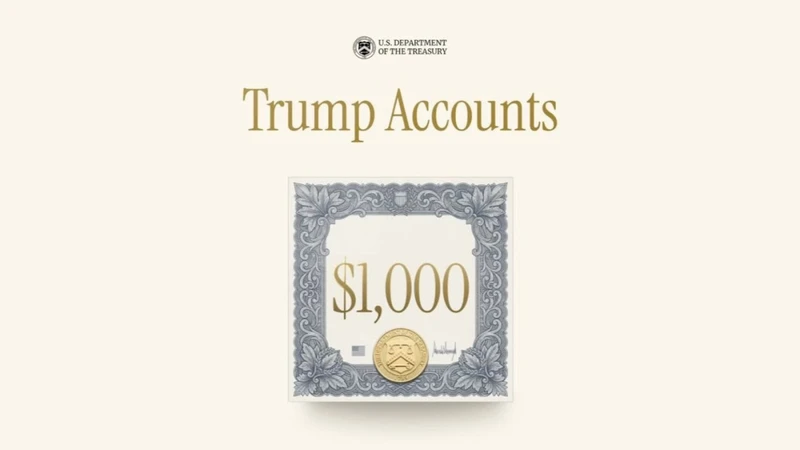
A $1,000 government deposit is nice. It’s a rounding error, though, next to what these accounts can do if you treat them like a wealth-building tool instead of a piggy bank.
Let me put real numbers on it.
Fund one to the max – $5,000 a year through the growth period – and at a 10% return you’re looking at roughly $225,000 by the time your kid turns 18. Then leave it alone. Don’t add another dollar. At that same growth rate, the account crosses $12 million by age 60.
Twelve million.
From money you finished contributing before they could legally buy a drink.
That’s time in the market plus compounding, working on a runway most of us never got.
So my answer is simple. Max it, and teach it.
Why “max it” is the easy part
The mechanics are straightforward once you know the guardrails.
Five thousand a year is the cap during the growth period. The $1,000 federal seed for kids born 2025 through 2028 sits on top of that… it doesn’t eat into your $5k.
If you own a business, here’s where it gets interesting. You can route up to $2,500 a year through your company. That’s deductible to the business, it’s excluded from your income, and it counts inside the $5k cap. So you’re covering half the annual contribution with pre-tax dollars, then topping up the rest personally.
One detail that matters more than it looks: the money you put in personally goes in after-tax. Hold that thought. It becomes the whole game in a minute.
The move almost nobody is talking about
These accounts are built like traditional IRAs. Tax-deferred.
Now, you’ve heard me say that deferral alone makes me nervous. Taxes are about as low right now as they’ll be in our lifetime. Deferring a tax bill into a future where rates are higher can be a trap.
So deferral isn’t the finish line here. It just gets the money growing untaxed for now. The conversion is what makes it tax-free for good.
At 18, the account follows regular IRA rules, which means your kid can start converting it to a Roth. And because you funded it with after-tax dollars, a big chunk of that balance is already basis… only the growth gets taxed on the way over.
Here’s the beautiful part. A kid in college with little income has a standard deduction of roughly $16,000. Convert a slice each year that fits under that number, and that slice moves into the Roth at a 0% rate. Do it a piece at a time, year after year, and you can walk a lot of that balance into tax-free territory.
Once it’s in the Roth, it grows tax-free for the rest of their life.
That’s the difference between deferral and elimination. And elimination wins almost every time.
Just be clear-eyed about it. You’re not converting $225,000 in one shot at 18 and paying zero. That’s not how it works. This is a patient, multi-year play, and the kiddie-tax rules plus your kid’s own income will shape the math every year. Run it with a real tax strategist, not a compliance CPA who files what you hand them and calls it a day.
You know how I feel about that. The best investment I’ve ever made is world-class tax strategy. This is a textbook case for it.
Why “teach it” is the whole point
The $12 million isn’t the real story – the lesson is.
Most people live by default. They inherit their money habits the same way they inherit their eye color… by accident. We get to do it differently. We get to raise kids who understand money by design.
Sit down with your 12-year-old and show them what a single dollar does over 40 years. Show them why you finished funding the account before they finished high school. Let them watch the number climb.
That’s a different kind of inheritance. You’re not just handing them a balance… you’re handing them the understanding that makes the balance mean something.
And that matters practically, too. Your kid controls this account at 18. A quarter million dollars landing on an 18-year-old who’s never thought about compounding is a risk, not a gift. Teach first. The money is the easy part.
One honest caveat
Assume the rules change.
This is a brand-new account written into a brand-new law, and Washington rewrites these things. So don’t build your entire plan on today’s fine print.
Build it on the principle instead. Get money compounding early. Put it in the most tax-advantaged wrapper you can find. Teach the next generation to think like owners instead of spenders.
That principle survives any rule change. The fine print won’t.
If you’ve got kids and a business, this one’s worth a real conversation with a tax strategist who actually plans ahead. Not the person who files your return… the person who builds the multi-year map. That single conversation could end up worth more than the account itself.
Hope that’s valuable
Justin
P.S. Here’s the question I keep circling back to: If someone had opened one of these for you at birth and taught you how it worked… where would you be standing right now? That’s the gift sitting on the table. Don’t let the $1,000 distract you from the $12 million

Keep Learning

The First Step to Making Your Business More Valuable and Sellable with Eric Rozenberg – EP 309

What Two 9-Figure Exits Taught a Serial Entrepreneur About Investing with Ben Rubenstein – EP 308
