I want to walk through a framework that changed how I think about money. And I think it’ll change how you think about it, too.
It comes from Robert Kiyosaki’s Cash Flow Quadrant. And if you haven’t read that book, read it. But let me break down how I think about it, because I’ve adapted it into something more useful.

The Four Quadrants
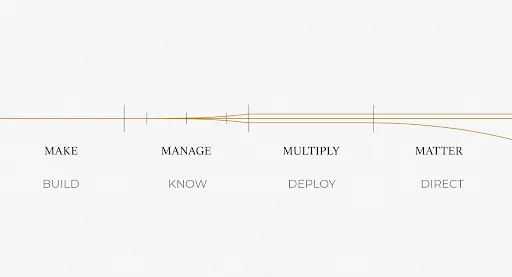
Quadrant 1: Make This is where you earn income. You’re good at this if you’re reading this email. You make money. You’ve built businesses, created income, scaled revenue.
The problem? Almost everyone who is excellent at making money is terrible at the other three quadrants.
Quadrant 2: Manage This is how you steward what you’ve made. How much are you actually keeping? After taxes, after expenses, after capital allocation… what percentage of what you earn is still yours?
Most entrepreneurs are horrible at this. They make a million, spend $1.2 million, and wonder where the money went.
Quadrant 3: Multiply This is where the real wealth building happens. This is investing. This is taking what you’ve managed to keep and deploying it in ways that compound without your direct involvement.
Very few people are good at this. Especially entrepreneurs who are used to being able to force outcomes through sheer will.
Quadrant 4: Matter This is the final quadrant. This is what you do with the surplus. It’s legacy. It’s impact. It’s knowing that all the money you’ve accumulated is actually being deployed toward something that makes a difference.
And almost nobody gets here. Most people get stuck in Quadrant 3, just chasing compounding, without ever asking why.

Where Most People Get Stuck
If you’re a founder or entrepreneur, you’re amazing at Quadrant 1.
You can make money. That’s your gift.
But here’s the problem: you think that gift will carry you through Quadrants 2, 3, and 4.
It won’t.
Making money doesn’t teach you how to protect money. Being entrepreneurial doesn’t make you a good investor. And having a big net worth doesn’t automatically teach you what legacy means.
I see this constantly. Someone builds a $20 million business. They’re crushing it at making money. But they have no financial controls (bad at managing). They have no alternative investments (bad at multiplying). And they haven’t thought for one second about what it’s all for (bad at mattering).
Then they sell the business for $20 million. And within seven years, they’ve lost most of it or spent it on things that don’t matter.
Why? Because they were playing the making game, not the other three.
What Shifted for Me
I realized at some point that I needed to stop trying to be great at all four and instead build teams around the three I wasn’t naturally good at.
For managing money, I brought in a fractional CFO and a bookkeeper. Suddenly I knew where every dollar was going.
For multiplying money, I brought in people who understood alternative investments, people who had actually made money in private equity and real estate, people who could teach me instead of me pretending I knew.
For making money matter, I spent time with people who were playing the giving game at levels I’d never seen. People like David Weekley who’s been giving away 50% of everything for 35 years.
The Real Insight
Here’s what I discovered: most people are waiting to be perfect at all four before they move to the next one. They’re trying to master making before they think about managing. Master managing before they think about multiplying.
That’s backwards.
You should be good enough at making, solid enough at managing, strong enough at multiplying, and intentional about mattering.
You don’t need to be an expert at all of them. You need to be aware of all of them and intentional about each.
What This Looks Like in Practice
For making: Stay in your lane. Build the business. Earn the income. That’s your superpower.
For managing: Hire someone who understands cash flow. Get a fractional CFO. Know where your money is. Don’t pretend you can do this in your head.
For multiplying: This is where I see people most asleep. They make $500K a year and have zero alternative investments. That’s insane. Start small. Learn the game. Build a portfolio of private investments alongside your business.
For mattering: Don’t wait until you have $100 million. Ask yourself now: what is all of this actually for? Who are you trying to help? What impact do you want to have? Those questions should shape every financial decision you make.
The Freedom in This Framework
Here’s the beautiful part: once you’re playing all four quadrants, even at different levels of mastery, you’re suddenly playing a different game than 99% of entrepreneurs.
You’re not one dimensional anymore.
You can’t get knocked over by a business downturn because you have multiple income streams.
You can’t get blindsided by market conditions because you’re paying attention to capital deployment, not just revenue.
And you can’t lose sight of why you’re doing any of it because you’ve connected the money to something that matters.
Until next week,
Justin

Keep Learning
The Hidden Cost of Poor Company Culture with Cathy Christen – EP 311

From Living in a Van to $1.4M in Net Worth with Michael Alberse – EP 310