Interview with John Molineux
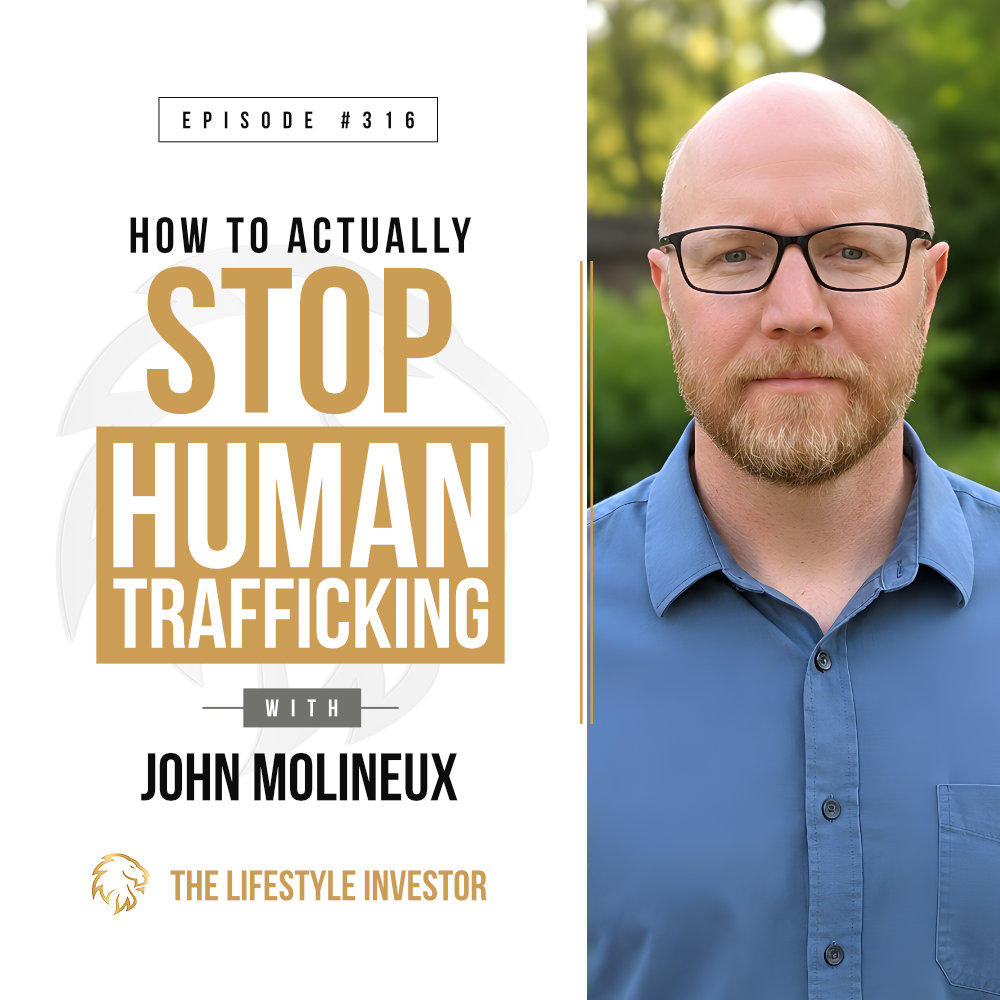
How to Actually Stop Human Trafficking with John Molineux
We talk a lot about financial freedom on this show. Today, I want to talk about a different kind of freedom.
About 50 million people are living in modern-day slavery right now, and much of it happens out of sight. By the time victims are rescued, they’ve often already suffered terrible harm.
But what if you could stop trafficking before it happens?
John Molineux, founder of Love Justice International, has spent more than 20 years fighting human trafficking. Today, his organization works in 21 countries, and when I first heard how little it costs his team to protect someone from being trafficked, I got chills.
We talk about how his team identifies people at risk, how they know whether their efforts are actually working, and a surprising discovery they’ve been reluctant to share publicly.
In this episode, you’ll learn:
✅ How traffickers use false job offers and real-looking opportunities to lure vulnerable people, and why that makes trafficking so hard to spot.
✅ Why stopping one trafficking attempt can have an impact well beyond that one person, including helping authorities arrest the people responsible.
✅ The connection between Love Justice’s work and falling slavery rates in 16 countries, and why John is careful not to claim credit.
Featured on This Episode: John Molineux
✅ What he does: John Molineux is the founder and CEO of Love Justice International, a nonprofit organization dedicated to fighting human trafficking by identifying and intercepting potential victims before they’re exploited.
After spending 20 years in Nepal, John relocated to South Africa, where he leads the organization’s international efforts. Under his leadership, Love Justice has expanded into 21 countries, helping prevent more than 121,000 potential trafficking cases and contributing to over 2,500 arrests.
💬 Words of wisdom: “We’re on a mission to drive the downfall of slavery.” – John Molineux
🔎 Where to find John Molineux: LinkedIn
Key Takeaways with John Molineux
- From a One-Way Ticket to a Global Mission
- What Makes Love Justice Different?
- How Human Trafficking Actually Happens
- Stopping Human Trafficking Before It Happens
- How Do You Prove Prevention Works?
- The Bell That Rings Every Five Minutes
- The Reality of Modern-Day Slavery
- Over 121,000 Potential Victims Intercepted
- The $161 Cost of Preventing Trafficking
- Can Data Prove Slavery Is Declining?
- How You Can Help Fight Human Trafficking
Inspiring Quotes
- “It would be far better, if possible, to prevent it.”– John Molineux
- “We believe that for every intercept, and particularly with arrests happening, it’s raising the cost for traffickers and therefore reducing how many people are being trafficked.”– John Molineux
- “We’re at a place now where we’re on a mission to drive the downfall of slavery.”– John Molineux
Resources
- Love Justice International
- Love Justice International on LinkedIn | Facebook | Instagram | YouTube | X/Twitter
- John Molineux on LinkedIn
- Day Maker
- Duane Hixon
- Earl Seals
- N2 Company
- Rebecca Hixon
- Unbound Now
- Walk Free
- City of Dreams (2023)
Want My Team’s Help?
- Tax Strategy Masterclass
Learn the 28 most effective tax strategies the wealthy use to save thousands.
lifestyleinvestor.com/tax
- Free Strategy Session
Get a personalized roadmap to financial freedom.
lifestyleinvestor.com/consultation
- Lifestyle Investor Newsletter
Join The Lifestyle Investor Insider for curated investing insights.
lifestyleinvestor.com/insider
Rate & Review The Lifestyle Investor Podcast
If you enjoyed today’s episode of The Lifestyle Investor, hit the subscribe button on Apple Podcasts, Spotify, Stitcher, Castbox, Google Podcasts, iHeart Radio, or wherever you listen, so future episodes are automatically downloaded directly to your device.
You can also help by providing an honest rating & review over on Apple Podcasts. Reviews go a long way in helping us build awareness so that we can impact even more people. THANK YOU!
Connect with Justin Donald
Get the Lifestyle Investor Book!
To get access to The Lifestyle Investor: The 10 Commandments of Cashflow Investing for Passive Income and Financial Freedom visit JustinDonald.com/book
Read the Full Transcript with John Molineux
Justin Donald: What's up, John? Good to have you on the show. Good to see you again.
John Molineux: Thank you, Justin. Yeah, glad to be here, and I appreciate the opportunity.
Justin Donald: Well, yeah, it was really fun having you in Austin, getting a chance to catch up at one of my favorite breakfast spots, Day Maker. I know it was a short little visit, so you didn't even get a chance to try their incredible breakfast. Anyone here in Austin will tell you that place is just unbelievable, but it was great getting time.
John Molineux: Oh, it was good company, and I really enjoyed the time we had together.
Justin Donald: Yeah, most certainly. Well, I appreciate, you know, shout-out to Aaron for helping connect us and helping set that up, and really just looking forward to spending some time with you here today because I think you are doing literally some of the most meaningful work that exists, and I want more people to know about you and what you're doing, and even the inception story of Love Justice. You know, we're at a unique time. We've got the holidays. We've got Thanksgiving coming up, all the things to be thankful for. You've got your Black Friday and Cyber Monday and Giving Tuesday. Like, this is a really important time of year for a lot of reasons, but especially for, I think, what you guys do, and I want to get the word out.
John Molineux: Yeah, I appreciate that, Justin. As you know, I have led Love Justice International from the field. I lived in Nepal for 20 years and now live in South Africa, and that has been a strength in a lot of ways in terms of, I think, our program work and the quality of it, the impact, but it's also probably one of the reasons that many of your listeners may not have heard of Love Justice International. So, I'm really thankful to be here.
Justin Donald: Well, let's dive in because you were born in the US, because I think you were visiting your family out west, right, when you were in town.
John Molineux: Helena, Montana.
Justin Donald: And so, yeah, Montana, and somehow you ended up in Nepal and South Africa, and this organization blossomed. So, tell us kind of the inception story here. And I've got, I guess, another shout-out to Duane Hixon and Earl Seals with N2 Publishing because that's ultimately where I learned about you guys, and Rebecca Hixon, who does an awesome job just kind of like vetting charities on behalf of N2 and on behalf of the Hixon family. And so, I'm so thankful that we have crossed paths. I got a chance to meet your team, got a chance to hear your story, do my own research. And so, it was a number of years back where I was doing a little consulting, an advisory-like stint there with N2, and our paths crossed then, and I've been a big believer and just one of your biggest fans since that point in time.
John Molineux: Yeah, we're very thankful for you, Justin. So, the story, I grew up in Helena, Montana, became a Christian when I was 18. I went for a walk, actually, and told God, "Use my life however You want." But after I went to Taylor University, and after graduating, traveled with four other guys to Nepal, and we were just looking for missions and adventure. And we ended up working with street children and had our hearts broken by their situation. And then a couple years later, a friend had been involved in starting a children's home in Nepal, and he called me and said, "I'm going back to Nepal. This home is starting." And I got a one-way ticket kind of thinking I'd be home by Christmas.
And when I got back to Nepal, and I saw, on the one hand, the street kids that we had worked with before, some had died, many had gone from bad to worse. And it was just like the worst thing ever. And on the other hand, seeing the children in this home so well cared for and loved, and singing and dancing and playing, it was like the best thing ever. And that contrast kind of made me reflect, "This is what I want to do with my life." And so, in short, when the other guys went back, I stayed. I spent my first Christmas in my life alone in Kathmandu. And the short version is I lived there for the next 20 years. And as Love Justice has expanded around the world, we have now moved our program headquarters to South Africa.
Justin Donald: Okay. Now, during that stint though, I think you met your wife and started your family, right, while you were in Nepal? Or was this post-Nepal? I think it was in Nepal.
John Molineux: I did. Yeah, I met her in Nepal. My wife is actually Nepali, and she worked for Love Justice. And yeah, now we are married. We have two kids and, yeah, it's been an amazing journey.
Justin Donald: Wow. Well, I love that story, and I love your friends just left, and you just stayed. You felt called. And then it's neat that you were able to kind of start that next chapter there. So, what was the impetus for moving then to South Africa, moving all operations there? Was that just more of a central hub for where you wanted to work? Was it more of a place that you kind of envisioned raising a family? Both?
John Molineux: Yeah. You know, there are a lot of factors involved that we had between 20 to 25 expat staff in Nepal for a long time. And, in the beginning, Nepal was a pretty easy place to work. And it became more and more difficult. We went through a lot of hard times and eventually kind of as we figured out how to scale transit monitoring beyond Nepal and we started expanding, and particularly a lot of our most fruitful expansion was in Africa. We just came to a point about seven or eight years ago of just saying it doesn't make sense for us to be based in Nepal. So, we started looking at a number of factors. We actually gathered with all the families that would move together.
We have four families, four American families who moved. We all have kids around the same age. And we looked at data points for 30 different cities around the world or so, and then together, it was over the course of a weekend, we rated those factors, and then we kind of looked at the results. And originally it said Cape Town, South Africa. And eventually, when we came on our trip to visit, our board, our South African board members and staff, said, "We actually think this other place north of Durban makes more sense for you guys." And so, here we are.
Justin Donald: All right. Well, for those that don't know Love Justice, they don't know what it's about, I would love for you to share kind of what makes you unique. And so, my audience probably knows at this point in time that the cause that I am most committed to is human trafficking prevention, and that, to me, is just that's where my heart is. That's what I want. I want to help people. I want to share a voice and shine a light in this space. A lot of people don't even know what's happening. Your team does an incredible job internationally. So, you're all over the globe. And so, I'd love for you to share just what makes Love Justice so unique and what your approach is.
So, you guys are different in the fact that you're creating, you basically are utilizing transit points where trafficking happens. You're monitoring those. So, not only are you able to rescue situations or stop potential, you know, I don't want to call it a transaction, but like the true step, like stop people in their tracks, but you're able to get convictions of the traffickers oftentimes as well. So, share with us a little bit about Love Justice and how it actually works.
John Molineux: Yeah. Well, I mean, if I go back to, it was probably about 21 years ago that I started learning about human trafficking, and I was living in Nepal, but you don't see it. It doesn't happen in the open. I learned about it probably the same way you did, by reading about it. And I remember what I learned was at that time, around 10,000 Nepali girls, they would say were trafficked each year from Nepal to India. And these are innocent girls. They'd be deceived by false promises, false jobs, and they would end up being lured into a brothel where they'd be abandoned. They would try to run away, and they would be told they can't leave. They can't contact anyone that they love.
And when they found out what type of work they were supposed to be doing to pay back this debt that they owed, sex work, of course these girls would refuse it, and they would be broken in the most horrific manners, ways imaginable. And so, when I learned all this, it broke my heart, and I felt like we have to do something about this. So, started learning about different strategies for fighting human trafficking. There's a number of strategies that are post-trafficking strategies, rescue, aftercare, and that's incredibly important work, but of course, it can never put back the pieces of what's been broken, and it would be far better, if possible, to prevent it.
But the prevention strategies that were being used, like awareness, job creation, didn't necessarily have a tangible impact where you could point to a person and say, "Here's a person who would otherwise have been trafficked." And some researchers suggest that they may not actually reduce how much trafficking is happening. And then I found this strategy that had been invented by several organizations working along the Nepal-India border in the early 2000s, and it's called transit monitoring. And it aims at the most strategic moment when a person is in the process of being trafficked but before they've been enslaved. And it has a tangible impact that prevents the enslavement of real individuals.
It's incredibly cost-efficient, great impact on the dollar, and it also provides desperately needed data about trafficking and trafficking networks. So, the way it works is we have staff who stand in key transit areas like a border station, a train station, a bus station, and they look for visual signs of human trafficking. When they see those signs, they use questioning. They start with, "Where are you going and why?" And they have a questioning protocol that they use to try to uncover red flags that suggest human trafficking may be happening. And when they see those signs, they seek to intercept either by convincing the person not to go or involving the police or, in the case of minors, involving the parents. So, we feel it's one of the most effective ways to fight human trafficking. It's kind of the world's only tangible prevention strategy.
Justin Donald: Yeah. That's incredible and I love the success that you've had, and you're in a number of countries, over 20 countries, somewhere between 20 and 30 countries right now currently, right?
John Molineux: Twenty-one, yeah, 21 at the moment.
Justin Donald: Twenty-one. Yeah. That's unbelievable.
John Molineux: And we've got about 12 that we're planning to expand into this year.
Justin Donald: Yeah. And so, when you look at the work that you've done, I mean, we know that there's tremendous impact. There are ways that you can measure it. There's also so much that's unmeasurable at the same time. But how is it that you're able to kind of truly measure and share and show impact of what you're doing?
John Molineux: Yeah. Well, I mean, one of the ways that we measure it is we measure intercepts, you know? An intercept is when we have a person who we believe is in the process of being trafficked who is prevented from going on due to our intervention. And what we're looking for is a person who may be vulnerable to enslavement, moving into a place where they'll have difficulty getting home, and particularly if they're moved by an illegitimate means of control, such as a false job, deception, coercion. There are all kinds of red flags that we're looking for in each of those elements. And so, every intercept will actually be verified by two different people independently to make sure that we were correct to intercept in that case.
And recently we started doing, because you can never know for sure, Justin, whether someone would have been trafficked, and it's kind of like the missile defense theory where the only way you can make sure to get 100% of missiles is to make sure you get 100% of birds. And the only way to make sure you don't have any false positives is to never shoot anything. So, somehow you have to calibrate that. You hear that sound. I don't know if... Did you hear a bell? Were you able to hear that buzzer?
Justin Donald: I heard it, yeah.
John Molineux: We have this monitor in our office, in all the rooms of our program headquarters, and every time an intercept happens, this is an intercept that just happened in Malawi. Looks like it's a 17-year-old boy. And a bell sounds and information about the intercept pops up and happens about every five minutes during working hours.
Justin Donald: Oh, my goodness.
John Molineux: But I interrupted myself. I was saying that recently we've started seeking external review of our intercepts by like the external third parties in the countries that we work at. And we basically take a random sample of 100 intercepts, and we have these experts look at them and try to tell us whether they believe this person was at high risk of human trafficking based on the information that we have. And so, that has been a really helpful process. It's been, in some senses, in many places, incredibly affirming. For example, Uganda, 153 out of 153 of the intercepts they felt were high risk. And then down on the other end in India, 59 out of 100 that they thought were high risk.
And it's also kind of flagged a category of intercepts that we have our eyes on of people who are genuinely really vulnerable but may not have direct evidence that they are being actively trafficked. And so, we're trying to really focus on improving the quality of our intercepts and to get intercepts that lead to more arrests. So, one of the things we track is what percent of intercepts lead to arrests, or one in how many intercepts lead. And it was about one in 100 for most of the history of Love Justice, and it's risen to 1 in 50. And we're continuing to try to improve that, to put traffickers behind bars, to deter trafficking, and ultimately to drive the downfall of slavery in the places where it's most rampant.
Justin Donald: Yeah, and I think a lot of people probably don't recognize that slavery still exists today. It very much still exists. It very much exists in many countries today. Is that accurate?
John Molineux: Yeah, every country in the world, I think. There are people enslaved in every country. Slavery is illegal in, I think, every country or almost every country in the world, but it exists today on some scale in every country in the world. About 50 million people, according to the Walk Free Foundation's Global Slavery Index, live in modern-day slavery today.
Justin Donald: Yeah. And for people that are listening to this or watching this that are like, "Well, hey, this doesn't happen in the US. We don't see this happen in the US," there was a huge bust just a couple of months ago in Dallas, Texas that was kind of, I guess, was tipped off and was worked through with Unbound Now. And this was massive. This was, I think it was 60 different children that were being trafficked through a business in Dallas, in a prominent suburb of Dallas. So, I mean, this stuff is happening literally everywhere. So, I do think it's important, number one, that we know about it, but number two, sometimes you wonder, well, isn't it more obvious that trafficking's happening?
But there's this covertness to it where it's not like, I mean, some kids are truly being abducted, but in other instances they're being manipulated, or there's a story behind it. Like, if anyone's seen the movie, City of Dreams, and if you haven't watch it, it's an incredible movie. But you've got a kid that was basically told he was going to go play soccer at this special soccer camp because he's got great skills and great potential, when in fact that was just a front to traffic him, and he ends up getting put into slavery, basically making clothes in the worst environments known to man. And there are so many other stories. Like, when I read your newsletters, you've got these families that are super poor.
And someone says, "Hey, we've got this opportunity for work for your son or your daughter," and they can make X amount, or sometimes the family can't even afford their kids, and so they're trying to find opportunities for their kids. So, it's very sad on every level, but sometimes it's not this simple abduction that you see or think about.
John Molineux: Yeah. I mean, the nature of it is that it happens in the dark, because it's illegal and it's so terrible to exercise ownership over a person. It is such a violation of their personhood. And so, that means that, I mean, it's in the dark in the sense that we don't know about it and we don't see about it, we don't see it. But it does happen in our world. And I don't want to say all around us, it's not everywhere around it, but it is real, and it is out there. And it is, in my thinking, it's one of, by far, one of the greatest injustices in the world because the number of things that you have to do to exercise control over a person, the number of ways that people are victims of trafficking are violated and broken and hurt is just heartbreaking.
Justin Donald: And, John, share with us how many intercepts you guys are getting at Love Justice because, like, when I read it, it is a staggering number where I'm like, "Oh my goodness." On one hand, this is incredible. Like, praise God, this is really amazing work.” And on the other hand, I'm like, "How can this much injustice be happening in the world?” And imagine if your team wasn't there to catch it and imagine how many others there are that we don't catch.
John Molineux: Yeah. Well, I'm looking at the number up on the screen that here in my office, oop, just went off. It's 121,000. I believe it was 743. No, 463. 121,463 and 2,541 arrests. Yeah, it took us a long time to get to where we are now, where it's about 2,500 or 2,000 intercepts each month. So, that means every day, every working day that we're here at the office, it's 50 to 100 times that we hear that bell go off.
Justin Donald: Wow. And you guys have also gotten so efficient that the cost, so as you're raising money for this work, the cost to save a life has dramatically come down too, right?
John Molineux: Yeah, yeah.
Justin Donald: I mean, when you shared this at our Lifestyle Investor Retreat last year, I mean, this number to me... So, it was like a year ago next month you guys shared this number, and I mean, it literally gave me chills, like goosebumps at like how little it costs to save a life.
John Molineux: $161 is the latest 12-month rolling cost per intercept. And with one in 50 are intercepts also resulting in an arrest. And I would say, Justin, that's just the direct impact, because we believe that transit monitoring has a preventative effect in places where people are getting away with trafficking people in the open, and suddenly we have people, we have teams that are stationed in strategic points asking questions, poking around. It's like a police car for the first time parked along the hitherto unpoliced highways that lead to slavery. Yeah, we believe that for every intercept, and particularly with arrests happening, it's raising the cost for traffickers and therefore reducing how many people are being trafficked.
Justin Donald: Yeah. Well, when you share these numbers, I mean, this is like, it's so palpable. Like, I'm so glad that you have the data, and there has to be a role of data and intellectual honesty in the way that you're able to do things. Has your data ever revealed something that you ultimately decided not to claim? And by the way, and I know the answer is yes because we've been talking about things here off air that we're not going to share specifically due to this. What does that teach you about measuring impact versus communicating impact and the balance between the two there?
John Molineux: Yeah. Well, I'll just tell you the story in broad overview. It has always been our stated aim of our anti-trafficking work to reduce slavery. And we've never really had a way to measure that. And there's only one organization in the world, the Walk Free Foundation, whose Global Slavery Index reports on the prevalence of slavery in every country in the world, and they've done so every few years since 2013. And we were initially skeptical of their methodology and had planned to measure prevalence ourselves, of slavery, in order to demonstrate transit monitoring's impact, but that was going to take years. And it was going to be like you do one measurement, you do transit monitoring for three to five years, and then you measure again, and you hope, and you see if it goes down.
And it was about a year and a half ago, just before boarding a plane, I decided, "You know, I should just check to see what has happened to the prevalence of slavery according to Walk Free's reports." And I thought, there are five countries where we've had the most intercepts, we've been working the longest. I thought that's where we might see the number go down. And just before boarding the plane, I looked it up, and I was blown away. All five of those countries saw the prevalence decline. So, I started going down the line and looking these up in the unsearchable appendices of Walk Free's report. And at the end of the day, there are exactly 16 countries we started working in prior to 2022, which is the time period you'd have to start to affect Walk Free's latest 2023 report, and they all saw slavery decline.
And so, we're not claiming that all of that is due to our work. We know correlation does not equal causation. We're being very careful. We thought about really broadcasting this message, but as we’re talking to outside researchers, just wanting to be very careful and honest with this. We have sort of avoided making really strong claims about that. And we're just sort of keeping it. We're holding it a little bit loosely, and we're seeking to do further research about it, and working with outside researchers ultimately to, yeah, figure out how to talk about this and how to put this out there, and ideally to publish and have it peer-reviewed.
Justin Donald: Well, I love that the impact is measurable. You have data to support it, but I love that you also don't have to necessarily showcase or share all the data because you know it's working, you know the numbers are working, and you want to be cautious in the way that you present all of this information. I mean, I think it's a very thoughtful approach that a lot of groups don't do, and I think that's going to serve you really well. And I just, again, love the work that you all are doing at Love Justice International. So, for those that really want to learn more about it, how can we get involved? Like, I hear $161 being the cost or the price to save, to intercept, to save someone's life, that is a very small amount for anyone who tunes into what we do.
And I'd love for there to be more support, especially as we're coming on a season and a time where we are called to be more generous. I think we're called to be more generous in general, period, but we are coming to that time of year where, when people are generous, it is kind of around this Giving Tuesday. So, how can we learn more?
John Molineux: Well, let me just say that I remember 20 years ago, walking into this little internet cafe where I would check my emails at that time and getting the first email saying that we've intercepted a person to prevent them from being trafficked. And I felt this sense of, that's the most important thing I've ever been a part of. Now, fast-forward, trying to hold that in my mind and hold that in my heart, that every time that bell sounds, it is that again. I don't have the capacity to feel what that should mean, but I would just say to people, I mean, we need your prayers. We would love for you to get involved in making that impact yourself. But we're at a place now where we're on a mission to drive the downfall of slavery.
We have 12 countries that we're ready to pilot in this year, but we need the support of donors like your listeners and our current amazing donors to have a life-changing impact. And so, you can visit our website at lovejustice.ngo to learn more about our work, and we'd love your prayers, we'd love your support.
Justin Donald: Well, the work that you're doing is incredible. I mean, it is mind-boggling to think about thousands upon thousands of intercepts, and what that equals every single day, what that equals every hour. And by the way, thank you also for doing this podcast. I know your time. You're in the evening. We're at the end of your day, whereas here, it's first thing in the morning. So, I appreciate you making the time and the space to do this. And I hope that this podcast speaks to a lot of people and it wrestles up some emotions, or even if it's not emotions, it wrestles up some logic in you to say, "Hey, I'm very blessed. I would love to participate in helping Love Justice do even greater work in the world."
So, John, thank you for joining us, and I hope that this is a very impactful opportunity for us in sharing your message and your organization. And I know there are bigger things in store for all of us. So, I'm thrilled about it.
John Molineux: Yeah, Justin, thank you for this opportunity and for your amazing support over the years. And thank you to all your listeners for your time.
Justin Donald: Well, thanks so much to those of you tuning in, if you're watching, if you're listening. I love ending every episode with a question. What is one step you can take today to move towards financial freedom and really living life on your terms, one that a life that you truly desire, not by default, but by design? And my challenge to you this week, as you're looking to do that for yourself, is how can you do that for someone else? How can you do that for one of these children that has been captured or is possibly in the throes of true trafficking? And we talk a lot about financial freedom on this show. Today, we're talking about real freedom, real human life, God-given rights and freedoms. And so, I just challenge you to take a step in the direction that helps create some action for helping others as well. Thanks so much! And we'll catch you next week.
Sign up to receive email updates
Enter your name and email address below and I'll send you periodic updates about the podcast.
Keep Learning
How to Actually Stop Human Trafficking with John Molineux – EP 316

Why Most Wealthy Families Fail to Preserve Generational Wealth with Brandon Schaefer – EP 315