Interview with Andrew Cushman
How to Avoid Losing Money in Multifamily Real Estate with Andrew Cushman
A real estate investment can look great on paper, promise impressive returns, and still end up losing your money.
I’ve seen it happen to investors who trusted the wrong sponsors, overlooked risky assumptions, or got caught chasing returns in a market that no longer made sense.
That’s why I’m excited to welcome Andrew Cushman to the podcast. Andrew is the founder of Vantage Point Acquisitions, a multifamily real estate investor with nearly 20 years of experience and approximately 3,300 apartment units acquired. Despite some challenging market cycles, he’s never lost investor money in a syndication.
In our conversation, Andrew shares what nearly two decades of investing have taught him about protecting capital, evaluating multifamily deals, and recognizing risks that aren’t always obvious in a pitch deck.
We also discuss why he stepped back from acquiring properties when other investors were aggressively buying, the costly mistakes that can turn a promising deal into a financial disaster, and what he believes will separate successful multifamily investors from everyone else in the years ahead.
In this episode, you’ll learn:
✅Why impressive projected returns can be misleading, and the hidden assumptions that could put your investment capital at risk.
✅ The red flags to watch for when evaluating real estate sponsors, including how some investment funds may be hiding serious financial trouble.
✅ Why Andrew stopped aggressively acquiring multifamily properties when everyone else was buying, and the opportunities he sees emerging in today’s market.
Featured on This Episode: Andrew Cushman
✅ What he does: Andrew Cushman is the founder of Vantage Point Acquisitions, a real estate investment firm specializing in multifamily properties. A former chemical engineer, Andrew left his corporate career in 2007 to pursue real estate investing, initially flipping houses before transitioning into apartment syndications.
With nearly two decades of experience and approximately 3,300 apartment units acquired, Andrew has navigated multiple market cycles without losing investor capital in a syndication, according to his account in the interview. He has also contributed to BiggerPockets and hosted conversations on The Best Ever CRE Show.
💬 Words of wisdom: “A great sponsor can take a bad deal and make it good, but a crappy sponsor can take an amazing deal and still run it into the ground.” – Andrew Cushman
🔎 Where to find Andrew Cushman: LinkedIn
Key Takeaways with Andrew Cushman
- From Chemical Engineer to Multifamily Investor
- Why House Flipping Isn’t Passive Income
- How to Vet Real Estate Sponsors
- The Hidden Risks of Debt Funds
- Why Projected Returns Can Be Misleading
- How Preferred Returns Can Deceive Investors
- The Risks That Can Destroy Your Investment
- Why Justin Stopped Investing in Multifamily
- Why Andrew Passed on 1,200 Deals
- The Future of Multifamily Investment Returns
- Knowing When to Sell Your Properties
- How to Make Smarter Investment Decisions
- Andrew’s Worst Multifamily Investment
- The Hidden Cost of Holding Bad Investments
Inspiring Quotes
- “No deal is better than a bad deal.” – Andrew Cushman
- “The grass is always greener over the septic tank.” – Andrew Cushman
- “You can fix a property, but you can’t fix the neighborhood.” – Andrew Cushman
Resources
- Vantage Point Acquisitions
- Vantage Point Acquisitions on LinkedIn | Facebook | YouTube
- Andrew Cushman on LinkedIn
- BiggerPockets
- Brandon Turner
- The Best Ever CRE Show
- Dilbert
- Rich Dad’s Prophecy: Why the Biggest Stock Market Crash in History Is Still Coming…and How You Can Prepare Yourself and Profit from It! by Robert T. Kiyosaki and Sharon L. Lechter
- Warren Buffett
Want My Team’s Help?
- Tax Strategy Masterclass
Learn the 28 most effective tax strategies the wealthy use to save thousands.
lifestyleinvestor.com/tax
- Free Strategy Session
Get a personalized roadmap to financial freedom.
lifestyleinvestor.com/consultation
- Lifestyle Investor Newsletter
Join The Lifestyle Investor Insider for curated investing insights.
lifestyleinvestor.com/insider
Rate & Review The Lifestyle Investor Podcast
If you enjoyed today’s episode of The Lifestyle Investor, hit the subscribe button on Apple Podcasts, Spotify, Stitcher, Castbox, Google Podcasts, iHeart Radio, or wherever you listen, so future episodes are automatically downloaded directly to your device.
You can also help by providing an honest rating & review over on Apple Podcasts. Reviews go a long way in helping us build awareness so that we can impact even more people. THANK YOU!
Connect with Justin Donald
Get the Lifestyle Investor Book!
To get access to The Lifestyle Investor: The 10 Commandments of Cashflow Investing for Passive Income and Financial Freedom visit JustinDonald.com/book
Read the Full Transcript with Andrew Cushman
Justin Donald: What's up, Andrew? Good to have you on the show.
Andrew Cushman: I'm glad to be here, Justin. Good to finally be able to have this conversation.
Justin Donald: Well, we have so many mutual friends, and it was only a matter of time, I think. There's so much of your story that I love, that I want to point to. Because your story... I mean, everyone's story is unique. I feel like you've got a very atypical path from maybe what you went to school for, what you started out as a career with, and in, and then what you're doing today with investing. So, please enlighten us on how you made this pivot from being a chemical engineer to now doing real estate syndications.
Andrew Cushman: Yeah. It seems like I meet a lot of former engineers in real estate. So, I like to say that I took the standard path and got an engineering degree. But if that was just a placeholder, I always knew I wanted to be an entrepreneur and kind of have more control over my own destiny. But I also had, l and college, I had no idea how to do that. No one teaches you that stuff. So, I'm like, "Hey, if I become an engineer, I'll at least have a decent job until I figure it out." So, seven and a half years into working as an engineer, my wife and I had tried all kinds of little businesses. They were sort of profitable but were more work than our regular job. So, it's like we were like, "No," like, "No, no, no."
And then, 2006, I saw an article in The Wall Street Journal about flipping houses. 2007, we successfully flipped our first one here in Southern California, made as much money as all year at my job as an engineer. And I said, "That's it. I'm done. We're out of here." And, so yeah, went into full-time house flipping right as the crash was, right as the rollercoaster would stop clicking. You know, when it gets silent for a second and then every, phew, you go over. Like, right when it went silent, I quit my job. Everyone thought we were nuts, but we had no competition. And this kind of reminds me a little bit of where we are today. Everyone hated real estate. What are you thinking about investing? And prices are going down. Well, we just bought at $0.50 on the dollar, fixed it up, and resold at 80. Had four amazing years. Then it bottomed. Everyone else piled in.
And the problem with flipping, it's a great income business, but it's all active income. It's not passive one bit. And you're only as good as your next deal. Like, that first one put a nice check in the bank, but guess what was behind it? Nothing, unless I got back on the phones and did all that. So, my wife and I sat down and said, "All right. This has been great, but we really don't like it. And we said, "Well, what's the next big thing?" Well, this was late 2010. We said we had a huge recession, which means we're going to likely have an expansion. Expansion means increasing jobs, increasing household formation. But everybody and their mother just got foreclosed on and can't buy a house, or they know someone who got foreclosed on, and they're scared to buy a house, which means no one's buying houses, expanding economy, rentals.
So, we said, "Let's go do apartments." Found a guy who had already bought like 800, hired him as a mentor for a year. Our first deal was 92 units in Macon, Georgia, on the other side of the country, which I would not invest in Macon now, but back then, that was our first deal. We syndicated…
Justin Donald: All right. Don't say that too loud. My brother-in-law's from Macon, Georgia. So, Ed, I'm sorry, but I tend to agree here with Andrew. But good quality people from Macon.
Andrew Cushman: Hopefully, he lives in the northwest corner of town, not where our apartments were. But, yeah, we've been doing it full time ever since. Done about 3,300 units. And so far, we've never lost investor money in a syndication and are still doing well despite the last four years.
Justin Donald: That's awesome. So, 19 years you've been in real estate. Now, you and I kind of got started then at the same time, because I bought my first home in 2005. And then I remember the issues that happened with GFC. Now, we were still buying some homes. We were still doing some flips. And what I do remember is, as that season continued on, when it was easy to go to the courthouse steps and buy a home at auction, it all of a sudden got really hard to buy a home at auction, right? So, I remember showing up, and we could outbid whoever it was, no problem. There weren't a ton of people there bidding on homes. And then all of a sudden, people started showing up with backpacks and blank cashier's checks. And they would buy every single home in the auction. They would bid up every single home.
They literally got every home, and you couldn't compete. The numbers didn't make sense, and they literally were doing a volume play. And this is when I realized that the institutions were coming in and buying up single-family homes and creating an asset class that didn't yet exist. You know, SFR was not officially an asset class until after that.
Andrew Cushman: Yeah, I remember talking to one of those guys, and he said, "I'm the McDonald's of home flipping," meaning high volume, low margin. And he goes, "I'm going to lose money on at least 2 or 3 out of 10, but that's okay."
Justin Donald: Wow.
Andrew Cushman: I'm like, "Yeah, that's not my business."
Justin Donald: Wow, so crazy. Well, what I will say is I learned a lot in that season, and it was also good because we were forced to pivot. So, we can't buy homes anymore. Okay. Well, why don't we start a company that services homes for these large institutional owners that are going to have an abysmal time trying to actually bring this maintenance crew in-house? Like, you've got homes in 5, 10, 15, 20 different cities. There's no way you are managing this in-house. There's no way you can handle this yourself, and that's where our company, Stellar, was born, was this idea of like, "Hey, you've got assets all over. You've got these single-family homes all over. We'll do the maintenance. We'll do the turns. We'll do the flips. We'll do the rehabs for your company, and we can do them at volume," which they had the volume.
So, yeah, if you can't beat them, join them. Find another way to service and add value, right? Because we weren't going to win on bidding on the homes.
Andrew Cushman: It sounds like another version of selling the picks and shovels to the gold miners, right?
Justin Donald: That's right.
Andrew Cushman: Like, let them do that. You've got the guaranteed. You know you're going to need that whether they succeed. Whether they succeed or not, they're going to need your services.
Justin Donald: That's right. And I think a lot of people don't know. So, you've been in real estate for almost 20 years. I think a lot of people probably don't know that you used to be the co-host on BiggerPockets. That's one of your claims to fame. Brandon Turner's a real good buddy of mine, and I'm assuming you as well. And you guys have done, gosh, a kajillion shows. I don't know how many you guys have done. But what an awesome podcast, and you built an incredible audience over the years.
Andrew Cushman: Yeah. I mean, really, Brandon, Josh, and David should take all the credit for building the audience. They just brought me in kind of when things were mature to be the multifamily guy. But it was a privilege and a joy to be a part of it.
Justin Donald: That's awesome. And now you've got your own podcast, which is cool, The Best Ever CRE Show, and I can't wait to join you on that. But let's talk a little bit more about investing. I think we've got someone that has been in the business a long time. You've been in single-family. You've been in multifamily. So, you know the space. You've done flips. You've done rentals. You now believe in the buy-and-hold strategy, and you have for quite some time. But I try and teach investors how to become, or people that want to invest, how do you become a better investor? How do you become more proficient? I made a lot of mistakes early on, so I learned through hard knocks. And man, I wish I could've learned differently.
But you know what? That was my education, and I'm thankful for it. In the moment, I wasn't thankful, but I am now. So, I want to help people not have to lose money like I did or not have to make poor choices, thinking that they were good choices or just totally ignorant to how to vet a deal. So, what should passive investors look for when they're evaluating a few things? One, a good sponsor; two, underwriting a deal; and three, whether to invest in that deal or not.
Andrew Cushman: All right. So, the first thing kind of overarching is try to learn from other people's mistakes as much as possible. So, the first thing we did before we went into... Yeah, house flipping is kind, like that's very accessible. Like, most people kind of can get a house and run the numbers. But we decided to go into apartments. We went, and first thing we did was go get a mentor, and I also joined a mastermind. It wasn't a real estate-focused mastermind, but nonetheless, it was a mastermind full of people way more advanced than I was, and that has been invaluable to our success. We wouldn't be anywhere near as far along as we are without that coach and without initially joining that mastermind. In terms of vetting a sponsor these days, I see a lot of pitch decks and stuff that say, "Oh, we've gone full cycle on 20 deals and the average IRR is 21%."
Okay, that's great, but if the last one of those sold in '21 or '22, that's not giving you the full picture. You need to say, "Okay, what if you sold everything today," right? "Did you buy anything in the last four years? What is the condition and status of those deals?" Now, if anyone's being honest with you, odds are those deals are probably not doing as well as they hoped, but that's a big difference between, "Oh, we lost the deal, and it went to foreclosure." Even the best of the best that I know have been doing this for 30 and 40 years, a lot of their deals are struggling, but the difference is they're still holding onto them, they still cash flow, and they're still going to be fine when we get to the upside of this, probably starting later next year.
So, number one, ask about recent sponsor history. Have they had capital calls? Another thing to watch out for is ask them if they've done any debt funds. Here's the reason why. Debt funds can be a great investment. I'm not knocking debt funds. But what a lot of, in particular, multifamily operators are doing is, all of a sudden, now mind you, they've been doing nothing but multifamily for the last five, ten years. All of a sudden, we're doing debt funds. What are they actually doing with that money? I know of many who are doing an income fund or a debt fund, and what they're actually doing is they're feeding that money to their current properties that are either negative cash flow or upside down on the loan to keep them going.
And if they don't bail those properties out in the end, all that debt fund/income fund money is going to also be gone. So, to me, again, I know plenty of very legitimate debt funds and income funds that I would invest in, but a lot of them are being used as a vehicle to hide distress. So, be very careful and dig deep and get very clear confirmation of what that money is being used for.
Justin Donald: Yeah. And by the way, you and I both have a mutual friend, or I should say someone that we know that this exact thing just happened to, well, it was just found out that it had been going on for a while. But now the SEC is after them. And it is very known, and it is very public, and it is not a good look, obviously.
Andrew Cushman: Yeah, definitely, definitely not. And it's funny, we've even contemplated saying, "Well, if we started a debt fund, we could do this and this," and actually, I don't even want to do that right now because it carries such a potential negative connotation of, "What are you doing? What are you doing with that money," right? So, I'm like, no, no, no, we'll just…
Justin Donald: Totally does.
Andrew Cushman: We'll stay away from that for now. Again, not saying they're all illegitimate, just be very careful. And then if you're looking at an LP investment in a deal, let's say it's a one-off multifamily syndication. We already talked about some of the things about the sponsor. And candidly, the sponsor is the most important thing. A great sponsor can take a bad deal and make it good, but a crappy sponsor can take an amazing deal and still run it into the ground. And that's assuming they're honest. You start putting in dishonesty or misaligned interests, and that's a whole another thing. But one of the biggest things I see, even in deals today, which kind of blows my mind, is, in a sense, almost ignore the headline IRR or returns that are being promoted, and dig into what the assumptions are that are being made to achieve those IRRs.
I see deals literally in the last few months with exit cap rates assuming a four and a quarter. Could it happen five years from now? Maybe. I certainly wouldn't bet a dime on it, right? And so, when we're underwriting, if we're saying, "Okay, today's cap rate is, I don't know, a six," which sounds crazy considering interest rates are higher than that, but stuff's still trading there. We're going to say, "Well, our exit's a seven." But if you're buying today at a six and you're underwriting at an exit of a four and a half, probably 80% of that return is baked into that exit cap rate being a four and a half or what it is. If it's actually a six, that deal's going to be barely break-even. So, check assumptions, exit cap rate being number one.
Number two is the rent growth assumptions. I saw one come out this spring where it's a deal in Austin, and they had the first 12 months' rent growth pegged in at 5%. Meanwhile, rent's dropping in Austin right now. And yes, the momentum has shifted. It is rapidly improving. I think Austin eventually is going to be a great place to invest. Once again, the fundamentals are still there. But if you're buying a deal this spring, and your numbers are based on 5% rent growth, that's not happening. You'll be lucky to be 0. And if everything goes well, nationwide, we're probably going to see rent growth 2% to 3% in 2027, and maybe getting between 3% and 4% after that, and varies dramatically by market.
So, year three, if you see underwriting at 3%, okay, that's probably reasonable. But 5%, I wouldn't underwrite to that in any market at any point in time. So, those are your two biggest levers. Also, look into planned refinances. That's a good way to bump up an IRR midway through. So, make sure those refinancing numbers look correct. Sometimes you'll see we're going to refinance at a lower interest rate in two or three years. Could happen. Wouldn't underwrite to it. So, those are some of the big ones.
Justin Donald: Well, and you bring up a good point. You've got to recognize. You've got to do enough homework to recognize what are they underwriting to. Are they underwriting for a medium-case scenario that they're labeling as a worst-case scenario or their bear case, or not? Like, I want to know. Like, you can give me a projection of like, "Hey, if everything went great, here's a best-case scenario. Like, lay it on me. They can be a little more...” I mean, I want them to still be reasonable, but they can be a little more of a stretch. But you got to give me real numbers on the base case, on the bear case, right? Like, we need to know this. And then there's a number of things that you said that were really important.
I did a webinar earlier today on the five wealth traps, and we were talking about family offices and the five functions, and I created a couple of different scenarios, and I talked about this at our last live event as well. A couple of different scenarios. Investment A is a deal that has a 10% pref. Investment B is a deal with an 8% pref, so preferred return, meaning the investors get paid first before the sponsor makes any money. And then we layer some kind of like rules around it. So, I talked about like a tax what is the bucket, or what is the tax infrastructure on that product? So, what is the tax rate in each one? And each one was a little different, and you actually can see a clear scenario where the 8% preferred return outperformed the 10% preferred return.
Now, let's strip away the tax strategy because this still applies even with just a typical waterfall, with the splits that happen, right? You can have a 10 pref that has certain hurdles and catch-ups that allow for the end result to be worse than an 8-cap that may have lesser catch-up provisions built in. And so, you just have to model these numbers out. You have to understand what it all means. Most people who are unsophisticated are going to say, "Hey, 10 pref. They're going to pay me 10% first. That's a better deal." Not necessarily. Maybe, but maybe not
Andrew Cushman: Yeah. And you alluded to some of this, but you got to be careful how that pref is structured because preferred returns can actually create misalignment between the sponsor and the LP. There's some incentives there for the sponsor to do things that actually aren't in the best interest of the LP, such as over-leveraging and underfunding the property and a handful of other things. And going back to your first question, Justin, there's one other really important thing, and this is harder to do, but anytime you're evaluating any deal, whether it's multifamily or anything else, ask yourself what is the low-probability, high-consequence event that could blow up this deal that maybe nobody's accounting for.
And a real obvious one in hindsight is '21 and '22, low probability, high consequence event was, well, what if interest rates just go get jacked up? Now, I didn't believe it was going to happen. I thought it was going to be 50 basis points over the next year and another 50 basis kind of a slow rise. But when we underwrote, we said, "Well, okay, if interest rates go up a lot faster, well, what happens?” Well, our debt could double and triple, and we could lose these deals and, like, not be able to refinance. And we said, "Well, all we got to do to eliminate that downside is fix our loan." So, we did. Right? And in hindsight, that looked brilliant, but we didn't know what was coming. We just said, "Well, that's the one thing that could completely blow up this deal, so let's just take it off the table."
And some of those deals are doing fantastic. Some of them are on the struggle bus, but none of them are in trouble. And going forward, that's what you got to do. Like, ask yourself, it's one thing to not hit the numbers and, "Hey, this deal didn't quite work out." That's very different from, "Oh, by the way, we lost all your money, and it's getting foreclosed on." So, that's another key question. Like, what's the low-probability but very high-consequence thing that might've gotten missed?
Justin Donald: Well, and I think a lot of groups are just really greedy. Because we have historic low rates, which means, A, you could lock in the best, lowest long-term rate that you could, but people are too aggressive or too greedy, and they want the bigger return that isn't the safer play. Like, if maybe we can turn this thing fast enough, we can get some sort of floating debt. We can do interest-only. It's like we can game it to be even better, and then we can sell this thing in 18 months to 24 months, and we're going to be out, and we're going to be good, right? Until you're not, because the music stopped. And I remember, and actually, I want to tip my cap to you on this one, Andrew, because I remember when I was looking at deals, and I was like, "None of these make sense. Like, they don't make sense."
And so, I stopped investing in multifamily altogether, and that was one of my strongest real estate asset classes, especially as an LP investor. A lot of people know I got into mobile home parks very early, and that one we held some positions LP, but most of them, we owned it. It was deeded property, and that performed really well. But we had a lot of positions. And then there were some that I was like, "I'm willing to just get out. Like, I'm happy to have someone come in and buy my position. I'm happy to have the sponsor buy my position." I didn't see it working. And so, I just stopped. I stopped investing in them. I got out of everything. I had zero multifamily deals in our entire portfolio. And mind you, I had done probably, I don't know, 50 to 100, okay?
I had zero when the rates started going up. And I had friends that teased me because they were making all this money, and I wouldn't go in their deal, or I got out early. Except that those same friends that were giving me a hard time, all of them had negative exposure and had issues with some of their deals. So, they did get out on some, and I did miss out on those, but I didn't get stuck, and they got stuck. But what you did, I thought, was really interesting, you and your partners. You're like, "Hey, we can't get anything to pencil here. Do we want to just try to keep doing deals, try to keep the business together? Like, these aren't good deals, but we could keep the doors open by doing some deals.
Or do we just pull the plug and say, 'No more. We're hitting pause. This doesn't make sense, and we're not coming back until it does.'" And you guys made the decision to just stop. And I remember you took time to go surf, go hang out with your family, travel. Like, you just stopped doing deals. I want you to talk through that because you are one of the few people I know that just said, "I'm out." Everyone else forced deals to work, and they ended up not working.
Andrew Cushman: Yeah. I mean, we did keep looking, but I remember, man, my poor acquisitions team try… I got to give credit to them for keeping up the good fight. And they're still here, four-plus years later. I mean, we did a couple of deals in the last few years, but it would be like we would literally look. I think at one point we went 18 months and looked at 1,200 before we finally were able to get that unicorn situation where it worked. Like, I think, we'd been working on the seller for a year and a half or two years. And then all of a sudden they got their 1031 property, and they wanted out now. And we were there and ready, and they came down to our original offer price. And it was what I like to call an offer we can't refuse.
Meaning it's so good that if they accept it, like, "Okay, we got to do this." So, we've had a couple of those deals in the last few years, but nowhere near our target. I mean, we hope to acquire 1,000 to 1,500 units a year, and it's been 100, 200, and that's been it. So, yeah, I've been doing a lot of surfing. Something else that we also did is operations candidly were pretty easy the last 10 years from 2012 to '22. I mean, even on the property management side, I mean, when market rents are going up 5%, 6%, basically, all you need is a babysitter, right? And they can sit there and raise rents 5%, and you watch a YouTube video, go out, take massive action, and all of a sudden you're making lots of money.
Until it goes the other way. And so, we spent the last four years not focused on acquisitions but focused on operations. Number one, to survive the downturn, but number two, going forward, that is where the money is going to maybe made, in skilled operations. Historically, the bulk of returns on multifamily are earned from cash flow and a little bit from appreciation. We are not going to have the massive cap rate compression in the next five to ten years that we had in the previous five to ten years. If anything, we'll be lucky if cap rates stay about the same. That was a massive tailwind that benefited anyone who bought real estate in the last 10 years. So, there's still going to be a lot of money to be made in multifamily, but we're going to have to earn it the hard way, which is skilled operations, so we've been really focusing on that the last four years.
And then something else we did, it was a little different than what you did coming into the top of the cycle is starting in 2021, we looked at our portfolio of a couple thousand units and we said, "All right, what in this portfolio would we not want to have to hold for another five-plus years? And then which properties would we be happy to hold for another five to 10 years?" And started selling off the stuff that we wouldn't. You know, the reasons for that, I'll give you a perfect... The last one we sold was in 2023, which felt crazy because we knew we were selling it at a little bit below peak pricing and everyone's like, "Why don't you just wait until it goes back up?" I'm like, "Eh, I don't know about that." In retrospect, that turned out great. But one of the reasons we sold it…
Justin Donald: Good instincts. Yeah
Andrew Cushman: Yeah. One of the reasons we sold it is because it was a 1970s property. We'd already owned it for six years. And when you have that vintage property, you come in, you do a renovation, you capitalize it. But within five or six years, that recurring CapEx below the line starts to eat you alive. So, if you start holding those things longer than planned, you can quickly run into trouble. So, 2023, we sold off the last one that we wanted to get rid of and then have held everything else. And one of the benefits of that is the cash flow and distributions from the remaining portfolio is enough for us to pay all of our bills, pay all of our salaries, and sit here and not do any deals and be perfectly fine.
So, it created no pressure to go out and do a deal when we shouldn't do. No deal is better than a bad deal, right? So, we didn't sell out of everything, because we knew we want to be in this business for another 10, 20 years. So, we sold all the stuff that we didn't want to hold in a recession, kept the stuff that we feel like will be good five to 10 years from now. And then again, that allowed us... Our entire team is still in place. Like, we haven't fired anybody, and no one has left, so.
Justin Donald: That's awesome. Well, well done on that front. And, by the way, I do believe that the next revolution of returns, the next wave is going to be operational efficiency. There is no doubt about it: figuring out how to do stuff in-house, becoming the cleanest and best operators out there, understanding your numbers, building the software to have it at your fingertips. I think all that's going to be so important. How does your background in chemical engineering influence the way that you underwrite deals and assess risk and use probabilistic thinking to make better investment decisions?
Andrew Cushman: Well, for any of you who are fans of the old Dilbert comic strip, engineers aren't exactly known for being the most emotional types. So, just kind of having that engineering, analytical background, I think made it a lot easier to not get emotionally attached to a deal and to just be like, "Nope, it's just the numbers, just the numbers, and we're going to look at 1,000 until we find one." Now, when I started, we only had to look at 50 or 60 to find one. And then it got like 1,200. So, just kind of that analytical, non-emotional mindset. And then also, and you mentioned this, and this, I think, is part of what has led to us surviving and still being here is the probabilistic thinking.
In engineering, you take a lot of math, you take a lot of statistics, and I think of everything in kind of in terms of a bell curve. Like, my base case is the middle, meaning this is the most, you know, we think this is the most likely outcome. But that's maybe only 60% to 80%, right? Just because we think that's the most likely, we're not going to just bank on the, "No, that will happen." And I think that's where a lot of just investors in general across the board make a mistake, is, okay they look at all the data and all the different forces, and they come to a conclusion and say, "Oh, that's going to happen." And you have to do that to some degree, right? You have to have an investment thesis.
But the nuance is to say, "No..." Like, for example, I just said it. I strongly believe by the time we get to the back end of next year, most markets we're going to see rent growth. And that's our base case. But you still have to say, "What if we don't?" On the left end of the curve, what if rent growth is 1%? What if in 2028 we get a new administration, and they somehow get nationwide rent control passed, right? That's the risk side of the curve. The other end of the curve is, well, what if Atlanta hits 5%, 6%, 7% rent growth again? Okay, I've seen forecasts that say that. I'm not going to underwrite to it, but it could happen. And so, that's the probabilistic of underwriting to a base case and then, oh, not stress testing. What's the word I'm looking?
We create a matrix that shows what happens with all the different variables as you move them and say, "Okay, well, what if rent growth is 2%?" Well, you're here. And then cap rates are this. Okay, now you're here. And you create a swath of likely outcomes, but then you also show the unlikely outcomes and what your results are. And if you get unlikely outcomes that start putting you in the negative, that's where you got to like, okay, how do you hedge against that? And what is an acceptable level of risk? And again, something that might lead to lower returns okay, rent growth is only 2.5%, probably an acceptable risk. Something that turns those returns negative and at a loss of equity, that's not an acceptable risk.
Justin Donald: Yeah. Well, all that makes tons of sense. My experience is most groups, they don't actually give a bear case. Like, their worst case is not truly a bear case, right?
Andrew Cushman: And their worst case is the base case.
Justin Donald: Yes. And that just doesn't work for me. I actually want you to be so darn conservative with your underwriting that I feel good with that scenario. Like, I want to understand everything through and through. Don't give me the fancy... Now, everyone can create a deck that says you're going to have a 20% IRR. That doesn't mean you're going to have a 20% IRR. I'd rather you conservatively tell me it's 14% than give me a fancy thing that's telling me it's 20% or 25%.
Andrew Cushman: Well, and nowadays you don't even have to create the deck. You can just say, "Hey, Claude, give me a deck that promises 18% and the numbers to support it," right? So, well, it's funny you said conservative. It's gotten better now, but for a while there, there were so many real estate investors on podcasts saying they were conservative investors. Like, if you turned that into a drinking game, you wouldn't even make it to the end of the typical real estate podcast, like, if you took a shot every time someone said the word conservative. But no one ever defined what that meant. To me, conservative means you're underwriting to assumptions that have at least an 80% likelihood of happening. That is, to me, conservative. Yeah.
Justin Donald: Yeah. No, that's good. Great point. What would you say your biggest lessons are, mistakes made, whatever it might be, something you did right, something you did wrong, just based on market cycles and things that you, you know, costly mistakes, great opportunities in today's multifamily market?
Andrew Cushman: Yeah. I'd sum it up by saying the grass is always greener over the septic tank. And what I mean by that is the worst syndication we ever did. We bought it in 2013. It was a 350-unit early '70s behemoth in South Dallas with a chiller system and all kinds of other things that you don't want. But, hey, we got a great deal on it. And the problem was it was not in a good neighborhood. And you can fix a property, but you can't fix the neighborhood. And so, we would renovate. We'd bump the rents. That worked. But then the people that moved in would destroy the unit, stop paying six months later, get evicted, and then we had to renovate the whole thing again. It wasn't just a quick turn. And then vandalism, we had shootings.
We actually had somebody crawl up onto the roof of the leasing center, bust out the skylights, and throw Molotov cocktails into the leasing center to try to burn it down, right? They caused like $30,000 worth of fire damage. And so, that was 2013. In 2015, everyone and their mother was predicting a recession in 2016. I think Kiyosaki even put out a book that said the 2016 crash or something like that. And so, we said, "Well, geez, we're doing okay now. We can probably turn this thing around. But if we get into a recession next year, this could get worse, and we could end up losing money." And again, the word, the last thing, Warren Buffett's rule number one, don't lose money. Rule number two, see rule number one.
So, we actually sold the property early. It was supposed to be a five-year hold. We sold it like two and a half years later. Got just enough to get back out. I think the total IRR was like 4% or something ridiculously low like that. In retrospect, the market kept on chugging, and we actually would've been fine, but knowing what we knew at the time and potentially losing money was an unacceptable risk. So, that was our worst syndication. Learned a lot about, I mean, a lot of our screening process that we have now in terms of picking markets and picking neighborhoods and picking deals came out of that deal. That deal taught us a lot about what we wanted to avoid. I think those type of deals are even riskier today when we have the K-shaped economy, and affordability is a far greater issue than it was 10, 13 years ago.
And not that I know some very skilled people who make great money in that type of stuff, but it is a different thing. And I think the temptation is when you're looking at a rough Class C on your Excel spreadsheet compared to a B+ on an Excel spreadsheet, the numbers are always going to look more lucrative on that C, right? It just always do. But the money is made in the execution, and that almost never goes to plan on those rough C-class properties. It almost never, ever works out as it does on the spreadsheet. And that's why, like I said, literally, grass is greener over the septic tank. Like, you don't want to step there. Just stay away.
Justin Donald: Well, and I'll even make the argument that though you could have held on and gotten a better return, maybe it was better to cut your losses, clock in a 4% IRR, and move that capital into an asset that actually made more sense, was easier to scale operationally. It's like less of a headache. You have less people that have to man the situations. This has happened in my life where it's like, "Hey, we could've gotten a better return, but you know what? We wasted so much darn time on that asset. That was the one that caused so much extra time and attention. It is better for it to be gone, for us to clock a win, we made money and move on to another place that we can make more money with less time and stress and operational needs."
Andrew Cushman: Yeah. There's a lot to be said for opportunity cost, meaning you're spending time, effort, tying up capital on this thing that's not making anybody any money. And even for your investors, if you've got $100,000 of someone's future retirement money and it's earning 2% and there's a risk of, well, that might be as good as it gets, you're better off giving that back to them so they can put it somewhere else, whether it's with you or elsewhere. So, yeah.
Justin Donald: Yeah. Well, this has been awesome, Andrew. I appreciate you taking the time and hanging with us. Where can people learn more about you and more about Vantage Point Acquisitions?
Andrew Cushman: Yeah, I'm not a big social media guy, so you won't see me doing anything on TikTok or whatever. But I do post somewhat regularly on LinkedIn. And it is actually me posting. It's not my chatbot. So, definitely connect with me there. As you mentioned, I host the BestEver's. got a bunch of podcasts, but I host the Best Ever CRE Next Level one, so it's geared towards a little bit more sophisticated and experienced investors. So, definitely, take a listen to that. And then, yeah, our website, if you just google Vantage Point Acquisitions, it comes right up, vpacq.com. And there's a handful of ways to connect with me on there.
Justin Donald: Awesome. Well, thank you so much for joining today. It was great hearing stories and lessons and things that you did well, things that you would do differently. Just 19 years of wisdom in this space, so appreciate your time, and your candor. And I love ending every episode with a question for our audience. So, if you're watching this or listening to this, my question for you, which is the same every week, but the question is, what is one step that you can take today to move towards financial freedom and really just move towards living a life that you truly desire on your terms, not a life by default, but a life by design? Thanks for tuning in. I challenge you to pick one thing from Andrew and put it into play immediately today, this week. And we'll catch you next week with another episode of The Lifestyle Investor.
Sign up to receive email updates
Enter your name and email address below and I'll send you periodic updates about the podcast.
Keep Learning
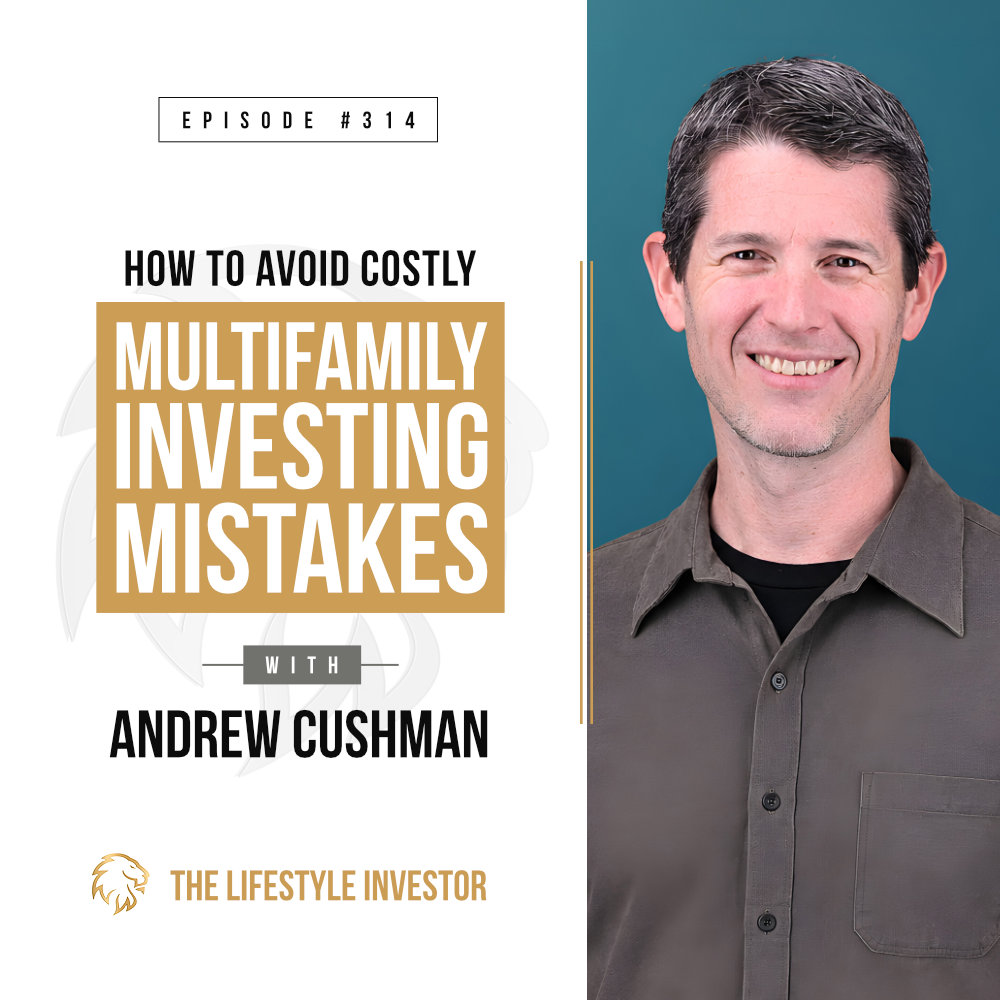
How to Avoid Losing Money in Multifamily Real Estate with Andrew Cushman – EP 314

How Finding the Right People Builds a World-Class Community with Phoebe Mroczek – EP 313