As the year starts to wind down, I like to look back at more than just what I invested in. I look at how I made decisions.
And one pattern keeps showing up, in my own life and in almost every successful person I talk to.
The things that help you become successful at one point in life can be the exact same things that hold you back later in life.
From Cost to Investment
I used to pinch pennies when it came to hiring professionals.
Years ago, when I was not making as much money and without a complicated estate, I could get my taxes done for a lot cheaper. So once the bills started getting into the $10,000, $20,000, $30,000 range, I didn’t like it. That mindset served me really well early on. Ironically, that same strategy later in life really hurt me.
Same with attorneys. I was trying to find the cheapest option, and it bit me in the butt. Today, I have a lineup of about nine or ten attorneys, each one best in class at their specific thing.
What changed wasn’t just how much I was willing to pay. It was how I saw it. I stopped looking at these as expenses and started looking at them as investments.
And I didn’t just want a great attorney. I wanted a great attorney who educated me along the way, so I became wiser, not just someone better doing my legal work. Same with my tax strategist. Not someone who simply files for me, but someone who teaches me as we go, so I get better at taxes every year.
That’s one of my favorite places to invest, and it’s paid me a multiple every single year. (It still doesn’t make it fun to look at the legal bill.)

Your Education Has to Evolve Too
There’s a principle I come back to a lot: your financial education should outpace your financial success by at least five years. You’re probably not going to see growth in your wealth before you see growth in your understanding.
But here’s the part people miss. If your education has to stay five years ahead, then the way you invest in your education has to keep evolving too.
Think about the first time you read *Rich Dad, Poor Dad*. For a lot of people, that was a huge leap. Maybe The Lifestyle Investor was another one… whole new concepts, all at once.
But if you’ve been reading for years, you’ve probably noticed it doesn’t work that way anymore. You pick up a new book, and most of it you’ve heard before. You get a nugget or two. It’s still valuable, but it’s just not the leap it used to be.
For me, investing in myself used to mean having lunch with someone every week, diving deep on a topic, getting a referral to someone else, and diving in with them. It meant how many books I could read in a year.
At some point, I realized that I wasn’t keeping pace with the level of growth I needed. A book or a podcast is often linear growth, and I wanted exponential growth.
Want the Lens in real time?
Every Sunday, the Lens lands in your inbox the moment it’s published. Join the email list and never miss an edition.
The Hidden Asset Class
A while back, I wrote about why what we call inflation is really debasement, and why the real number is a lot higher than the one most people are told. The only way to keep up with that is to invest well.
At our live event last month, I talked about the one asset class I believe can help every other investment you make outpace it.
It’s you.
These days, I set a goal every year for how much I’m going to invest in myself. I spend a minimum of $300,000 a year on my growth: the groups I’m in, the people I surround myself with, coaching, health. And over the last five to ten years, most years I’ve invested more in myself than in any single investment I made that year.
I’m part of about 14 different groups. Not because I love being busy, but because I want to be around people who can cut my learning curve by ten years. That’s the exponential growth a book can’t give you anymore.
Because the multiple I get on investing in me dwarfs what I get on any single deal.
A Question for Year-End
So here’s what I’d ask yourself before the year closes.
What was the biggest investment you made this year, and how does it compare to what you invested in yourself?
If the answer makes you a little uncomfortable, that’s not a bad thing. It might just mean the version of you that built those habits was working with a smaller life. Maybe you’ve outgrown that version, so your habits and your education should too.
Until next week,
Justin
Keep Learning
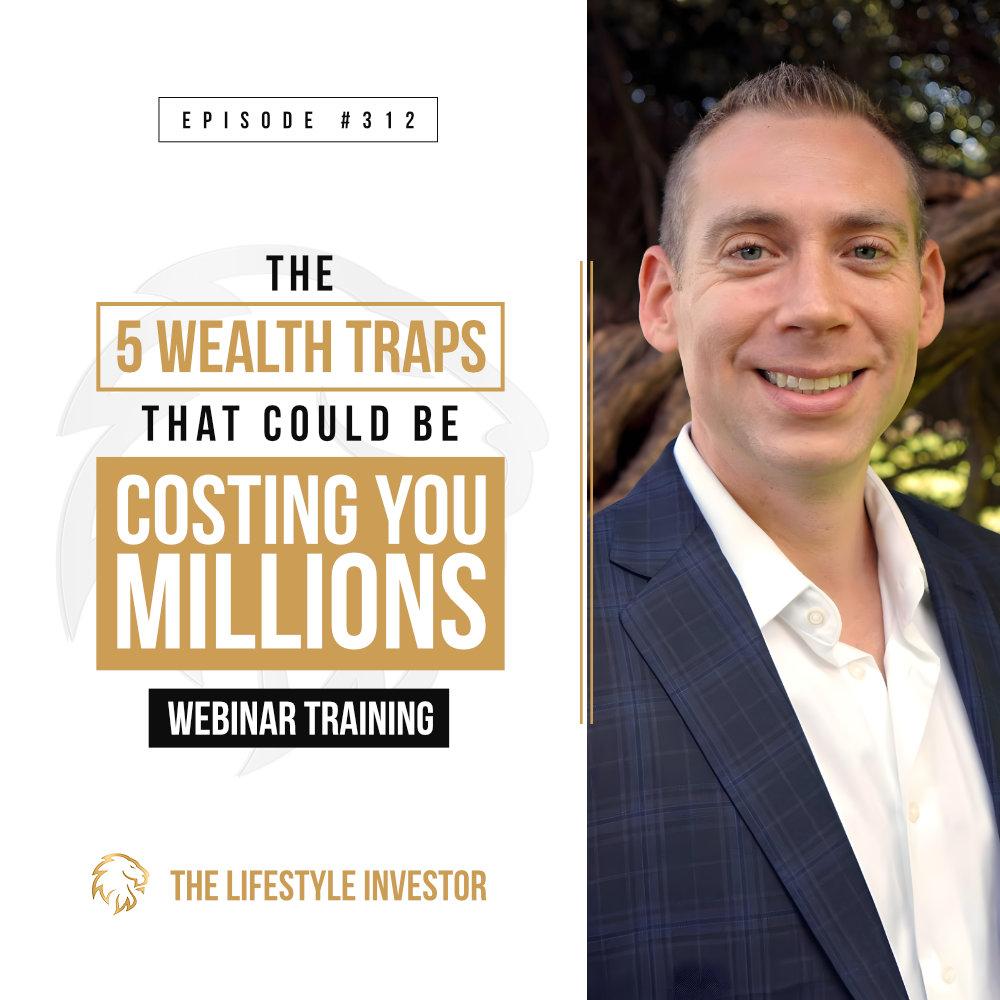
The 5 Wealth Traps That Could Be Costing You Millions with Justin Donald & Dane Espegard – EP 312
The Hidden Cost of Poor Company Culture with Cathy Christen – EP 311