Interview with Brock Fortner
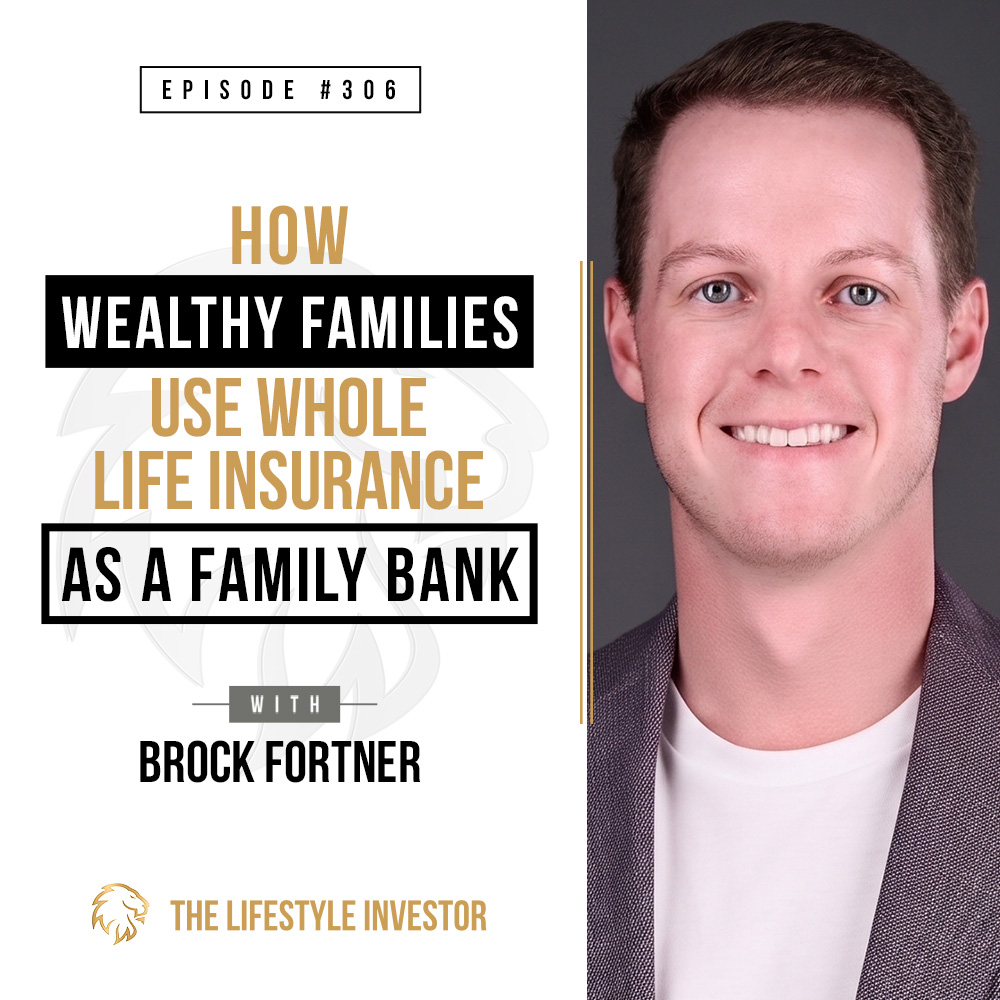
How Wealthy Families Use Whole Life Insurance as a Family Bank with Brock Fortner
Have you ever wondered what makes the wealthiest families, like the Rockefellers, so successful? They don’t try to maximize the return on every dollar. Instead, they build diversified portfolios with different assets serving different purposes to provide liquidity, stability, and access to capital when opportunities arise.
That’s why I’m excited to welcome Brock Fortner back to the podcast. Brock is a wealth strategist at Stone Century Financial and a longtime member of the Lifestyle Investor Mastermind who has become one of my most trusted resources on dividend-paying whole life insurance. I’ve personally used whole life policies for nearly 25 years to store cash, fund investments, and create greater flexibility with my capital.
In our conversation, Brock and I challenge some of the conventional thinking around asset allocation, the traditional 60/40 portfolio, and the idea that every dollar needs to earn the highest possible return. We also talked about teaching the next generation to think differently about money and some of the costly mistakes people make when choosing and structuring life insurance.
In this episode, you’ll learn:
✅ The incredible benefits and flexibility of using whole life insurance in your cash and fixed-income portion of your portfolio.
✅ How borrowing against your policy creates liquidity to quickly capitalize on new investment opportunities.
✅ How wealthy families use whole life insurance to build a family banking system and transfer wealth for multiple generations.
Featured on This Episode: Brock Fortner
✅ What he does: Brock Fortner is a wealth strategist at Stone Century Financial who helps individuals, business owners, and families use dividend-paying whole life insurance as part of a broader wealth-building strategy. Following in the footsteps of his father and longtime industry veteran Trent Fortner, Brock specializes in helping clients create greater liquidity, flexibility, and control over their capital while building a financial foundation that can serve future generations.
💬 Words of wisdom: “When you add dividend-paying whole life insurance to your portfolio, it’s going to make everything else better.” – Brock Fortner
🔎 Where to find Brock Fortner: Website | LinkedIn | Facebook | Instagram
Key Takeaways with Brock Fortner
- Where Whole Life Insurance Fits in Your Asset Allocation
- Whole Life As A Fixed-Income Strategy
- Why the Traditional 60/40 Portfolio Is Losing Its Appeal
- A Better Place to Store Your Emergency Cash
- How the Rockefellers Built a Multigenerational Family Bank
- Using Whole Life to Build Wealth Across Generations
- Creating Whole Life Policies for Your Kids
- How Whole Life and Roth IRAs Can Work Together
- You Don’t Need to Maximize the Return on Every Dollar
- Using Whole Life as a Tool to Fund Other Investments
- Who Whole Life Insurance Isn’t A Good Fit For
- Choosing the Right Life Insurance Advisor Matters
- How You Can Learn More From Brock Fortner
Inspiring Quotes
- “When you put a product out there that provides so much value for people, you just can’t hold back on it.” – Brock Fortner
- “I use the bank to pay my bills, and I use my life insurance to store my cash.” – Brock Fortner
- “You want to put your oxygen mask on first because if you pass away, well, then none of it works out in the long run.” – Brock Fortner
Resources
- StoneCentury Financial
- Brock Fortner on LinkedIn | Facebook | Instagram
- Book Your Meeting With Brock Fortner By Clicking Here
- EP 84: Leveraging Quiz Funnels to Generate Leads and Sell at Scale with Ryan Levesque
- EP 164: TLI Member Spotlight: Tax-Free Wealth Accumulation with Ryan Thacker
- Hans Box
- Justin Grimm
- Franklin Social
- Caleb Williams
- Drew McWilliams
- DLP Capital
- Don Wenner
- Bo Parfet
- Garrett Gunderson
- What Would the Rockefellers Do?: How the Wealthy Get and Stay That Way…and How You Can Too by Garrett B Gunderson
- Ryan Thacker
- Ryan Levesque
Want My Team’s Help?
- Tax Strategy Masterclass
Learn the 28 most effective tax strategies the wealthy use to save thousands.
lifestyleinvestor.com/tax
- Free Strategy Session
Get a personalized roadmap to financial freedom.
lifestyleinvestor.com/consultation
- Lifestyle Investor Newsletter
Join The Lifestyle Investor Insider for curated investing insights.
lifestyleinvestor.com/insider
Rate & Review The Lifestyle Investor Podcast
If you enjoyed today’s episode of The Lifestyle Investor, hit the subscribe button on Apple Podcasts, Spotify, Stitcher, Castbox, Google Podcasts, iHeart Radio, or wherever you listen, so future episodes are automatically downloaded directly to your device.
You can also help by providing an honest rating & review over on Apple Podcasts. Reviews go a long way in helping us build awareness so that we can impact even more people. THANK YOU!
Connect with Justin Donald
Get the Lifestyle Investor Book!
To get access to The Lifestyle Investor: The 10 Commandments of Cashflow Investing for Passive Income and Financial Freedom visit JustinDonald.com/book
Read the Full Transcript with Brock Fortner
Justin Donald: What's up, Brock? Welcome back to the show.
Brock Fortner: What's up, Justin? Thanks for having me.
Justin Donald: Well, it's really special for me anytime I feature someone at least two times on the show. And we've done a video series even outside the podcast, so you may be my most featured guest that I've ever had. And I think there's good reason for it because what you do, I just believe in so wholeheartedly. Number one, I'm a customer and client and believer first. And number two, I just think you do great work, and I'm excited to get you back on the show. So, welcome.
Brock Fortner: Thank you, Justin. I'm excited for this. I'm looking forward to this. I think I want to make sure I'm in the zone with you a lot so Hans knows that I'm coming after him to be the number one referrer for the group.
Justin Donald: I love it. So, for those that don't know, Brock Fortner and Hans Box are two members that have referred more people into the Lifestyle Investor Mastermind as members than anyone else in the history of Lifestyle Investor. I think Hans may still have. I mean, we got to actually got to check the numbers, and Ryan Casey will have exactly the numbers. But I think you're one or two spots behind, and I know you got a couple of people that you're excited about. In fact, we hung out in Nashville. I met your buddy. Justin Grimm, who, by the way, for me as a Cubs fan I'm a big fan of anyone that played for any of my teams, growing up in Chicago, but he's just a cool dude. So, Justin, if you're listening, shout out to you. I loved hanging with you and Franklin at that… What was the cool place we were at?
Brock Fortner: We were at Franklin Social, right there on the square.
Justin Donald: That place is awesome. And shout out to the founder there, because what a cool team, what a great group. I think it's three of them. They gave us the ability to rent the place out and just do an open bar and dinner for, I don't know. We invited all your friends and all of Caleb Williams' friends. I think we had 65 to 75 people roll through there, and we anticipated maybe having 15 to 20. I mean, it was hysterical.
Brock Fortner: Yeah. They were so gracious to us for bringing all those people. That was awesome.
Justin Donald: I loved hanging out with Justin. Super cool guy. Excited for him to join the Mastermind. But super thankful to you, because not only are you helping pave the way in whole life insurance for our members, but you are, I mean, at the time, I mean, you've been a member now for three or four years, where you are at that time our youngest member. And you have been our top recruiter really the last two years for sure. So, thank you.
Brock Fortner: No, thank you. When you put a product out there that provides so much value for people, you just can't hold back on it. And I think the fact that I can refer that to anybody and then be confident that they're going to join a group where the people are great, the content is great, and they're going to push their life forward, I mean, there's no reason not to refer more people.
Justin Donald: I love it. Well, your friends have become awesome members, people I've enjoyed becoming friends with and getting to know and just hanging out with. I mean, that's the cool thing about it. When you have high standards, you only let a certain type of person in the group, and they're all people I want to hang out with, so I feel super blessed in that regard. And then let's just talk about you and Drew McWilliams going over the top, planning our annual golf outing, the agenda, the accommodations, the golf courses, everything is world-class.
Brock Fortner: Yeah, this is going to be awesome. I'm super excited for it. It's going to be our first annual golf trip with the Lifestyle Investor Group. Drew has done a phenomenal job. He's really the one that has put it all together. I think I just gave him a couple of opinions. But, man, we're so looking forward to it. DLP, Dale, he's going to be there, speaking to us. They're sponsoring the event, so I'm super excited for this.
Justin Donald: Love it. Well, shout out to Dale, and love having him as a member. Don Wenner, Bo Parfet. I mean, great, great crew. Love DLP. Well, let's chat about whole life. I want to talk about… I don't think we have spent much time talking about life insurance, and where that fits in an asset allocation, right? So, we talk all the time about family offices and how they allocate their capital. You see a big difference between your centimillionaire, $100 million and above family office to $500 million, and then from $500 million to a billion-plus. It's very similar data, but there are some differences. But overall, if you take 100 million and up, you are seeing a much different allocation of funds, allocation of net worth than what you see for everyone else in the world.
But let's just talk specifically US. The financial institutions kind of share a story and try to paint a picture of what the way that they think people invest, and maybe even encourage you to think that everyone invests that way, but the wealthy are kind of on the other side, using a totally different playbook. And so, where do you see life insurance fitting into asset allocation?
Brock Fortner: Great question. You know, to me, I think the life insurance, specifically whole life insurance, the dividend-paying whole life insurance, it's guaranteed to be there, guaranteed to grow. I think that really fits into your fixed income bucket, could also be the cash bucket, right? And the reason I like to put that there is whenever you think about making a fixed income bucket, there's so much you have to think about, right? There's taxation. What kind of tax treatment is optimal for my fixed income? You got credit. You know, how much risk am I willing to take on the quality of that borrower? I've got duration risk. How much interest rate risk am I willing to take with that? I've got liquidity risk. How much price volatility am I willing to endure with that?
And then when you put those altogether, then you have to ask yourself, okay, well, what kind of correlation am I assuming about bonds and stocks? Because we've talked about this, but a lot of people have talked about the 60/40 portfolio is dead. Well, it's dead because stocks and bonds are starting to move together. And it's not doing what we supposed that we thought it was going to do. And then the final question is we have to ask ourselves this question, is how much complexity are we willing to take to enhance all the trade-offs, right? And you did a podcast with someone a long time ago. It's one of the first podcasts I ever listened with you, listened of you, and you talked about when you are building massive wealth, it pays massive dividends to keep it simple.
Justin Donald: That's right.
Brock Fortner: Right? And so, if that's our fixed income and how we make a fixed income portfolio, to me, whole life fits right there in it, right? Because overall, if you looked at whole life insurance, it pays corporate bond yields, it has muni bond tax treatment, and it's got money market liquidity. So, on the tax side of things, we've got complete control of tax incidents. Whatever's going on, we know how to manage that. To credit, well, we got these highly rated credit, supported by state guarantee associations. We've got, on the duration side, these dividend interest rates that are super diversified, right? They're through the portfolio of the insurance company that's been paying these for 178 years.
Justin Donald: Yep.
Brock Fortner: Straight. So, that's through the Civil War, through COVID, they've been paying them. You've got immediate liquidity at par with no volatility to the market whatsoever. When it comes to the correlation of the market, it's guaranteed zero correlation with equities. You know, no matter what, your whole life insurance has to go up. It's just a matter of how fast. And then finally, it's just simple, straightforward product on a chassis that's got guarantees over time. So, to me, that whole life insurance bucket, that was a long answer, but that whole life insurance really fits into that fixed income bucket for your overall portfolio.
Justin Donald: Yeah, it's interesting. I get real skittish any time any investment says, "Hey, this is a guaranteed return," because I don't think investments should ever use that language. I don't think anything's ever guaranteed. Life insurance is different because it is actually guaranteed. You have a guaranteed minimum. Usually, it's around 4%, depending on the company. And then you may get the higher, between what is guaranteed and the dividend. And so, it's kind of like whichever one is best you get, but at a minimum you're earning whatever that number is, usually at or around 4%, okay? So, that I wanted to just point out. Now, I'm going to say something here, and I've got to be careful because this was shared behind closed doors.
I'm a little more open with names and stuff inside the Lifestyle Investor Mastermind because everyone signs NDAs and confidentiality agreements so that stuff is not shared. But what I'm going to say is, there is an executive that works for the largest asset manager in the world who told us, told me, told this small group that the 60/40 asset allocation is dead. That was literally what he said. This is the guy who manages, has more responsibility with the largest sums of money of anyone, and for his own portfolio... And by the way, I would also say that comment kind of goes against what this large asset manager does. But for his own personal wealth, even though he's an executive at the largest asset manager in the world, for his own wealth, he does not believe in the 60/40 split, 60/40 meaning 60% stocks, 40% bonds.
If that doesn't tell you everything you need to know, I don't know what will. What the wealthiest families do is they look at about 15% to 30% of their net worth in the stock market. Usually, it's 10% to 20% real estate. Usually, it's 5% to 10% private credit. It is about 25% to 35% private equity. Usually, see about 5% to 10% venture capital. Sometimes that number's rolled in with private equity. Sometimes it's separated out. Sometimes you can even break out secondaries. Usually, see about 5% to 10% in cash, which is what we just talked about a moment ago. And then usually see 5% to 10% in fixed income. And so, what I love about whole life, about my policy, is I treat those dollars as if, number one, it is my fixed income.
I am getting paid a fixed amount with regularity, and I have access to those dollars. I can get access to them within 24 hours, sometimes less. So, it fills also that cash need of actually sitting in cash, except I'm not sitting in cash, right? And by the way, usually when people say they're sitting in cash, it's usually in treasuries. It's usually making them 3% to 4% or whatever the going rate is. And with whole life, it's making 4% guaranteed, probably a little bit higher. Probably internal IRRs over the life or somewhere between 4% and 6%, I would imagine. And so, I like that. I like that as a product for me. I like that I can have quick cash. By the way, if you have quick cash, you can make cash offers on deals. You can win deals for other people that have to get financing.
Or you can make a cash offer. You can purchase something in cash. You can refi later. And a lot of people don't even know this. You typically get better rates when you've already bought it in cash and you refi it than if you first went and got a mortgage on it or got a note on it.
Brock Fortner: Right. There's so many different ways that you could think about it, but I think one of the key terms that you said there was the going rate on the cash, right? And that's something we all forget. We've got this short-term memory on. JPMorgan recently, they put out this investment booklet. They send to financial advisors and money managers and all these people, and over the last 15 years, cash has done 1.5%, right? Right now, most people are like, "Yeah, I've got 3%, 4%, 5% on my cash." Well, it was just five short years ago where the highest savings account was getting maybe 1%. So, for me, I'm not somebody who likes to keep a lot of cash in the bank, right? I use the bank to pay my bills, and I use my life insurance to store my cash.
And the reason is, I don't want to play those games with the bank where I might be 1% one year, 3% another, and then I got to pay taxes on it. I just want to make sure that it's in my cash bucket within my life insurance policy and know that I can use it whenever I want, and it's always growing. And then on the emergency fund, to me, I minimize what I keep in the bank, maybe three months of expenses, and then everything else goes into my whole life policy. And I just recognize in my life, if I know that I always want six months of expenses on hand, I'm going to keep three months of expenses in my bank, and then the other three months I will house within my cash value life insurance, and I just won't ever borrow below that unless I need it for an emergency.
Justin Donald: Yeah. I think that's great. And I also think, for those that don't have those emergency funds, start at three months, get to six months, get to nine months, and eventually get to a year. Be able to survive for a year on cash that you have built up but have it in a place that you have quick access to it and have it in a place where it is earning a return. And so, like you, I do that. My emergency funds are in our whole life policies. That is for me a staple for how we live. It buys me optionality that if anything should ever change with my income, my life will not be interrupted for one year, which gives me plenty of runway to figure things out.
Brock Fortner: That gives a lot of confidence.
Justin Donald: Yep. And by the way, we can parlay this into… I don't think you and I have ever talked about this, but our good friend, Garrett Gunderson, he's been on. He wrote Rockefeller Habits, What Would the Rockefellers Do, right? And they are probably the best case study out there of multi-generational wealth and the actual playbook that they use with the foundation of how they are actually growing their wealth, passing it down to each generation, having done so for many decades, many generations, unlike virtually every other family out there. I mean, I think you've got the Rothschilds, you've got the Rockefellers, and there aren't really that many other families that have been able to keep the wealth.
I would imagine the Morgans, but there's not a whole lot of we don't see a lot of data on it. We know that things have fallen off with many of the other biggest families. Like, if you watch that documentary on those who built America, most of those families lost all that wealth through the different generations. So, I love that they talk about whole life insurance as a bank, as a foundational bank for the family that everyone contributes into, people borrow against it, they pay it back, they use that for estate planning and navigating the world of income tax or state tax rather. I'd love to hear your thoughts on that because I know you've probably talked to a lot of people on this, and I know that there are a lot of people in the ultra-wealthy levels or arena that use this as their core fundamental way of building wealth for the family, where they can teach it.
And by the way, this is perfect timing because we just invited a bunch of families in from Lifestyle Investor to talk about this, talk about investing, talk about creating wealth, talk about businesses. So, we've got the kids. We got 10 and under. Actually, it's 9 and under, 10 and older, and then parents. So, it's like three different breakouts, and I'm so excited about it. But this is the type of stuff we're talking about. So, share with us some of your thoughts here.
Brock Fortner: Yeah. No, that trip is going to be fantastic. So, first I'll say, I'll give you a link. We can put it in the show notes or whatever, to where your audience can get a free copy of What Would the Rockefellers Do? so that they can see how this works and read through it on their own. But this is such a common aspect, and I think it's one of the best planning tools out there for multi-generational planning. And when I say this is the most common, I mean, we're using it... I have multiple families that are nine figures that we're planning with it for right now. Just even this morning, there was a family. They might be eight figures or less, but we were talking about what if their son is needing their first home.
Well, we could show up with his policy, the dad's policy, and be able to say, "All right, son, well, we can purchase your first home." If it's pretty hard to get right now based on what his work was, the son's work was, the dad could purchase that home for the son and work out his own, their family's own mortgage-type payments back to the policy. So, they're keeping things within the house, right?
Justin Donald: Which, by the way, is a great option because right now it's hard to get a mortgage, and then secondly, the interest rate is really high. So, you could offer a much more favorable interest rate that's still in compliance with how you would need to do this. That is a total win-win for the family.
Brock Fortner: Yeah. Big shout-out to our friend, Ryan Thacker, who in our, what was it, our Lifestyle Investor Kids at our annual retreat last year, where he was really diving into. There's really five barriers of wealth or there's five barriers to wealth creation for our next generation, me. You've got education loans, you've got credit cards, you've got auto loans, mortgages, and income. Well, education, you could use the policy for that, or they could go get an apprenticeship. You've got credit cards. You want to establish for credit. Auto loans, well, a very easy and super beneficial way to have an auto loan is using a life insurance policy. The same for a mortgage. You could help your kids buy their first home if you started your policies early enough.
And then lastly, income. Well, one of my favorite things to talk about is how you invest as a family unit. Well, now you can bring your kids into this, and you could start saying, "All right, kids, you guys have these life insurance policies. These are how they work. Your job now is to go find investments, do the due diligence, bring them back to me, let's talk about them, figure out if we're going to invest in it. And if we do invest in it, you guys are going to borrow against your policies, I'll borrow against mine, and we'll invest together as a unit." That is one of the easiest ways to think about the Rockefeller method. But every time... So, you first want the breadwinner, the head honcho, get the policy first, right?
You want to put your oxygen mask on first because if you pass away, well, then none of it works out in the long run, right? So, you first, then maybe your spouse, and then you start going to your kids, which we might be able to talk to here in a little bit. But every single time someone is born in the family, you want to start their own policy for them. So, as life continues, they can borrow against it, and they can use that family bank for whatever it is that they want in their life.
Justin Donald: Yeah. And let's talk about policies for kids, because that was one of the first things I did for my daughter. The younger they are, the cheaper the insurance is, and you want to get as much as humanly possible, whatever that maxed-out number is. I talked to our COO, Ryan Casey, about this, and he is a big fan and has done this for his kids. There are tons of members in the Mastermind that have done it for their kids. And by the way, you had mentioned Ryan Thacker. Shout out to him. Go check out the episode I did with him. It was probably a year ago. It was a killer, killer episode, but that guy's a wealth of knowledge.
And him and Ryan Levesque, whom I've done an episode with him too, those two tag-team one of the best multi-generational sessions. Like, I'm really excited for our live event here in September because we're going through family offices. We're going through like family governance. We're going through how to do this as a family, right? The business of the family, not the family business, right? So, that's actually what we're wrapping up with, and I'm thrilled about it. Don Wenner from DLP is going to be sharing that, and he's been teaching his kids all kinds of things with the family office. And I just love seeing the parents in our community that are pouring into their kids and teaching these lessons that I didn't learn.
I wish I had known this stuff at a very young age. And it's cool seeing Thacker and Levesque both having kids so knowledgeable. I mean, Thacker's stuff's cool because his kids are part of his committee that help vet deals and make decisions together, and they all need to agree in order to make an investment. So, it is a family business, but I love that people are using the bank, the foundational bank, through their whole life policy as how to actually fund the different things, fund an investment, fund a home, fund a car, fund whatever the thing is, and then teach the responsibility of paying it back.
So, that was a long tangent, but let's talk about policies on your kids because I think that's so important, and I'm so glad I did that. So, the best time is when they're six months or younger, and the second-best time is now, right? But tell us why.
Brock Fortner: Yeah. Well, let's first get the bad stuff out of the way, right? Because this is becoming a new normal, which I hate to say. But when you look at life insurance, it's the only asset that you have to qualify for with your health and your wealth. And unfortunately, just with the reality of our world today, there are so many kids on antidepressants and different medications and therapy, and there's a lot going on. And we have seen multiple times where kids just weren't able to get the life insurance because of some of the things that they're going through. And if they can't get it now, it's very unlikely that they'll be able to get it later unless there's a lot of course correction.
So, that's just the bad part is you, because you're not always allowed to get life insurance, and if you can, go ahead and get that knocked out of the way for them. That way they don't have to worry about it so much. Now, when it comes to building up that asset for the kids, if you're... You know, we talk a lot to business owners. I think this is one of my favorite things to talk about. When you put the kids on payroll, then you're able to move that money somewhere else. Now, the biggest question is, "Well, Brock, why wouldn't I just do a Roth? Why would I do life insurance if I can just do a Roth?" The way that I think about it is, why can't we do both?
Justin Donald: Exactly.
Brock Fortner: Because if I think about a Roth, if I just do a Roth and I start at the Roth, right, I put my money, I invest my money in the Roth. Well, the money that I invest in the Roth can only stay in the Roth. As great as it is, it just has to stay in the Roth. But let's say that they get 10 years down the road, an incredible deal comes along. You are able to pull, let's say, $100,000 of your contributions out to go invest in that deal because it's better, and that deal cashes out. Well, can you put that $100,000 right back into the Roth 401(k) that same year that it cashes out? No. Right? Because there are tax limits on how much you can contribute. Whereas if you started with the life insurance, you could start funding that life insurance over time.
Downside, sure, you can't get market returns, right? But you're going to get guaranteed growth on that. It's going to continue to compound. If that same 100 deal comes along and you borrow against it for that $100,000, and it cashes out, well, you can pay back the full $100,000 to the policy, because there is no limit. We use the mechanism of borrowing against it, which leads us to think about, well, what could we use that borrowing capacity for? You could do it for their first car, right? You could teach them how loans work. You could use it for college. You could use it for house. You could use it for so many different things. I mean, in our own life, my younger brother, he's a baseball player. And in his first school, he didn't have to pay for school, but he needed somewhere to live.
And so, what my parents did was they borrowed against the policy, bought the home, made him the property manager, rented it out to his teammates, and then when he left that school, they turned around and sold the property, paid back the policy. And so, you're building up all these assets along the way that's really growing not only your wealth, but your family's wealth throughout time, and it all starts with the children.
Justin Donald: That's awesome. I love that. I think it's great. Now, you made a comment I would just like to reflect on real quick, because I've got to imagine the number one objection that you hear, or one of the top, my guess is it's the number one, you let me know, is, "Well, I could earn more money on my money investing it in this real estate deal or that private equity or putting it in the market," yada, yada, yada. And what I want people to understand, I desperately want people to understand this, because once you do, the game changes. Most people are trying to maximize every dollar they have, which means they're putting too much risk. If you care so much about getting the highest return everywhere, then there's a lot of risk on that money.
You're over-concentrated most likely. The wealthiest families, they build wealth through diversification and having different returns and different asset classes that, no matter what the economic season, the whole portfolio as a whole is growing, even though you might have some investment sectors down. And so, anytime I hear that, and I'm not in the business like you are, but anytime someone says it to me, it's like, "Oh, let me help you understand this. This is fixed income. You're comparing this return to the 3% to 4% that you should have set aside in treasuries," right? Like, this is your cash bucket or your fixed income bucket. And in that category, it's treasuries, it's bonds, it's maybe annuities.
I mean, that's kind of what you're seeing in fixed income. And the return that you're getting is very comparable, if not better. And then the underlying benefits of it beyond the return are, you know, it just dwarfs any other comparison in fixed income. Like bonds, you got to wait until the term's done. Same with T-bills. You can space it out, so shortest duration is going to be one month or 28 days. And if you wanted, you could space it out week by week where you said, "Hey, I want to put 100K or a million dollars or whatever that number is in 28-day T-bills." And you say, "I'm going to put in 25% of it in week one, 25% week two, 25% week three, 25% week four," and then you're just renewing or you're redeeming. And now you have liquidity every week.
So, like you're taking best-case scenario weekly if you do it that way. But overall, really, it's like a month on that money that's what your liquidity is, versus life insurance 24 hours, right? Versus borrowing against it on any asset. It doesn't matter. Like, this isn't reported to anyone, it's not reported to the bank, doesn't hurt your debt-to-income ratio. In addition to that, you then can borrow to invest in something else. You can make two returns with the same dollars. I mean, the list goes on and on. I just wanted to clarify that because I'm sure people who don't recognize what the wealthiest people do are always comparing it to the opportunity cost of investing into something else.
But I think it's important to bucket it into its correct category, because that is buying you liquidity, it's buying you flexibility. You're still getting the return, and then you got all these other perks or benefits to having a whole life policy. We didn't even talk about the power of a bank and other family. I mean, we did earlier talking about it, but like not in this conversation. So, I would say the benefits are like 50 to one, maybe 100 to one on some of these other investments in the same category of fixed income or cash or whatever.
Brock Fortner: Man, I love when you talk about that, because I was actually going to ask you, it's like, number one, yes, that is my... It's like the number one objection, “Well, I could go get better returns over here.” Yeah, you could. This is not an investment vehicle. This is an investment tool to help you get into those investment vehicles. And I love when you talk about, you don't have to maximize the return on every single dollar, right? When you add dividend-paying whole life insurance to your portfolio, it's going to make everything else better. Right? And like you said, like when you can borrow against it, the coolest thing is that you do not interrupt the compound growth. Every time that you keep your cash in the bank and then go acquire an asset, yeah, you're acquiring the asset at that new rate of return, but you're also losing out on all the return you could've gotten in that awesome high-yield savings account you've been telling me about.
Justin Donald: That's right.
Brock Fortner: And so, when you take these loans, there's no credit checks, there's no debt-to-income ratio, there's no questions for what it's for. The only qualification is that it's there. And one of the biggest things is there's no origination loans or origination fees, right? We talk all the time about asset allocation, right? We want stocks, we want fixed income, we want real estate. Well, we did a panel about this, maybe it was two years ago, where you've got real estate. Well, the real estate, when you want to borrow against it, you got the fees to go get it. They're going to question you for what it's for. They're all about it, and they can call it, right? They can freeze it.
Justin Donald: Yeah. The banks, you're saying.
Brock Fortner: Yeah, the banks could call it and freeze it.
Justin Donald: Yep.
Brock Fortner: And you could only do, I think it's about 80% for most properties.
Justin Donald: Yeah. And depending on what it is, most banks kind of want it to be more like 65%.
Brock Fortner: Yeah. And then that even goes to the brokerage account, borrowing against it. You might get up to 70%. But then again, you might get a call that says, "Hey, you're encroaching here. We need to sell," or, "You need to put some money in," with the whole life insurance…
Justin Donald: Or line of credit. We're actually closing your line of credit. By the way, I got a notice, and I'm in good standing, that they were cutting my line of credit in half. I'm like, "Why? Did I do something?" They're like, "Oh, no. It's just us as a bank tightening up," da, da, da, da, da. So, I mean, you…
Brock Fortner: They're in control.
Justin Donald: They are always in control.
Brock Fortner: Right.
Justin Donald: The banks, so it's a love-hate relationship, and I much prefer taking loans from my whole life policy than from a bank.
Brock Fortner: Agreed, because you get to borrow up to 95% of the cash that's in there, and you control how you pay it back, when you pay it back, and if you pay it back.
Justin Donald: That's right.
Brock Fortner: I would say the other hurdle that a lot of people get into is, "Well, Brock, well, I could just borrow against my portfolio." Well, yeah, you could borrow, and it looks a lot sexier because you've been putting money into your brokerage account for years on end. You haven't even started your whole life policy yet. If you started them at the same time, we'd be talking all kinds of stuff right now.
Justin Donald: Yeah. There's a big difference on what happens in a tax-free growth vehicle versus a taxed annually vehicle. So, I think that's important to note. So, who is whole life not for? I mean, in our world, our members, it is for everyone, but I don't think whole life's for everyone. And I think you've got to be very careful with who you use as your agent, because most of them don't know how to build a policy that is, in my opinion, in your best interest or in my best interest. So, I am very picky with who I use. I've been very picky over my career. I've had a policy now for 20, 25 years. Okay? So, yeah, that's super important to me.
Brock Fortner: Yeah.
Justin Donald: So, talk about that.
Brock Fortner: I'd say your policy's probably cooking right about now, isn't it?
Justin Donald: It is. Oh, yeah. The compounding is incredible.
Brock Fortner: Do you continue to pay premiums on that or haven’t you?
Justin Donald: I have never missed a premium payment.
Brock Fortner: Yeah, that's awesome.
Justin Donald: So, I have 25. It's either 24 or 25 years that I have not missed. It has been continuous. I had paid-up additions built in, so I was actually paying extra to kind of juice it. So, I have never missed, and I have borrowed against it virtually every single year of the 24 or 25 years.
Brock Fortner: That's awesome. That's awesome. That's probably got to be one of your most favorite places to put money and then watch it grow risk-free and tax-free.
Justin Donald: That's right. That's right.
Brock Fortner: Right? I think that's awesome.
Justin Donald: It's the gift that keeps giving, you know? I borrowed to make an investment, buy some real estate, bought a bunch of mobile home parks that way, bought some other real estate that way, have done a bunch of deals. I've done a bunch of our Lifestyle Investor deals that way. And as I get the returns, I just pay it back, and then it's there for the next one.
Brock Fortner: That's right. And that's the key part is paying it back so that you can reutilize those dollars over and over again.
Justin Donald: Yeah, I don't have to pay it back, right? It's my policy. If something happened to me, that would just be taken out of my death benefit at whatever point in time it is, so my heirs would just get whatever the loan less what the death benefit is. But it compounds more. It compounds faster if I keep paying premium, even though I don't have to. I mean, my policy's self-funding, so I don't have to pay premium, but I do, and then I don't have to pay my loans back, but I do because it gives me more money to borrow. I mean, I've probably done... This may sound like an exaggeration. This is probably, I mean, I haven't actually added this up, but I would be shocked if I've done, like, I think I've done at least 50 deals, 50 loans from my policy over that period of time.
Brock Fortner: It might be a good thing to go back and look at how many you've done because, I mean, I even look at one of my own policies. One of my policies I started four years ago, five years ago maybe now, and I've borrowed against it, I think, six different times for six different deals. So, I'm right there with you. But to get back to your original question, that was a big rabbit hole but get back to it. Like, who's this not for? Well, if you're not saving at least $10,000 a year, probably shouldn't do this, right? Going back to what we talked about earlier, if you don't have three months of expenses saved up, probably not for you because you've got some… I like to say the order in which we do things is extremely important. And so, you want to get those things in order first.
And then you are correct. You want to work with the right agent. I kid you not, I was getting a little heated when you were talking about that because within the last two weeks, I've talked to two different people and then got referred to a third one literally right before this call of three people who were sold a policy that they said were whole life. And then they got it, and I read it. And it was not a whole life.
Justin Donald: Was it variable?
Brock Fortner: It was an index universal life.
Justin Donald: Oh, no. And, by the way, actually, there is a chance that this is just people working in the industry that don't even know better. Like, they're not trying to pull a fast one. They, as the agent, didn't even know, is my guess.
Brock Fortner: Yes, very much so. We see that a lot, and sometimes it gets people into, I've seen it cause family drama where somebody gets in the industry, they don't know any better, they get their parents to do something else, and then they learn something, and they're like, "Oh, my gosh, I ruined something really, really, really bad.” So, you got to definitely work with the right people on this.
Justin Donald: Well, Brock, where can people learn more about you? And for anyone that's interested in working with you, getting this started, getting a policy with you, for themselves, their spouse, their kids, whatever, you've got my highest endorsement. Our members would say the same thing. Where can they go?
Brock Fortner: Yeah. Well, probably the main place would be LinkedIn. You can just find me under Brock Fortner. I'm there almost every single day. You can find me on my Instagram at brock4tnr. And then if you wanted to, I'll put it out there because I think I did it last time, but just email me, brock@thirdcenturyfinancial.com, and then we'll give you that link for the free download of the What Would The Rockefellers Do book, and you will be able to connect through there.
Justin Donald: Love it. And just for those that want to know how good Brock is, I think it's important to just give a shout-out to your dad, Trent, who is a legend in the industry, and I can't even imagine how much info you've just learned over the years through osmosis and being in the same room, and whatnot. So, I mean, when I first met you, I was like, "Wow, this guy knows his stuff, and he's wise beyond his years." But you're just a student of what you do. So, I see you hitting the gym of education and staying ahead of your peers. And a lot of people, I think, they maybe see their parents as rivals, whereas you don't. You're so good about being in partnership with your dad, and allowing him to not just be a dad but be a coach in an industry that he knows, that he's beloved in.
And it was really special seeing you guys both together, hearing him speak at Caleb's event. Like, you guys are just awesome. So, I just wanted to give you not only the endorsement for you, but I think the reason that you've been so successful in what you've done is you've had a great mentor in your dad, shepherding you from young to now. You're crushing it, you're flying and doing your own thing, but I think that's awesome.
Brock Fortner: Thank you. I appreciate that a lot, and I know he does as well. He is the man, so it definitely has helped in my launchpad and knowledge and everything. And I got to give it to all those that went before me, especially you. You are a huge mentor in my life, so thank you for being a leader to me in literally every area of my life. So, thank you.
Justin Donald: Well, thank you. That's super kind, and I'm just excited. Ladies, I'm sorry, Brock's off the market. He's getting married here in T-minus, you know…
Brock Fortner: 57, 58 days.
Justin Donald: Days. Yeah. All right. Well, I'm excited for that. Love ending every episode with a question for our audience. So, if you're watching this, if you're listening to this, what is one step you can take today to move towards financial freedom and move towards living a life that you truly desire on your terms, not a life by default, but a life by design? And what is it that Brock can help you with to help move you in that direction? Is there one thing you can do? Is it reaching out to him, reaching out to his team, learning more about whole life and the role that that can play in your world? I know it's been a game changer for me. I hope it can be for you as well. And we'll catch you next week. Thanks so much, Brock.
Brock Fortner: Thank you, Justin.
Sign up to receive email updates
Enter your name and email address below and I'll send you periodic updates about the podcast.

Keep Learning

Why Asking for Help Is a Superpower for Success with Nathan Thomas – EP 307
How Wealthy Families Use Whole Life Insurance as a Family Bank with Brock Fortner – EP 306