![[Justin Donald] - Optin Preview](https://lifestyleinvestor.com/wp-content/uploads/2020/12/Justin-Donald-Optin-Preview-e1607533704966.png "[Justin Donald] - Optin Preview")

![Logo 1 Gold horiz [Converted]](https://lifestyleinvestor.com/wp-content/uploads/2019/08/Logo-1-Gold-horiz-Converted.png "Logo 1 Gold horiz [Converted]")
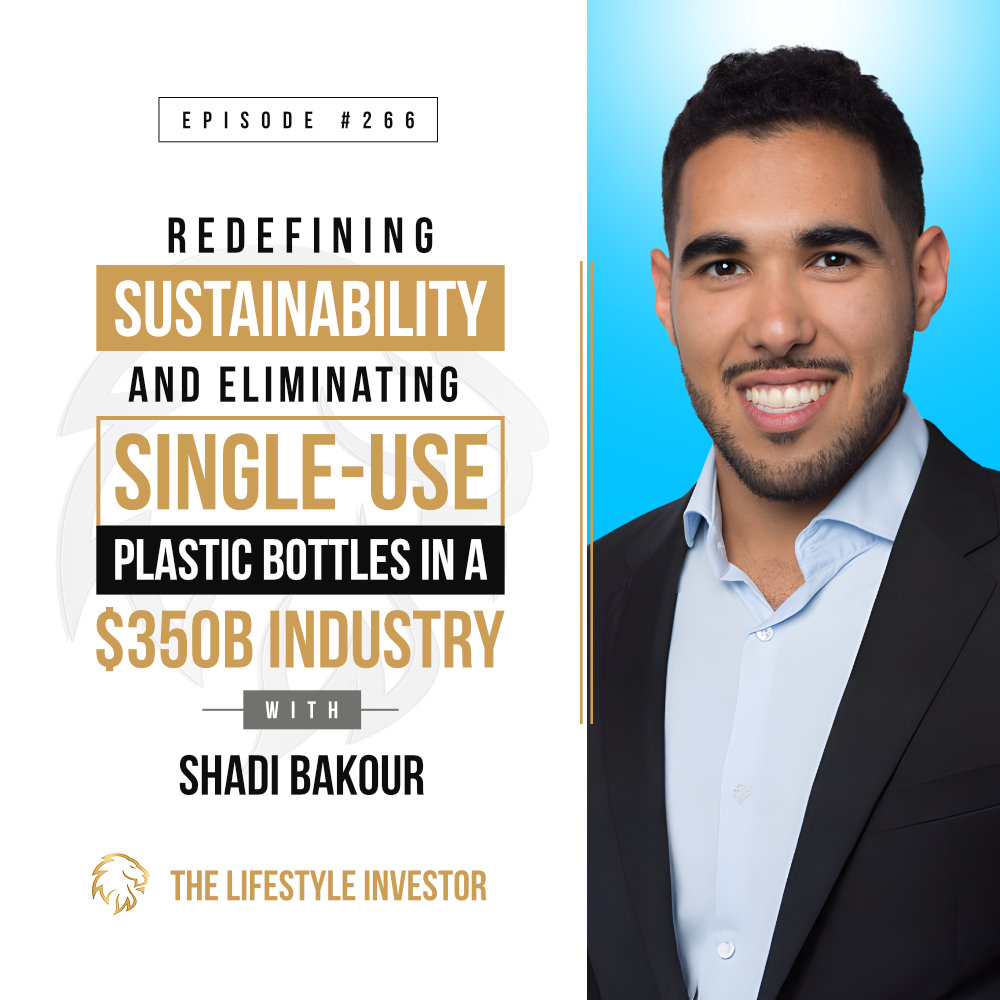
Interview with Shadi Bakour
Redefining Sustainability and Eliminating Single-Use Plastic Bottles in a $350B Industry with Shadi Bakour
Experts tell us that every 60 seconds, over one million plastic bottles are sold worldwide. Sadly, most of them will end up in landfills or the ocean, polluting the very thing that all living beings need to sustain life.
It’s no secret that the continued use of single-use plastic bottles is unsustainable for our planet and health. Few have made it their mission to solve this issue. But that’s exactly what today’s guest has been doing for almost a decade, and they’ve already eliminated over 500 million plastic bottles so far.
Shadi Bakour is the co-founder and CEO of PATH, the world’s first 100% refillable, recyclable bottled water brand. What started as an idea in a CVS parking lot has grown into a purpose-driven company. The mission: eliminate single-use plastics while offering consumers a premium, health-conscious option and eliminate 10 billion plastic bottles in the next few years.
In this episode, we explore what it takes to scale a purpose-led company, how sustainability is not just a trend but a permanent shift in consumer behavior, and why aligning profit with purpose might unlock the biggest investment opportunities in the years ahead.
In this episode, you’ll learn:
✅How Shadi turned an idea into a movement that’s eliminated over 500 million plastic bottles from oceans and landfills.
✅Why purpose-led businesses outperform competitors and attract top talent, partners, and investors.
✅The powerful shift toward a refillable economy—and what it reveals about the future of consumer behavior.
Featured on This Episode: Shadi Bakour
✅ What he does: Shadi Bakour is the co-founder and CEO of PATH, a sustainable bottled water company redefining how the world consumes hydration. Under his leadership, PATH has become a national brand available in over 75,000 stores and leading hotels like 1 Hotels, Four Seasons, and Marriott.
💬 Words of wisdom: “When you align profit with purpose, you don’t just build a company—you build a movement.” Shadi Bakour
🔎 Where to find Shadi Bakour: Website | LinkedIn | Instagram
Key Takeaways with Shadi Bakour
- The Origin Story: PATH’s “Lightbulb Moment”
- Why Microplastics Make Plastic Bottles a Health Hazard
- From Private Equity to Purpose: Shadi’s Leap Into Entrepreneurship
- Eliminating 500 Million Plastic Bottles and the Path to 10 Billion
- How Purpose-Driven Teams Retain Staff and Stakeholders
- Sustainability Is Not Just a Trend
- How to Connect with PATH and Shadi Bakour
The Fastest Growing Beverage Brand in the US
Inspiring Quotes
- “ Sustainability is not a short-term trend. It’s a long-term shift in consumer behavior.” – Shadi Bakour
- “ As humans, we have the choice of whether we want to preserve our natural resources or if we want to overuse and misuse our natural resources.” – Shadi Bakour
- “ If you look at it on a global scale, bottled water is a $350 billion industry globally. And so, there’s a lot more growth to happen for us.” – Shadi Bakour
Resources
- PATH
- PATH on LinkedIn | Facebook | Instagram | X/Twitter | TikTok
- Shadi Bakour on LinkedIn | Facebook | Instagram
- Jay Rose
- Steph Rose
- 1 Hotels
- Four Seasons Hotels and Resorts
- Hyatt
- Marriott
- Booz Allen Hamilton
- Jim Collins
- Good to Great: Why Some Companies Make the Leap…And Others Don’t (Good to Great, 1) by Jim Collins
Want My Team’s Help?
- Tax Strategy Masterclass
Learn the 28 most effective tax strategies the wealthy use to save thousands.
lifestyleinvestor.com/tax
- Free Strategy Session
Get a personalized roadmap to financial freedom.
lifestyleinvestor.com/consultation
- Lifestyle Investor Newsletter
Join The Lifestyle Investor Insider for curated investing insights.
lifestyleinvestor.com/insider
Rate & Review The Lifestyle Investor Podcast
If you enjoyed today’s episode of The Lifestyle Investor, hit the subscribe button on Apple Podcasts, Spotify, Stitcher, Castbox, Google Podcasts, iHeart Radio, or wherever you listen, so future episodes are automatically downloaded directly to your device.
You can also help by providing an honest rating & review over on Apple Podcasts. Reviews go a long way in helping us build awareness so that we can impact even more people. THANK YOU!
Connect with Justin Donald
Get the Lifestyle Investor Book!
To get access to The Lifestyle Investor: The 10 Commandments of Cashflow Investing for Passive Income and Financial Freedom visit JustinDonald.com/book
Read the Full Transcript with Shadi Bakour
Justin Donald: Hey, Shadi, welcome to the Lifestyle Investor podcast.
Shadi Bakour: Thanks for having me. Excited to be here.
Justin Donald: Me too. And shout out to Jay and Steph Rose. They were on for a handful of months, but it was probably six months ago, because they’ve got a killer business. So, go check out theirs and they’ve got a really cool dojo studio here in Austin. You’re also in Austin. So, I’m excited to meet up in person sometime, but your story is incredible. You’re doing a lot for the environment. You’ve built a company that is scaling that really does good things in the world. And so, I’d love for you to talk about PATH, how you even came about the idea of PATH, and really, how you’ve gotten it to just, I mean, the trajectory is incredible. I’m seeing PATH water bottles all over the place.
Shadi Bakour: Thank you. Yeah, it’s been a journey. When we started out, we’re just young and kind of naive enough to think that we could tackle one of the biggest categories in the world. And we’ve made some big strides since then.
Justin Donald: That’s awesome. And by the way, did the business start because you wanted cleaner water? Did it start because you wanted to eliminate the plastic waste? Like how did– give me the inception here.
Shadi Bakour: Yeah, I mean, we were literally just a couple of young guys with a dream to build the next trillion-dollar business, disrupting industry and really make it a change in the world. And I love building things. I love creating things. I’m a business background. So, when we looked at– well, I mean the story is we were just like a few guys sitting in the back of a pickup truck in a CVS parking lot in Northern California and just brainstorming about what’s the next big idea. And we walk into the CVS, look at the water aisle, and what we realized in that moment was that most of the innovation in the water space had been focused on the liquid inside of the bottle, but not on the actual container, the packaging itself. So, we had this light bulb moment. Why don’t we just put water in a refillable, recyclable, reusable aluminum bottle instead of single-use plastic.
Justin Donald: Yeah. By the way, now we’re learning with single use plastic, all the microplastics that are getting into our bodies from a health standpoint. So, like you could talk about the angle of sustainability, better for the environment, better for animals and your health. But now, it’s true, like these microplastics are getting all into our systems primarily from single-use plastic bottles. And correct me if I’m wrong here, PATH, I believe created the first 100% refillable aluminum water bottle that’s actually made and produced here in the United States, right?
Shadi Bakour: Correct, correct, yeah. I mean, well, it’s aluminum. We’re the first refillable bottled water, so it’s not just a bottle, but it actually has water in it. So, you’re a plastic bottle of water and you’re really durable, amazing, a reusable bottle that you spent a bunch of money on. They merge together to create this hybrid product, which is providing sustainable options conveniently at a very affordable price. And for a few bucks at the store to get not only a bottle of water, but also a reusable, refillable, and recyclable bottle at the same time at a very affordable price is something that’s never been done before. And to this day, we’re really the only ones that are continuing to charge forward for a number of reasons. We’ve been able to do some really creative things to create barriers to entry for anyone that might want to compete with us. And beverage business is not for the faint of heart.
Justin Donald: I’m sure. CPG is tough any way you slice it. And on top of that, you’re an industry that there’s just tons of competition no matter how you look at it, whether it’s hydrogen water or pH water or this quality of plastic bottle, glass bottle, I mean, the list goes on and on. One of the things that was interesting for me, so I don’t know what hotels and resorts you’re in, I actually think the first time I had your water, I was staying at a super high-end resort that had your product. And I was like, “Oh, what a brilliant idea.”
Shadi Bakour: Yeah, I mean, we do water for 1 Hotels, Four Seasons, Hyatts, Marriotts, I mean, the list goes on and on and on. Hotels is a big opportunity to really make an impact because they go through so much water. And I mean, most water in general is in a single-use plastic container. So, even with the trajectory that we’ve had and the success that we’ve had, we’re still a very, very small piece of the pie. If you look at it on a global scale, bottled water is a $350 billion industry globally. And so, there’s a lot more growth to happen for us.
Justin Donald: That’s incredible, yeah. Some nice team right there. So, let me ask you this, like, give us your background. Like, I think you were in private equity at one point. I think you’ve been in tech, like, you’re kind of in– Austin’s become this convergence or confluence of basically tech, wealth creator, entrepreneur, influencer, it’s really interesting, all the different types of people that are kind of making up Austin today. It’s fascinating. And I feel like your background is a little bit of a few of those.
Shadi Bakour: Yeah. No, it’s somewhat of a wide variety of background and somewhat focused, I would say. Coming from immigrant parents that came to the US with very little, my goal was just create as much financial wealth for my family as possible, as quickly as possible, and kind of break everyone out of the pressures of financial burden and all of that. So, that really drove me. I studied finance and economics. I worked in private equity for a little while. Loved it, but had another opportunity to work in consulting at Booz Allen Hamilton. So, I went, took that opportunity, hated it.
Justin Donald: By the way, it’s funny that you hated it because most people, like you’ve made it, like they have such a big name. It’s the industry standard. But man, if you don’t love it, you got to leave.
Shadi Bakour: Oh, my God, it was the most boring job I’ve ever had. And I’ve had a lot of jobs.
Justin Donald: Well, I’m glad you left and started PATH.
Shadi Bakour: Yeah. So, I mean, after that, so throughout and throughout my– even throughout school, throughout high school, college, I had various ventures that I started with friends and things like that, and co-founders, and some had mild success. Obviously, nothing to the scale of what we’re building with PATH, but little hustles and ideas that could have been really big if we stuck with it. But I kind of took them all as learning lessons. There were probably five of them. Some of them never really got off the ground. Some of them were just a business plan, and then some of them, we actually had some customers. It varied. But yeah, I was kind of looking for my next gig after consulting. Moved back from Virginia back home to California, where I’m born and raised, and I took a job in wealth management. And long story short, two weeks after taking the job, it was found out that it was not the right opportunity for me, quit. And I’m like, you know what? Screw this. I’m going to start my own thing.
Justin Donald: Well, back-to-back duds, you may have learned that you’re just unemployable.
Shadi Bakour: Yeah, exactly.
Justin Donald: You better go out and do something cool on your own.
Shadi Bakour: Yeah. I just always believed that if someone just gave me the opportunity to show my potential, I would do whatever it took to, like, I will show you what I can do. And I’m very like, I don’t want to say competitive, but I have a deep-seated belief that I can just work my face off and that whether I succeed or not, like, I think success is relative, right? But it’s like, I look at it as more of a long-term game. Like, it’s not what am I going to do in two years? Am I going to be a millionaire and am I going to go from 0 to 10 million in 2 years or 10 years? I look at it as like, what can I do in 40 years, 50 years?
And I think if you look at it that way, it kind of removes the expectation that you have to have this crazy business trajectory and become a billionaire and all this stuff you see on Instagram, which 90% of it is fake anyways. So, I think, looking at it that way is like you’re just learning the entire time and you’re just growing and you’re building your Rolodex, your skillset, as an entrepreneur, you’re sharpening your sales techniques, you’re sharpening your fundraising, just everything across the board, right? So, I think having that long-term view has served me well.
And if I had a shorter-term view, which, don’t get me wrong, like when we started the business, I was like, this is going to be a billion-dollar business next year. And here we are, 8, 10 years later, like just continuing to build it, but we’re having a ton of fun with it. And I wouldn’t trade it for anything.
Justin Donald: Well, I think Jim Collins in the book Good to Great talks about having a BHAG, a big, hairy, audacious goal. And so, I think that you’re doing exactly that, and when I think about the numbers here, you guys, PATH has successfully eliminated over 500 million plastic water bottles from oceans and landfills, which is incredible. But again, you’re talking about, hey, in the next few years, how do we eliminate over 10 billion? That’s making the world a better place while also providing good quality water that’s not leaching plastic from it, that’s in a reusable bottle, and that really kind of pushes the narrative of drink more water. It’s good for you. Drink half of your body weight and ounces of water every single day and bring your to-go container so you’re not also absorbing all the toxins and microplastics and all the particles that are going to be in these single-use or single-serve plastic containers.
Shadi Bakour: Right. And it’s not just microplastics. There are a lot of chemicals. The PFAS is one that’s popped up and that people are really trying to avoid these days. There’s antimony. There are all these chemicals that leach into the water that, what are you really drinking at the end of the day when you’re drinking a plastic out of a plastic bottle, it’s kind of crazy.
Justin Donald: Well, yeah, and the purification process, and I say that in quotes, if you’re not watching, you’re just listening, I mean, a lot of these companies standard to actually purify water. So, I mean, first and foremost, if you’re drinking water out of the tap, most cities have a very low standard for what is considered clean water. So, you have all kinds of stuff that you’re consuming. So, then you can kind of go to the next level and you can purify that. But there are these companies that have “purified” water, but their bar of purification is so low. It’s not reducing hardly anything. In some instances, these companies have been caught actually just bottling tap water and selling it as spring water. It’s crazy.
Shadi Bakour: It’s crazy. It’s crazy. I mean, some water, tap water is not bad. Like, New York tap, people swear by it, and I think it’s pretty high quality. San Francisco, where I’m from, they get it from the Hetch Hetchy reservoir. But now, living in Austin, like Austin water is horrible. I do not recommend drinking Austin tap water without having a really high-level purification system.
Justin Donald: Yeah, we’re a bit of health nuts in our family, the Donald family. We’ve been doing reverse osmosis and whole house carbon filtration systems for the showers, I mean, for everything, literally, like the entire home for over a decade because we’re just, I mean, when you think about it, it’s like, what’s the thing that you need more than anything in life, like the highest priority? It’s air and water, right, and then food. So, it’s like if we’re going to be obsessive about something, we’re going to be obsessive about the quality of air. So, we have all these air filters. We are going to be obsessive about the quality of water so much so that we even test. I’ve sent off to labs the tests of the different systems. So, what is the water with just the carbon filter? What is the water coming out of the fridges filter after going through our carbon filter? What is the water on the reverse osmosis? And we also add elements back into the water from the reverse osmosis. And then, obviously, with food, we eat super clean, super organic. That to me is a must. Like that’s foundational for us. So, I love what you’re up to.
Shadi Bakour: Thank you. Thank you. Yeah, you’re reminding me that I got to get an air purifier and a couple of other things. So, good little tokens there, but…
Justin Donald: So, what does it take to scale a purpose-led company into the fastest growing beverage brand in the country?
Shadi Bakour: Yeah, it’s, look, having a purpose-led organization is actually a huge plus for any company because it rallies everyone to a single goal. And you talked about the BHAG, the big hairy, audacious goal, right? It’s like, we’re all doing something and yes, everyone wants to make money. Everyone wants to put food on their table. Everyone wants to know that they’re being valued for the work that they’re putting in, right? That’s just, we have to survive as humans and that’s a necessity. But when you’re doing that, while also doing something that’s just taking things to the next level and you feel like, wow, I’m like, if you’re making a bunch of money, but you’re hurting people, it kind of like, you might second guess, am I doing the right thing? I could be making money in other ways.
But if you’re really succeeding financially and succeeding in many other ways, and one of the most important ways is through social good, right? Like, how am I giving back to the community, to the world at large? And so, for us, the way that we look at it is, it’s not just, yes, our product is better for the environment, better for your health. We’re getting rid of plastics. We’re getting rid of microplastics. We’re getting rid of chemicals. We’re changing the way that consumers think about consuming all products, not just water on a day-to-day basis by giving them the opportunity to refill and reuse. All that stuff is great.
But then also, we’re doing stuff like, recently, we just launched for the third year in a row, an autism awareness bottle because we have some people in our community that are connected with the world of autism. And we just did a made in USA bottle that we’re able to– we’re doing different cause-based kind of activations that allow us to take the business success and actually use it as a platform for these causes and bring them onto a larger stage because yes, we’re in over 75,000 stores across the US today. So, if we’re doing some sort of cause-based promotion, we’re not just promoting our own brand and our product, we’re promoting this cause, we’re bringing awareness to it, and it’s something that people really care about. So, it’s a win-win for everyone.
So, having an organization like that, I think, and again, you don’t have to be saving the planet from single-use plastic bottles to be a purpose-led and purpose-driven organization, right? There’s so many things you can do to drive social good. But when you’re an organization that has that as one of its core tenets, it allows you to really maintain a team, a group of stakeholders, investors, just kind of build an army of people that want to see this organization succeed and grow and become larger because it’s more than just financial gains. And so, I honestly think that’s why we’ve gotten to where we are today is because, yes, we have a team that’s dedicated, that’s really smart, that’s doing everything in their power to grow and to learn and take feedback from the market, but there is an X factor, right? And so, yeah, I can dive into all the little tactics that we’ve done and there’s so much there. But just having an organization that’s based and built on that, I think, increases employee retention, decreases turnover, gives another reason for people to want to be on the path with us, pun intended.
Justin Donald: Yeah, I love it. Hey, so when I invest, I’ve been investing for about 25 years and let’s call it 15 or so, maybe a little more, 15 or 16 or 17 years in alternative investments. So, one of the things I look for is spotting trends. I want to know what a trend is that is going to become mainstream. So, super early on in my investment career, I got into mobile home park investing and people thought I was crazy, but I recognized a trend. I also recognized a supply/demand imbalance. And so, when people told me not to do it, I did it because I just knew the economics around it, or at least I believed it, right?
And then I got into single-family home maintenance and started a company in that space because I recognized that we went from primarily, people owning their own homes, but then the global, the GFC happened 2008 to 2012. And towards the tail end of that, you had institutions that were coming in scooping up homes by the 100s and 1,000s, and 10,000s. And so, we built a company to service those homes because we knew there was no way they could do it at scale in different markets, and so, that company has done very well. And I could go on and on and on with different things.
I started investing in AI literally 10 years ago. I started investing in robotics even before that. So, let’s call it 11 or 12 years ago. And so, I’m always looking for like, what is the trend that– what’s going to become mainstream that’s not? What’s an invisible deal? What do most people not see? Like, right now, I’m looking at millennials because they’re the ones that are going to control over the next 5 to 20 years. They’re going to control the vast majority of the wealth in the US. There’s going to be somewhere around $100 trillion that’s going to be handed down to them from baby boomers. So, it’s like understanding what their desires are. What do they like? What do they dislike? How do they like to travel? How do they like to live? What do they do for recreation? What causes are important to them?
You’re already seeing this trend with alcohol that is totally dipping. Baby boomers are the highest consumers. And then, you drop down to Gen Z and it’s less. You drop down to millennials, it’s even less– or Gen X rather, and then drop down to millennials and drop down to Gen Z. And so, like, that’s a big-time trend that millennials aren’t drinking, right? So, it’s like, so we can learn a lot through this. So, what I’m curious about, like, I don’t believe this refillable economy is a trend. I believe this is here to stay. I wonder what type of market research you’ve done to know what trends look like for refillable/reusable water bottles that economy, that PATH is paving the way for.
Shadi Bakour: Sure, sure. I love how you state everything because, literally, I couldn’t have said it better myself. I mean, look, in the beverage space, if you look at just beverage specifically, like to your point, there are these short-term trends. We saw, for example, kombucha. Everyone was on the kombucha hype, coconut water, more recently, prebiotic soda, right? These are things that I think, they have specific consumer tastes and preferences, and so yes, they can catch on, they can be good for you. There’s a better for you wellness type of theme that’s happening in general.
But when we look at sustainability as a whole, and I think it’s the reason that you have all of these major macro funds like the BlackRocks and those of the world that have specifically set aside a large pool of capital for ESG and sustainability, right? Because in my mind, sustainability to your point, is not a short-term trend. It’s a long-term shift in consumer behavior, right, because it’s not sustainable for us to continue to pump billions and billions of single-use plastic bottles and plastic items into the waste stream, into landfills, oceans, that go into microplastics, that get into our soil and ultimately, into our food, into our bodies.
So, the news is really starting to hit now. And as humans, I think we catch things on a little bit late, we kind of procrastinate on things, and now, they’re literally finding plastics in our brains. They’re finding plastics in embryos. So, now, New York Times headline, there’s finding hundreds of thousands of microplastics in a bottle of water. And now, people are becoming really aware of it, which is fine, like, and hopefully, we can work to kind of reverse that, but to be honest, most of the plastic that has been produced in the world, I think it’s some statistic, don’t quote me on it, but it’s the large majority, over 75% of plastics that’s been produced in the history of mankind has been produced over the past three years. So, it’s not like we’re slowing down, right? I mean, I can order something on Amazon and have it here in an hour, right?
Justin Donald: It’s so crazy.
Shadi Bakour: So, we live in this stuff economy, right? So, there has to be some sort of change or else, just like any organism that comes in, if you have a fungus that comes into a lake and it starts to grow and grow and grow and feed off of the, whatever it is in the lake. Well, eventually, if it grows too big, then it has nothing else to feed off of, then it’s going to actually die off. So, as humans, we have that choice of whether we want to preserve our natural resources or we want to overuse and misuse our natural resources and ultimately, where that would lead us. So, I think there’s hope and I think there are a lot of people, organizations that are driving to make these changes that are necessary. And I think, as humans, we’re very solution oriented and we can figure it out.
But I love how you think about investing. Like, it’s really cool to hear. I think it’s a very contrarian mindset in a lot of ways, which is exactly how we’ve built our business as well. And I think that’s when you really identify these massive wins that, to your point, may have been invisible, right, 10 years ago. And people were talking about AI, but it was more of a whisper. And now, people are screaming at it and throwing money at it, and everyone and their mother thinks that they can have an AI business that’s optimizing X, Y, Z and I can raise $50 million for it and get this sovereign wealth fund behind this and that, right? And so, it’s interesting times for sure.
Justin Donald: It is. Well, Shadi, I love what you’re up to. I love PATH. I love your water. I love your technology here. And I wish you the best. Where can people learn more about you and more about PATH?
Shadi Bakour: Yeah, we are online in drinkpathwater.com, @pathwater on Instagram. My Instagram is @shadibakour. I’m also on LinkedIn and all the social platforms. So, please reach out. We would love to find ways to collaborate and get you some good hydration.
Justin Donald: And by the way, we do a lot of events in Austin. So, I feel like we should probably team up and do something there. I bet you there’s a lot of things and we have good size events. Like, there’s all kinds of stuff I feel like we could do. So, let’s circle back. We’ve got an event coming up in September, September 8th and 9th here in Austin. It’ll be a live event, so I feel like there’s a bunch of cool things we can do. So, let’s chat about it. So excited about connecting with you. Thank you for the time.
Shadi Bakour: Thank you.
Justin Donald: And I love ending our podcast with a question for the audience. What is one step you can take today to move towards financial freedom and really move towards living a life you truly desire that’s on your terms? So, again, not a life by default, but a life by design. Thanks for checking in here this week, and we’ll catch you again next week.
Shadi Bakour: Yeah.
Sign up to receive email updates
Enter your name and email address below and I'll send you periodic updates about the podcast.
Keep Learning
How Writing a Book Can Add Revenue Streams and Millions to Your Business with Chandler Bolt – EP 268
Creative Real Estate Strategies to Build Generational Wealth with Dedric & Krystal Polite – EP 267