
![[Justin Donald] - Optin Preview](https://lifestyleinvestor.com/wp-content/uploads/2020/12/Justin-Donald-Optin-Preview-e1607533704966.png "[Justin Donald] - Optin Preview")

![Logo 1 Gold horiz [Converted]](https://lifestyleinvestor.com/wp-content/uploads/2019/08/Logo-1-Gold-horiz-Converted.png "Logo 1 Gold horiz [Converted]")
Interview with Richard Wilson
He Analyzed 1,000+ Billionaire Strategies (Here’s What He Found) with Richard Wilson
What if you could tap into the exact investment strategies billionaires use to multiply their wealth—without being one?
In this episode, I’m joined by Richard Wilson, founder of the Family Office Club and Billionaires.com. Over the last 18 years, Richard has analyzed over 1,000 billionaire strategies, advised more than 250 family offices, and built the world’s largest network of ultra-wealthy investors.
Today, he’s sharing what he’s learned from nearly two decades studying how the ultra-wealthy think, invest, and structure deals. From mental models and niche investing to AI-powered tools and negotiation tactics, you’ll discover the exact strategies billionaires use—and how to apply them to grow your own wealth, no matter where you’re starting.
In this episode, you’ll learn:
✅ How Richard built the #1 investor club for billionaires—and the exact mental models he’s seen them use to spot better deals and scale with precision.
✅ What he’s learned from interviewing hundreds of billionaires and centi-millionaires—including insights from Tony Robbins, Mark Cuban, Kevin Harrington, and many others.
✅ How to leverage AI to amplify your investment returns, streamline deal sourcing, and gain a competitive edge.
Featured on This Episode: Richard Wilson
✅ What he does: Richard Wilson is the founder and CEO of Family Office Club, the world’s largest association for family office wealth management, serving over 100,000 members globally. He also owns the #1 website on billionaires’ mental models and scaling strategies – Billionaires.com and is a trusted advisor to billionaires and ultra-wealthy families on investment strategy and deal structuring.
💬 Words of wisdom: “If your net worth grows faster than your financial IQ, gravity will correct that equation very quickly.” – Richard Wilson
🔎 Where to find Richard Wilson: Website | LinkedIn | Facebook | X/Twitter
Key Takeaways with Richard Wilson
- Buying the Billionaires.com Domain Name
- The Secret to Accessing Ultra-Wealthy Investors
- Screening Investments for Billionaire Clients
- Launching Family Office Club & Acquiring FamilyOffices.com
- A Common Trait Among Billionaires
- Accessing Billionaire-Level Deal Flow
- Why Family Values Matter More Than Wealth
- Trust Your Gut, Not Others’ Opinions
- Invest Heavily in Your Zone of Genius
- Wealth Without Health Means Nothing
- The Importance of Raising Your Financial IQ
- What Makes Family Office Club Different?
- Leveraging AI to Amplify Your Investment Returns
- 2How Top Performers Dominate Their Niche
Your Net Worth vs. Your Financial IQ
Inspiring Quotes
- “Investing in your health is massively important. Being ultra-healthy fuels your ability to have focus, stay in peak mental state, and maintain an abundance mindset.” – Richard Wilson
- “It doesn’t work to just copy what the wealthy do verbatim because now that moment in time has moved on and the world is slightly different. But if you knew their mental models and why they acted that way in that context, you can learn more from that.” – Richard Wilson
- “People worry a lot about passing on their wealth, but it’s way more important to pass on their values.” – Richard Wilson
- “The most successful investors I know have public markets, real estate, and then play offense in the industry they know best.” – Richard Wilson
Resources
- Family Office Club
- Family Office Club on LinkedIn | Facebook | Instagram | YouTube
- Richard Wilson on LinkedIn | Facebook | X/Twitter
- Billionaires.com
- Bloomberg
- Financial Times
- Wiley
- Oprah Winfrey
- Sara Blakely
- Mark Cuban
- Warren Buffett
- Tony Robbins
- Sam Altman
- Mike Tyson
- Charlie Munger
- Be Useful: Seven Tools for Life by Arnold Schwarzenegger
- The Success Principles: How to Get From Where You Are to Where You Want to Be by Jack Canfield and Janet Switzer
- Goldman Sachs
- Apollo
- KKR
- Ryan Casey
- ESPYS
- David Goggins
- Anthropic
- OpenAI
- xAI
- Perplexity
Want My Team’s Help?
- Tax Strategy Masterclass
Learn the 28 most effective tax strategies the wealthy use to save thousands.
lifestyleinvestor.com/tax
- Free Strategy Session
Get a personalized roadmap to financial freedom.
lifestyleinvestor.com/consultation
- Lifestyle Investor Newsletter
Join The Lifestyle Investor Insider for curated investing insights.
lifestyleinvestor.com/insider
Rate & Review The Lifestyle Investor Podcast
If you enjoyed today’s episode of The Lifestyle Investor, hit the subscribe button on Apple Podcasts, Spotify, Stitcher, Castbox, Google Podcasts, iHeart Radio, or wherever you listen, so future episodes are automatically downloaded directly to your device.
You can also help by providing an honest rating & review over on Apple Podcasts. Reviews go a long way in helping us build awareness so that we can impact even more people. THANK YOU!
Connect with Justin Donald
Get the Lifestyle Investor Book!
To get access to The Lifestyle Investor: The 10 Commandments of Cashflow Investing for Passive Income and Financial Freedom visit JustinDonald.com/book
Read the Full Transcript with Richard Wilson
Justin Donald: Hey, Richard. Welcome to the show.
Richard Wilson: Appreciate you having me here, Justin.
Justin Donald: Yeah. Good to have you on the Lifestyle Investor. I'm just thrilled because of all the people I've interviewed, I think we've interviewed 250 to 300 people, I mean, I think we have around 250 episodes out and probably 300 in the kitty, you are the person that may have one of the most similar tracks to me and what I've seen and what I do and I'm just excited to expose our audience to the cool stuff you're up to. So, welcome, and let's have some fun.
Richard Wilson: Appreciate it. Let’s do it.
Justin Donald: Yeah. So, like me, you are a father. You're a girl dad. Now, you've got a few more girls than I do, but you love adventure and we've been married for almost the same time. I'm just shy of 15 years, and you're right at 15 years, I think. In many instances, we're walking a similar path, really trying to democratize what billionaires are doing so that other people can kind of learn and know and understand the playbook. But you had an even better idea than me and that was to either start or buy Billionaires.com. And I mean, hey, what a great domain name. Well done. How did you come about getting that?
Richard Wilson: Yeah. So, I had already run Family Office Club for three, four years and I thought, "What else is a sandbox that would just be amazing to get really good at like democratizing best practices, et cetera? And I thought, "Oh, well, billionaires. Of course, they're never going to go out of style and there's always going to be more of them.” And so, I tried to negotiate the purchase of Billionaires.com for 12 years, and every three to four months I would follow up, follow up. They kept on telling me, "No. Go away. We're never going to sell it to you.” And then eventually they said, "Okay. You get the money together in the next five weeks, we'll sell it to you under that price during COVID.”
So, then we bought it just to interview 100 billionaires, rank and document every book ever written by billionaires, and analyze all 1,000 public talks that can be found on billionaires. That's kind of the goal.
Justin Donald: Well, I have a funny feeling we're going to be sending a lot of foot traffic to your website. So, that's a really cool story. Now, how did you get to the point that you were running a family office and I guess getting access to all this info because it's hard if you don't know what you're looking for. It's hard if you're not willing to pay money or if you don't have the access to get the data that you and I look at. I mean, I love single-family office data. I study it all the time. I get my hands on everything humanly possible. But I'm curious, like what led you to where you are today and how did you gain the access?
Richard Wilson: Sure. Well, early on it was like what Mark Cuban says, "You don't have to have all the capital or the network. You choose a high-value niche. You read everything on it. Most people won't do that. You interview lots of people like you're doing on your podcast, right? And so, early on I was raising capital and I was calling wealth advisors and many of them said, "Oh, well, we don't have accredited investors so we can't look at your hedge fund. You're wasting your time.” And I was like, "Yeah, I am wasting my time.” And then I talked to one wealth advisor. He's like, "Yeah. I'm a family office. Of course, my investors are accredited. They're all 10 million plus net worth.” And I was like, "Wait, what? You're a what?” And that's how I learned what a family office was.
And then what was so weird to me is that I looked up how to get better at working with family offices, how to work with them. And there was no trail guide. There was no one publishing anything helpful. It was like a Bloomberg reporter/Financial Times guy who had never worked a day in his life in the industry. I was like, "This is backwards. There's no trail guide.” So, I just started a blog and just started sharing everything I was learning and it just took off from there.
Justin Donald: So, talk about your season running a family office. What did that look like? Was it yours? Was it someone else's? What were your responsibilities?
Richard Wilson: Yeah. So, we've helped put together and start 250 different family offices now over the last 18 years since we got started. So, we help screen and originate direct investments for largely centimillionaires and billionaires. We have some clients that are worth 20, 50, 70 million that we work with sometimes. But like our most active clients, a billionaire we’ve closed 19 transactions for him that we sourced from our community. He is a publicly traded entity. But a lot of the time, a lot of family offices, even if they manage hundreds of millions, are not experienced in structuring deals. They don't know how to put together a dashboard for a family office or just don't know what the norms and best practices are. They only talk to 5 or 10 other people like them if they're lucky, right? So, they can't see the forest like you can running your show.
Justin Donald: Yeah. It's interesting how little visibility many of these other family offices have into neighboring family offices, same city, same town, same everything. And oftentimes it's not as collaborative of what you would imagine of a community, right? It's a little bit more like in competition with. But the family office thing, it's fascinating because years ago this didn't exist. For a long time, it was only the ultra-wealthy that did it. I mean, this now holds a place in the IRS tax code but at one point in time, it didn't, right?
Richard Wilson: Right.
Justin Donald: And so, how did you find yourself kind of pivoting to where you are today from helping out the family offices? I guess you're still doing that but into more of like the data aggregation.
Richard Wilson: Yeah. Well, I think what happened is that while starting the blog, it just took off like wildfire. At age 26, I got on the front page of the Boston Globe and I spoke on the same stage as prime ministers in Europe. And I couldn't even eat that day because I was so nervous. I had no idea what I was doing on stage, right? Because I was just a kid. And what I realized is that there was a gap. So, we went to be as helpful as possible in that gap. We got a book deal with Wiley. And the transformation was when I got the book deal with Wiley, I was like 27 years old, I was like, "Maybe I don't know everything about family offices at 27, right?”
So, I interviewed 30 family offices, put all the interviews in the book, and then that positioned me to have a network. Our social media network took off and I started getting invited to speak a couple hundred times in a dozen countries. And then I realized like, "We can host our own events. We can host our own community. Like, we don't need to speak at other people's events.” And then that's how we transitioned into really Family Office Club and buying FamilyOffices.com for that early on, et cetera. So, that was moving from being a blogger to consulting, helping run family offices to running like Family Office Club as a community transition.
Justin Donald: That's awesome. And so, obviously, we both have communities where we run things, we do deals. What are some of the mental models, maybe a couple that you've learned that are most consistently present amongst the billionaire class or the centimillionaire to billionaire class?
Richard Wilson: Right. Yeah. Great question. And just like you, I believe in democratizing things. So, when we mention Billionaires.com, everything we're learning is free, like we don't charge anything. There's no gate or anything like that there. And when I look at the most consistent things across the billionaire segment, I find it's a hunger ambition beyond just obviously having enough to be comfortable, so they think big but a visceral anti-herd mentality. If they're in a room and everyone's agreeing with everybody and everyone thinks the new idea should work and is very reasonable, they know that's not the right track usually.
Like, there are some things you have to do as table stakes to have quality and to be at the table. But if some people aren't laughing at you saying, "You don't know what you're doing,” saying, "That's not how the industry works,” saying, "That's not realistic,” then it's probably not something that's going to move the needle. It means like everyone's doing it and you're just going to be average, right? So, that stands out to me as like an expectation of excellence, but also to do something exponential like Bezos says, "You have to know that usually it's right to follow the herd. But to do something substantial, you really need to have some shots that are exponential, kind of like moonshots.”
Justin Donald: Yeah. And do you find that the type of deals in the billionaire class are a lot different than the type of deals that the general public gets access to? I mean, I know the answer's yes, but I want people to hear it. I want people to hear the ins and the outs.
Richard Wilson: Yeah. There are a couple of things related to that and maybe are less obvious, right? So, blackmail is like, “Hey, I'm going to break your window if you don't do this thing for me.” The opposite of that, that has nothing to do with the color of your skin is whitemail. And it's kind of like people will do things for you because they know how powerful you are in the industry. And people will do a deal with Oprah Winfrey or Sara Blakely or Mark Cuban or Warren Buffett because of who they are. And that goes down to people who are non-famous as well. If you're a titan of your space and you're worth $100 million, people will go out of their way to offer you deal terms that someone else doesn't ever get to see.
So, the takeaway to that, to us normal human beings that aren't any of those people, is that if as an investor in your local community or an industry, if you can see deals first exclusively and at better valuations, then you're just going to do very well and your balance sheet's probably going to multiply in size. And we talk a lot about, "How do you do that? And what's a strategic choke point? How do you acquire those to get that done?” and those types of ideas.
Justin Donald: That's awesome. Well, I love that. And, yeah, it creates a moat for you as an investor. You don't have to be the billionaire or the centimillionaire. But if you have access to them, if you have access to their deals, if you have access to their network, you can have some of that network effect. It can rub off. You can get the preferred terms. I mean, that's one of the big things that I always say to people, "We love doing deals in the Lifestyle Investor community that, A, most people will never have access to and, B, that we get preferential terms on. Right?
Richard Wilson: Yeah.
Justin Donald: And I think that's really important and you guys get that too.
Richard Wilson: For sure. That's how we interviewed Tony Robbins is he's on the board of a company that was at one of our events. And so, the power of having Tony Robbins as your partner just helps you get on stage or just get extra access. So, part of it is just thinking really strategically. Like, Sam Altman said on social media like a week or two ago that a CEO should be spending a lot of their time strategizing and planning out their next moves, not rushing all around, scurrying around, executing things nonstop. You have to really be strategic, thoughtful, and precise with some of your movements.
Justin Donald: Yeah, that's good. I like that. What are some personal, I guess, mental models or habits that you've learned from billionaires and from the access that you've had that you use personally in your daily life? Maybe it's parenting, maybe it's business, maybe it's deals but I'm curious how you implement that.
Richard Wilson: Sure. I've got two free tools that anybody could use and develop themselves. They don't even need the template from me, but I've got a Word document template if it saves them a bit of time. But basically, it comes from the realization that when I interview family offices, centimillionaires, billionaires, or pro athletes like Mike Tyson or NBA/NFL players, they all did extraordinary things by taking unique actions. But why do they take those actions? It's the unique mental models. It doesn't work to just copy what the wealthy do verbatim because now that moment in time has moved on and the world is slightly different. But if you knew their mental models and why they acted that way in that context, you can learn more from that. Munger says we should have a hundred mental models.
And so, my theory is that if you have a positive mindset, can stay in peak mindset, and be ultra healthy, study pro athlete, discipline, and grit, study family offices, centimillionaires, billionaires, you'll really be unstoppable. And I was broke in my basement studio apartment when I started this business. And now I've done well because of studying all the types of people that you study. And so, the two tools are, I use one for myself, one for my kids. The one for me is I put my monthly, quarterly, annual goals on a Word document. I then put 40 different one-liner statements or just a couple of two to four-word statements that are like my mental programming.
Like, if you were doing a ChatGPT prompt and you're like, "Act like this. Be this. Don't do that. Always do this,” like it's basically if I did these things, things would go amazingly well. And then I read that every morning. As I'm shaving, I did that this morning. So, that's been enormously helpful because it keeps my brain focused. I know how to operate in the world. And then for my kids, likewise, I tell them, "You can ignore your teachers at school. You can ignore every authority in your life. You can ignore politicians, the news, all of that if you just follow our family values.” And then I've got an AI summary of a couple of books on a one pager, and I said, "This simplifies life. If you follow this one-pager, you're going to do amazing in life. Everything else that people say is a suggestion. This is what you need to live by.”
Justin Donald: And what's your one-pager? I'd love to learn your family values. They sound awesome.
Richard Wilson: Yeah, sure. So, first of all, like the book that you choose for your kids could be very different, obviously, than the books I choose, but I chose the book, Be Useful by Arnold, which I read with my kids and they loved it. And then the book, Success Principles by Jack Canfield, which has a series of 52 principles of being successful in life. And then at the very top, we have the family values of healthy, bold, brave, clean, cheerful, kind, grit, responsible, respectful, high integrity. And so, we punish or reward the kids based on living by those principles essentially.
Justin Donald: That's awesome. Well, I love the clarity that you have around it, and I just think it's great that you're championing these things. Like, this is the most important thing. You are a Wilson, so this is how we show up. I think that's so cool and what a great legacy piece that you have it distilled down into this so it can pass from generation to generation.
Richard Wilson: Yeah. People worry a lot about passing on their wealth, but it's way more important to pass on the values. If you succeed on passing on a bunch of wealth, you might just spoil your kids to do nothing or enable them to buy Ferraris and, God forbid, drugs. If you pass on values, you can lose all your money and then gain it back. Or if you pass on money without the values, they might just not talk to each other, or God forbid, sue each other over your estate. It's like the values are way more important than the money. Most families don't have family values above their kitchen table but every CEO, which is most people who become wealthy, or business owners and CEOs, they know that values are important to keep a team together. So, why wouldn't you have family values formalized for your family, right? Most people don't.
Justin Donald: Yeah. You would never run a business without those formalized mission statement, values, right? So, I love that analogy. Here's an interesting thought, like, so what's one core belief for you about success that's changed since really building Billionaires.com?
Richard Wilson: I think not caring what other people think too much. Like, in my life, I've never met a single human being that said, “I love Hawaii. If I have to be on Zooms and emails and host events and do all this stuff, yeah, I’m going to live in the place that’s going to make me the healthiest person and happiest. So, I’m going to go live out in the middle of the ocean where it's inconvenient to go anywhere else.” And to do stuff like that and follow my gut to have the courage to do what my brain after spending 40,000 hours on my platform like you have with yours, no one's thought about my platform more than myself. No one knows my niche in the exact vision I have than myself.
So, just having the courage to really trust my insight after seeing things play out over 18 years, you learn to trust your gut a bit more. So, I think that's like the number one thing is just that billionaires have that rejection and they reject what most people may judge on them and they expect the excellence and doing some unique things. So, I think of that. That's enabled me to live like a happier, more successful life, I think.
Justin Donald: That's good. What's the most counterintuitive strategy you've seen from this ultrawealthy class to scale their wealth?
Richard Wilson: Well, I think counterintuitive in terms of how most people think of investing is they've just heard the drumbeat of wealth advisors that only know one song called diversify, diversify, diversify. And that's all they do. But what's counterintuitive, I think, is that the investors I know who are most successful, they have public market stuff, usually managed by a wealth advisor or two, and they say, "Oh yeah, by the way, I like or don't like Tesla and Costco or whatever.” They invest into real estate, good chunk into real estate, most of it cash flowing, some development. And then they keep on investing in the space that they know best, and that's where they play offense.
And I think a lot of people just think of like, "Oh, well, I already have a wealth advisor. Like, my wealth management's kind of taken care of,” or they just do a couple of real estate deals and they don't play that next game after their exit of being chairman of the board. Or like you are the person that somebody wants to be when they grow up. If you sold your five dry cleaners and somebody has one, you are them in the future, they hope, right? So, that's how you get the best quality deal. So, I think that's counterintuitive for a new investor trying to figure stuff out, I think.
Justin Donald: I love that. And really on our podcast, I talk all the time about asset allocation of single-family offices, and aka the billionaires, and you said it spot on because most of them only have 5% to 15% of their net worth in the stock market, right? Whereas most of the general public has the majority of their wealth there, and they've got another 10% to 20% in real estate. They've got another 5% to 10%, maybe even up to 15% in private credit. They've got 20% to 30% in private equity, like you said, offense. And so, when I look at all this data, and I'll look at it from everywhere from whether it be like UBS, Goldman, Apollo, KKR, like any of the groups and then just the family office groups that aggregate data.
And it is so consistent across the board. It is so crazy. Another, what, 5% to 10% in cash and 5% to 10% in fixed income, and 1% to 2% in oil and gas or other commodities, 1% in precious metals, 1% in collectibles, anywhere from 1% to 5% in Bitcoin. And so, it's very interesting to see how consistent that is, even when many of them don't have a lot of communication with the others.
Richard Wilson: For sure. I think the other counterintuitive thing is that, but it's so obvious when you say it out loud, but almost all the wealthy have this completely backwards, is that I was in a room of 130 medical doctors and dentists who are paying $30,000 to $50,000 a year for like a wealth management club. And I said, "Raise your hand,” and these people that work in healthcare, "Raise your hand if you spent $30,000 on your health last year.” One hand went up. I don't know if he had cancer or some special treatment, but that means that even people that work in healthcare in general spend way more on managing their wealth than their health.
But the thing is, if you've been divorced seven times and you're an alcoholic and you have all these vices and you don't talk to your kids and you're super wealthy, you are a complete failure really in most people’s eyes. You wouldn't choose that obviously. And if you die early or get sick often, I just feel like being ultra-healthy is not in a state of ultra-wealthy. I feel like being ultra-healthy is one of my top goals in life. And I think it'll fuel my ability to have focus, stay in a flow state, stay in a peak mental state, be optimistic and positive, abundance mindset. And so, investing in your health is massively important. And it's not so much about how many dollars you spend per year. It's really about the intent and your prioritization within life, I think.
Justin Donald: Yeah. What's the old adage that, "If you're healthy, you have all these goals and dreams in life. And if you're not, you only have one,” right? It's to get your health back. It's so true but it's not often lived. And then the other thing I just see all the time is people want to outsource their financial education and success to someone else. And that's just never going to get you to the level that you probably want to be at. Like, there needs to be some responsibility that you take in learning and growing and networking and doing the things that it takes, right? If you know that the way you're investing is opposite of the way the wealthiest people in the world invest, doesn't it make sense to maybe study alternative investments a little more since we know that about 60% of the net worth of the billionaire class is in alternative investments?
But some people still want to outsource that to other people that actually only 5% of the time in the last 15 years outperformed a simple S&P index or any of the other indexes and less than 1% in the last 30 years. So, you spend more for an advisor or money manager who performs worse without in-housing any of the knowledge and education and doing anything yourself. So, it is very fascinating.
Richard Wilson: Yeah, for sure. I would encourage people to look at maybe they made their money in auto dealerships and now they're passionate about stem cells. I think the future is X, Y, and Z. But those three buckets of like the public market, real estate, and then where are you going to play offense, it's super unique to you, I just find that so helpful of a template just to like, think about it, because the same brain trust that's managing your public markets probably is not super tuned into real estate strategies and they probably don't know what you know about wherever you made your money. And so, thinking about it in that nuanced way, which is not super complex, but it's more differentiated than how a lot of people approach it to me is a helpful template.
And definitely, there's a saying that if your net worth grows faster than your financial IQ, gravity will correct that equation very quickly. If you're a pro athlete, and a lot of pro athletes will sign 20 car leases for their friends. Most lottery winners end up going bankrupt because their net worth went way up and their financial IQ did not at all. And then people will remove that money from your bank account very quickly. So, your financial IQ needs to be scaling faster. Just like in your CEO, you need to be scaling your CEO IQ faster than you know the size of your company or your revenues. Otherwise, it's going to come right back down perhaps. So, those are some things I always try to keep in mind.
Justin Donald: I love that. Our COO, Ryan Casey, always says that to our community that your education and your intellect on the wealth creation needs to outpace your reality, your present state. And I think that's so true. And then it's also, you got to be careful having biased information. You want as many unbiased advisors around you because if you are working with someone that there's a benefit to them managing your money, well, then they probably don't think it's a good idea for your money to go anywhere other than them, right? They take a pay cut if you want to go into an alternative investment that they're not offering that they don't get a cut of.
Richard Wilson: Yeah, exactly. Exactly. It's like asking the barber if you need a haircut. It's like such a basic thing once you think about it. So, I'll just be super careful on that. Most people in the finance industry that are educating you on something are selling you in the same breadth, and it's just the most credible sales pitch. We had someone who said, "Oh yeah, I'd love to speak at your events.” And we're like, "Okay. Well, you're selling something so you'd have to sponsor it.” And he's like, "Oh no. Well, it's just an educational talk.” I was like, "Yeah, all of our sponsors give only educational talks.” That's the only credible way to sell to like ultra-wealthy is to educate them first. And if they see you as an expert and see your value add and were helped so much by your words that they'd love to get to know you better, that's the only sales pitch they want to hear, really. Otherwise, there's no context around what you're trying to pitch them.
Justin Donald: Yeah, 100%. So, just out of curiosity, what differentiates the Family Office Club from other investor networks in terms of value? I mean, there are a handful of these out there. I'm in a bunch of them. You've probably been in a bunch over the years. So, what's your big differentiator?
Richard Wilson: So, we've got like a three-point differentiation. One is we host 16 to 20 events a year. So, we're in Dallas, Beverly Hills, South Florida, New York four to six times a year each. And so, that way it's relatively easy to come to our events. It's not just once a year, once a quarter in one city. The other thing is that after doing this for 18 years, we have about 17 million social media group members and followers. And then we've hosted 300 live events so we have all the data of 1,500 people who have spoken on stage and then we transcribed 986 public billionaire talks and interviewed 45 billionaires. So, like all that data means that we have proprietary access to that data because it's our own. And so, we built 30 artificial intelligence tools just for our community.
I built it myself in-house. There's no white labels, there's no licensing things, and they all work. We tried 100 plus AI tools. Most of them are like beta mode, half work, or really complex to set up, weren't built for me, and it was just frustrating. So, then we went down that path to kind of a rabbit hole. So, those are the main things is really like the frequency of events, the investor data profiles we have on 22,000 investors, and then AI tools.
Justin Donald: Well, let's dig into these AI tools. I would love to know how you use AI for more leverage because I think you do this at an elite level.
Richard Wilson: Sure. So, I'd love to give you a couple of examples. I'll say them quickly because it's a little bit of a mouthful, but the one that we were already talking about, mental models. I believe so much in mental models that we gathered a hundred mental models from Warren Buffett, a hundred from Munger, a hundred from Sara Blakely, a hundred from Mark Cuban. We then went and looked at all 986 billionaire talks that were given publicly. We transcribed them all. Asked for 200 mental models from that. Asked for another couple hundred mental models from all the investors who have spoken on stage at our events, and we gathered all these up into an AI sandbox.
And then we said, "Tell it what you're trying to do. Tell it who you are. Upload your pitch deck if you want to give it more context and then tell it what your challenges and opportunities are.” And it will suggest to you mental models that you should maybe read off daily or you might want to adapt to get you where you want to go, right? So, to me, that's like insanely powerful.
Justin Donald: That's awesome.
Richard Wilson: It's not as tangible as some other things you can do with AI, but it's like so powerful. So, that's one. We also cut data with AI so that we will take our 22,000 investor profiles and you just upload your pitch deck and it'll see what you're doing, where you're based, and say, "Here's the 1% you should be really talking to. Here's like 150, 300 investors out of the 22,000 that look for what you do, or they're right in your backyard.” So, this will save you a bunch of time. You don't need to reach out to 22,000 investors. Nobody can effectively, so just focus here and you'll save a lot of time. And then the other things we do is, we have tools that… Let's give one more example out of the 30. One's called [Deal Structure Ninja – 26:19].
This is one of my favorites. It's like if you're negotiating a deal as an investor or a capital raiser, you tell it what you're solving for. You say, "Here's the challenges of this deal. Here's what the counterparty wants. Here's what could blow up the deal. Design for me 10 custom structures.” It knocks out the 10. You say, “I like two and six. Give me 10 more that look like that.” And you do that over and over until you say, “I love number four. Just add this one little component and make the collateral or equity part uncapped or whatever.” And then it'll draw upon a thousand deal structures to custom a structure that's just for you. And that could change someone's life if they're selling their business or buying a business or investing in something. So, honestly, it's more powerful than all of our events, like what just one or two of these tools can do if someone really uses it.
Justin Donald: Wow. I love it. Well, I'm excited to dig in more. I'm thrilled about attending an event here at some point in the future. I'm not too far from Dallas, and I'm definitely going to be scouring Billionaires.com to learn some of the cool stuff that you have. You were talking about pro athletes earlier, and I thought it'd be fun to share with you that I'm going to be attending the ESPYS this year, which is really cool. And we're running a wealth creation event, kind of like compounding wealth amongst many of those pro athletes that are going to be in attendance at that event the day before in LA. And so, I'm thrilled about that and I feel like you and I are running in similar circles, getting a chance to rub elbows with some influential people.
What are some of the biggest takeaways that you've had interacting with pro athletes, the decamillionaires, the centimillionaires, the demibillionaires, the billionaires. Like, what are some of your biggest takeaways as we kind of wrap things here today?
Richard Wilson: Yeah. Part of it is like dedication to the niche and going deeper. And like Arnold says, he won because he would work out in the morning two and a half hours a day. And then with a different workout partner in the afternoon, do two and a half hours a day. And most importantly, he loved every minute of it and he enjoyed it. So, he outworked and he out-fun the other people like he had more fun doing it. So, it wasn't really work to him. And I think that a lot of pro athletes and billionaires have that level of passion where David Goggins says, "Imagine what your competition would do then imagine they're thinking the same as you and you do more. Then think what's tiny bit more and then do way more than that and just go insanely deep where no one's going to ever want to go that deep on whatever the niche is.”
And I think that I see that in the pro athletes. We've had probably about 70 pro athletes on stage at our events. We've got a few friends in the LA area and we're happy to connect you to a couple or have you come to one of our events for free as our guests since you have me on here.
Justin Donald: That'd be great.
Richard Wilson: But I think that mindset is what's important, right? To find something so fun, valuable long term is going to be amazing to be honing your craft on. You just go so deep that you are the authority on that niche. And it would be hard for – a publicly traded company would have to spend millions a year for a decade to try to catch up with you, you know?
Justin Donald: Right. That's fantastic. So, where can people learn more about you and more about the Family Office Club, Richard?
Richard Wilson: The best place would just be to go to FamilyOffices.com. We have our membership options there. We have a list of the 30 AI tools that we call Investor Super Intelligence. They're all listed out there on the website and that's really the best spot. And my email's just richard@familyoffices.com. If anyone has questions or needs a Word document template for your kids or for yourself in the morning, always happy to give that out and happy to share one of the AI tools for free with your community as well since you're nice enough to have me on here. I'll shoot you over a link afterwards.
Justin Donald: Oh, that sounds awesome. Well, yeah, our community will love that. And I just feel like AI to me is just it's the new frontier. And so, I've told a lot of people this, but we don't know which companies are going to win, but I figure you go big in the ones that are big right now, and then maybe find some outliers. So, as an investor by trade, I got in early to Cohere, Anthropic, OpenAI, xAI, Perplexity. And there's a handful of others. And so, it's like each of these, I don't know if they're all going to make it. Maybe they will. Odds are probably good they won't. But are one or two or three of them? Probably. And then what's that next tier? Who's coming up? Because I do think AI is the next wave.
But contrary to popular belief, we just, in fact, invested in an AI company that just got bought for 2X in two years, so a newer company. But contrary to popular belief, a lot of people think AI is rather new. I've been investing in it for about 10 years. So, it's actually been around for quite some time and it just keeps getting better and better. And so, I love your cutting edge tools, but I think for anyone who's listening that's like, “Hey, I I'm not sure what's next. I don't know what to study in school, or I want to pivot careers or whatever,” I think AI is a great place to double down and see what fruit might be there for you.
Richard Wilson: Oh, yeah. For sure. A lot of people have a fear-based mentality with AI, and AI will have good and bad things that come from it, but if you want to ensure that it's a great thing for you and your family, then going really deep on that. Just like when COVID hit, if you were hosting live events, you had to go virtual and the faster you pivoted to virtual, the better you did in the world, typically. The same thing with AI right now. It’s like if you're not pivoting hard on AI, then definitely something to consider.
Justin Donald: I love it. Well, to those of you that are tuning in here, I just really want to challenge you here today. Level up in some way. If you're looking to make the move, find a group, a mastermind, an investor club, and join it. There are different ones at different price points with different specialties. I think that though there are probably some that are better than others, anyone is probably better than not being in one. And I think it's great to whether it's the Family Office Club, whether it's Lifestyle Investor, whether it's some other group, I think the best place to learn and grow is in a peer group where you have the opportunity to have equals, but you have mentors and you have the ability to pour into others at the same time.
So, give, take, but be able to learn and have accountability from people doing cool things and really just be exposed to the things other people are doing that maybe your current ecosystem and peer group isn't doing. So, I just want to challenge you all there. And I like wrapping up every episode with a question, and my question is the same each week. So, if you're watching or if you're listening, what's one step you can take today to move towards financial freedom and move towards a life by design, not like most people who live a life by default but what's one thing you can take from Richard today that moves you one step closer to financial freedom and life by design? Thanks! And we'll catch you next week.
Sign up to receive email updates
Enter your name and email address below and I'll send you periodic updates about the podcast.
Keep Learning
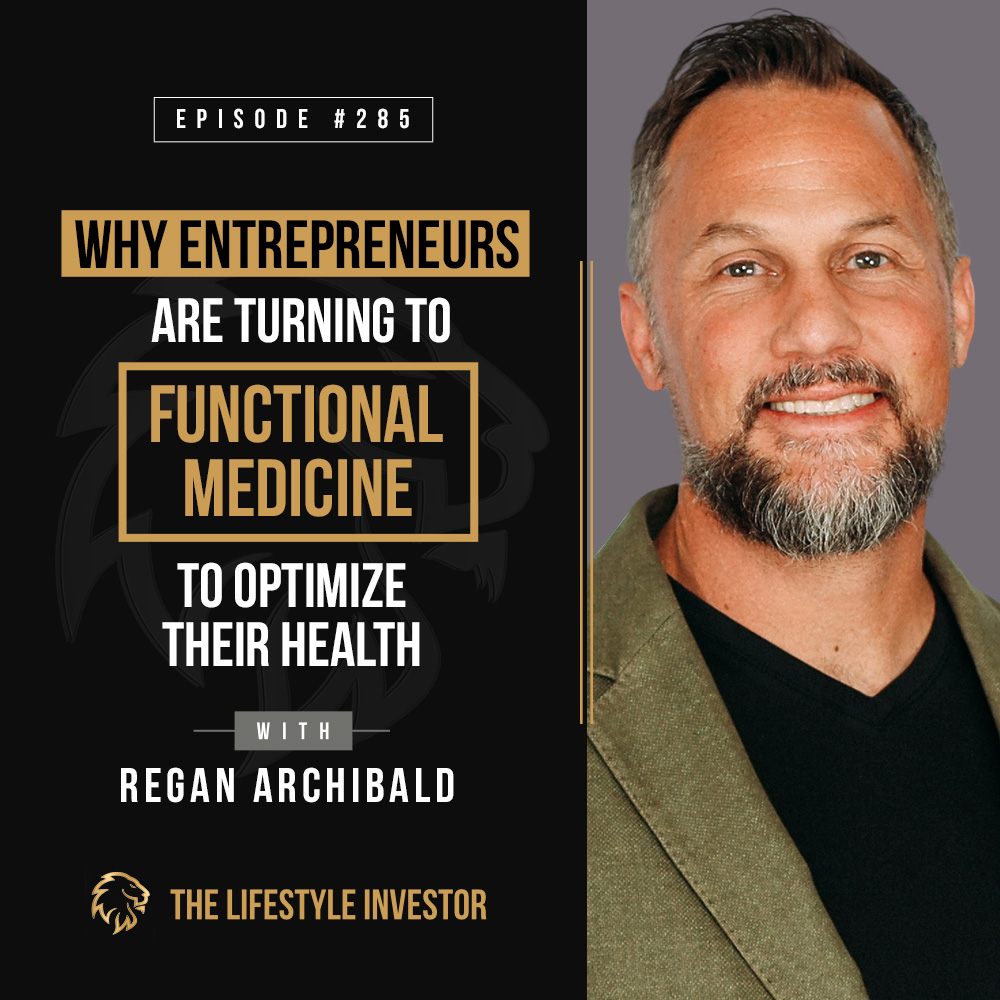
Why Entrepreneurs Are Turning to Functional Medicine to Optimize Their Health with Regan Archibald – EP 285
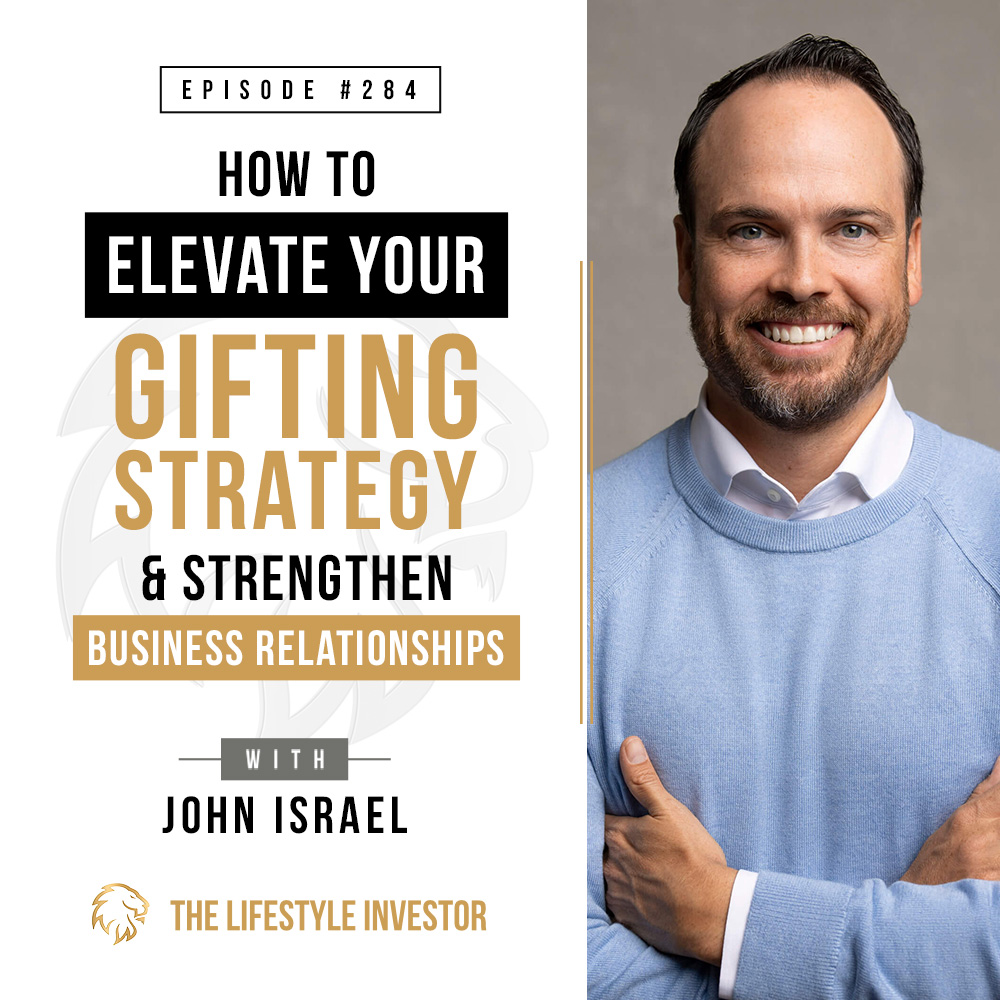
How to Elevate Your Gifting Strategy and Strengthen Business Relationships with John Israel – EP 284
[…] Richard Wilson is one of a handful of investors, entrepreneurs, and high achievers who have a path similar to mine on The Lifestyle Investor. […]