![[Justin Donald] - Optin Preview](https://lifestyleinvestor.com/wp-content/uploads/2020/12/Justin-Donald-Optin-Preview-e1607533704966.png "[Justin Donald] - Optin Preview")

![Logo 1 Gold horiz [Converted]](https://lifestyleinvestor.com/wp-content/uploads/2019/08/Logo-1-Gold-horiz-Converted.png "Logo 1 Gold horiz [Converted]")
Interview with Regan Archibald
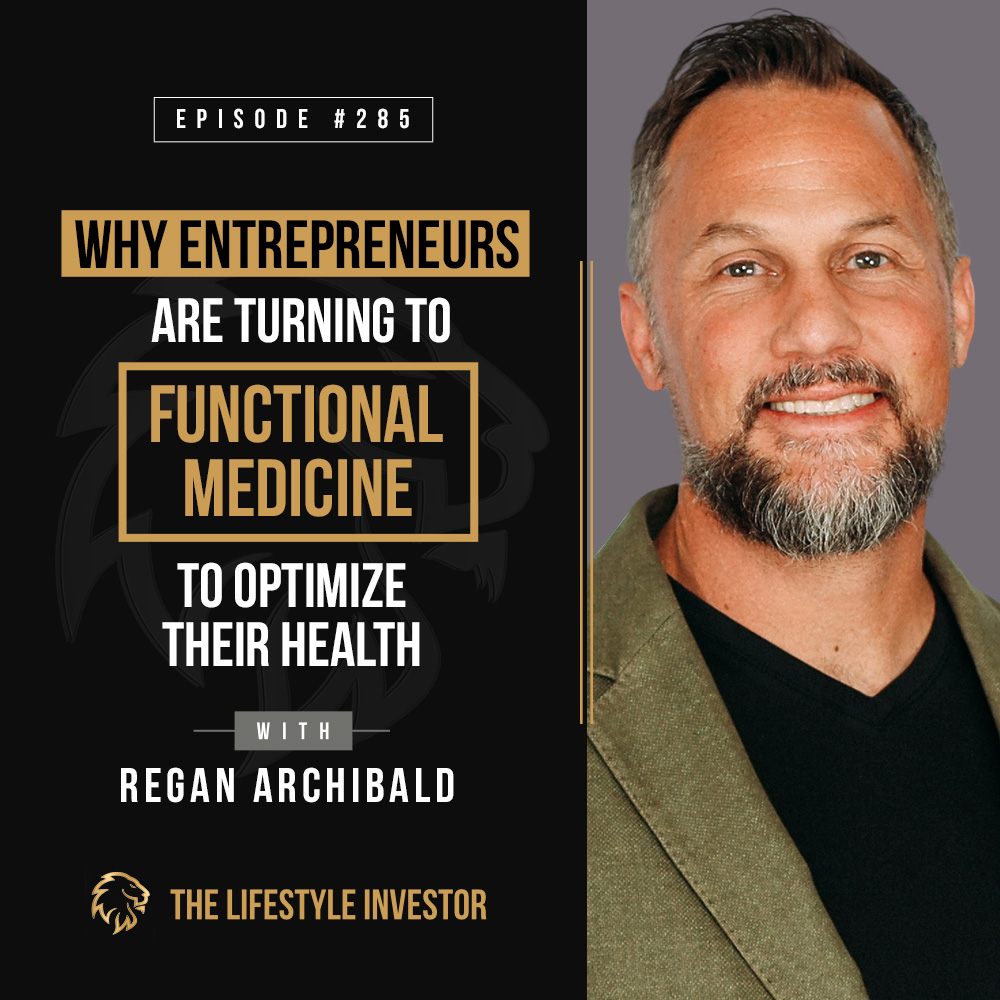
Why Entrepreneurs Are Turning to Functional Medicine to Optimize Their Health with Regan Archibald
There’s a big difference between building wealth and being healthy enough to enjoy it. And too often, entrepreneurs focus so heavily on growing their businesses that they unintentionally sacrifice their health and overall well-being in the process.
Regan Archibald is the founder of Ageless Future and a pioneer in functional and regenerative medicine. Over the past two decades, he has worked with high-performing entrepreneurs, executives, and athletes to help optimize their health using cutting-edge medical innovations. His work focuses on identifying the root causes of health issues and helping people reclaim their energy, clarity, and vitality.
In our conversation, Regan pulls back the curtain on what’s happening at the forefront of longevity and functional medicine. From breakthroughs in regenerative therapies to the growing role of peptides and personalized protocols, he explains how these innovations are helping people not just recover from injury and illness, but operate at a higher level than they thought possible.
If you want to enjoy the wealth and legacy you’ve created, this episode will challenge the way you think about health, longevity, and investing in your future.
In this episode, you’ll learn:
✅ Why investing in your health may deliver the greatest ROI of any investment you can make.
✅ How regenerative medicine, peptides, and stem cells are transforming the future of longevity.
✅ Why optimizing your brain, heart, and muscle health today can dramatically impact the quality of your life in the next phase of life.
Featured on This Episode: Regan Archibald
✅ What he does: Regan Archibald is the founder of Ageless Future and a leader in regenerative and functional medicine. For more than two decades, he has helped entrepreneurs, executives, and high performers optimize their health through advanced diagnostics, peptide therapies, and longevity-focused medical protocols.
💬 Words of wisdom: “From an investment perspective, there is more money on the table that goes into longevity medicine than any other sector in medicine that I’ve seen. But there’s no one who really stands out as far as having the right structure and having the right capabilities. There’s a lot of noise out there and we’re the signal through the noise.” – Regan Archibald
🔎 Where to find Regan Archibald: Website | LinkedIn | Facebook | Instagram
Key Takeaways with Regan Archibald
- Justin Heals His Ankle Injury with PRP & Stem Cells
- Justin’s Road to Recovery From Mold Toxicity
- Symptoms and Warning Signs of Mycotoxin Exposure
- Regan’s Ageless Future Longevity Framework
- Medicine 4.0 and the Future of Healthcare
- How Peptides Help Optimize the Body
- The Huge Investment Opportunity in Longevity Medicine
- Where to Learn More About Regan & Ageless Future
How Medicine 4.0 Helps Avoid 10 Years of Suffering
Inspiring Quotes
- “The disadvantage of surgery is once you get cut on, then your structure is changed for life. It’s permanent.” – Regan Archibald
- “One of the things that people can do is make sure that you’re treating pain as quickly as possible before it gets to the stage where you have had a knee replacement, hip replacement.” – Regan Archibald
- “If you can diagnose, get to the root cause of things, treat it, then you can have even greater levels of health.” – Regan Archibald
- “We want to have that decisiveness and, if your brain’s not working and your gut’s not working, decision making just gets clouded very quickly, like you mentioned.” – Regan Archibald
Resources
- Ageless Future
- Ageless Future on LinkedIn | Facebook | Instagram | YouTube | Apple Podcasts
- Regan Archibald on LinkedIn | YouTube
- Chilipad
- Eight Sleep
- BedJet
- The daVinci50 Mastermind
- Peter Attia
- Outlive: The Science and Art of Longevity by Peter Attia MD
Want My Team’s Help?
- Tax Strategy Masterclass
Learn the 28 most effective tax strategies the wealthy use to save thousands.
lifestyleinvestor.com/tax
- Free Strategy Session
Get a personalized roadmap to financial freedom.
lifestyleinvestor.com/consultation
- Lifestyle Investor Newsletter
Join The Lifestyle Investor Insider for curated investing insights.
lifestyleinvestor.com/insider
Rate & Review The Lifestyle Investor Podcast
If you enjoyed today’s episode of The Lifestyle Investor, hit the subscribe button on Apple Podcasts, Spotify, Stitcher, Castbox, Google Podcasts, iHeart Radio, or wherever you listen, so future episodes are automatically downloaded directly to your device.
You can also help by providing an honest rating & review over on Apple Podcasts. Reviews go a long way in helping us build awareness so that we can impact even more people. THANK YOU!
Connect with Justin Donald
Get the Lifestyle Investor Book!
To get access to The Lifestyle Investor: The 10 Commandments of Cashflow Investing for Passive Income and Financial Freedom visit JustinDonald.com/book
Read the Full Transcript with Regan Archibald
Justin Donald: What’s up, Regan? Good to have you back on the show.
Regan Archibald: So good to be here, Justin. Thanks for letting me return.
Justin Donald: Well, this is fun. You and I get a chance to hang out at a number of different events. We’re both part of a handful of different masterminds. We’re both traveling to some of the same places. I get to come into your clinic in Salt Lake City and do some work there. You guys come to Austin, frequently, and so we get to do some work here, and I appreciate it. I appreciate all the work that we have done. In fact, I want to tell some of the stories of some of the work we’ve done since the last time you were on the show while we hang out here today.
Regan Archibald: Great. Would love that.
Justin Donald: Well, it’d be fun to kind of just start like just talking about a story because I was playing sand volleyball with some friends, and so, the cardinal sin in volleyball is when people go under the net. You’re not supposed to do that. Well, we are playing with some friends, actually, a friend that has been on this podcast before and he came under the net. My foot hit his knee or shin and it rolled to the side, and all my weight, so I went up for a kill. He came under the net. My ankle gets clipped. I come down with all my weight on the side of my ankle, and you could just hear like pop, pop, pop. And I tore through the three major ligaments, full tears on two of them and almost a full tear on that third one.
You looked over the MRI that I got and you’re like, “Oh, man, this is not good.” And this was a previously reconstructed ankle. So, I had already had surgery. I already had a bunch of different work done on it. I think I had five different surgeries inside or five different things that were done inside of a single surgery, and it may have been six different things. And so, I was like, “Oh, man, do I have to go through all this again?”
And instead of having surgery this time around, we did PRP and stem cells, and this thing is back to good. It is amazing how quickly it recovered. It’s amazing how fast I was able to put weight on it. And it just healed up so great. And so, I was able to fly out to Salt Lake City, see you get some work done. You came out to Austin later in the year. So, a few months later, I had stem cells injected by your team again. I’m a huge believer in the stem cells and I’d love to just chat about that for a bit.
Regan Archibald: Yeah. The nice thing about that is you also did BPC-157. You’re injecting right into the area. Justin had the courage to do it, so he is a real man, everybody. It’s not easy to inject yourself in the ankle region, but…
Justin Donald: Oh, the ankle’s tough, not a lot of fat fatty areas there. It’s all like skin and bone.
Regan Archibald: Yeah, it really is. But the cool thing about that is if you looked at the opportunities that you took advantage of, because a lot of people don’t realize that they would just go to an orthopedist and they’d say, well, you’re going to need surgery because your tears were so severe and your ankle was massive. I mean, it was like the size of…
Justin Donald: It’s like a grapefruit.
Regan Archibald: Yeah, it was wild. And so, all that trauma, I mean, just the logical next step would be surgery. And the disadvantage of surgery is once you get cut on, then your structure is changed for life. It’s permanent. And a lot of times, there’s an inherent weakness in that area. So, then you’re more prone to future injuries. And you’d already had surgery on it, so it was like, let’s see what we can do to regenerate it.
And regenerative medicine is like Moore’s Law in reverse because what we used to get excited about was a million live stem cells postop. The attrition rate was just so high that it’s very hard to maintain the viability. And now, we’re seeing 40 to 50 million in our flow cytometry. So, you benefited from, and we’ve been doing this a decade and a half and the stem cells are better. We know how to treat it in between. So, that’s where BPC-157 is angiogenic. It helped the tissue recover much faster. I mean, you’re pretty much, are you back to 100% on it or what?
Justin Donald: I’m back to 100%. So, I mean, in a year’s period of time, it was amazing. And so, I mean, I remember when I was walking and playing sports, and even my surgeon that luckily is a holistic surgeon, which those two words, it’s a little bit of an oxymoron, right? But he’s like, hey, why don’t you try doing PRP and stem cells? And if we can heal it that way without surgery, let’s do that. And so, that’s what we did.
And so, every step of the way, he’s like, you are months ahead of schedule. Like, I can’t believe you have weight on it. I can’t believe you’re running on it. I can’t believe you’re playing pickleball on it. Like, you’re back to volleyball. I got a soft brace that I was able to use. And so, he literally was blown away that this protocol, so he originally said, most people would go surgery this route. I can tell you kind of don’t want to do that. Why don’t we see how this goes and we’ll assess. And I mean, at a given time, I was probably three months ahead of a typical patient through this rehab process.
Regan Archibald: And we see that all the time. Even our clients who, they’ve had joint replacements and we just saw a patient the other day who had his knee replaced and he is like, the pain hasn’t gone away. And he was super frustrated because there’s still some tendons there. You still have that connective tissue that holds the joint together. And we did stem cells for him, even though he had a joint replacement. He’s already feeling better. It was like a week after and he is like, this is what I expected the surgery to do, but he just didn’t quite have the healing that he wanted because our bodies lose their resident stem cell population as we age.
And so, one of the things that people can do is make sure that you’re treating pain as quickly as possible before it gets to the stage where you have had a knee replacement, hip replacement because, Justin, I want you to have all your joints 50, 60 years from now because the innovations are so exciting that maybe there’s other organs we’ll be thinking about replacing. Like, hey, maybe it’s time to replace those kidneys, Justin. So, let’s grow them with your own stem cells and then we can have a safe way of reintroducing them into your body.
Justin Donald: Well, the speed of technology and innovation in healthcare is just mind-boggling. And it really is. Isn’t it Moore’s Law where it’s just astronomically larger over a shorter period of time? I mean, it’s nuts what happens.
Regan Archibald: That’s it. And we’re seeing Moore’s Law in medicine, specifically in the peptide space, in the regenerative medicine space with stem cells. It’s more and more exciting. So, things get– it doubles in their capability and the price comes down. And so, that’s the fun thing.
Justin Donald: Hey, I’ve got another personal anecdote and story of just this crazy mold situation that we’ve been dealing with, with our primary home. And you’ve been along every step of the way on that whole scenario with me. And by the way, I do plan on putting out a solo podcast episode. I’ve actually never done a solo podcast episode and I’m going to, most likely do a whole session on all the things that I’ve learned, what this whole process looked like, kind of A to Z.
But I think it’d be fun to touch on because there’s a lot that we were able to do with peptides and other supplements to help with my mold detox. And so, I had mold poisoning so bad. The toxicity levels were off the charts. I have a mold specialist, medical professional here in Austin that I used, and he is like, “Oh, my goodness, these are some of the worst numbers I’ve ever seen.” And so, you’ve seen all those numbers, but you said, hey, there’s ways that we could tackle this with supplementation and with peptides and went through a protocol with EastWest Health and you guys, and it has done wonders for my recovery, where the first six, seven months of this year were brutal for me from just a health standpoint, a clarity standpoint. I had brain fog. I got migraines. I had body aches. I didn’t sleep well. I had ringing in the ears. I mean, I couldn’t get out of bed for days at a time. I mean, it was truly debilitating.
And this is something that you’ve had experience with, I mean, you’ve had personal experience with, but then on top of it, you’ve treated it before. And so, I think there’s this overlooked ROI in health that I think should be addressed. And I think people should know that there are answers out there that can help solve these problems because today, I’m on month nine and I feel back to myself again, finally.
Regan Archibald: Right. Well, and you were restricted to about 15 foods for the year.
Justin Donald: That’s right.
Regan Archibald: And now, Justin’s got a six pack. Your body fat’s down to like 9% or 10%. I mean, it’s ridiculous, but the biggest thing is you got your health back. And I look at biology and it’s simple. It’s like remove interferences. So, what are the things that are getting in the way from you being optimized and then build up the deficiencies? And it’s as simple as that. If you can diagnose, get to the root cause of things, treat it, then you can have even greater levels of health, even though you had this insanely toxic mold exposure in a house you just built too, which is so sad.
Justin Donald: Yes. Oh, it’s such a shame. And it was a beautiful home that we would’ve loved to stay in, but that wasn’t the hand we are dealt. So, we’re going to roll with the punches. But it’s fascinating because a good thing came from a bad thing, right? So, I got so sick. It was one of the worst things I’ve personally ever experienced. But now, on the other side of it, going through all the protocols that I’ve gone through and even through the diet plan that I had to embark upon, which was crazy, right? Just absolutely nuts, no alcohol, no dairy, no gluten, no corn, no soy, no legumes, no added sugar, it was just absolutely– oh, no rice. So, imagine a diet of basically protein and veggies and berries and citrus and that’s it, for about four months.
And what I will say is like, I think every guy and probably a lot of women love the idea of like having six-pack abs and it looks good and, as happy as I am to have that and be in that type of shape, it pales in comparison to how I feel internally, how I feel emotionally, having my intellect and clarity of thinking back. Like, I would trade all the exterior facade of being in shape for the internal health that I have now because it just feels so good to be where I am today. And so, I do think that horrible situation, the silver lining is that I’m now in better shape than I was before it happened and I know how to stay at this place.
Regan Archibald: Man, well, and I think, what you’ll be able to do too with the people that you know is 95% of people we test for mold toxicity habit. And either their antibodies are elevated, so they’ve had it in the past and their immune system still trying to grapple with it or we find the acute exposure in their urine. And so, if anybody notices that they have, what’s called photophobia or you need sunglasses just to go outside, that’s a classic sign. You could have a mold exposure if you wake up with stuffy sinuses, if you notice that your body aches. You mentioned brain fog. What was your brain fog like?
Justin Donald: I had indecision galore. It was hard to make decisions, hard to process information. I was constantly tired, like I would wake up and feel like I needed to go back to bed. I would be up for a few hours and feel like I need to lay down, but not just take a nap, like lay down for the night, but like in the morning.
Regan Archibald: Oh, wow.
Justin Donald: I just could not process. It was like this brain stopped processing everything and I was having a hard time making some of the critical decisions that I needed to be making for business and family and all the different areas of life.
Regan Archibald: Man, detrimental. And so, I think, indecision, I mean, brain fog, if you have a hard time learning things, if you can’t read a book and focus anymore, if you’re very distracted, check for mycotoxins. It’s very common. I had a recent client of mine. He had his house checked and everything because we tested his levels. And then yesterday, I’m on a call with him and I said, “Is there anything else?” And he said, “You know what? I looked at my Chilipad,” because he has one of the old, the Ooler bed. It’s like an Eight Sleep. And he found that there was all the mold and mildew in the water tank in his bed cooler. So, he is like, I threw it out.
And so, make sure you check even those little things that should be sealed up, but they can still harbor mold and mildew. If you’re looking for an alternative, BedJet is a good one because it just blows hot air or cold air. We want people sleeping cooler. Any other symptoms that you notice that people could be aware of right away when it comes to mycotoxins?
Justin Donald: Well, I mean, I certainly had some gut health issues that I think were kind of exacerbated by the mold, by the mycotoxins. So, that would probably be it. Even just weird bodily reactions to different foods or bloating or it’s just like my gut was not working right. And I think it actually led to leaky gut. I think I had a small case of leaky gut.
Regan Archibald: Yeah. Because your intestinal permeability gets disrupted when there’s mycotoxins. If you crave sugar more, this is where you want to be careful on the fruit you eat because a lot of the fruit will start to get moldy on the bottom. There’s nothing worse than you go on for a handful of blueberries and it’s like, oh, never mind. But yeah, there’s a lot of exposures that you can get.
Your experience, especially when you do your solo podcast, it will save people a lot of time, a lot of money because you think of the decision-making capability and busy entrepreneurs. We want to have that decisiveness and, if your brain’s not working and your gut’s not working, decision making just gets clouded very quickly, like you mentioned.
Justin Donald: Yeah, it goes out the window. And speaking of that, I do want to get into some of the Ageless Future protocols, like you have a full-body operating system type of protocol under the Ageless Future banner. So, when we’re talking about ROI on health, I mean you work with a ton of high performing, high charging entrepreneurs that often push themselves to the edge. So, what do you see happening in their muscle, their heart, their brain, like brain health, that maybe most people ignore until it’s too late?
Regan Archibald: Well, first of all, Ageless Future is, and actually we’re going EastWest Health to Ageless Future. We transitioned. We’re opening up centers in Denver, in Seattle, Little Rock, Arkansas. I think I was talking to you about that last night. And we’re just really excited because we’re licensed in all 50 states. And Ageless Future is really where you’re getting healthier every year.
So, if you look back on your health a year ago. you’re a lot healthier than you were a year ago. Yes, you had a massive, you went through more transformation than what you and I anticipated with your injury, and then the mold toxicity has been a crazy year, but you came back stronger. And that’s really what this Ageless Future is all about, is using the medical innovations now that are available instead of waiting 20 years before the medicine actually catches up with the research.
I just returned from daVinci50 and presented there a couple of the days. And I look for leverage when it comes to medical innovation, so I want to make sure it has to pass the litmus test where it’s going to help get you to a state of optimized health in a shorter period of time without risking future health. And so, that’s where peptides meet the criteria. There’s thousands of peptides that we still don’t know anything about. But the ones we do know, roughly 700 of these peptides that have been structured and sequenced and studied heavily, we see phenomenal benefits with those.
In the major systems that we look at, as you mentioned, is the muscle because why would you want good muscle health? It goes beyond just vanity, and vanity may be a part of a reason why people want to live longer if you can still look good. So, there’s nothing wrong with it. But from the physiology of muscle releases, these peptides called myokines, and that informs the brain as to the health of your body. The neuromuscular adaptation response, your body’s ability to push really hard and then recover is dependent on that muscle brain connection. The muscles also need nice levels of glucose.
So, if people have metabolic issues, which is very common, as we– if anyone’s over the age of 35, you’ll know that the universe just doesn’t really seem to care as much. Your body breaks down. The genes start getting turned off, and you got to fight back. And so, that’s where having the cardiovascular fitness so you can hold onto muscle, it regulates, it’s a glucose disposal system. So, your blood sugar stays nice and balanced. And then the heart is all about being able to do the things you love doing. You’re a phenomenal pickleball player. I mean, I was mm2 and we were playing like, Justin’s just like so fast.
Justin Donald: Well, thank you.
Regan Archibald: Yeah, well, thank you. And I apologize, it was my first time ever playing and you guys let me join in with you guys.
Justin Donald: Oh, heck yeah.
Regan Archibald: But you think, when you’re 80, you’re going to want to play pickleball, right?
Justin Donald: For sure. You bet. I want to stay just as active then as I am now, and the decisions I make today are going to impact whether I can do that or not.
Regan Archibald: Yeah. Well, and you think of your daughter, when you’re 80, she’ll be roughly 60, or I guess she’ll be 50, right?
Justin Donald: Yep.
Regan Archibald: And she’ll probably be fit and then she may have some kids and then you’re going to want to hang out with your grandkids because grandpa’s the coolest person on the planet. I mean, at least, my grandpas were, and I’m sure your grandkids will think that of you. So, if you can just kind of plant the seed for what do you need to support yourself, what are the main systems that will allow Justin to be able to look, feel, and perform as best at that stage of life? That’s where you really want to protect the heart, protect the brain, and protect the muscle.
Justin Donald: Yeah, that’s awesome. I love that you’re diving into those areas. Love the new branding, by the way. I think it’s awesome. Actually, the name answers like, I think with EastWest Health, you’re like, okay, can you explain that to me? Versus Ageless Future is kind of self-explanatory, and I like it and it has a nice ring to it.
Something along the lines here of Ageless Future, you talk a lot about Medicine 4.0, and so, if we’re talking about the future of longevity, I’d love to have you talk about, really, it’s the prediction, prevention, personalization, and participation. So, can you break down how this approach changes the game compared to the traditional healthcare path?
Regan Archibald: Yeah. Well, conventional medicine is crisis care management. Like, if you have an ankle injury, there’s ligament tears, there’s massive damage, we need orthopedists because fortunately, yours was just not enough to require surgery. The regenerative medicine could correct it. Medicine is designed to look at your labs, diagnose a disease, and then here’s a prescription medication. And usually, that prescription medication is intended for you to be on the rest of your life.
There’s no further conversation. It’s like, oh, we found out you have high cholesterol. Here’s a statin to lower it. The conversation doesn’t continue, which, in Medicine 3.0, the conversation does and it says, okay, why is your cholesterol high? And here’s some things we can do to prevent heart disease beyond just drugs.
And Peter Attia coined the term in his book Outlive. And he talks about the marginal decades. So, that last 10 years of people’s lives is the worst 10 years. This is where people are watching Netflix, their bodies breaking down. They just don’t have any kind of quality of life. They don’t have relationships. Even Harvard just released a study early in ‘25 or late ‘24, and they found that people who have loneliness, they have the equivalent of seven years of a decrease of life span, similar to someone who smokes two packs of cigarettes a day.
Justin Donald: Wow.
Regan Archibald: And if you don’t have your health, you can’t commit to play pickleball. You can’t go on the hike with your friends or your family. It’s just you can’t travel. And so, that marginal decade is really what we’re trying to avoid. Medicine 3.0 got really good at running more advanced diagnostics and doing full body imaging and really helping people apply the principles of diet and exercise. And that’s all part of Medicine 4.0, but Medicine 4.0 is where we look for leverage and so, you work with investors, you work with very ambitious entrepreneurs, as do I.
And the thing that they’re looking for is they’re saying, what’s the fewest amount of inputs I can put into this deal or this opportunity that yields the highest ROI? And Medicine 4.0 is that way in health, and so, that’s where we’re looking at. What are the smallest, safest, most subtle inputs that we can apply biologically that turn on the genes where people can get healthy in the shortest amount of time possible without risking future health. And that’s where the three main medical therapies that we’ve landed on is regenerative medicine. And that would include, like even what you’ve done with plasmapheresis, where your replacement with albumin, exosomes, things like that, that includes stem cell therapy which we’ve talked about, that includes peptide therapy which we are probably one of the largest, I’ve been told, we’re the largest prescriber of peptides in the country.
Justin Donald: All right.
Regan Archibald: Which is really exciting. We just bought a pharmacy a couple weeks ago, and so, we have genius pharmacists and now, we’ll be able to make our own peptide blends. That was a two-year process of getting all the licensing and everything set up, but it’s here.
Justin Donald: Congrats. That’s amazing.
Regan Archibald: Isn’t that cool? That will save us a lot of headache because it’s not easy getting peptides. And then, the big one that nobody’s talking about is the microbiota transplant, which is on the way to you, so hopefully, before you head out to Japan. But this one, actually, I worked with a GI doctor early in my career. All I treated the first 10 years of my career was autoimmune disease, all the patients that no one else could help. And I had a knack for helping them because I had my own autoimmune disease that I had to learn how to heal myself.
And there’s a GI doctor and he sent over a patient with diverticulitis. Six months later, the patient’s symptom free, and they do a colonoscopy. And the GI doctor calls me and said, hey, Bill doesn’t have any divertic– what did you do? I’ve never seen this. And like, oh, I just use herbs. And then we healed the leaky gut. We used lactoferrin. And all of a sudden, he was just like, sent everyone over. And so, we would do fecal matter transplant through his office, but it was like collecting stool from a healthy kid and it was very unscientific, but it saved people’s lives who had C. diff.
So, C. difficile is an infection that the antibiotics, it’s very resistant to any antibiotic therapy. And I just saw it worked so well. But then, the state board, they kind of, they said, hey, we don’t want you practicing that way. And he’s like, okay. And so, the hospital, we’d send him up to the hospital in those cases and they would handle it. But now, we have a facility out of Canada. They screen all the donors. And I know people are like, this is really weird. No, you don’t have to do an enema anymore. That’s not what we’re sending you, Justin. We’re not sending you a bag of poop. This is from young donors who have not had antibiotics, no drugs. Everything’s purified. So, it’s odorless, colorless. It’s just capsules that are enteric coated so they can make it to your gut.
But what we’re seeing with the microbiota transplant is issues with autoimmunity coming down. We’re seeing people’s histamine response lower, patients with IBS. We have a patient with ulcerative colitis. She weighed 80 pounds when she started working with us. Three months later, she weighs 100 pounds, no more bleeding. Saved her life. So, I’m really excited about this.
But the gut biome, as we age, so does our gut biome. And our gut biome ages before your own body does. And so, the goal and what we’re going to be doing with you is the goal is to get ahead of that aging process by going right to all the signaling in the body, which comes from the bacteria.
Justin Donald: Well, all this stuff that you’re talking about reminds me of the old adage that if someone’s healthy, they have thousands of dreams. And if someone is not healthy, they have one dream, right? It is to get their health back. And so, I love being on the cutting edge of all these different things earlier. I mean, what’s today? Tuesday. So, yesterday, I did my very first therapeutic plasma exchange as you referenced, where we pulled out 3.3 liters of plasma that likely is mold ridden and with tons of microplastics and other toxins. And we were able to replace that with albumin, as you had mentioned. And I feel great today.
I’ve got another session on Friday, so you’re supposed to do two in the same week, at least 48 hours apart. And then once you’re done with that second session, then you get an IV of exosomes and stem cells and a bunch of other really healing supplementation of vitamins and nutrients. And so, I’m thrilled to be able to do this before I head out to Japan for our Lifestyle Investor white glove experience.
Regan Archibald: Yeah, the clinic you went to, I mean, they’re doing it the right way. It’s so exciting. That’s where I told Justin, I’m like, we’ll get into it. We don’t do it yet. It’s a big setup and, basically, on dialysis, Justin is a hero. He did in two hours and 15 minutes. What? Just, I mean I’ve never heard someone do it that fast, so that got me excited. But what have you noticed since you had the TPE.
Justin Donald: I’m full of energy. I’ve got great mental clarity. I’m hungry as an ox, which is interesting. But I just feel like I can go, I mean, I feel like I got that Energizer Bunny back that I once had, that I lost through, all this mold exposure, but I feel like I’m even like at another level and we’re only one day in, right? I mean, at this point in time, we’re, what, 24? So, we’re about 24 hours into, or finishing that procedure.
Regan Archibald: That’s so cool. Well, even last night, Justin and I are talking, he is like, yeah, it was 5:30 Austin time and he said, I feel like it’s morning. Like, I just have so much energy. But you slept good last night. That was…
Justin Donald: I did.
Regan Archibald: It’s not like you were stim– like it wasn’t a stimulation. It was real energy.
Justin Donald: That’s right. Yeah, so I’m thrilled about that. I do think we should probably get into peptides a little more because I feel like peptides are a mystery in a lot of people. And what I want people to know is that these are naturally occurring chains of amino acids that are different proteins in your body. So, can you explain to people that may be wondering, like, what is a peptide? Why would I want to use a peptide and really, just how it’s a powerful tool in functional medicine?
Regan Archibald: Yeah. Well, if you think of the way your body communicates, it’s all around cell signaling. And so, when you did the therapeutic plasma exchange, you removed interferences. Same thing if you can’t get good cell coverage or if we didn’t have good Wi-Fi, you and I would have a really hard time communicating. And that’s what happens in our bodies. Our genes get turned off. But what turns genes on or off are certain peptides. And so, what we’ve been learning is we’re looking at what we call the peptide pathway, and I call it the peptide bypass. We actually have a patented process where we look at blood labs. And then we can determine what peptide structures and cycles are going to turn on genes in the most sequential effective way so that we can help people optimize their health.
So, there’s peptides for the brain, like Selank helps turn on 52 genes that help promote the release of GABA. There’s peptide called Cerebrolysin that improves BDNF and helps with Alzheimer’s and dementia. And Cerebrolysin is actually approved for treatment of dementia and Alzheimer’s in most European countries. So, a lot of these peptides, they do become drugs, and the pharmaceutical companies, you can’t patent a natural agent, even something like Ozempic, the GLP-1s, which is arguably one of the biggest medical breakthroughs of anyone’s lifetime because people are more likely to die of obesity than starvation.
But GLP-1s, they patent the administration, they patent the process, the pens that they go in, because your brain releases GLP-1 and that’s what lets you know you’re full. You’re getting a lot of ghrelin response because you’re hungry all the time. And so, your body’s probably starving for nutrients because you removed a lot of that interference. So, now your cells are like, Justin, we need more nutrients. So, it’s great. But it’s the peptides that turn on the genes that end up having that compounding effect in health.
Justin Donald: Yeah. I’ve loved kind of going through your protocol over the last couple of years because you’ve cycled me on and off a number of these different proteins and it’s really interesting because I have a lot of friends that take testosterone or do things that supplement that. I’ve always been a believer that instead of supplementing the thing that you want naturally occurring in your body, if you supplement it, it’s probably going to slow down production. So, how do we actually get the body more optimize around it so it naturally produces more testosterone and/or whatever else your body needs to produce, mitochondrial function, whatever? And so, I like peptides for that reason and the compounding pharmacies over maybe a pharmaceutical company. And so, just a lot to be bullish on in that space.
It kind of brings me to like, what I think will be a fun discussion is the investment angle on longevity. So, I love that you’re scaling your company. And I think this is going to be huge for you. I think it’s going to be huge for your clients. I think it’s going to be huge for the people that you reach because I do think this is one of the fastest growing industries, but when you think like longevity medicine, the growth potential here is massive. You talked about the GLP-1s and what’s happening there. But where do you see the biggest opportunity for innovation and investment over the next 5 to 10 years?
Regan Archibald: Oh, man, well, in Ageless Future, actually, I’ve had a lot of my clients over the years like you need to franchise this, and I’m like, I think I want more control. And medicine changes so quickly. The franchise model would not necessarily work with the innovations that are coming up because you have to get approval. You can get sued pretty easily if you’re changing all the protocols.
And so, in our legal meetings, we decided, we do want to bring on partners. These will be Series B shares that we’ll be offering very soon with our new spaces. And from an investment perspective, there is more money that’s on the table that goes into longevity medicine than any other sector in medicine that I’ve seen, but there’s no one who really stands out as far as having the right structure and having the right capabilities. There’s a lot of noise out there and we’re the signal through the noise. I mean, we’ve been doing this 21 years. We have very, reproducible results. So, 95% of people who work with us, they actually obtain the results that they were after.
You may say, what about the 5%? Well, in medicine, it’s like 50/50, if you’re lucky. And so, we feel like now we’re at a stage where we’ve got a great CMO. Our leadership team and executive team is great. We’re acquiring new clinics. So, very soon, Justin, this will be an opportunity, where people in Lifestyle Investor will be opening things up.
Justin Donald: That’s awesome. Well, I’m excited about that and as an investor by trade, I love investing in this space. I’ve invested in another companies in health and longevity and we’re just seeing an uptick everywhere. I mean, it is becoming so mainstream, which I love. I love that health and fitness and longevity and biohacking, like all these things are becoming cool and mainstream. That’s going to be so good for companies like yours that Ageless Future, to grow and scale the way that you want, first, it’s easier when you’re actually getting the results and you can show it. It’s also nice when you control the whole process from start to finish owning your own compounding pharmacy. So, I mean, I think that’s going to be big for you.
But overall, I think this is a space that is going to have huge returns and I’m excited about it for my portfolio. I’m excited about it for the impact that it will have on longevity for people, for friends and family, loved ones. So, hats off to you and to the Ageless Future team. You guys have really a world class organization and company with world class people that work there that I personally think the world of.
Regan Archibald: Oh, I appreciate that, Justin. It’s a pleasure to work with you and I appreciate the opportunity to share with your audience today.
Justin Donald: Well, where can people learn more about you, Regan, and about Ageless Future?
Regan Archibald: AgelessFuture.com. And then, my YouTube is just Regan Archibald, and it’s blowing up. I just started my own channel a few months ago, all on peptides. It’s all the nerdy stuff I study and research. And so, people can go there who really want to go deep in the science.
Justin Donald: That’s awesome. Well, thanks for sharing that. Thanks for taking the time today. I’m glad that we got a chance to catch up yesterday and just hang out a little bit. But the timing could have been more perfect for our little meetup, and then, to turn around and do a podcast episode here. So, this is really fun. I always love our time together.
And I love ending every episode with a question for our audience. So, if you’re watching this, if you’re listening to this, what is one step you can take today to move towards financial freedom and move towards living a life that you truly desire on your terms? So, again, not life by default, but life by design. So, what’s one thing you can take here from Regan today that can help you move one step closer to that life by design? Thanks, and we’ll catch you next week as always.
Sign up to receive email updates
Enter your name and email address below and I'll send you periodic updates about the podcast.
Keep Learning
Why Entrepreneurs Are Turning to Functional Medicine to Optimize Their Health with Regan Archibald – EP 285
How to Elevate Your Gifting Strategy and Strengthen Business Relationships with John Israel – EP 284