![[Justin Donald] - Optin Preview](https://lifestyleinvestor.com/wp-content/uploads/2020/12/Justin-Donald-Optin-Preview-e1607533704966.png "[Justin Donald] - Optin Preview")

![Logo 1 Gold horiz [Converted]](https://lifestyleinvestor.com/wp-content/uploads/2019/08/Logo-1-Gold-horiz-Converted.png "Logo 1 Gold horiz [Converted]")
Interview with Peter Worrell
Meet the M&A Expert Helping Entrepreneurs Exit for Life-Changing Wealth with Peter Worrell
“We’re going to ask the investor community to prove that they deserve the opportunity to invest in your beautiful business.”
That’s a quote from today’s guest, Peter Worrell—a mergers & acquisition expert with over 4 decades of experience helping entrepreneur owner-managers achieve successful capital gain events by maximizing the enterprise value of their businesses.
Pete’s here today to address one of the biggest challenges that entrepreneurs face…
How can you maximize the value of your business and secure the best possible exit?
Most entrepreneurs rush into selling and leave millions on the table—without even realizing it. But Pete’s approach has helped countless entrepreneurs sell their companies for life-changing wealth—often far beyond what they ever dreamed possible.
In this episode, you’ll learn:
✅ His unique strategy that flips the script on investors, making them work to prove why they deserve a stake in your business – rather than you feeling pressured to accept the first offer you receive.
✅ When to tell your team that you’re selling your business – and why involving them early on could be the key to boosting your business’s value and long-term success.
✅ Why potential investors hold all the cards in negotiations—and what you can do to level the playing field and get the best possible deal.
Featured on This Episode: Pete Worrell
✅ What he does: Pete Worrell is the Managing Director and Co-Chief Executive Officer at Bigelow LLC where he guides entrepreneurs seeking to sell or merge their businesses.
💬 Words of wisdom: “You do not have to be interested in selling your business to want to optimize the enterprise value of the business. All good things come from increased enterprise value.” – Peter Worrell
🔎 Where to find Pete Worrell: LinkedIn
Key Takeaways with Pete Worrell
- Why Boosting Enterprise Value is Essential for Every Entrepreneur
- The Right Time to Tell Your Team You’re Selling Your Business
- The Best Time to Start Preparing Your Business for Exit
- How to Make Investors Compete for a Stake in Your Business
- How to Level the Playing Field in Investor Negotiations
- Choosing the Right Advisors to Maximize Your Business Value
- Why High Margins, Not Just Revenue, Attract Top Investors
- Why Your Company’s Future Vision Drives Higher Valuation
- Attracting the Right Fit Investors—Not Just Any Buyer
- Take Investor Calls on Your Terms, Not Theirs
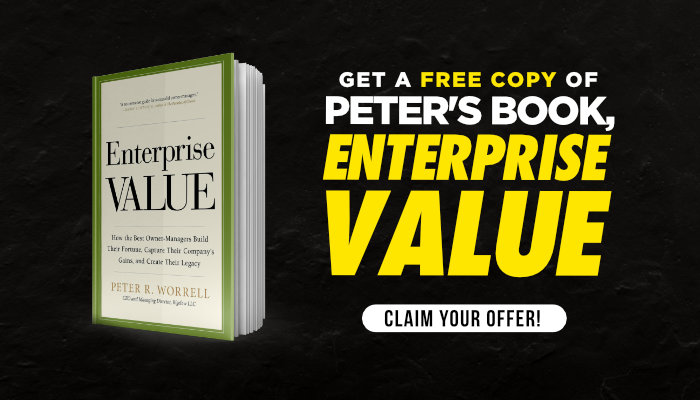
- The Enterprise Value Book
Inspiring Quotes
- “You do not have to be interested in selling your business to want to optimize the enterprise value of the business. All good things come from increased enterprise value.” – Peter Worrell
- “What the investor has is a commodity. And we can rent it at the same price from any one of them. It’s what the entrepreneur owner-manager has that’s rare and valuable. We’re going to ask the investor community to prove that they deserve the opportunity to invest in your beautiful business.” – Peter Worrell
- “Investors are doing transactions like this once a month. So, there’s this asymmetry of experience. The investors have way more.” – Peter Worrell
- “What is the positioning of this business that makes it so special? We’re not trying to sell anything. We’re trying to find that investor who’s going to most appreciate what this client of ours already has.” – Peter Worrell
Resources
- Bigelow
- Bigelow on LinkedIn
- Pete Worrell on LinkedIn
- Enterprise Value: How the Best Owner-Managers Build Their Fortune, Capture Their Company’s Gains, and Create Their Legacy by Peter Worrell
- Bank of America
- Yale University
- Dan Sullivan
- Strategic Coach
- Free Zone Frontier: Achieving competition-free growth and profit by Dan Sullivan
- Chad Belinsk
- Bain & Company
- McKinsey & Company
- EY-Parthenon
- IGS
- Stax
- McGraw Hill
- Audible
Tax Strategy Masterclass
If you’re interested in learning more about Tax Strategy and how YOU can apply 28 of the best, most effective strategies right away, check out our BRAND NEW Tax Strategy Masterclass: www.lifestyleinvestor.com/tax
Strategy Session
The Lifestyle Investor Insider
Rate & Review The Lifestyle Investor Podcast
If you enjoyed today’s episode of The Lifestyle Investor, hit the subscribe button on Apple Podcasts, Spotify, Stitcher, Castbox, Google Podcasts, iHeart Radio, or wherever you listen, so future episodes are automatically downloaded directly to your device.
You can also help by providing an honest rating & review over on Apple Podcasts. Reviews go a long way in helping us build awareness so that we can impact even more people. THANK YOU!
Connect with Justin Donald
Get the Lifestyle Investor Book!
To get access to The Lifestyle Investor: The 10 Commandments of Cashflow Investing for Passive Income and Financial Freedom visit JustinDonald.com/book
Read the Full Transcript with Pete Worrell
Justin Donald: What’s up, Pete? Welcome to the show.
Pete Worrell: Hey, Justin, great to see you. Thank you for having me.
Justin Donald: Well, this is fun having you on. We have had a fair number of conversations, in-depth conversations about what it’s like and what the process is of selling a business and how a lot of these advisors and legal professionals are just not great at what they do and maybe even aren’t giving the right tools or don’t have the right knowhow. So, I’m excited to have you here, so we can provide some extraordinary value from a guy that’s been in the M&A space for 44 years. So, thank you for being here.
Pete Worrell: Great to be with you. And look, there’s lots of advisors who have had lots of opinions and we work with them all and we respect them all. And I’m just here today to be able to share with you a lot of years of scar tissue that I can tell you, hey, this is what’s worked for our friends and clients and this is what hasn’t. So, we’ll give it to you straight.
Justin Donald: Well, I love that. And you do give it straight. And I think that that’s why so many people in our community, the Lifestyle Investor Mastermind, use you and use your services. And you’ve helped several of our members, and one of my private clients and dear friends exit their company for substantial sums of money, I mean, true life-changing wealth on many accounts many times over. And I can’t wait to get into some of the secrets behind that.
Pete Worrell: So many times, entrepreneurs that we deal with and probably that you deal with, too, these are not Silicon Valley startup to flip, they’re not Silicon Valley startup to sell out, but rather, they’re frequently– and I say this with great love, they’re frequently ADD, dyslexic misfits who always felt the dumb kids in the room and were unable to get along at Bank of America or at Yale University or whatever. And so, they didn’t make it in that first job or second job, and they decided to go out on their own.
And now, they’ve created a product or service which their customers love so much that it turns out that the company has built a lot of enterprise value. And so, yes, in those kinds of situations where suddenly, the entrepreneur owner-manager is thinking, you know, I might have another chapter in me. Maybe I’ll learn to paint, maybe I’ll start a software startup with my daughter, maybe I’ll go sell around the world. We like to encourage them that sometimes the simultaneity of their life arc is the same as the simultaneity of their business arc. And so, frequently, they come to us with that question of how am I going to get this business to succeed beyond me? And that’s the question we’re trying to solve.
Justin Donald: Oh, I love it. It’s beautiful. And I think that you’re a walking example of that. I know I got a picture from you this summer on your travel, sailing your sailboat around and really enjoying your time. So, I know you’re a lifestyle first kind of guy.
Pete Worrell: Yeah. I don’t know why this happened to me, Justin, but very early on in my career, before anything happened, I realized I didn’t want to be the kind of person that worked for 40 years and then decided to do what he wanted to do, but rather, I wanted to do it all along the way. So, I’ve always taken the page out of Dan Sullivan’s book, I’ve always taken 12 or 16 weeks off a year. It hasn’t been easy because the mass popular culture wants you to work 9 to 5 and take two weeks off a year or something like that, but my wife and I always felt like, yes, we love our professions, but we also love sailing around New Zealand. We love our professions, but we also love spending time in a rented house in Santa Barbara. We love our profession but– so we’ve tried to mix that up. It’s challenging to do that, right?
Justin Donald: Oh, totally. And shout out to Dan Sullivan and Strategic Coach because you and I actually met at a Free Zone Frontier event and got a chance to grab dinner and just get some extended time. And it was such a highlight of my year connecting with you and many of the people that we had a chance to spend some good time with.
Pete Worrell: Thank you. I had so much fun there too. I didn’t know what to expect because I had not been to a Free Zone summit before. I think we were both guests of Jay.
Justin Donald: That’s right. JJ has originally connected us and we’re thrilled about that. And Chad Belinsky has just had just wonderful things to say about you as well and many other people. And I think that if I were to sum up what maybe one of your superpowers is, it’s actually the name of your boat, but it’s how you show up, I think, in your interactions with everyone. So, I don’t want to steal your thunder. What is the name of your boat?
Pete Worrell: The name of my boat is Patience. And it actually comes from the desire that I have and my wife had, always to be thinking personally and professionally about the long term. No, not the long term, the really, really long term, the 100-year long term that we are willing to make decisions personally and professionally that we’re thinking about the 100-year term. And so, Patience, the boat, always was a reminder to us as we sail, and you may know this, but sailors are quite well known by their boat names, sometimes more than their own names that when we sail around and people see Patience, they know it’s us. And for us, it’s a little bit of an inside joke that it’s really being willing to make short-term sacrifices for long-term gains.
Justin Donald: I love that. It’s profound and it’s the foundation of how you’ve lived your life and how you’ve run your business. So, I think it’s great. And I really...
Pete Worrell: Thank you for observing that nuance.
Justin Donald: Yes, yes. And I really want to jump into just some really fun content right away because I think a lot of the people listening to this podcast, they either are W-2 that plan to be business owners or they actually already are a business owner. We have a number of people that are listening that have had exits and are probably starting their next company. So, I think a huge value-add that you provide and just you do a great job of explaining this is that if someone plans to exit their company and if you exit your business, if you sell your company, you’re going to have a capital gain. And even if you’re just in real estate, you’re going to have a capital gain at some point. You can kick the can down the road a little bit with 1031 exchanges and such, but at some point, there’s going to be a gain. You have at least half a dozen strategies that you’ve kind of walked people through that you think they need to consider prior to this exit. And I’d love to hear about that, prior to the capital gain, specifically.
Pete Worrell: Our philosophy, Justin, is you do not have to be interested in selling your business to want to optimize the enterprise value of the business. Our belief is that, after all, if you want to have a greater success sharing plan with your employees, if you want to put a wing onto the plant, if you want to do whatever, whatever, it comes from enterprise value. We would say all good things come from increased enterprise value. So, yes, we’re very laser focused as outside objective advisors. When we talk to owner-managers, that’s our term for entrepreneurs, entrepreneur owner-managers, people who lead and owned significant businesses, we ask them, when you’re making a decision as a manager, is it positively affecting the enterprise value for you as an owner? And we try to connect those two roles because we find that most of us spend 95% of our time as managers and only 5% of the time thinking as owners.
And one of the first things we ask going to the enterprise value is, is the strategy of the business so simple that you can say it in one sentence? And to be a little hard on, you might say, if not, why not? And actually, is the strategy of the business so simple that your employees can say it in one sentence? Actually, is the strategy of the business so simple that your customers can say it in one sentence? Because if they can, you’ve eked out a strategy that’s so pure, it’s going to deliver a name and image of reputation to the firm, which increases the enterprise value drastically. So, we really start with strategy. And it’s hard because most entrepreneur owner-managers are deeply caring about their business, but they’re in the combat every day. In combat, you’re in tactics, not in strategy. So, it takes a little bit of a deep breath, maybe get off site, and think about that strategy, do we have the right one? What are we going to say no to? It’s about strategy also.
Justin Donald: Well, yeah, I mean, most owners, founders, most people that are running a business spend the majority of their time in the business, not on the business. And so, there’s a degree of coaching that needs to exist to help people get out of the day to day and think about the long term. And you guys do a great job of it. And I know you just had a company here in Austin that you helped have an exit last week, which is tremendous. And I’m sure that some of the strategies you mentioned or that you’re going to mention that you probably mention to them on here are things you should be considering before your capital gain. So, let’s get into some of those.
Pete Worrell: Yeah. So, most entrepreneur owner-managers who want to have capital gains someday are thinking about that issue well in advance, but frequently, regretfully, they don’t talk about it with outside advisors well in advance. They’re concerned about confidentiality. All of us owner-managers are concerned about what do our management team think. Oh, my goodness, what would the management team think if they thought I was thinking about enterprise value? Well, as I said to an owner-manager yesterday, do you think your management team is pretty smart? Oh, you do. Do you think they know how old you are? Do you think they know what kind of car you drive? Do you think they know where your second home is? Of course, they know all of these.
And so, actually, one of the things they are speculating amongst themselves is what’s going to happen to the business in the long term when this owner decides to go do whatever they’re going to do. So, actually, our approach to this discussion is very controversial, but we take the approach from based upon experience, which is if you want to have a capital gain someday, why don’t you tell your management team that now? What if you said to them, “Hey, I want to have a capital gain someday and I need your help”? I need your help to optimize enterprise value. And in order to access your brainpower and your energy and your help, of course, I’m going to align some economic incentives for you with me. And you can align a simple structure that allows the management team to get a piece of the transaction value that would make sense. And I can show you sometime when we have a paper and pencil, why arithmetically, for most owner-managers, it makes sense that you will actually earn more if you are able to give away 5% to 10% of the transaction value to your management team.
So, that’s one of the things we ask them to think about very early on is do you have a– I’m not talking about all managers. I’m talking about a handful of senior managers who you can confide in. You could have a non-disclosure agreement with them if you want to. But then when we’re all working day to day for the next years in the business, we’re working to optimize the business on a day-to-day basis, of course, but in addition, in the back of our management’s heads is the knowledge, yeah, but someday, the owner is going to want to have a capital gain, and I’m going to have a piece of that too. And I can be helpful to that too. So, there’s an example where I think that that kind of conversation can start years in advance of a transaction.
Justin Donald: I love it. And by the way, I think this is an important point, just as a standalone, that if you ever want to exit, the time to prep for it is at least two years prior, maybe even ideally, three years prior. And I think most people, they kind of rush into it at the end. They haven’t done the prep. Someone offers them some offer and they like it, they don’t necessarily shop it. They don’t maximize enterprise value of their company, and they’re just happy with the number, not even recognizing maybe what they’re leaving on the table if they had done the work or even knew what work to do. And I’d love to hear some of your thoughts on that too.
Pete Worrell: Well, we live in a world basically, Justin, where, as you know, our world is awash with capital. Strategic investors are brimming with cash. Private equity investors have all raised 10-year-plus funds. Frequent says there’s $1 trillion of private equity capital raised, has yet uninvested and that’s unleveraged.
Justin Donald: Wow.
Pete Worrell: And so, our approach to this discussion is that what the investor has is a commodity and we can rent it at the same price, mainly one of them. It’s what the entrepreneur or the manager has that’s rare and valuable. And so, we urge our friends and our clients to think of it that way, to think, actually, we’re going to ask the investor community to prove that they deserve the opportunity to invest in your beautiful business. That’s a different approach than almost any other intermediary I can think of, but it’s approach that’s designed to get us the best fit investors. And of course, the best fit investors love the company’s culture. They love the company’s strategy. They love the company’s management team, and they indicate their love with a higher economic value. So, it all comes together.
Justin Donald: Well, that’s awesome. I love that, and I like flipping the script whenever you can do that because the reality is the number of reps that these people who are buying companies have gone through is often hundreds, maybe thousands, especially with the legal teams involved, with the brokers involved. And so, I think it’s so important that you have someone representing you that knows this process, but can also position you in the right light and can create an even more competitive process, but bringing in all the different potential suitors and acquirers that fall in different industries, right? It’s not always just private equity. I mean, there’s a lot of other– I mean, a strategic buyer could make more sense in some instances. And you, guys, kind of lay that out.
Pete Worrell: Sure. Family offices can be an investor or an acquirer also. So, basically, what we do is approach the world. Let me back up one paragraph. In the US, in North America, there are less than 4,000 publicly owned businesses. There are 6 million private businesses. So, let me say that again. There’s 4,000 public entities. There’s 6 million private entities. Almost everyone who listens to this podcast, information about the M&A market comes from what is in the public market, whether they read the Austin paper, The New York Times, The Wall Street Journal, where they read, why is that? Because that’s the data that’s disclosed. And yet, that’s a tiny little market that has literally nothing to do with the private transaction market.
In the private transaction market, as you just pointed out, the great nuance, most entrepreneurs go into the market once in their lives, for sure, the most significant financial transaction of their life and the legacy-enhancing transaction for their business, whereas, as you pointed out, investors are doing transactions like this once a month. So, there’s this asymmetry of experience, meaning the investors have way more. There’s an asymmetry of information, meaning I’ve seen frequently investors come to first meetings with entrepreneurs with a draft of a market study that they’ve already commissioned.
And there’s a principal agency difference. And what I mean by that is the entrepreneur owner-manager is a principal in their own business. They have skin in the game. And because that’s the case, in positive psychology, we would say they have cognitive biases that are affecting them. If they know about them, it’s good. But either, whether they know about them or don’t know about them, it’s affecting them.
The investor world, on the other hand, first of all, they have asymmetry of information, they have asymmetry of experience, and they don’t have any cognitive biases about the entrepreneur’s business because they’re not principals in that business. And I’ll tell you a little secret. It’s not their money. So, they feel completely differently than those of us who are business owners do. So, our role at Bigelow is to level that playing field because, of course, the investors want to pick the pockets of entrepreneurs. And we’re here not to let that happen. What our clients have built over periods of years and decades is so valuable, it’s hard to be duplicated if it can be at all. We want to make sure that they get a fair shake in these kind of transactions.
Justin Donald: Yeah, that’s brilliantly said. And I think it’s important that people understand those nuances. So, back to what we were talking about, you had mentioned a great strategy to employ with the employee pool, for some equity ownership, for executives, key people, key personnel. What are some other strategies that people can think about in the event that they ever want to have an exit? And for a lot of people, I think it’s important to realize that right now, you may not feel like you want to exit, but you might have a life event, you might have kids, another kid, complication, parents, health, like all these things that come up that in a moment’s notice, everything changes. And so, anyone who thinks that they just want to run their business in perpetuity, I think it’s a very small percentage of people that actually end up doing that. So, I think it’s good to be thinking through, well, if I do sell, what should I be prepared for? So, I’d love to learn more of your capital gains strategy early.
Pete Worrell: So, first, let me say that, as we know, summer comes to an end, Seinfeld stops its episodes, The Beatles break up, and we’re all terminal. So, you can decide not to sell your business. It’s America. You can say whatever you want, but you are going to be terminal and you could be carried out their feet first, if that’s what you desire. Most of our clients feel like, wait a minute, I don’t want to do that because I want to exert some responsibility about who is going to be the next owner of this business because, see, these entrepreneurs have this fight between our head and our heart. Our head says we know we should move on.
And by the way, our professional decline does not start at the end of our career. Our professional decline starts at the peak of our career. So, we all want to move on in some way or we ought to think about doing that. In our heads, it’s coming at us every day. In our hearts, we think, yeah, but no one’s going to love this business the way I do. No one appreciates the customers and employees the way I do. And so, we have this war going on between our head and our heart, and our clients and our friends sort that out. Sometimes it takes them a period of time, frequently a period of years to get through what, in positive psychology, we call ambivalence, that feeling of I want it, but I don’t want it, I want it, but I don’t want it.
And one of the things we do during this time is to prepare. So, another piece of preparation would be, do we have the right outside advisors to be able to help us? What I mean by that is we probably all have Joe or Josephine, who’s been our trusty lawyer and done all of our real estate leases. And if we’re going to do a $100 million transaction, I would like to work with an M&A attorney that does a $100 million transaction once a month. So, we may need some temporary help, so a legal special M&A counsel. We are going to want to talk to our trust and estate counsel because if we think there’s going to be a capital gain in our future, meaning 12 to 60 months, and our trust and estate attorney knew that, an example might be they might want to move some ownership out of our estate to be able to make sure that the capital gain comes into another interest, whether it’s our children or grandchildren, philanthropic, whatever.
So, there’s fundamental things we can do to leading up to a transaction which is better. A tool that we’ve been employing a lot recently is, as you probably know, in due diligence today, every private equity firm will commission a third-party market study in due diligence. I’m talking about a quick and dirty market study, two to three weeks long from firms like Bain, McKinsey, Parthenon, IGS, Stax, I’m sure I’m missing some, who they are completely focused on doing this kind of work for private equity firms.
Fifteen years ago, we decided, wait, if they’re going to do a market study in our clients’ firms in due diligence, why don’t we commission a market study three years in advance so that– we just have a client, for example, right now, who is in the oil burner business where they make burners, power burners and make-up air. These are all intellectual property protected. It’s a beautiful business. But when you ask the owners, what’s the size of the addressable market for the power burner business in North America? They couldn’t tell you from a coffee cup.
Well, what if we went and commissioned a third-party market study and we realized, here are the eight market segments. We only have a right to win in five. So, let’s stop going after those three other market segments. Let’s put our eggs in these five market segments. And wow, what a wonderful thing that is leading up to a capital gain transaction. And it isn’t bad either to have that third-party market study by an identified firm who is known to the investor community because the investor community will then use that study in their work.
So, I think as we get through that war between the head and the heart and, look, some, entrepreneurs walk in the door and they know they want to go to market. The vast majority, however, take some time to work through that. We can do these things, which are a great preparation and add significantly to the enterprise value of the business.
Justin Donald: I love it. Well, and this whole idea of we’re going to make decisions that add to the enterprise value is so powerful because I think a lot of the time, people are making decisions too short term or they’re making decisions on, hey, I just want to grow, I just want to scale. And I think there’s some interesting things that we could walk through there, but in fact, this might be a real good time to talk about it. So, when companies are focused on growth and on scale, and we saw in the last decade a real unhealthy pursuit of this, even in the face of profit, like, let’s actually throw profit out the door because we care so much about revenue growth. I would be interested to know and I know you have tons of studies on this, but the impact of EBITDA margin as compared to total annual revenue.
Pete Worrell: So, in our world, sometimes growth is substituted as if it’s the same thing as success. And we definitely do not believe that. And I think you’ve just come through a period of time, particularly with early-stage businesses, where the game was to do a startup to get a valuation as quick as you could to operate, to try to get growth and profit be damned. And if you need more capital, you just keep getting it in higher and higher valuations because you have a bunch of sucker investors who are going to do that for you. I feel that, thankfully, that chapter has come to a complete end and that is not going to be able to work for a while.
We are very patient for growth. We are impatient for break-even cash flow in early-stage situations. And in more mature situations, we look and we ask, how profitable is your profit? And by that, what we’re talking about is whether we’re talking about pretax income, EBITDA, whatever number that you want to focus on as the bottom line, it’s fine. And we would ask, what is the percentage of that EBITDA margin to your total revenue? Do I care nominally about profit? No, I do not. I use profit as a proxy that tells me, if you have a 5% EBITDA margin, wow, you’re working really hard to make very little cash flow, and you must be in a business where the customer does not appreciate your product very much, or it’s able to be substituted very easily.
On the other hand, if you make a 25% EBITDA margin, your customers are telling you we love the product or service that you’re giving us because they’re allowing you to make that big margin. Those are our clients and those are the businesses that have the most value because investors are really smart and so they know what I’m saying is that those high profit margins are indicative of something. So, we just had a discussion the other day with a couple of experienced entrepreneurs, and their business is heading quickly towards 200 million in revenue. And they were talking about revenue, revenue, revenue. And they were talking about their sales team was compensated on revenue and their operations team was compensated on revenue.
And finally, I raised my hand and I said, “What are you guys talking about? What’s the pretax earnings on that 200 million?” And they said, “Well, our goal is 10%, but we’d be happy with 5%.” And I said, “Well, first of all, I don’t like that language that you’d be happy with 5%, but do you understand that 5% of 200 million, which is 10 million, gives you a valuation, but 10% on 100 million is a much, much more valuable business?” And these entrepreneurs looked at me with crossed eyes, like, “What are you talking about? We’ve never heard that before.” I said this, “I’m talking about in a capital gain situation now, $100 million business making 10% is far more valuable than the $200 million business making 5%, even though both of them have $10 million of EBITDA.” And it’s obvious why, right? The market’s telling you something.
And so, we try to have entrepreneur owner-managers be focused on the right numbers, and the right numbers have to do with, you may have to sacrifice some quick scale in order to optimize the pretax. And the reason we think that’s so important is because if you optimize the pretax and get those margins high enough, you’ll have plenty of cash flow for growth. And if you don’t, you won’t. And I just had a discussion with someone who’s a world saver. And they’re in a business, which is a very laudable business in the rehab, in the substance recovery rehab business, which is a business we understand quite well. And they were arguing that they only want to have a 2% profit because they want to make sure they’re helping the people. And my point to them was, if you have a 2% margin, you’re actually endangering your mission. You’re actually going to go out of business and you won’t be able to serve these clients that you say that you care so much about. You need a 10% margin in order to be sustainable.
And so, we’d like to get that message across to entrepreneurs who may be listening to this is that I’m not talking about price gouging. I’m not talking about anything untoward. As I told you, I don’t care about profit in and of itself, but to have a business which has a culture of having a great, healthy product, a profit margin is really a great thing.
Justin Donald: I love hearing you say that because this, fundamentally, has been the way I’ve looked at businesses. And for the last decade, I just was scratching my head, just not understanding how this could be reality, that it’s grow revenue at all costs, even if it puts the business in jeopardy. It made no sense to me. So, I like that we’re kind of coming back to reality here and at some point in time, history does repeat itself and we’ll probably get back into a season of that, but it probably is going to be a long ways off. A lot of great lessons have been learned. A lot of companies crashed and burned. A lot of down rounds have happened. A lot more are going to happen. I mean, it has created some true carnage and chaos in the markets.
But something else that I think is important to discuss is, all the language and the acronyms and how intimidating it is when you don’t live in the investor world, you live in the founder world, but everyone’s valuing your business based on multiples and based on acronyms and based on different– I would call them different equations for profit that have several different names. So, I would love to hear your thoughts on that and maybe what an entrepreneur can do to be in a better place come exit time.
Pete Worrell: So, that’s a great question. It’s a challenging question. First of all, most entrepreneur owner-managers who are successful are absolutely experts in their business. So, if they’re making these kind of paper coffee cups, I bet you they know more about paper coffee cups than anyone in the world. They don’t typically know a coffee cup from EBITDA margin, however, because they haven’t been involved with that kind of thing. And I find today that with the proliferation of peer-to-peer CEO groups, there’s a rapid adoption of slang language, which, at least in our industry, I feel like has not helped our owner-managers a lot, example, EBITDA multiple. So, wherever you go, you hear in the golf club, the workout club, the yacht club, wherever you hang out, people talking about EBITDA multiples. Did you hear she got a 10 times EBITDA multiple for her business? Did you hear that he got a four times multiple? Oh, that poor guy, she got 10. No, no, I mean, this has not done our world any good.
Let’s talk about valuation for a second. What’s the single largest driver of valuation? It is what is your go forward plan. Let’s not forget that when we sell our business for $100 million, that’s our exit, but that is the investor’s entrance. So, they’re really not very interested in what you did last year, two years, five years ago, as much as they are what you do next year, two years from now, five years from now. So, actually, EBITDA multiple, which is often quoted about, is it six times multiple? Is it eight times multiple? Just forget that. That is an output, not an input.
Let me just illustrate it quickly. If you and I were going to go buy the most simple four-unit apartment building, what would we look at to drive our knowledge of value? Well, we’d look at the rents and we’d look at the rents going forward, wouldn’t we? We wouldn’t look at the rents going back. The only reason we’d look at the rents going back is to do a validation check onto the rents going forward make any sense. And let’s say we have a plan that says the rents are going to go up by 5% per year. And you and I, Justin, might say, “Yeah, but we’re going to add up all those rents for the next five years. We’re going to discount it back to today using time as a discount and also using risk as a discount, execution risk.” And then you might persuade me, “Hey, Pete, that apartment building needs a new roof. We got to take that out. And the pavement needs to be restriped, we’ll take that out.”
We’re going to get a value. In business, we call that value, enterprise value. If you take that enterprise value of that four-unit apartment building and you divide it by last year’s rent, you’ll get a multiple. That’s the EBITDA multiple. That’s an output, not an input. So, where we began to talk about EBITDA multiples as slang for history, looking at outputs, like that was an eight times multiple, that was a six times multiple, it was never intended that it’d be the device that you use to drive the value of your business. The value of the business is driven by the go forward plan.
That’s another reason why we believe it’s so important to bring your management team into the conversation early because, actually, what I found over the last 40 years, managers, non-owner managers frequently have a point of view about the three to five-year plan, and some of them may feel that they actually were being held back by the owner, who became a little risk averse as they got more and more successful. And so, sometimes when you let a management team imagine what if you had a new investor and what if the new investor had a really big checkbook, what are the things that we could do then? Then you’ll really open up the door to have a healthy discussion about the three to five-year plan, which is the thing that drives value.
Justin Donald: This makes tons of sense because you also hear often about these outlier multiples and you’re like, how on earth did they get such a high multiple in an industry that is atypical for that? That’s double or triple what someone will get and that is totally based on the output of compelling vision of the future and what this business can do and people being willing to overpay because they know what they can get, they know that they’re at least going to get, in most instances, private equity wants at least a 10x multiple from their entrance, and hopefully, more than that. But I think when you paint that compelling vision of the future and what the company could be, what it looks like, what is positioned to do all the market share that you haven’t grabbed in these different areas that’s primed to grab through these market studies, that’s where you can get these real outliers of multiples that don’t make sense.
Pete Worrell: Yes, I’m agreeing with you, I’m nodding my head, agreeing with you. The other place you get it is that management teams are really smart and they look around and they see what their competitors are doing. And sometimes, what management teams– I’m speaking of non-owner management teams, management team sometimes could feel like, hey, let me add it. Just let me add that capital. We need a $25 million distribution facility in the West Coast. We really ought to have a distributor in Germany. And sometimes, owner-managers who have achieved the level of success and that life arc that they’re on, early on, when they were down at the bottom left, they were willing to take those kinds of risks.
And today, if someone comes along, like me, who’s a wise guy and says, “I think the business might be worth 75 million,” that owner-manager sometimes can just tap the brake because they might feel like, if it’s worth 75 million, that’s really scary because I got it from 0 to 75, I could easily take it back to zero. So, I got to be really careful to do that. And so, frequently, those management teams have been a little bit slowed down by the owners.
Justin Donald: Yeah, I could see that. And I also think when you engage the right people, you engage Bigelow, you find all the potential acquirers in every vertical, every niche. And a lot of these strategics will buy not based on what it produces, but what it will produce for their portfolio. And in many instances, these companies buy other companies. And the company that is being acquired doesn’t even have to make money, though it might because they make money just by implementing that offering or that value-add into their company, what they offer their customers into another strategic play that impacts maybe ancillary companies as well. So, it’s fascinating to see where the value can be derived from, as you kind of promote and market the company you’re looking to sell the right way and to the right people.
Pete Worrell: Yes, yeah. So, what we’re always doing, Justin, is we’re always seeking the best fit investor. We explain to our clients we’d like them to banish the words selling the company from their vocabulary, that we’re not selling the company. We’re acquiring a new investor, and we go at it just like that, very proactively going after the investors who would really most appreciate this business. And as you pointed out correctly, many times, those investors are in adjacencies or in places that you wouldn’t have thought of.
This is why– there’s another piece of controversy for you. Sorry. This is why we believe that vertical industry specialization is an excellent strategy for the M&A firm, but for the client, not at all because for an M&A firm or for any other advisor, it’s easy to take your most junior people. And if I’m going to have them be specialists in the aerospace industry, it doesn’t take one newly minted MBA very long to figure out who all the players are in the aerospace industry. We know all the investors. We go after them over and over, and they pay average multiples, and we know what those average multiples are.
So, if you have a below average business, if you want to get an average multiple, go to an industry specialist because they specialize in getting those industry averages. We, on the other hand, want to go into every industry with a beginner’s mind, and we go into it asking, so what is the positioning of this business that makes it so special? And who is the investor somewhere in the world that’s going to most appreciate that? So, we’re not trying to sell anything. We’re trying to find that investor who’s going to most appreciate what this client of ours already has.
We had a woman say to me just recently, Pete, I noticed on our investor work, and you may know we don’t write a prospectus, a book, a sim, we haven’t for 15 years. We use a different technology. But this woman said, “In the slide, the very second slide you’re using with investors, talking about my culture.” And I said, “Yeah,” and she said, “You’re kind of scaring me because I feel like I have a scary culture. I’m way out there with my culture, and I’m not sure the investors are going to like it.” And I said to her, “Lisa, if they don’t love it, we don’t want them as an investor. You spent 40 years building this beautiful culture and it’s part of what differentiates the business. We want to find investors who say we love that.” And of course, we did find that.
Justin Donald: That’s great. That’s so smart. I know we’re coming to the end of our time, but I have to ask you, I’ve got a bunch of friends that get offers all the time to buy their business. They have PE firms, they have banks, they have brokers, just people constantly reaching out. What do you think about taking those meetings? Does it make sense? Should people lose? I mean, you can make the argument you might lose focus if you’re taking these calls. But on the other hand, it’s kind of nice to know what the value of your company is and how much people like it. Curious your thoughts?
Pete Worrell: So, the way that we get to know fair market value for anything is by creating a little market. And I can show you some data which will show you that when you take a company, it’s approached by one investor and they get an offer compared to when we create a little market for the same company and then we get offers, the dramatic, dramatic difference, frequently more than 100% difference. Having said that, you’re right. The best businesses today get approached daily or weekly. Sometimes they get approached by private equity investors who are legitimately looking at their industry and have done some homework. Sometimes they get approached by a business broker who actually is fishing for listings and doesn’t represent anyone.
But if you can sort out who’s who and if you have a legitimate overture by a potential investor, we take the controversial approach of saying, actually, we think if you’re interested, you can take that meeting or that call, provided you understand this is 100% for you. And you can make it really clear to the people on the other side, I’m going to take a call or meeting with you because I want to learn. I want to learn about why are you interested in my industry. Why are you interested in my company? Tell me about the other industry investments that you’ve made. Tell me about what’s happened to the other management teams in the companies that you’ve made those investments in. What happened when the going gets tough? How did you behave? How did those managements behave?
And when the investor says to you, “Yeah, Justin, that’s great. Just send me three years of audited financials and I will send you an NDA,” you say, “No, thank you.” I’m not going to send you three years of my financials because that’s what the company used to be. I want my company to be valued on what it’s going to become. And I’m not going to sign an NDA because I’m not going to talk about anything that’s confidential about my company. This is all going to be you talking to me about your strategy. So, if we have entrepreneur owner-managers who can handle that, that’s complicated. But if they can handle it, I think it’s wonderful when they get a meeting or two with investors because they find out what other smart people think about their industry and about their company, and they always learn a lot.
Justin Donald: And I love it, though, because you’re flipping the script again, because it is standard that you would sign an NDA. And I love that you’re giving pushback and saying, “No, actually, we’re not going to do that.” So, that’s brilliant. And no, we’re not going to send you the financials that you’ve requested. I absolutely love that. Pete, this has been so much fun. You have so much knowledge, and I know you have a book that, I think would be great for people to know because it’s all about enterprise value. So, number one, where can people learn more about you? And number two, where can people find your book?
Pete Worrell: So, our website is BigelowLLC.com and it is filled with immediately useful information for entrepreneurs. We freely share all of our intellectual property to business owners, even to our competitors. We put out a lot of IP. We want to freely share it because we’re trying to help entrepreneurs. Our book is called Enterprise Value. It’s published by McGraw-Hill. It’s available on all the bookstores. It’s also available on Audible.com, read by me.
If there’s a business owner listening to this, Justin, I would make you an offer of a gift, which is we would be happy for people who are friends of yours or listen to your podcast, the Lifestyle Investor podcast, to overnight them a copy of Enterprise Value of no charge, just as a gift from us and from you, so that they could read about the questions that other entrepreneurs had as they were thinking about having a capital gain someday. And the book is filled with little stories, all true, probably will make you laugh a little bit.
Justin Donald: I love it. That’s so awesome. Well, thank you so much for your time. I love ending every episode with a question to our audience. So, to those of you tuning in, watching, listening, my question to you is this, what is one step you can take today to move towards financial freedom and move towards living a life that you truly desire, that’s on your terms, so not a life by default, but a life by design? I know there’s tons of nuggets from Pete. Pick one and move forward. Thanks so much, and we’ll catch you next week.
Pete Worrell: Love it, Justin. Thank you.
Sign up to receive email updates
Enter your name and email address below and I'll send you periodic updates about the podcast.

Keep Learning
How to Avoid Leaving Millions on the Table When Selling Your Business with Stephen Scoggins – EP 281

How Niching Down Led to a 10x EBITDA Exit with Andrew Lassise – EP 280