![[Justin Donald] - Optin Preview](https://lifestyleinvestor.com/wp-content/uploads/2020/12/Justin-Donald-Optin-Preview-e1607533704966.png "[Justin Donald] - Optin Preview")

![Logo 1 Gold horiz [Converted]](https://lifestyleinvestor.com/wp-content/uploads/2019/08/Logo-1-Gold-horiz-Converted.png "Logo 1 Gold horiz [Converted]")
Interview with Karlton Dennis
Why Hiring a Tax Strategist Is The Best Investment You’ll Ever Make with Karlton Dennis
Believe it or not, income taxes can become the biggest expense for entrepreneurs. Yet most people approach tax planning reactively, missing powerful opportunities hiding in plain sight.
Today’s guest helps investors get ahead of the game by treating tax strategy not as compliance, but as one of the most important wealth-building tools available.
Karlton Dennis is one of the leading tax strategists in the country and the founder of Tax Alchemy. Through his work with high-earning entrepreneurs, he helps clients legally reduce taxes, increase cash flow, and reinvest capital intentionally rather than giving it away unnecessarily.
In our conversation, Karlton breaks down why proactive tax planning often delivers higher returns than any investment deal—and how understanding the tax code allows you to keep more money working for you, with more investment opportunities, year after year.
In this episode, you’ll learn:
✅ Why investing in world-class tax strategy can outperform real estate, private equity, and traditional investments.
✅ The most common tax preparation mistakes that cost business owners tens of thousands per year.
✅ Which tax strategies attract IRS scrutiny and how to use the tax code to your advantage without crossing red lines.
Featured on This Episode: Karlton Dennis
✅ What he does: Karlton Dennis is a nationally recognized tax strategist and the founder of Tax Alchemy. He specializes in helping entrepreneurs, investors, and high-income earners legally reduce their tax burden through proactive planning, entity structuring, and strategic investing. Karlton and his team work with clients across the country to turn the tax code into a long-term wealth-building advantage instead of a recurring liability.
💬 Words of wisdom: “People don’t realize that taxes are their biggest lifelong expense. It’s not your mortgage payments. It’s not that expensive vacation that you’re going to go on. It’s going to be taxes.” – Karlton Dennis
🔎 Where to find Karlton Dennis: Website | LinkedIn | Instagram
Key Takeaways with Karlton Dennis
- Investing in Tax Strategy Is the Best Investment
- The Wildest Tax Strategy: The Augusta Rule
- Using Short-Term Rentals for Tax Savings
- LLC vs S-Corp: Tax Savings Myths
- IRS Audit Red Flags to Avoid
- Conservation Easements & Captive Insurance Risks
- Tax Savings Opportunities in the US Film Industry
- Tax Strategists and CPAs: Why You Need Both
- How Private Family Foundations Creates Huge Savings
- Documenting Travel & Expenses in a Manifesto
- Year-End Tax Moves Most Entrepreneurs Miss
- How The Wealthiest People Legally Pay Less in Taxes
- Where to Learn More from Karlton Dennis
How Business Owners Can Create Tax-Free Income
Inspiring Quotes
- “Whether they’re an LLC or not, spending money is how a business owner reduces their tax bill, not being in an LLC.” – Karlton Dennis
- “There’s a difference between hiring a CPA that may just be focused on just filing your returns or doing accounting, versus having someone that is a tax strategist that’s coming up with tax plays for you.” – Karlton Dennis
- “The wealthy legally pay less in taxes because they’re willing to invest more money than you. It is that simple.” – Karlton Dennis
- “People think that the wealthy don’t spend money, that they just make billions of dollars, and it’s just all tax-free. The wealthy invest more than any other class, period, and they know exactly what to invest in.” – Karlton Dennis
Resources
- Tax Alchemy
- Tax Alchemy on LinkedIn | Instagram
- KarltonDennis.com
- Karlton Dennis on LinkedIn | Facebook | Instagram | YouTube | X/Twitter
- Airbnb
- Vrbo
- Mercury
- Progressive
- GEICO
- ChatGPT
- Grok
- Liam Neeson
- QuickBooks
- Caleb Williams
- The Alchemist: A Fable About Following Your Dream by Paulo Coelho
Want My Team’s Help?
- Tax Strategy Masterclass
Learn the 28 most effective tax strategies the wealthy use to save thousands.
lifestyleinvestor.com/tax
- Free Strategy Session
Get a personalized roadmap to financial freedom.
lifestyleinvestor.com/consultation
- Lifestyle Investor Newsletter
Join The Lifestyle Investor Insider for curated investing insights.
lifestyleinvestor.com/insider
Rate & Review The Lifestyle Investor Podcast
If you enjoyed today’s episode of The Lifestyle Investor, hit the subscribe button on Apple Podcasts, Spotify, Stitcher, Castbox, Google Podcasts, iHeart Radio, or wherever you listen, so future episodes are automatically downloaded directly to your device.
You can also help by providing an honest rating & review over on Apple Podcasts. Reviews go a long way in helping us build awareness so that we can impact even more people. THANK YOU!
Connect with Justin Donald
Get the Lifestyle Investor Book!
To get access to The Lifestyle Investor: The 10 Commandments of Cashflow Investing for Passive Income and Financial Freedom visit JustinDonald.com/book
Read the Full Transcript with Karlton Dennis
Justin Donald: Karlton, it's so good to have you on the show. Welcome.
Karlton Dennis: Justin, it is a pleasure to be on the show, man. How are you doing today?
Justin Donald: I'm doing great. I'm better now that we finally connected, and man, I secretly, selfishly wish we had recorded the earlier 20 minutes that we are hanging out, talking, geeking out on tax strategy and investing. I mean, you're a wealth of knowledge, and I think that there's really a lot of cool synergies that we could partner up on.
Karlton Dennis: I 100% agree. It's funny. Sometimes the best parts of a podcast actually happen before the record button actually starts. It's because you get that first engagement with somebody, and you just start digging into what they're about. And then you're like, "Hold on a second. We need to hit record.” So, here we are, guys.
Justin Donald: Well, you are one of the foremost tax experts out there. You've built an incredible business. You have over a thousand clients, super impressive. You have over a million subscribers to your YouTube channel. I'm a huge fan of your YouTube channel, and I want people to know more about you because one of the things, so whenever I keynote, I kind of lead off with one of my biggest questions that people ask me, which is, what's the best deal you've ever done? And I always tell them the best deal I've ever done, “What if I told you that the best deal I've ever done that’s available to you doesn't cost any money out of pocket, and can return 30% to 50% a year every single year?”
And people are chomping at the bit to get it. And then I say, “You probably think it's some real estate deal or private equity deal, but really it's investing in world-class tax strategy. That's it. That's the best investment I have ever made.” And so, what better person to have on the show to talk about it than you?
Karlton Dennis: I am ecstatic that you brought that up because people don't realize that taxes is their biggest lifelong expense. It's not your mortgage payments. It's not that expensive vacation that you're going to go on. It's going to be taxes, and the sooner that you can put your mind on it and start figuring out strategies to mitigate your tax bill, the sooner you start getting in control of your finances.
Justin Donald: Yeah, 100%. So, I think it'd be fun to start off with, like, what are some of the wildest tax strategies that you've implemented and you've taught that actually work?
Karlton Dennis: Yeah. I mean, we see things all the time in the tax and accounting space that really takes us for a whirlwind. Some of them have stories attached to them, and some do not. One of the ones that really is unique that I always love talking about is the Augusta Rule because it has such an awesome story attached to it. When many people hear about Augusta, they probably think about the city in Georgia, and you should absolutely think about that city in Georgia. What you probably don't think about is the fact that there's a master's golf tournament, the largest golf tournament in the United States, that's played in Augusta, Georgia.
The issue with that city in particular, at least the issue back in the 70s and 80s, was that there wasn't any hotels, or at least there wasn't enough hotels to house all of the guests and people that came from over country, out of state, overseas, for that golf tournament. So, what did landlords have to do? They had to run their own short-term rental businesses for a couple of weeks out of the year and collect rental income. And to be honest with you, the average rental income that people are making per day during the Augusta Golf Tournament is around $8,000 a day. Now, you have to report all of this rental income. Well, at least we thought we had to report all this rental income.
In the city of Augusta, Georgia, they passed the Augusta Rule that allowed for landlords to not report 14 days of rental income because they knew that this golf tournament went on for exactly 14 days. Women had their week, and men had their week, a total of 14 days. Well, a year later, the IRS caught wind of this, and it became a Federal tax law. Now, we see business owners utilizing this Augusta Rule with their own primary residences. How are they doing it? They're creating a rental agreement between their corporations and themselves, stating that, “I'm renting my primary residence to my business and I'm going to charge a fair market rate. And I'm going to go ahead and have tax-free rental income coming back to me as long as it's for 14 days or less.”
So, that Augusta Rule or the 14-day Rule sits in the tax code today, and it's been one that I've been able to help clients utilize to put money back in their pockets.
Justin Donald: Yeah. That's awesome. I love that. I've been using that for years, and I just think it's a great hack that a lot of people don't know about. Any other wild tax strategies off a beaten path that you guys utilize?
Karlton Dennis: Yeah. So, this one has been exploited recently, and probably one that has given me quite a bit of attention on social media, and it's the short-term rental strategy. For many people, when they jump into rental real estate, they're jumping into passive types of investments. But in order for you to use real estate to offset W-2 income or 1099 business income, you have to be an active involved manager over your own real estate portfolio. The IRS calls this a real estate professional, someone who can spend 750 hours in the year managing their own investments, or someone who can show the IRS they're spending more time in real estate than any other thing. Those are the two tests to become a real estate professional.
It's very, very hard to become a real estate professional when you're working a W-2 or a 1099 job because you would have to essentially show that you're spending more time in real estate than your W-2 or 1099 job. Now, if you have a spouse, right, Justin, that's completely fine. Maybe you have a spouse that's not working, so you can qualify your spouse to be a real estate professional. But that disqualifies a lot of people out there. A lot of people don't have spouses. This is where the short-term rental strategy started to become popular because the short-term rental strategy only requires you to run an Airbnb or a Vrbo for seven days or less per customer, and it only requires 100 hours.
So, for many of my clients that are working W-2 or 1099 jobs, they're ecstatic to know that they can get some of the same tax savings with real estate like a real estate professional by being in a short-term rental, such as an Airbnb or Vrbo.
Justin Donald: Yeah. That's awesome. I love that. I think that there are a lot of myths around LLCs and S Corps, and I'd love for you to kind of clarify some of that. And even for a lot of people, I think when they first get started, they don't know what entity to use. What do you create? And I think the more you grow your wealth, the more complex your estate gets, but a lot of people have to unwind what they did and kind of create a different structure. So, it's probably good to figure out how do we start. What's the smartest way to start?
Karlton Dennis: Yes. The first thing to understand is what you would need an LLC for. When we are thinking through LLCs and corporations, the very first thing you need to have on your mind is, what am I trying to protect? Because when you're a business owner, you are trying to typically protect your personal assets from what could go on inside of your business. That means your personal IRAs, your personal checking accounts, those are the things that matter to you if your business goes belly up. So, getting an LLC limits the liability to the extent of what goes on inside of your company. You've separated the business liabilities from what could go on personally from yourself.
That is great, but it doesn't save you any money on your taxes by simply having an LLC. And this is where most people get confused. They see online that business owners can take write-offs and business owners can take advantage of the tax code. But what they fail to understand is business owners have to spend money in order to reduce their taxes. Whether they're an LLC or not, spending money is how a business owner reduces their tax bill, not being in an LLC. And LLC also leads to a lot of self-employment taxes because, as a business owner, you are responsible for paying into your own Social Security, your own Medicare. Most business owners are unaware of this.
And as an LLC owner, you pay it twice. You pay it as by being technically your own employer. And the IRS also thinks you're your own employee underneath your LLC. So, you pay 7.65% at the employer level and 7.65% at the employee level for a total of 15.3% in self-employment tax.
Justin Donald: That’s big.
Karlton Dennis: It's huge. I mean, when you think about it, just off of $100,000 of business profit, that's $15,300 that I'm paying just in self-employment taxes outside of federal taxes to the IRS and state taxes if I'm in a state that taxes. So, this is where we start to invite that conversation of the S corporation in. When do we switch to the S Corp? It's right around $50,000 in business profit that it makes sense for a business owner to consider adopting an S corporation if they have ordinary income flowing through that LLC. The reason why is because when you become an S Corp, now you have to give yourself a W-2 from the business. Instead of paying that 15.3% self-employment taxes on all of your business profits, you'll only pay 15.3%. Or now what's called payroll taxes on whatever W-2 you give out of your company.
So, going back to that example, if we made $100,000 business profit and you gave yourself a W-2 for $30,000, that 15.3% will just be on that 30,000. Your other $70,000 in business profit is only subject to federal and state taxes. You essentially shielded 15.3% on a majority of your business profits, saving you a substantial amount of money.
Justin Donald: Yeah, I love that. And that's actually a really easy transition from an LLC to an S-Corp because it's just an election that you can make on your tax filing form.
Karlton Dennis: You are absolutely right. The election is called a sub-chapter SE election, and it's done by filing a form called a 2553 Form. That form can be filed at any point during the year, and it can be retroactive to January 1. So, even if you're listening to this podcast today and you're like, "Oh, snap, I've already made over $50,000 in business profit,” you can submit a Subchapter S Election Form today, and it'll retroact you to being an S corporation as of January 1st, subjecting you to those tax savings.
Justin Donald: Yeah, love that. You know something else that's really interesting in the world of taxes, you've got the IRS that loves to crack down on things that people maybe abuse. So, you have something in the tax code that is good that you can use, and then people maybe try and add leverage on top of whatever is already kind of like given, and it kind of distorts a good thing into a bad thing that creates scrutiny. And so, every year, the IRS kind of has their new dirty dozen that they want to look at, that they say, “Hey, these don't fly. We are going to flag anything on this dirty dozen list.” So, I would love to know what you see as the audit red flags that the IRS is watching in 2025.
Karlton Dennis: Yeah, one of them being the captive reinsurance entity. So, what this is, and I want to make sure I say this correctly, you have the ability to go ahead and hire insurance companies to support you on any insurance needs that you may need. As a business owner, I have personal liability insurance because I have tons of employees, and I know that my employees are providing financial services and consulting all the time, right? So, in the event, God forbid something goes wrong, my personal liability insurance should step in to cover those expenses or whatever payouts that are needed. That being said, there are so many other areas in my personal life as a business owner where I may need insurance.
I might need car insurance for some of these cars that I have. Maybe you have a boat, you need boat insurance. So, rather than having multiple different insurances, insurance companies, Mercury, Progressive, GEICO, you can decide to set up your own reinsurance company. It's called a captive reinsurance company. And what this will allow for you to do is allow for you to make payments from your S corporation, let's just say for example, to this captive reinsurance corporation that will report and file tax returns even though it does not pay any taxes. So, money will move from your S Corp into this corporation, this reinsurance company that you also own. It's your insurance company, and it's set up for the intent to pay out insurance claims on behalf of your company in the event that there's an insurance issue.
Why does this show up on the IRS's dirty dozen list? Because people have abused this reinsurance company. They're moving money over and then taking money out of the reinsurance company for things that are not stipulated for reinsurance. Or they'll set up a separate LLC and have the reinsurance company make a loan to that LLC. And now you're taking a distribution from this LLC and going and parking that money to go buy a Rolex or to go buy a car on a family vacation. You're completely abusing the structure and the way that it was meant to be placed to really support your business endeavors.
Now, that's not to say that the money should just be sitting there stale. You can have that money invested in index funds and low-risk investments, but the majority of what people have done is they've abused this structure because they don't have the financial discipline to not touch the money once they see it sitting inside of that company's bank account.
Justin Donald: Yeah. And for clarity's sake, a captive insurance company is a great strategy if done properly. It's the same thing with conservation easements, right? They were great for a long time until people started putting leverage on them and saying, “Hey, you can get four times what you put in, and now it's scrutinized.” So, I mean, in the purest form, if you follow the rules, you follow the laws in place, you can operate in both of these. You just can't abuse them.
Karlton Dennis: Yes. What have you seen, Justin, with people abusing the conservation land easements, or with the land conservation offers that certain companies are promoting, I've had some clients come over to me that have had to completely unwind certain structures like that. Or they've had all these different grantor, defective spendthrift trust, all connected together, and then they've had to unwind similar structures. But let's start off with the land conservation easements. What have you seen?
Justin Donald: Yeah. I mean, so we've seen a lot of what you're talking about. We have seen where you're kind of investing in a fund. And the fund's putting leverage on it, and it's kind of abusing the original intent of that conservation easement. So, I mean, if you have your own land that you're going to contribute to a conservation easement, that's one thing, and that can work if done the right way. But when you don't own the land or if you're a fractional owner or if you're trying to get multiples on what you put in, it's just not going to fly. It's highly scrutinized. If you have a conservation easement on your return, you're likely going to get audited. And if you've done it the right way, then great.
But most people are not doing it the right way because you have all these charlatans out there saying, “Hey, this strategy works. It's worked for other people.” And I want to remind people that just because something hasn't been audited doesn't mean that it works. It doesn't. It works until it doesn't work. And you just have to be careful with those strategies that are distorting the original intent or the spirit of the law.
Karlton Dennis: Yes, and anytime someone tells you this investment that you make, we've already have money set aside for the potential of an audit to happen, that should be a red flag for you because with the majority of these land conservation easement companies, you're making an investment not only into the fund to be a partial owner of the land, you're also making an investment for the potential of an audit to happen, and you’re pre-paying for financial services for a potential audit. So, they're essentially saying, "We know a possible audit can happen in the future, and we want to collect money from you right now in order for us to make sure that we can fight those legal battles on behalf of the fund.” Very, very scary circumstances to be in just for some tax savings.
Justin Donald: Yeah. And I think for anyone that's listening or watching this, just go Google or ChatGPT, or Grok the IRS dirty dozen list for the year, and you'll know the things that you need to stay away from. You'll know the things that are going to create some sort of scrutiny around your tax return. And if you just avoid those or you do them in their purest sense, it's going to work out. But because they've been so abused, even if you're doing them in a pure fashion, there's still a high likelihood you're going to get audited if they're on that dirty dozen list.
Karlton Dennis: Correct. Yes, you are. And it's important for you to not only have the right type of legal counsel in place, it's important for you to also get a CPA letter as well. It's important for these reasons. In the event that you do get audited, what did you do to ensure that you were making the right decisions from the onset? Because if you're just saying, “I'm trying to reduce my tax bill,” that's not a good thing to say in front of the IRS. That is not what they want to hear. They want to hear that you made strategic investments for the betterment of society and that you were using these tax codes the way that they were meant to be used, not just to get a write-off.
Justin Donald: Yeah. And while we're talking about bewares, beware of the deal that gives you incredible tech strategy when you are focused too much on the tech strategy and not the quality of the deal. I see a lot of garbage deals that offer great tax strategy, but the deals themselves fail. And so, now you're out that money, you did it for the tax savings, so you don't have to pay today, but now you lost all the money in that investment, and I see that happening all the time.
Karlton Dennis: Yes, absolutely, absolutely. What we're starting to also see now is a lot of our clients have started to invest money into movie films. There's a tax code called IRC 181, which allows for the production of a movie film that's built in the United States to be deductible in the year of the production. Well, the cool thing that a lot of our clients have access to is, these movie producers are essentially seller financing the intellectual property or the movie underneath IRC 181’s tax criteria, which is you can essentially get up to a $20 million deduction for investing into an IRC 181-qualified movie film production. And these movie producers are essentially seller-financing that 20 million to investors.
And so, investors have the ability to invest money and take on recourse debt. And because recourse debt is deductible, you are getting a sizable deduction relative to your investment. And so, we are seeing somewhere around a 4:1 type of investment for people putting money in because they're taking on debt. Now, the part of this...
Justin Donald: That's the recourse debt. Yep.
Karlton Dennis: Recourse debt. The part of this that you have to understand is this is not a tax elimination strategy. If I put $100,000 into a Liam Neeson movie, and yes, I'm getting a $400,000 deduction, that movie is going to production, and if that movie generates money, the money that it generates, one, is taxable income to me, and two, it has to go back to pay the recourse debt. So, although this is a great strategy for some of our clients and it's helping them defer taxes, we also have to prepare for when we start to get that movie set to profit in the following year, as the recourse debt starts getting paid back. But it's been a great strategy for some of our clients that weren't able to wipe out the rest of their tax bill by other means, such as investing in real estate.
Justin Donald: That's right. And I love that strategy. I've used that. I've done several deals this way. And I think also, your current situation really matters. So, if you know that you had a big exit that is atypical, so your taxable estate is high in a given year, but it's likely going to come down in future years, then that might be a good play for this year so that you're in a lower tax bracket when you're taxed on those dollars from the success of the film, above and beyond that seller note.
Karlton Dennis: I love that you said a play, because when it comes to what I do, people sometimes get me confused with a CPA, and I'm an enrolled agent. There's a difference between hiring a CPA that may just be focused on just filing your returns or doing accounting, versus having someone that is a tax strategist that's coming up with tax plays for you. I know this conversation is probably really exciting to the listener's ear, but then they might get confused as to, "Well, who do I go to work on this stuff right after I hear something like this?” And you may have a professional on your team that does a great job. They file the returns. They're always there for you when it comes to compliance.
But that may not be the same professional that's going to come up with those tax plays for you, and that's part of the reason why I think it's important to know the differences between just tax accountants versus tax professionals, because maybe your tax accountant is doing a greater job accounting for all the items that make up your return. But you might need a tax professional that can help you find ways to reduce your tax bill.
Justin Donald: Totally. I love sharing inside the Lifestyle Investor community that not all tax professionals are made equally. CPAs are generally compliance officers, and they're actually compensated based on the number of returns that they file. They're generally very conservative, generally don't know the law, the tax laws that well, and they're trying to make sure that they're filing in a way that they're not aggressively taking advantage of what is written in the tax code because they're just not aware of it. And so, I always tell people, you want to hire a tax strategist that actually coaches your CPA on how to file properly because your CPA, like, think about it. If you're like, “Hey, CPA,” and this goes for like 99% of CPAs, they are not paid on vetting strategies that you come up with.
In fact, they don't even, in most cases, know about the strategies. They don't know if they comply or not. So, now they're spending time that they're not making money when they could just be filing more returns, right? And so, it's two different worlds, and I think you have to have a good CPA, but that CPA has to be coachable, and the CPA is going to be reactionary. You need a tax strategist that is proactive, coming in and making moves, and coaching your CPA into a successful return that actually reduces your tax bill.
Karlton Dennis: Yep. You nailed it on that. CPAs work off of historical data. You're uploading your prior profit and loss statements, your balance sheets, your mortgage interest statements, your property tax statements, your W-2s, your pay stubs. You're providing them all this historical data so they can input it into the software and provide you a number. And they want to make sure that it's as consistent as possible for them because they're doing hundreds, if not thousands, of tax returns a year. If you have 15, 20 different strategies inside of your return, and they had to do research for that, you become what's called a complicated client. And many CPAs don't like dealing with too many complicated clients.
They may take on one or two of those cases, but not every client can become a complicated client because it obstructs their business model. The business model is, "How do I make sure I churn out as many returns because I'm paid based off of how many returns I can complete accurately and timely?” And so, your tax strategist will be more proactive.
Justin Donald: Yeah, 100%. And I do think if you want to grow your wealth, you need both. Both are necessary and, in my opinion, mandatory because you're going to save more. Like, a good tax strategist will save their annual cost per year, and in many cases it's twofold, threefold, fivefold, tenfold. And so, it's one of the best investments that you can make.
Karlton Dennis: Yes, you're absolutely right. Your tax strategist is an investment with an ROI on it. Your CPA is just a cost, right? Everybody has to file a return. Not everybody needs a tax strategist, so your tax strategist absolutely would come with an ROI.
Justin Donald: Yeah. So, there are a lot of different strategies people can use, but what's a big strategy that people can use to cut their tax bill in half?
Karlton Dennis: So, if we're moving away from depreciation, such as the short-term rental strategy and qualifying a spouse as a real estate professional, and even looking past IRC 181, what else do I have at my disposal without me having to go start a new business tomorrow? One of the ways in which a lot of people can control money without having to give it over to Uncle Sam is by establishing a private family foundation. You see, most people think that having a philanthropic entity is one reserved for billionaires or people with loads of money, but that's not true. You can set up what's called a non-performing private family foundation, which just essentially means is you haven't really dictated the ways in which you wish to be philanthropic.
It's just going to be a private family foundation for you and your family to determine how you wish to be philanthropic later. And the foundation has some very cool rules that can allow for you to control money without just giving it away. It's called the 30 and 5 rule. 30% of your adjusted gross income of cash can go into a private family foundation for a year-one tax deduction. So, if I have $1 million adjusted gross, I can roll over $300,000 into my private family foundation. Pretty simple. Now, that $300,000 doesn't all have to be dispersed by the end of the year. This is what makes the foundation so awesome. You only are required to administer 5% of the charitable assets inside of the foundation on a yearly basis.
And this is where the foundation can really become powerful because that foundation can make investments, that foundation can own real estate, crypto, you name it. There's no capital gains tax inside the foundation. The foundation can hire employees and can pay out salaries, cover expenses related to the foundation. So, even if you don't know what you wish to do with your foundation yet, you might want to have a family member on that foundation that will eventually run that foundation with you and be a part of the board. You may eventually want to have expenses for that foundation, or you might incur expenses until you know what you want to do with that foundation.
And so, it gives people control, control over how you wish to be philanthropic. And until you know how you wish to be philanthropic, at least you only have to dish out 5%. So, that is something that really can cut a tax bill in half.
Justin Donald: That's huge. And correct me if I'm wrong here, and by the way, there are structures that you can use that are very similar in terms of like a charitable remainder trust, a charitable lead trust, but all these are going to be based on like a 30% AGI, adjusted gross income. And then in the private family foundation, that one, I think year one, you don't even have to do the 5%. It starts in year two. Isn't that right?
Karlton Dennis: Yeah. I like saving that one as a little bonus for people. But, yes, in your first year, you technically, legally can skip your 5% contribution. You can make it up in the following year.
Justin Donald: All right. So, let's do a super easy one that I think anyone can put into play, like immediately this year. Your car, your home office, your travel destinations, or travel deductions, there's truth, and there's hype around what you can really do. But these are actionable items that anyone listening today could really put into play in their estate, and I'd love for you to cover that.
Karlton Dennis: Yeah. Let's do it. So, when it comes to what I call your power five, these are things that should automatically be on your tax returns every single year. And that is, one, your rent or your mortgage, your vehicle, your travels, the food, and I would personally say your own personal payroll would be the last one. So, if I'm somebody that is traveling for work, I need to make sure that I'm having a document that tells the IRS ahead of time that this was the reason why I traveled. So, what I do is I create with my personal assistant what's called a travel manifesto. We put together a travel manifesto before I go on any traveling trip to ensure that my traveling trip is more than 50% for business.
And then I've documented the reason why I am traveling for business and who I am meeting up with. The reason why this is so important is because when IRS audits happen, Justin, they typically do not happen in the year that you filed the tax return. They happen several years after you've filed the tax return and the issue…
Justin Donald: They can happen up to seven years, I believe, right?
Karlton Dennis: Yep. You can get assessed up to seven years. It's a killer. So, if you're trying to recreate what happened back in 2021, good luck, but it's better if you had all of this documented because your bank statements alone won't tell the story. Let's say that you spent $1,000 at Home Depot back in 2021 in January, and the IRS is auditing you over a particular expense on your profit and loss statement. They open it up to January, and they see that you've been going to Home Depot a lot, and now they're asking you questions about, "What are these Home Depot expenses?” Your statement of telling them verbally is not going to be enough. They're going to want to see a receipt.
And if you have not saved those receipts, guess what? You now are in a situation where the IRS can disallow that expense on your tax returns because you didn't have proper documentation. An expense that's over $75 has to be saved. You have to log that receipt because it shows the IRS what the money was spent on. If I went to Home Depot and I spent $1,000, was all $1,000 for my podcast studio, or was $500 to fix my home toilet and home sink, and the other $500 was for stuff that was actually going to my podcast studio? How is the IRS, and how is anyone going to know that if I wasn't saving copies of those receipts? So, when I get asked all the time whether it's for travel, whether it's for meals, these are the things that you have to do right, the basics, documenting, saving these receipts.
And if you're somebody that wants to use automation, I would highly recommend that you work with ChatGPT and send your photos to ChatGPT of all of your receipts. ChatGPT will learn and start categorizing your receipts for you. If you have QuickBooks, you can also use QuickBooks as well. QuickBooks will attach the receipts to the transaction, and you can get into a habit of just saving your receipts inside of QuickBooks.
Justin Donald: Yeah. That's awesome. I highly recommend that. We do that for our family. And I think more documentation is better than less. We're entering into the fourth quarter, right? So, I'm not sure when this is going to air, but it'll air in Q4. I think, year-end, a lot of people have kind of procrastinated their tax strategy, and ideally, what you do is you are planning your tax strategy from January 1st. You're literally looking at what you're making. You're coming up with your plan. You have an idea of what you've made over the past year. So, really, you want to do this along the course of the year, but most people don't. They procrastinate. So, what are some year-end hacks that most entrepreneurs miss that could really help them save money on their tax bill?
Karlton Dennis: Yeah, I'll give you one that I utilize right at the end of the year, and one that's been, I wouldn't say proprietary to my company, but we've been utilizing it for so long, and it just doesn't seem like other companies have caught onto this. And it's called the off-year C-Corp management. So, C corporations are the one entity structure that can operate on their own fiscal year-end. And so, what I like to do is if I have a client that has multiple different business entities, they normally don't have one sole management company that manages all of those entities. And so, that management company could really serve a very strong purpose. It could make a lot of the managerial hiring decisions. It can determine how much money to spend budgeting for the other companies.
You can hire your own employees and have your own staff inside of a management company. And guess what? If you set up this management company right at the end of the year because you forgot to do all your other strategies, you can move money from an operational entity into a management company that doesn't have to file tax returns come April 15th. Most of the time, when we set up these off-year C-Corp management companies, we give them a fiscal year-end of September 30th because four months after September 30th and 15 days is when it has to file a tax return, right? Just when we finished the year, April 15th, four months, and 15 days into the year, we have to file a return. Same thing with the corporation.
So, that means it would push the C corporation's filing deadline until January 15th of 2026. So, if someone wires money from their LLC or their S corporation into an off-year C corporation, they essentially have all the way until September 30th to try to figure out how to spend down that money inside of that management company, or they'll risk paying taxes at the C corporation level. But let's just say you're at the 37% tax bracket. If you move money over to a C Corp, isn't that at the 21% tax bracket? So, there's a delta. There's a delta of 16% on your money if you just do nothing, right? At least you're saving 16% on the money if you do nothing.
The real issue comes when you try to take money out of the C corporation, but that's where loans can become very enticing, right? Because loans are non-taxable, and C corporation owners are notorious for taking loans from their own C corps. This is another way in which a business owner can reduce the amount of salary they take in their operational S Corp, move money over to a management company and be able to take loans from a management company to have liquidity, or based on what they are doing, reduce their overall tax inside of their corporation so they can use that management company as a way to minimize liability.
Justin Donald: And invest those dollars to make the returns…
Karlton Dennis: And invest those dollars.
Justin Donald: …during the hold. I mean, you just bought yourself almost a whole another year, depending on when you do it. So, it's brilliant. I love that strategy. And with the new Big Beautiful Bill, I mean, C corps are like, I mean, it's never been better to have a C Corp than right now.
Karlton Dennis: Yeah, because exiting out of a C corporation can be very beneficial depending on how long you've held your stock or your shares inside of a C corporation. For some business owners out there, I believe it's IRC 1203. Don't quote me. I believe it's 1203. But essentially, if you held onto your C corporation stock for I believe five years, you could sell your stock up to 20 million tax-free, I believe, or gain 20 million tax-free.
Justin Donald: Well, it's 10X or, so they boosted it, I think, to 15 million this year, or 10X your investment, but they also lowered the threshold. So, now, instead of it being that you have to do it all five years, you can do four years at 75%, three years at 50%. So, there's a lot of really cool things in the new tax bill. So, the QSBS has really kind of become a strategy on steroids.
Karlton Dennis: Wow. And for those that are listening, QSBS stands for Qualified Small Business Stock, for those that want to do some research on this. This is great. I love that. And absolutely something that more of our clients are going to be needing to do as well.
Justin Donald: A hundred percent. And I'd love to wrap things up with one final question because I think many people assume that the wealthy just get away with not paying taxes, and that's just not the case. But wealthy people do pay less taxes in the United States, and there's a reason for it. They have learned the tax code. They have learned that it is not telling you, don't do these things. It's actually the government saying, “Hey, come alongside us. These are the initiatives that are important to us for our economy. If you help us with affordable housing and agriculture and energy, specifically renewable energy,” or whatever it is, like whatever the initiatives are, they're inviting you to actually participate with them to do things that reduce your tax bill, whether it's a deduction or a tax credit. So, I'd love to know just your thoughts on how the wealthy legally pay less in taxes.
Karlton Dennis: The wealthy legally pay less in taxes because they're willing to invest more money than you. It is that simple. People think that the wealthy don't spend money, that they just make billions of dollars, and it's just all tax-free. The wealthy invest more than any other class, period, and they know exactly what to invest in. And when you look at the tax code, the tax code is just an incentive system. If the government can invest and own everything, they would try to. Trust me. If they can own every oil and gas well, every piece of real estate so they could provide us all the affordable housing in the world, trust me, they would do it. They can't do it. They would be even more in debt. And guess what? Your government's already in debt.
So, instead, they partner with us, they partner with everyday taxpayers, and they create tax incentives that we have the ability to exploit. The wealthy just choose to focus on them every single year. They don't get distracted, and they don't blame other people. They just say, "You know what? These are the rules. I'm going to abide by them, and I'm going to do the best at leveraging them,” and they do it every single year. The game that they play is called the loss game. They have so many losses on their tax return that they never have to worry about paying taxes because there's just tons and tons of rental losses or passive losses that are offsetting their income. So, this is absolutely something that I want for all of my clients and your listeners as well.
Justin Donald: Oh, I love it. Well, I'm thankful to Caleb Williams, who connected us originally. We have a lot of mutual friends, but Caleb is a dear friend of both of ours.
Karlton Dennis: Yes.
Justin Donald: I'm so glad he had the foresight to say, "You guys not only should be doing stuff together, partnering together, but you should…” He wanted me to have you on my podcast, and I'm so glad that we've had you here, Karlton.
Karlton Dennis: Thank you for having me on. Caleb, you're the man. We appreciate you, brother.
Justin Donald: Yeah. Tell us where we can find out more about you and more about your business. I think you've got a really cool company name, Tax Alchemy, which I'm a huge fan of The Alchemist, incredible book, but you're doing that on the tax side of things.
Karlton Dennis: Yes, we are. We're trying to demystify the tax industry, and hopefully, we're making taxes sexy, which is why our YouTube channel has performed so well. So, you can definitely visit our YouTube channel if you're looking to get more information around tax strategies that we offer. You could visit our website at taxalchemy.com to book a consultation to speak with our tax strategists about what strategies are available for you between now and December 31st. And if you're on Instagram, don't be afraid to shoot us a DM with any tax questions you have. I'm always on Instagram, and so is my team. We look forward to helping you.
Justin Donald: Love it. Well, thank you for sharing that. Thank you for spending time with us today. And I love ending every episode with a question for our audience. So, if you're watching this, if you're listening to this, I've got a question for you. What is one step that you can take today to move towards financial freedom and really move towards living a life that you truly desire on your terms? Most people live a life by default, but how do you default into living a life by design? And what's one thing you can take from Karlton today and put into action immediately that helps you get to where you want to go? Thanks for tuning in, and we'll catch you next week.
Sign up to receive email updates
Enter your name and email address below and I'll send you periodic updates about the podcast.

Keep Learning

How Niching Down Led to a 10x EBITDA Exit with Andrew Lassise – EP 280
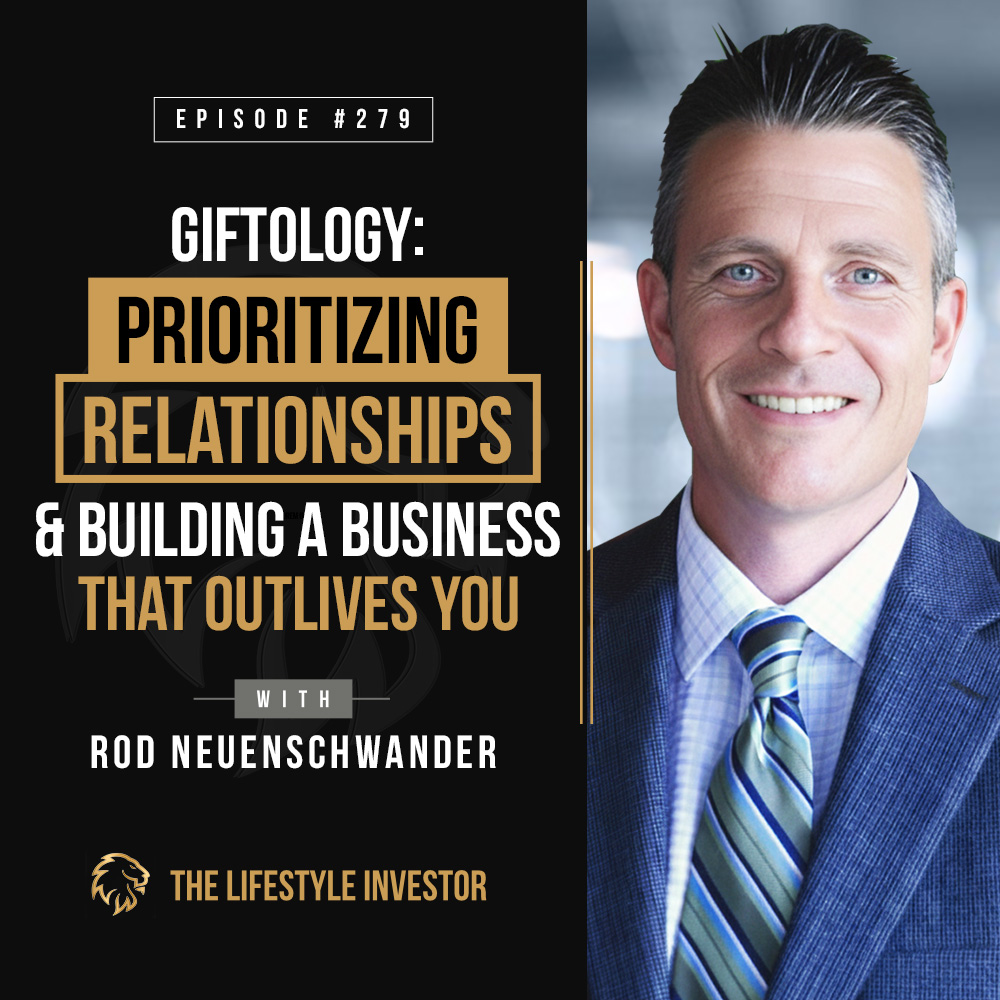
Giftology: Prioritizing Relationships and Building a Business That Outlives You with Rod Neuenschwander – EP 279