![[Justin Donald] - Optin Preview](https://lifestyleinvestor.com/wp-content/uploads/2020/12/Justin-Donald-Optin-Preview-e1607533704966.png "[Justin Donald] - Optin Preview")

![Logo 1 Gold horiz [Converted]](https://lifestyleinvestor.com/wp-content/uploads/2019/08/Logo-1-Gold-horiz-Converted.png "Logo 1 Gold horiz [Converted]")
Interview with Erwin McManus

What No One Tells You About Getting Rich with Erwin McManus
We all chase success. But sometimes, even after achieving everything we set out to, something feels off. I’ve seen it happen time and again: high-achieving entrepreneurs who look around one day and think, Is this all there is?
Today’s guest, Erwin McManus, knows exactly how that story goes. Erwin is the founder and lead pastor of Mosaic, an artist, and author with over one million book sales who’s worked with everyone from the NFL and the Pentagon, helping them perform at the highest level while living a balanced life.
In our conversation, Erwin shares what these elite performers do to rise to the top. But more importantly, he talks about why so many still end up miserable and trapped despite their achievements. And he’s sharing his best advice to help you avoid that trap.
Plus, he gives a sneak peek into his latest book, Seven Frequencies of Communication, where he breaks down how to become a world-class communicator who leads with influence and intention.
In this episode, you’ll learn:
✅ How Erwin transformed his life from struggling to afford college and living below the poverty line to becoming an internationally renowned speaker and consultant for powerhouse organizations like the NFL and the Pentagon.
✅ The habits, mental frameworks, and decision-making strategies that separate the top 1% from everyone else, and how you can apply them to your life and business.
✅ Strategies for creating wealth while staying true to your values and purpose and building a life that’s financially rewarding but also deeply fulfilling.
Featured on This Episode: Erwin McManus
✅ What he does: Erwin McManus is a renowned life architect, award-winning author, and artist. With over one million book sales and translations into multiple languages, he has captivated audiences in stadiums across seventy countries on five continents. He has consulted for esteemed organizations like the NFL and the Pentagon. For three decades, McManus has advised CEOs, athletes, celebrities, and billion-dollar companies, helping them overcome limitations and unlock their genius. As the founder and lead pastor of Mosaic, a global spiritual movement, he has inspired millions and leads impactful humanitarian initiatives alongside his wife, Kim.
💬 Words of wisdom: “One thing that I learned very early on is that it’s it was my role to give people opportunity, but it was their role to bring determination.” – Erwin McManus
🔎 Where to find Erwin McManus: Instagram | Facebook | LinkedIn | X
Key Takeaways with Erwin McManus
- How growing up with nothing shaped Erwin’s future
- Why ambition alone won’t get you there
- The success secret of the top 1%
- Are you holding yourself back without realizing it?
- How fear of being seen as selfish holds you back from success
- Bigger houses and shiny cars won’t fill the void
- The DNA of world-class communicators
- Communication styles: Trump vs. Kamala
Inspiring Quotes
- “If we can deal with the internal limitations, it’s amazing how they change our external circumstances and situation.” – Erwin McManus
- “My life changed when I stopped living a life of obligation and I lived a life of intention.” – Erwin McManus
- “Whoever tells the best story creates the future.” – Erwin McManus
Are You Your Own Worst Enemy? | Erwin McManus Shares Secret to Wealth & Freedom
Resources
- Erwin McManus
- Erwin McManus on Instagram | X | Facebook | YouTube
- The Communicator’s Tool Kit
- The Seven Frequencies of Communication by Erwin Raphael McManus
- Mosaic
- Michael Abramson
- Pete Vargas
- The Wellspring
- Robert Heinlein books
- Andre Norton books
- Isaac Asimov books
- Kim McManus
- Donald Trump
- Kamala Harris
- Jon Gordon
- The Energy Bus: 10 Rules to Fuel Your Life, Work, and Team with Positive Energy by Jon Gordon, Ken Blanchard
- Ben Newman
- Finding Forrester
- Whiplash
- John Maxwell
Tax Strategy Masterclass
If you’re interested in learning more about Tax Strategy and how YOU can apply 28 of the best, most effective strategies right away, check out our BRAND NEW Tax Strategy Masterclass: www.lifestyleinvestor.com/tax
Strategy Session
The Lifestyle Investor Insider
Rate & Review The Lifestyle Investor Podcast
If you enjoyed today’s episode of The Lifestyle Investor, hit the subscribe button on Apple Podcasts, Spotify, Stitcher, Castbox, Google Podcasts, iHeart Radio, or wherever you listen, so future episodes are automatically downloaded directly to your device.
You can also help by providing an honest rating & review over on Apple Podcasts. Reviews go a long way in helping us build awareness so that we can impact even more people. THANK YOU!
Connect with Justin Donald
Get the Lifestyle Investor Book!
To get access to The Lifestyle Investor: The 10 Commandments of Cashflow Investing for Passive Income and Financial Freedom visit JustinDonald.com/book
Read the Full Transcript with Erwin McManus
Justin Donald: Hey, Erwin. So good to have you on the show.
Erwin McManus: Man, I'm so glad to finally connect, Justin. Thanks for having me.
Justin Donald: We've taken some time to get here but I knew at some point it would work out. And between so many of our mutual friends, Michael Abramson and Pete Vargas and many others, it has been a joy to get to know you.
Erwin McManus: Hey, thank you so, so much. I love that you live in Austin, the California in Texas.
Justin Donald: That's right. That's right. There's no doubt about that. We've got a ton of Californians here. And it's become kind of a spot for a destination, I guess, if you will.
Erwin McManus: It is. I live right here in Hollywood. And so many of the people I know have moved to Austin. They've moved to Nashville or Franklin and Colorado Springs or certain epicenters around the country but Austin is definitely the most popular one.
Justin Donald: Yeah, there's no doubt. It's fun seeing the influx of all the people. I mean, it is crazy how many people it is but it's really awesome because it's interesting people. It's people of all different kind of business acumen and like we've got the tech scene, we've got the influencer scene, we've got the entrepreneurship scene. So, it makes Austin a really neat city and you just run into some cool people.
Erwin McManus: It's awesome.
Justin Donald: Now, I heard a message from you. You spoke at a mastermind community and part of this Christian entrepreneurship group called The Wellspring. And you spoke actually a couple of times to our community. And one of the messages you gave just blew my mind. And I was like, "I have to get to know you better. I have to get time with you and see if you'll be willing to come on the show." And so, I'm excited you're here because I feel like I've had some epiphanies in my exposure to you. And I would love for our audience, everyone watching and listening to get a chance to hear some of the things that I've heard. So, thanks in advance for being here.
Erwin McManus: You're welcome. All right, let's dive in.
Justin Donald: Let's do it. Let's do it. So, I want to know how you got started and how you got to where you are. I mean, your background is very incredible. It's very abstract. I mean, a guy that is not born in the U.S. doing amazing things here from, you know, you're an author, you've written a ton of books. We're going to talk about your newest one here today. You're a filmmaker, fashion designer, artist, pastor of one of the preeminent churches in the world, especially here in the United States. I mean, how on earth did you cover all these areas? How did you get into it?
Erwin McManus: Well, that's a big question but I am from a small country in Central America called El Salvador. And I was born in the capital, San Salvador. Ironically, the name of my country literally means 'the savior,' and the capital where I was born means 'holy savior.' And I grew up on a street called Calle del San Salvador, which means the street of the holy Savior. So, my address as a child was the street of the Holy Savior in the city of the Holy Savior in the country of the Savior of the world. But I had no idea who Jesus was. So, you can have the right address and have the wrong destination, you know?
Justin Donald: Wow.
Erwin McManus: But I grew up in a very unique kind of family system. I never knew my real father. He spoke 6 to 12 languages. He was a linguistics expert and he was teaching in college. My mom was 16. She was in there. They met and they got married. She had my brother, who's older than me, and then me. And their marriage ended while she was pregnant with me. You know, he's a very brilliant person but really struggled with addiction, alcoholism. And so, who he was sober was different than who he was when he was intoxicated and did just extreme violence. My mom had to exit that relationship, gave me birth, and my grandparents raised me for the first years of my life.
My mom became one of the first Pan Am stewardesses in the world. And so, she's like this young, adventurous entrepreneur, pioneer kind of person. And so, I think a lot of my attributes come from her. And then we came to the States when we were very, very young. You know, Spanish was my first language. So, I learned how to be an outsider, learning how to work your way in. And I think it does shape you and change you as a human being when you know you're not one of them, when you're an outsider, when you're an outlier. And not only was I an outlier in terms of being from another country and speaking a different language and coming from a different culture, but I also had like significant, I guess, mental uniqueness, as I'll say.
So, I was in a psychiatric chair by the time I was ten years old and was really just a really troubled, fragmented kid. Now, they thought that maybe I was like mentally challenged or back then, you know, would say retarded. And I thought there was something desperately wrong with me. I was a straight-D student from first to 12th grade. And really, I didn't have any kind of organized cultural structure like faith or religion or anything in my life. So, I didn't really have a compass to try to make sense of life. So, early on, I just began reading books by like Robert Heinlein and Andre Norton and Isaac Asimov, and science fiction and the blending of physics with metaphysics and with science fiction shaped me at a very, very young age.
And so, I think it really spurred imagination, creativity, ingenuity. And so, even though I was failing from school, I was actually really learning at a very complex and deep level. And then when I was out of high school, I didn't go to college. I couldn't go to college. I couldn't qualify to go anywhere and just worked construction, worked as a carpenter, worked as a lumberjack. I worked flipping burgers, worked spinning pizzas. I just did whatever jobs I could get and just felt my life was pretty meaningless and begged my way into a university. And I mean, literally, drove to university, walked in, met with the vice president of the university. I just forced myself into his office, begged the man to give someone a chance. They gave me admission into Elon University and it changed my life.
And so, I'm forever grateful for those people. I remember looking at this man and I'm only, you know, I'm 19 years old and I'm saying, because I graduated from high school at 17 so I was really young and I said, "I just need you to look at me and give one human being a chance." And that man decided to give me a chance, let me into school. They told me I was supposed to flunk out and not make it but I stumbled on Socrates and Plato, Aristotle, the Stoics. And next thing I knew, I was a philosopher. And I discovered that there were other people who were looking for meaning in life and people who were trying to make sense of reality and people who wanted their life to be principled and to have value. And it just really, I think, prepared me in my own journey.
So, when you asked me why I do all the things I do, just some of the backstory is just trying to figure out who I was as a human being. And in that journey and you know this, I had an unexpected faith encounter with Jesus Christ, which for me was incredibly unexpected. It wasn't something that was in alignment with necessarily what I thought my life would become. But I never felt comfortable inside of the world of religion or even Christianity or even though now I had a personal faith, I always felt like an outlier. And so, I was always trying to figure out, you know, what do you do with that? I spent ten years working with the urban poor. Most people don't know that. I worked with drug cartels and gangs and assassins in the world of drugs and prostitution.
And I spent a decade just trying to help people who were in the most difficult environments in the world find hope and meaning in their life. And it helped me find hope and meaning in my own life by serving other people. And then when I was around 32 years old, I felt... I was a sociologist. I became an urbanologist who studied trends. I worked as a futurist for companies and universities, and I made a determination when I was around 23, 24 years old that Los Angeles was the epicenter of the future, that the future didn't come in and it came in disproportionately, did not come evenly. And so, there are places in the world that are 500 years in the past, some that are a thousand years in the past, and the future emerges from different places. And I determined that Los Angeles was the epicenter of the future.
So, I moved to L.A. when I was 25 to try to be a part of the emergence of the future of humanity and to make a difference here. And so, that's why I moved here, believed it was a creative epicenter of the world. And I remember 40 years ago just sharing this thought that whoever tells the best story creates the future. And that became part of my...
Justin Donald: Well, isn't that the truth?
Erwin McManus: Yeah.
Justin Donald: Right? I mean, that's kind of how it's played out.
Erwin McManus: It is. And then there are so much there, so many layers of implications. And so, I thought it was going to be mostly in the movie industry but I didn't know that I would end up starting a very countercultural church called Mosaic. I started it in a nightclub that Prince owned in downtown L.A. and it was mostly for all my friends who are atheists, agnostics, Buddhists, Hindus, Muslims, and Catholics who didn't find organized religion to have meaningful answers for their lives but were still open to some kind of spirituality. And that became like my spiritual base. And then from that, I just found the freedom to create.
I just always had a longing to create beautiful things and worked in films and have designed clothes for years and years and years and have written books for decades and have written a graphic novel, created fiction and nonfiction. And it's just been a natural part of my life and it's just something I love doing. I find that whenever there's beauty, there's always hope. And I actually find it's very difficult to choose violence when there's beauty around you. And I think you can see that when it shouldn't surprise us when prisons are absent of beauty, that they're more violent, that projects where there's absence of beauty have more violence, that when there's a higher value for beauty, there's a higher expression of peace and of a humane expression of who we are as humans.
And so, I just began integrating creativity and spirituality and that's sort of been my life story all along the way. And, Justin, I think when I met you, for years and years I've worked with companies and universities helping them understand the future and how to move toward it, but I also coached a lot of people privately but I never made it public. And after the pandemic, I kind of took my private work and made it my public work. And people thought, "Oh, wait a minute, we thought Erwin was a pastor. Now, he's a business guy. Now, he's mentoring all these entrepreneurs. Now, he's working in the world of whatever, you know, or Mosey or Robbins, whoever it may be." And that was always my world. It was just always my private world.
And then I just turned it, flipped it upside down, and made it my public world. And I really do love it. I love focusing on people who want to be the top 5% in the world. And it takes one amount of work to help people go from below average to average. And it takes some level of coaching and real focus to go from average to good. And the level of intentionality increases dramatically when you're going from like from good to great. But if you go from great to elite, the level of change, they are micro changes and you have to thin-slice the mindsets and the patterns of thinking and the way you live your life. And I like being in that high-octane space for people who say, "I want to be the best in the world."
And for too long I put too much pressure on everyone to be the best in the world. I just want everyone to be the best in the world. And I realize not everyone wakes up in the morning with this compulsive need or drive to be the best at what they do. And I realize working with the poor, I spent ten years working with urban poor and one thing that I learned very early on is that it was my role to give people opportunity but it was their role to bring determination that I cannot bring determination to another human being but I can bring opportunity to another human being. And that the way you can create, you know, in a sense, we talk a lot about having equality and equity in our society.
And the problem is that we want an equality of outcomes and I want an equality of opportunity. I want people to have the opportunity to live their most extraordinary life. And if you have that opportunity, it's not my responsibility to bring the determination. You have to bring that. But I also found that even with the best of the best, you know, the difference in that 1% is really the mental structures that they have. The talent's the same. The physicality is the same. The IQ is usually the same. Across the board, they look the same. It's their ability to recover from failure and to move toward re-engagement of the challenges and problems they face that makes the difference. That's a long narrative of taking you from the beginning to where I am now in my life.
Justin Donald: It's a beautiful story, Erwin. And it's actually very poetic because you came into the country as an outsider. You described yourself as an outsider, even with potentially some learning disabilities or maybe a slower path to learn. Whereas I can relate to this a little bit having a daughter that has dyslexia that there were some things that were a little more challenging for her until we found the right education where she could thrive. And by the way, she's quite the artist, right? So, there are some things that were a little harder to grasp but on the art, on the drawing, the painting, the pottery, the making clothing, making jewelry like that sort of thing, storytelling, she's off the charts. And so, I love that you were able to find your voice.
But what's so poetic about it is you said you are an outsider looking in but the irony is that you've been paid by the biggest companies to speak, like Nike and Sony and Fox and Apple, and you've consulted with the NFL and you've done consulting for the Pentagon and pro athletes and celebrities. You talked about kind of the top 5%, but we're talking about CEOs and Fortune 100 companies. And so, this outsider looking in that was kind of struggling through school and kind of went a different route, a different path, I mean, who says that their job as a futurist, right? I mean, that's even unique in its own, right, in its own regard. And I love that.
But you've been able to take your unique talents and gifts and you've been able to have some massive impact on a stage that most people will never get to experience. And that's pretty powerful. And I hope anyone listening to this recognizes that they're not always limited by their situation. And I think your story is just a beautiful description of that and representation of it.
Erwin McManus: Thank you. Thank you so much. And you're right. We're actually never limited by our circumstances. But most of the time, I think our circumstances are simply external projections over our internal limitations. And if we can deal with the internal limitations, it's amazing how they change our external circumstances and situation.
Justin Donald: Yeah, there's no doubt.
Erwin McManus: And that's part of what you do, right? And that's part of the growth journey is taking ownership of your life and figuring out how do you transfer from a sense of powerlessness that things are happening to you to really owning your power, to saying, "I'm creating things and I'm making things happen."
Justin Donald: Yeah. Yeah. It's amazing. Your path, your story, though, what you can paint as possibility and opportunity and breathe life into other people with it. And for those that don't know you that well, I mean, you're a household name in a lot of circles, but you've also in kind of intentionally kept a lot of what you did private for a long time. So, there are people that don't know you necessarily who probably could or should but it was kind of based on intentionality that they don't know you. And I just want everyone to know that the church that you've planted is literally in the middle of kind of like the who's who. It's Hollywood celebs.
It's like the people that you come in contact with, the people attending your church, the people that you have the ability to impact and influence are many of the individuals that most people will have a hard time ever connecting with, meeting with, but maybe some of the most inspiring people to them, right? And because of that proximity, this choice that you made to be in L.A., you now have the ability to foster these incredible relationships and even coach and consult at a high level with people that have a lot of influence.
Erwin McManus: Yeah. You know, people are very much at their core the very same. And if you realize that once you remove all the layers of celebrity or fame or power or wealth or status, that at the core, we're all human. And it's just sometimes more difficult to get a core humanity to help a person really grow and become the person that they long to become. But yeah, no, I'm a part of Mosaic. I'm sitting right now on Hollywood Boulevard. So, this side of the podcast is on the corner of Hollywood and La Brea. We were right the beginning of the Stars Walk of Fame. And it's crazy that we've been here all these years and it's insane who just walks in. I have no ability to recognize people facially in a room. And so, maybe that's like the way God...
Justin Donald: Probably all for the better.
Erwin McManus: Yeah. But I cannot tell you how many times my team has said, "Did you see her?" or they tell me, "Did you see him?" And I'm oblivious. In fact, I was talking one time to I'm not going to say who, but one of the most famous artist musicians in the world maybe for 15 minutes, and then I walked away. And I think my daughter came up to me and said, "You know who that was, right?" And I go, "No, he seems like a really sweet kid." And she's like, "That's you know." And I cannot tell you how many times it's happened to me. So, I think people think I don't care. I just don't know, you know? And I probably would have been like more mesmerized if I realized who they were.
And so, sometimes the people that I'm more astonished by our people that would not be considered like celebrities, I think. We had one of the top three physicists in the world coming here who was an atheist because he was really intrigued by our perspective of God. That for me was like, that's more like intriguing and more adrenaline rush kind of experience for me to have that kind of person here trying to make sense of their lives.
Justin Donald: So cool.
Erwin McManus: Yeah. And I love being here because I know that the influence we have here on people's lives, their lives will have disproportionately more influence than I will ever have. And so, if I can have a positive influence or impact on their life, I can exponentially do good in the world. And if your goal in life is to be famous, my strategy is a terrible strategy but if your goal in life is try to expand the good that happens across humanity, then I'm really happy with my choices.
Justin Donald: Yeah, that's fantastic. I'd love for you to share a pivotal moment in your life that significantly shaped your beliefs in some way, shape, or form. Because I think our beliefs are powerful and I think people miss that they don't understand or they misrepresent the impact of beliefs. But it's like one shift. You talked about it at the very top that these are like micro shifts that happen, and it's likely micro shifts in beliefs or mindsets that causes that greatness to move to elite level. So, I'm curious what that was like in your life.
Erwin McManus: I'm sure there have been like so many of them in my life but maybe even like related to your audience because I know you have a lot of entrepreneurs, a lot of business people. I mean, frankly, and this may not be what you're expecting, but when I became a person of faith, I became a monastic. And everything I owned, I could put into a paper bag. And I think I reacted to my family and decided that wealth was evil, money was evil, possessions were evil. And I basically lived, I think, for ten years, my average income would be about $8,000 a year.
Justin Donald: Wow.
Erwin McManus: And I mean, I lived below a welfare level for maybe 15 years of my life. And a lot of it was like a reaction to materialism and too many other issues and culture. And when I got married, my wife, Kim, she grew up as an orphan and she was abandoned in a government project when she was eight years old, lived as a foster child from 8 to 18, never had one piece of clothes that belonged to her, lived in really abject poverty, and she fought her way out of that poverty, nine brothers and sisters that were all orphaned or homeless or drug addicts, drug dealers, criminals, and walked away to school and went to high school, got a college scholarship. I met her when we were getting our master’s degrees.
And so, in some sense, she matched my monastic view of life. I was just going to prove that I had virtue by having nothing. And when we were married, we slept on the floor because I wouldn’t buy a bed because I said a bed is a luxury, not a necessity. In that sense, I’m an extremist in maybe too many ways. I’m like an anarchist in some ways. And my family knows this. It’s just the way I think God has designed me. I have this high intensity.
And I remember we’ve been married a decade and we had a foster daughter that we brought home with us and stayed with us 12 years. And we then had our son Aaron, then had her daughter Mariah. And I just had this epiphany moment, I’m not really sure why. But I went home and I told Kim, I said, “I think God has given me permission to create wealth.” And my wife said, “What are you talking about?” And I said, “I actually felt this release, like I’m supposed to. My stewardship is to create wealth.” And she goes, “You’re capable of creating wealth?” She had no idea, right? And I said, “Yeah, I’ve always just kept this buried.” because I felt that maybe it was not a virtue. And she goes, “Well, I wish you’d get at it.”
And that’s when I began working as if I just created the role of a futurist. And then before I knew I was getting hired all over the world and traveled to nearly 100 countries and spoken to millions of people and all that emerged in many ways in them, I gave myself permission to actualize all the gifts and talents that were actually inside of me.
And I actually think there are people who don’t give themselves permission to become the most extraordinary version of themselves. And because you don’t want to be arrogant, you don’t want to be greedy, you don’t want to be a narcissist. And so many of the models for high achievement have those attached to them.
And I can tell you, Justin, there have been different moments in my life where I achieved success and then I became my own enemy. I was uncomfortable with my success. I felt like I was not worthy of it, I didn’t deserve it.. It was a bad reflection on my faith. And I would literally stop myself from being successful.
And what really struck me was this deep awareness that I feel like God gave me one day was that the only person in this parable of the talents that Jesus called evil was the person who buried his talent and did nothing with it. He said, “You lazy, wicked servant.” And I had this moment of epiphany of optimizing your gifts and talents are not optional. They are the response of faithfulness. And if you have the ability to create great wealth, you should employ a thousand people and you should make sure that their families have food on the table. You should make sure they have an income where their kids can go to college. And that really, I think, was a very pivotal thing because it was very difficult, believe me.
And it’s easier to hide behind non-virtue if you’re poor. It’s very, very difficult to live a truly virtuous life if you have wealth, and you have to hold yourself to a higher level of accountability and a personal stewardship. And so, I think that the reason I’m where I’m at now is that I had to have almost like a crisis of faith, and go, I want to die with so much potential because potential isn’t static. Potential is dynamic.
And so, every time I actualize my potential, I have more. And so, now that I’m 66, I don’t see myself landing the plane. I don’t see myself at the end of my story. I see myself at the high point of a really epic tale where I haven’t even begun to discover the full capacity of what I can do in the world. And it’s been, for me, really transformative. And I can put it another way. My life changed when I stopped living a life of obligation and I lived a life of intention.
Justin Donald: That’s powerful. And just that shift in belief around money is bad or making money or wealth is bad to, like, actually, if I have these gifts, why not optimize them? Why not actually see how much I can create? And why not be radically generous with those gifts and with those talents? And I love that. I love that shift. That’s one of those little millimeter micro shifts that is a total game changer.
And for a lot of people listening, I do think that there’s this feeling or this belief that having money or making a lot of money is bad, or it’s evil and it’s just not. The love of money, putting money on a pedestal where it’s more important than your faith or people or relationships or having a relationship where it’s disproportionately large and in charge, that is not a good way to live. But if you have the gift of creating wealth, it’s amazing, the impact you can have since we’re a society that functions and runs on money.
Erwin McManus: Yeah, and if you think, if you break it down, I remember years ago, I was working with these Wall Street investors. I think the smallest fund was 9 billion. And we had this interesting conversation because they ended up asking me about God. And they were asking me like, “Why believe in different things?” And I said, “Let’s talk about economics.” And I said, “because economics are simply an agreed assignment of value.” And they go, “Oh, that’s exactly what it is.” Like, we both decide what this phone is worth or what this hat is worth.
And then we pretend that dollar is worth what we understand psychologically is a dollar or $100. And so, even the paper has an agreed upon value. And for society to operate, you have to have agreed upon values. And one thing I was mentioning is that you cannot live a life that’s not value based because everything is based on value. And it’s just you just may not like your values.
Justin Donald: Yeah, that’s true.
Erwin McManus: And so, your values may be airplanes and bigger houses and lots of watches or whatever it may be, but you still assign something value. What’s interesting about human beings is that we can treat meaningless things as meaningful and we can treat meaningful things as meaningless, but we intrinsically know when something actually is meaningless. Like even the person who’s living a meaningless life, they know it’s meaningless.
And when you’re living a meaningful life, even when things go bad, you know your life still has meaning. It’s because power, wealth, success, fame, they’re great outcomes. They’re terrible intentions. And when your intention is actually rooted in a deeper meaning, then your identity can’t be affected by success or failure, but when your identity is rooted in the outcomes, your identity is very fragile.
And so, even just in that process talking about where do these intrinsic values come from, and that’s where the economist where I was actually talking about God and that somehow, all of us human beings have these intrinsic values that all of us are driven by. No matter what generation we’re from, what nation we’re from, what economic background we’re from, we all desperately need meaning in our life. We all desperately need intimacy and to be loved. We all desperately need progress, a sense of a future and destiny. And so, there are, in a sense, an economy that explains the transcendent nature of human beings.
Justin Donald: Well, by the way, so many profound points, and this is why I love talking to you because you say things in a very eloquent way that make a lot of sense, that really get to root level stuff, foundational things, foundational concepts. So, thank you for sharing that. I know that you have been sharing your wisdom for years and years, whether it be speaking, coaching, writing. You’ve got a ton of books that you’ve written over the years, but your newest book is out and I’d love for you to talk about The Seven Frequencies of Communication.
Erwin McManus: Yeah, my newest book is The Seven Frequencies of Communication: The Hidden Language of Human Connection. And I’m very, very excited about this book. In fact, if I could just say, you always do pre-sales with the book just to try to see if it gets momentum, and this is the fastest selling book I’ve ever had and it’s not even out yet.
Justin Donald: Congrats.
Erwin McManus: And I think it’s because it resonates so deeply with people because you cannot connect at a deep human level if you don’t understand how to communicate, how to be understood, and how to understand. And the seven frequencies really lays out a universe of human frequencies of how we hear and speak. And so, quickly, we break down seven frequencies of the motivator, the challenger, the commander, the professor, the seer, the healer, and the maven.
And we have an assessment that we’ve spent the last two years developing that actually helps a person identify their core frequencies. And so, the assessment gives you your top three frequencies and breaks down your core primary frequency. And it’s been transformative. We’ve done it. We’ve been working with it for a couple of years here.
And even with my wife, like my wife’s primary frequency is, she’s a commander. And so, I’ve been married 40 years to someone who’s very clear what I should do with my life and with my day and with my hour and with this moment. But once I understood my wife’s a commander, I wasn’t offended by the commands anymore. I just knew that was her natural communication frequency. She doesn’t even hear it as a command. She thinks it’s a request or an idea or an option, but it always comes in this one frequency.
And then, my frequency is a very, very different frequency. My daughter has a frequency called the challenger. And so, whenever Mariah texts me, I always wonder, am I good enough yet? Because the challenger really believes in you, so they see what you’ve accomplished, but they are always calling you to more. So, they’re calling you out and they’re calling you up. And it’s very encouraging and very inspiring. But sometimes when you have a challenge in your life all the time, you’re like, have I accomplished anything? And are you ever going to be happy with me? And you can have a deep sense of deficit.
And then each one of these frequencies has a shadow. And that’s one of the things I think is very critical, because so much of the models of communication we have on television and film are only shadow frequencies. So, we’re learning how to communicate with each other from our shadows and we don’t understand what we’re not making deep human connections.
And so, the book really breaks down these seven frequencies. It breaks down the shadow frequencies, and it teaches us how to elevate our frequency, and then, also how to hear and understand other people’s frequency. So, I’m really excited about it.
Justin Donald: Yeah, that’s powerful. And just to elaborate a little more, can you give an example or can you help us understand what a shadow frequency is, which, it sounds like you’re operating from a suboptimal place in your communication? Probably not going to yield the results that you want. And I’d love to just get a little overview on that.
Erwin McManus: Sure. If I could just use a controversial one, the political one, for a moment, with Donald Trump, regardless whether you love Donald Trump or not. And I think one of the great challenges with Donald Trump is that you can hear his frequency as a commander frequency. And so, when he uses his commander frequency well, he creates a sense of authority and respect, and I know what I’m doing, you can trust me, you can follow me. And he builds confidence in here.
But the shadow of a commander is the dictator. And so, once you move into that shadow frequency, you become a dictator and you feel it starts expressing a sense of oppressiveness, of control, of dogmatism. And so, I think what happens with former President Trump is that he actually goes back and forth between his commander frequency which actually evokes trust and confidence in people, and then the dictator frequency, which creates distrust and fear in people. And that same frequency has the shadow in authentic expression. And you can feel it as you go through.
Since I went on the political side, I think it’s very difficult to hear Kamala Harris’ frequency. And one of the reasons for that, and this is the political environment, is that when you have a lot of people writing scripts for you, they’re trying to interject the frequencies they want you to use that they feel will connect the audience best to you. But if it’s not your authentic frequency, it doesn’t come across genuine and authentic. And so, I think it’s very, very challenging for Kamala Harris because she’s trying to be so many different things that she’s being told she needs to become, and so, you don’t hear a clear, authentic frequency from her. So, even if you like her, you do get a sense of I don’t really know who she is. And so, you have an interesting kind of dynamic there.
I think another example of this kind of frequency dynamic would be the motivator. I think the motivator is probably one of the most popular frequencies. They’re the most sought-after speakers because they bring energy to the room. They build your deep self-belief. One of my great friends, Jon Gordon, is the optimal, classic motivator of the world.
Justin Donald: I love of Jon. Good friend. He’s been on the podcast.
Erwin McManus: And he wrote a book called The Energy Bus because he’s full of energy.
Justin Donald: Yes. So good.
Erwin McManus: But the shadow of a motivator is the performer. And if you’ve ever heard someone on stage and you thought they’re motivating and they are full of energy and they have great charisma, but I’m not really sure if it’s the real them. I think they’re– and you feel this disconnect. You’re not even sure why. And it’s because they’re in their shadow. What happens is when a motivator is insecure or maybe they’re not in their best place personally, they move in to the performer. And so, they’re using a persona and more focused on the audience, loving them than them loving the audience.
And so, it can be very, very subtle. Like, with the challenger, the challenger’s shadow is the manipulator. And so, a challenger can be really powerful. I don’t know if you know Ben Newman.
Justin Donald: Oh, yeah. Love Ben. Good friend.
Erwin McManus: Ben is one of the great challengers, I think, like, his voice just resonates so powerfully. Whenever he speaks, the room shakes, your soul shakes, right?
Justin Donald: That’s right.
Erwin McManus: But you also know with Ben, it still isn’t enough. No matter what you did, it’s not enough. And what he needs from you is more, and you’re going to feel that. And because Ben’s such an authentic person, I’ve never heard him from his shadow.
But the natural shadow of a challenger would be a manipulator, a person who is now, not calling out the best in you, but calling out the best in you that they need for them. And so, it can become very subtle. And so, I would say, it’s like you’re in your shadow when you’re communicating to move people for your benefit and you’re in your light when you’re moving people for their benefit.
Justin Donald: Okay, yeah.
Erwin McManus: And so, each one of these has a very, very specific shadow. I don’t know if you ever saw the movie Finding Forrester or the movie Whiplash. But I would say that that’s like a professor frequency in a shadow form. So, like, the professor frequency, he really believes that transference of information is the key. Like, I have information and I’m here to teach you. And if I can give you this insight, this information, this data, it’ll change your life.
But when a professor is in a shadow, they’re like a diminisher. They demean you and they make you less to make them more. And so, a lot of times, in some of these characters in movies, the professor frequency is the person who’s always telling you what you’re not, that you’re not good enough, that you’ll never be good enough, and they’re trying to show you that you’re stupid, that you’re ignorant, that you’re worthless.
And so, that frequency that can so transform you by passing light to you, and elevating you by opening your mind and your depth of knowledge can also be a diminisher that makes you feel like you’re not smart enough, you’re too stupid, you’re never going to get this. That’s just a few examples of the shadow to the light.
Justin Donald: Oh, that was wonderful. I appreciate you sharing that with us, Erwin, and I’m excited to read your book. Where can we learn more about you? And where can we pick up your book?
Erwin McManus: Well, the easiest place is my personal website, ErwinMcManus.com. And you can actually pick up the book there. But also, if you go to ErwinMcManus.com/free, I teach a 6 to 10-hour masterclass on the art of communication. And we have a free resource there. That’s The Communicator’s Tool Kit.
So, if you’re interested in learning how to communicate better to how to craft your thoughts and ideas and express them in a more effective and powerful way, then I would just encourage you to go get the free resource, get The Communicator’s Tool Kit. But you can pick up the book at ErwinMcManus.com or you can also go to TheSevenFrequencies.com and pick it up, or on October 15th, it also releases on Amazon. So, if it’s easier for you to go to Amazon, you can go there now and preorder.
Justin Donald: And what about the assessment? How do people take the assessment? Do they need the book first?
Erwin McManus: No, you can go to my website, Shop.ErwinMcManus.com. Shop.ErwinMcManus.com, you can get the assessment. I would encourage you, get the book and get the assessment. The link is in the book, but you can go right to my website and hit that Shop.ErwinMcManus.com, and you can grab the assessment right there.
Justin Donald: I love it. That’s awesome. Well, I’m such a fan of assessments. I’ve used, I want to say, all of them, but I haven’t used all of them. I’ve used a ton of them. Obviously, people are coming out with new and improved ones all the time, so I’m excited to check this one out.
I just think when you have a clear language that you can understand other people’s world and communicate your world, it makes everything better, relationships better, working environments better, marriage, parenting, you name it. So, I love it. It’s like, having a compass, whereas before you’re just out navigating, seeing if you can find land somewhere.
Erwin McManus: Actually, it’s amazing how much language helps us grasp concepts that will change our lives.
Justin Donald: Yeah, totally. Hey, this has been so much fun. I love learning from you. I love your story. I appreciate you sharing the ins and the outs and being open and being vulnerable. And I love that you have such a hero’s journey. I love how bad it was, but how it defined who you are today. And I love that you fought something in your life, even this gift of being able to build companies, build wealth, build people, and you later changed and said, no, not only am I going to not keep this private, I’m going to make this public facing, I’m going to do great things and have more impact and more influence.
So, I think you’re a great role model for many, and you are just one of the preeminent leaders of our time. I just spent the weekend with John Maxwell, and it was wonderful, like learning from him as well. We talked about this off camera, but it’s like there’s such a world of wisdom from so many years of experience, from not doing the thing that you are designed and built to do, to doing the thing and living it out every single day. And then it’s cool to see the fruit of that labor and just how massive that return can be, how massive that impact can be. And I just think you’re living proof of it. So, thank you.
Erwin McManus: Hey, thank you so much, Justin. It’s been wonderful being with you.
Justin Donald: Well, I love closing out our episode with a question to our audience. So, if you’re watching this or listening, my question for you is the same every week, and that is this. What is one step that you can take today to move towards financial freedom and, moreover, move towards living a life that you desire, one that’s on your terms? So, not doing what everyone else does, which is a life by default, but what’s one step you can take today to living a life by design? Hopefully, there’s a ton of nuggets that you can grab from Erwin. Thanks, and we’ll catch you next week.
Sign up to receive email updates
Enter your name and email address below and I'll send you periodic updates about the podcast.
Keep Learning
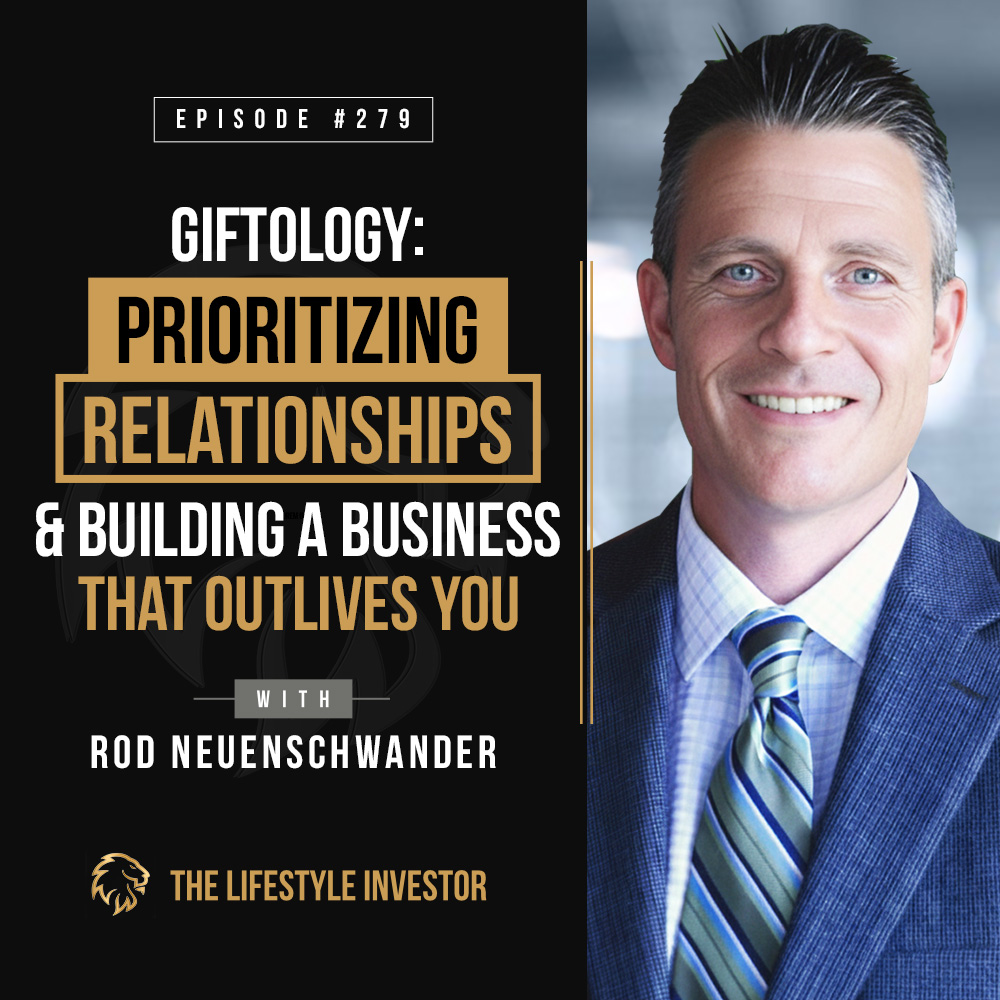
Giftology: Prioritizing Relationships and Building a Business That Outlives You with Rod Neuenschwander – EP 279

From a Huge Exit To Reimaging IT & Cybersecurity with Bill Tyndall – EP 278