![[Justin Donald] - Optin Preview](https://lifestyleinvestor.com/wp-content/uploads/2020/12/Justin-Donald-Optin-Preview-e1607533704966.png "[Justin Donald] - Optin Preview")

![Logo 1 Gold horiz [Converted]](https://lifestyleinvestor.com/wp-content/uploads/2019/08/Logo-1-Gold-horiz-Converted.png "Logo 1 Gold horiz [Converted]")
Interview with David Bayer
Rewire Your Mind: The Simple Formula for Wealth & Freedom with David Bayer
Success in business and investing often gets framed as tactics, strategy, or sheer hustle. But according to David Bayer—renowned mindset and performance coach, transformational speaker, and founder of the Powerful Living Experience—the real driver isn’t what you do, it’s the state of mind you operate from.
David has guided thousands of entrepreneurs and leaders through his coaching programs, live events, and his book A Changed Mind, helping them rewire limiting beliefs, heal past trauma, and unlock exponential growth. His work blends neuroscience, psychology, spirituality, and business strategy into practical tools that create real transformation.
In this episode, he breaks down his framework for Mindset 2.0—a shift from simply recognizing limiting beliefs to actually rewiring them at the neurological level. He explains why your thoughts create the states you live in, how to move from “primal” states of stress into “powerful” states of clarity, and why the quality of your inner game determines the quality of your results.
David also reveals his deceptively simple but life-changing formula: Desire + Non-Resistance = Desired Result. Instead of pushing harder or grinding longer, the path to wealth, peace, and fulfillment comes from removing the resistance built into your thinking.
If you’ve been stuck in stress, chasing success but feeling misaligned, this conversation will show you how to rewire your beliefs, unlock energy, and create results that flow with far less effort.
In this episode, you’ll learn:
✅ How to rewire limiting beliefs with Mindset 2.0 — and why shifting from “primal” states into “powerful” states changes the way you think, feel, and make decisions.
✅ The simple formula to achieve anything in life — David’s proven framework for turning desire into results without relying on hustle or grind.
✅ Why your reactions reveal your beliefs — and how frustration in business (or life) is never caused by the circumstance itself, but by what you believe underneath it.
Featured on This Episode: David Bayer
✅ What he does: David Bayer is an entrepreneur, author, and researcher known for blending neuroscience, psychology, and business strategy to help leaders rewire limiting beliefs and unlock peak performance. His podcast A Changed Mind reaches over 1 million monthly listeners, his book of the same name is an Amazon Bestseller, and his Powerful Living Experience LIVE was named a “Top 3 Must-Attend Personal Development Event for Entrepreneurs” by Inc.. Through his pioneering frameworks, David equips high achievers to eliminate resistance, align with purpose, and create lasting results in business and life.
💬 Words of wisdom: “Desire + non-resistance = desired result.” – David Bayer
🔎 Where to find David Bayer: LinkedIn | Facebook | Instagram | YouTube | X/Twitter
Key Takeaways with David Bayer
- A Holistic Approach to Business Growth
- Breaking Free from Addiction & Finding Purpose
- The Compulsivity of the Mind Is Pervasive
- Mindset 2.0: Rewiring Limiting Beliefs
- Powerful vs. Primal States
- Life Isn’t Hurting You, It’s Guiding You
- The Simple Formula to Achieve Anything in Life
- Why Putting Family First Grew My Business
- Your Reactions Reveal Your Beliefs
- Money Has a Bigger Purpose Than You Think
- Aligning Wealth with Your Mission
- Healing Generational Money Trauma
The Formula to Achieve Anything in Life
Inspiring Quotes
- “You just decide first, and the how opens itself up.” – David Bayer
- “I wanted to create the kind of community that I had experienced in my drug and alcohol recovery, but just moving beyond recovery and moving into personal growth and personal evolution.” – David Bayer
- “When several of us are aligned in a particular direction, it creates an acceleration of manifestation.” – David Bayer
- “If you change your own life by changing your thinking, then collectively, we must be able to change the world, not by trying to mess with the world, but by changing what we believe.” – David Bayer
- “Pain creates an open-mindedness, and it creates a willingness, and it creates a commitment level.” – David Bayer
- “The difference between what drives you into a powerful state or a primal state is one thing and one thing only, which is your own thinking.” – David Bayer
Resources
- DavidBayer.com
- David Bayer on LinkedIn | Facebook | Instagram | YouTube | X/Twitter
- A Changed Mind: Go Beyond Self Awareness, Rewire Your Brain & Reengineer Your Reality by David Bayer
- A Changed Mind Podcast
- The Powerful Living Experience™ Live
- Tony Robbins
- Unleash The Power Within
- Napoleon Hill
- Ron Chernow
- Titan: The Life of John D. Rockefeller, Sr. by Ron Chernow
- Think and Grow Rich by Napoleon Hill
- Awakening the Buddha Within: Tibetan Wisdom for the Western World by Lama Surya Das
- Twelve Steps and Twelve Traditions by Anonymous
- Alcoholics Anonymous
- Kingdom Principles: Preparing for Kingdom Experience and Expansion by Myles Munroe
- Harv Eker
- Joe Dispenza
- Abraham-Hicks Publications
- Phil
- Coach Mike
- CAST Centers
- Khalil Rafati
- SunLife Organics
- The 5AM Club: Own Your Morning. Elevate Your Life by Robin Sharma
- Garrett Gunderson
- Rich Christiansen
- Scott Ford
Want My Team’s Help?
- Tax Strategy Masterclass
Learn the 28 most effective tax strategies the wealthy use to save thousands.
lifestyleinvestor.com/tax
- Free Strategy Session
Get a personalized roadmap to financial freedom.
lifestyleinvestor.com/consultation
- Lifestyle Investor Newsletter
Join The Lifestyle Investor Insider for curated investing insights.
lifestyleinvestor.com/insider
Rate & Review The Lifestyle Investor Podcast
If you enjoyed today’s episode of The Lifestyle Investor, hit the subscribe button on Apple Podcasts, Spotify, Stitcher, Castbox, Google Podcasts, iHeart Radio, or wherever you listen, so future episodes are automatically downloaded directly to your device.
You can also help by providing an honest rating & review over on Apple Podcasts. Reviews go a long way in helping us build awareness so that we can impact even more people. THANK YOU!
Connect with Justin Donald
Get the Lifestyle Investor Book!
To get access to The Lifestyle Investor: The 10 Commandments of Cashflow Investing for Passive Income and Financial Freedom visit JustinDonald.com/book
Read the Full Transcript with David Bayer
Justin Donald: Hey, David. Great to have you on the show.
David Bayer: Justin, great to be here. Thanks for having me.
Justin Donald: Yeah, this is fun. Well, you and I have a bunch of mutual friends, and I feel like it was only a matter of time until this episode happened and our paths crossed. And I love what you're doing in the world, I love the impact that you're having, and I think our time today is going to be well spent because the principles that you work on mindset shifts and bringing success to people that maybe haven't experienced it at the highest level or want to take it to a new level, maybe they're very successful, but they want to go to even greater heights, I feel like your programming, your concepts, your frameworks are all just so applicable to our audience, and I'm excited to have you.
David Bayer: Yeah. I'm excited to share and go wherever we go.
Justin Donald: What's unique about what you do, David, is you've got this blend of human evolution, entrepreneurship, high performance, emotional intelligence, but it's all kind of rooted in neuroscience, behavioral psychology. And then somehow you weave that into business strategy for these entrepreneurs. And so, I'm curious to understand the secret sauce a little bit better because you're taking a lot of science, you're taking a lot of emotional intelligence, you're taking some spirituality. I know our faith is important to both of us, but somehow you're blending it in a way that you are creating major impact and creating raving fans, but in a way that no one's really packaged it before.
David Bayer: One of the things I like about entrepreneurs, especially when we're mission-driven and impact-driven is that there's no going back. And so, it puts a hard stop behind us. And the pain of not being able to move forward just increases and increases and increases. And so, pain creates an open-mindedness, and it creates a willingness, and it creates a commitment level. And so, that's one reason why I like entrepreneurs because the entrepreneurs that show up in our community get that everywhere they go, there they are. They’re like, "You know what? For a while, I blamed my external circumstances, my industry, my team, inflation, tariffs. But you know what, like there are other people that aren't suffering from tariffs or inflation or their team. So, what is it about me?” So that's number one.
Number two, the game of entrepreneurship is a very reflective game. We get great reflections from our children. We get great reflections from our spouse. And where there's friction, there's reflection. And we certainly get a lot of friction as entrepreneurs. And so, there are a lot of really rich touch points that if you understand how to play the game, give you an opportunity to really deepen your awareness. So, those two things occur, right? I understand that I'm responsible and that the thoughts I'm having are revealing to me what I believe.
And there's a lot of touch points for a lot of friction-based thoughts. And I got to sort through this because I'm committed to what I'm creating, right? So, I love that environment. And the third thing is that I'm an entrepreneur. So, I understand what it feels like. I understand what the thought patterns are. It takes a pretty significant amount of suffering. I've been an entrepreneur since 1998. I graduated from Columbia University. I started my first business on the internet. It was an e-commerce store. I've been building businesses ever since. Most of them failed. A couple of them have been successful. So, I also understand the tactics and strategies.
And so, we're able to combine that into a holistic approach to business growth. And I've been through enough suffering. It takes a lot of suffering to drive you into drug, alcohol, and sex addiction all at the same time. So, having gotten to the other side of it, I think we're able to uniquely combine the tactics and strategies with the who you're being and resolving the trauma of your past so you can grow the business of your future and become who you're destined to become, and then building a community around it. And so, all of those pieces have, I guess, been part of the special sauce of how we're showing up in the market right now.
Justin Donald: Yeah. And I love that what you're teaching you had to use in your own life. And I'm curious how that got started, and we can talk more about these mindset shifts for entrepreneurs, these mindset shifts for investors. You're an entrepreneur and an investor, and you understand those worlds really well. But what was it that drove you to addiction and all of those addictions at the same time? Maybe it wasn't at the same time, and it was one led to another, led to another, but how then were you able to break free? Because most people, once they're addicted, they can never dig themselves out.
David Bayer: I thought what I was doing was just called fun or being a guy. Like, I was in my early thirties, and so it was difficult to distinguish that like pornography wasn't a thing I should be looking at every day. Maybe like one night stands wasn't a thing I should be doing or strip clubs or smoking pot every day, but like you build a container around you of people who are doing what you're doing, so it's a little hard to notice. And so, I had this experience where two things happened in about a month. One, I hit a guy because I thought he did something while I was out drinking. And I don't know if he did it or not, but it was a break of my identity. I've never hit anybody in my life. So, it’s like there's something wrong here.
And then another time, while I was out drinking, I basically got jumped by four guys. And I was like, "Look, there's a pattern here.” And I knew I had tried to quit smoking pot and quit looking at porn before, and I just couldn't. So, I knew something needed to change. And I was really fortunate because my brother had been sober and was on the clinical side. My brother used to be on the Dr. Phil Show as Coach Mike, and he was in LA. He ran a treatment facility. He still has CAST Centers out in LA. And so, I called him and he's like, "Yeah, you're an addict.” And I was like, “I don't even know what that means.”
And so, he found a place in Winter Park, Florida, because I was living in Orlando, and I went in. I met the therapist. This therapist talked to me for a while, did an assessment, and was like, "Look, you're an addict.” And it was really confusing, right? I was like, "What do you mean? What does that mean exactly?” And he kind of laid out…
Justin Donald: “Yeah, I'm just doing what all my friends are doing. What are you talking about? We go out and have some drinks.”
David Bayer: And I have heard of addicts and alcoholics, and I’m like, “I'm not one of those people.” And I was fortunate that the specialist that I found understood the addicted brain. So, it started speaking to me in a logical language I could understand that there was unresolved trauma, that I had built these neural networks, that my nervous system was moving into fight or flight, that I was using drugs and alcohol and sex to downregulate my nervous system, but that it was no longer sustainable and so he gave me the plan. And the plan was, "You're going to go to meetings five days a week, and you're going to get a sponsor, and you're going to come to group therapy once a week.” And so, I did it. I didn't want to live the way I'd been living anymore. And so, I was really fortunate that I feel like my bottom wasn't nearly as deep as a lot of other people.
Justin Donald: Yeah, for sure.
David Bayer: And so, that was my process. And it was actually through the principles of the Twelve Steps that I had a spiritual awakening and started building a relationship with a higher power of my own understanding, because I didn't grow up in a family where there was any God or any religion. And I started learning these principles, like taking accountability for yourself, making amends when you've done something wrong. And all of that started to offload the tension that I realized I had been carrying my whole life that was actually driving this compulsive behavior. And so, it was the greatest thing that ever happened to me. And that then segued me into wanting to know, "Well, geez, if I can change this behavior and this is what's happening to my brain as I'm doing it, well, like what else is possible?” And so, that's how I got into personal growth.
Justin Donald: Yeah. It's powerful. It's palpable. I'm glad you didn't have to hit rock bottom to wake up, because I do think most people. I've got a couple of friends that have been on the show. I don't know if you know Khalil Rafati, the founder of SunLife Organics. I mean his rock bottom just kept getting worse. You would think his rock bottom was as bad as it could get, and then it got 10 times worse, 10 times over. And it's great to hear you were able to just recognize these patterns in your life did not suit you, that that's not who you were, that's not who you want to be, and you were able to make that change. But I think because you've had that change, it's so much easier for you now to coach people through it because you've done it, you've lived it. You know the temptations right around the corner and how to kind of put those in their place. And I'd love to kind of get into this Mindset 2.0 that you talk a lot about in your community.
David Bayer: Well, one of the things that occurs for me, Justin, is the compulsivity is pervasive. So, I don't know anybody who's not, if we want to use this language, addicted. At the highest level, we're just addicted to habits of thought. And so, recovery principles are really essential, however they're delivered in understanding how to liberate yourself from the compulsivity of the mind. Because of that compulsivity of the mind, we're using other things in order to check out from the discomfort that comes up. And really, right now it's technology. I noticed that I took a four-day technology break. It was really, really difficult for me, especially with the level of engagement in the way that I use AI. I realized I started to think in terms of questions to ChatGPT.
Another thing that's been incredibly compulsive for me is coffee. And so, I'm in a stage right now. This is my second time. I talked about this on the last episode on my podcast. I stopped coffee about four weeks ago because I had a really intense case of gastritis, and I was like, "Take away everything. Just don't take away my coffee. Coffee's my love language.” But what I realized was I was having 10 ounces of coffee in my first cup, 10 ounces of coffee in my second cup, and maybe a cold brew in the afternoon. And so, I'm having 500 to 700 milligrams of caffeine a day, which is above the FDA limit. And if anybody pays attention, like the FDA limit's probably higher than it should be anyway.
Justin Donald: Right. I agree with that.
David Bayer: And so, I realized that I was just being compulsive with my coffee as well. Things are going good, have a cup of coffee. Things are stressed out, have a cup of coffee. And the irony is, is that's just continuing to move me into the sympathetic expression of the nervous system. And so, long story short, before we get into some of the frameworks that we talk about, there's a lot of things that we can do to find peace. Like, I think we're all pursuing peace, many people looking for peace. And I've actually found peace in eliminating coffee. This is my second time of 10 days in. Of course, six weeks ago, when I did it, once I started to find peace, I did what any reasonable person would do who's finally found peace after decades of searching for it, which is I started drinking coffee again.
Justin Donald: “I've mastered it. I can go back.”
David Bayer: Yeah. But this is the compulsivity, right? And so, I think it's important to make a priority working on your inner game. And not only for your business, but for our families, for our emotional well-being. And Mindset 2.0 is really a transition from understanding that your limiting beliefs are problematic to actually identifying and changing them, to rewiring the neural networks that represent the habits of thought and building new neurosynaptic connections and becoming a different person. Because when I was coming up in personal growth, there was a lot of philosophy of personal growth, but a lack of integration.
Justin Donald: And a lot of rah-rah, right? It's like let me pump you up in this moment, but then you leave this environment, and you're ill-equipped.
David Bayer: And the channel with that is then you start to feel even worse about yourself because you think you suck at personal growth. But really, what you've done is you've put yourself in a peak state for a couple of days, and you're going to come down off of it. And so, our approach is to teach distinctions. Our approach is to help people understand how their operating system functions in tandem with understanding how reality works. I needed to find a way to give myself permission to relax. So, one of the things, for example, that I believe today is that life is always working for my greatest growth, my greatest prosperity, and my greatest evolution.
And we're taught that in scripture, like it's all explained there, but I needed to truly understand from a metaphysical perspective how to explain these things that are showing up in my life that seem like they're threatening me or seem like they're not in alignment with the goals that I have, because the evidence is there. And one of the things, for example, that we teach is that there are only two states of being, and we talk about powerful states and primal states. Powerful states are states of being that feel good. Primal states are states of being that don't feel good. And when you're in a powerful state of being, you're in the parasympathetic expression of your nervous system. When you're in a primal state, you're in fight or flight or the sympathetic expression of your nervous system.
And more than that, you're always in one state of being or the other, and you're never in two states of being at the same time. And so, one of the things that we teach entrepreneurs is if you were to look at sort of a first principles approach to your business plan, it's not tactics and strategies. It's how much time am I spending in a powerful state? How much time am I spending in a primal state? Now, it's measurable. In addition to that, one of the things that we help people understand is that the only thing that determines whether you're in a powerful state where there's intuition, health, vibrancy, connection, presence, money, smart investment decisions, access to strategic decisions that are going to grow your business, that's all in a powerful state.
The difference between what drives you into a powerful state or a primal state is one thing and one thing only, which is your own thinking, that the experience that you have is completely separate from your own thinking. And so, the last layer there around this explanation of how we look at Mindset 2.0 is that after 10,000 coaching conversations, we realized something, which was that every single time one of our clients was thinking something that moved them into a primal state, it turned out not to be true. Every time we unpacked it with them using the tools and processes that we use in our coaching methodology, they would tell us by the end, "That thing I told you at the beginning that was causing me to move into a primal state, I realize it's not true.”
Justin Donald: But to your body, it doesn't matter, right? So, I mean, that's the danger of it like what you believe is true, is true to your body.
David Bayer: And then it becomes your reality because of the way behavioral psychology works, because of the nature of reality, which is a vibrational reality, and how we transmit information and attract coincidences and synchronicities. And so, what we're really talking about here are systems and structures for interfacing with yourself in a deeper way while simultaneously understanding how you are interacting with reality so that you can start to identify the bad plays that you're running and learn how to run better plays.
Justin Donald: Yeah. That's fascinating. I want to unpack that some more. You said something, though, that I just want to touch on again real quick, because you had talked about how you basically beat certain addictions, but found yourself with new addictions. And maybe these were better quality addictions, but I think we're all predisposed to some degree to be addicted to certain things, different people to different things. And exercises that I like to do to win the addiction game, to win the mind over matter, my body is craving this, or my heart's craving this, but my mind is going to say, "No, we don't.” It's the different things where you might do like a master lemon cleanse. So, 10 days no food, right? Or I'm not going to eat meat for a year. I'm not going to have added sugar for so long.
And so, I've done these my whole life, and I find myself today in a really crazy spot. I actually have not shared this with anyone outside of a couple of friends, but we experienced a situation where the new home that we built was not built properly and got water all in it, so tons of mold. I got so sick. I'm already allergic to mold, and I was bedridden for days. I mean, it was rough. The last six months have been like the most challenging six months of my life from a health standpoint. And so, I had to go on this year-long mold detox. My numbers are off the charts, literally 10X the norm.
And so, for the last three months, I have not had any… So, it's no added sugar, no alcohol, no dairy, no gluten, no soy, no legumes, no rice, no corn. So, it's kind of like, well, what can you have? I can have protein, I can have veggies, I can have berries and citrus, and that's really it. And at first it was really hard to do that, but through the process, I've noticed not only can I do this, and on top of all these other supplements and IVs and hyperbaric and sauna, steam room, cold plunge, like the whole nine yards, right? I'm on this crazy regimen, but through it all, I've realized, well, this diet is such a healthy diet. I'm getting in great shape. I'm now thinking more clearly than I was before. I probably should have been doing this anyway.
And it's interesting how that inner voice changes as you go along, and then you kind of get addicted to the good results. It's like, "Well, this is so good. Now, it's not hard to not do it. Now, I want to keep doing this because I see the change physically, I feel the change mentally.” And I'm sure that a lot of my experience the last six months falls right in your wheelhouse of the things you talk about and teach. And I love, like, I want to keep my mind sharp, and I'm always going to do things that put mind over matter and create difficult situations that I need to figure out how to overcome, but this one I was forced into. So, it wasn't as pleasant at the beginning.
David Bayer: It’s really good. First, I relate a lot because I'm mold sensitive and went through my own mold journey. Second, I'm in my eighth week of gastritis, where I had to give up almost everything. It was interesting because I had been praying for peace. And so, life delivers the solution in strange and mysterious ways. And it often comes through a challenge. And what happens is we want to resist the challenge rather than accept the challenge and see the benefits that are gleaned from the challenge itself. And so, you and I are both speaking into the willingness to accept what is and to take proper action and to see that life isn't trying to hurt you, but life is encouraging you into achieving the thing that you've asked for. But it never comes in a linear, clear way, or often doesn't.
Number two, you reminded me of something in scripture. And again, like I'm new to the Bible, but it's this idea of like don't take the left path or the right path but stay the middle course. The tricky thing about the mind, like I talk about the devil has one trick. It's just the best trick in the book.
Justin Donald: That's right.
David Bayer: Because it's the same mechanism, but it comes in really, we would describe it in recovery or in addiction as cunning and baffling. Cunning, baffling, and powerful is that even when you're engaged in something that is the byproduct of healthy discipline, the mind will want to abuse it in order to perpetuate more mental activity. And so, then that's the middle way, right? It's not about perfection. It's about realizing when you're using something in a compulsive way and then moving back into middle ground. And so, I relate to everything that you're saying, and I think it's really powerful because you're a living example of this journey and the benefit that comes from it. And, yeah, we will always want to grow, but it requires a level of sensitivity and awareness to even see when your growth becomes compulsive.
Some of the people who come into our community are super committed to their personal growth. One of the distilled-down distinctions that I teach is a little formula. It's called desire plus non-resistance equals desired result. And what that basically says is that if you have a desire or a dream or a vision or a goal, you will 100% of the time consistently and predictably produce the desired result through the mechanism of non-resistance. It's not desire plus have a perfect plan equals desired result. It's not desire plus hustle and grind equals desired result. It's because we create our own realities through our thinking, going back to Napoleon Hill. The name of the game is to identify the resistance that you actually have to the desire that you have and learn how to drop the resistance.
So, that changes the game. Now, we're looking more inward. And someone would say, "Well, how do I know where my resistance is?” And I would say, "Well, it's the thinking that's causing you to move into a primal state. That's what the resistance is. We would call it limiting beliefs or unmetabolized childhood trauma.” And so, when we want to achieve something, the work is to focus on the non-resistance.
Justin Donald: Yeah. That makes a ton of sense. And I like how simply you can boil that down, but it does go back to what you were saying of being in the different states. And like I've got a bunch of friends with adrenal fatigue issues, and I think to myself, "Yeah,” because they're in that primal state, then they're living in that state where they're just go, go, go, and more reactionary than proactive and forward thinking.
David Bayer: Yeah, and it's challenging because as entrepreneurs, we think if we solve the external problem, then we'll give ourselves permission to relax, and that's how we kind of recover our health. But really, it's this unrelaxed state that has become the habit, and problems show up in your external reality to meet the unrelaxed expectation, right? It's like a cart before the horse. And it requires, I think, some guidance in understanding how to play the game differently, and in the same way that you teach investors how to play the game differently, because what's very important to you, and I've seen it in your investor model, is to have a holistic life. Family is important.
Justin Donald: Yes.
David Bayer: And so, when we do the reset, then we get everything that we want, whether it's out of our business or whether it's out of our investments. And it's a really crazy thing. And I think it goes back to that idea of like, "My yoke is easy.” It's like, "Wait, you're telling me that the business plan is to actually relax more, that the business plan is to spend more time with my family, that the business plan is to actually go sit in the sauna rather than tackling this problem that I have. Dave, you don't understand. I have these problems. They have to be addressed.” But if you look at metaphysical principles, even if you look at what Einstein said, you can't solve a problem with the same level of frequency that created it. So, a lot of times the solution is to just get away from the problem, and the problem resolves itself, or we come back from a more resourceful state to be able to solve it.
Justin Donald: Yeah. Or whatever you can do to not resolve it and see if it resolves on its own, which is also making a decision to not address the problem. You know, it's… Go ahead.
David Bayer: No, no, no. You go.
Justin Donald: So, what's interesting, I was going to share like this idea that I had. So, there was this point in my life where I think I thought I was being a better family man than the reality of me showing up as a family man. And I had a good buddy that said, “Hey, Justin, I hear what you're saying, but the greatest indicator of what you do and like how you show up is going to be your calendar. That's going to be the most direct reflection of what your priorities are. And so, we looked at my calendar and sure enough, I still was prioritizing business over family. And by the way, I don't think I was doing a bad job as a husband or a bad job as a father, but I certainly wasn't playing at the game that I could have or should have.
And I was comparing myself to people that maybe weren't playing at the highest level versus what are the best fathers doing and the best husbands doing, and how do I level up to there? And so, I needed a priority shift, and that's when I just wiped everything out of the calendar and said, "All right, family goes first. What are my boundaries? Where am I not going to work? Where am I not going to take calls? Where am I not going to check my text messages?” And I created these boundaries around weekends and evenings, and when I'm done, I'm done. And I made peace with the fact that there are two things I'm investing in. And if I'm choosing one, then by default, then I'm letting the other one slip, right?
So, if I'm saying yes to work, I'm saying no to the family. If I'm saying yes to the family, I'm saying no to work. And so, in my mind, I had to rationalize, if I'm going to be this family man, I have to be comfortable with the business doing less. I have to be comfortable with these boundaries taking me out and putting other people in charge. And the reality is we might do less, but I'm okay if we do less because we're going to do fine, and my family's the priority. The reality of what happened, David, is that the business, there were several businesses at play here. All of them took off. All of them, we had leaders that felt empowered. We built better systems. I had more free time. I was able to relax. I was able to be present. The businesses grew, the people thrived, and the reality is I worked less and I worked way less, and we got way better results, and I had way more free time. And I could get into the parasympathetic state more frequently.
David Bayer: Desire plus non-resistance equals desired result. The desire is I want to be a great family man, and I want to grow my business, but the resistance is I have to choose one or the other. And so, when we're able to actually realize that, no, because the game says that I should be in non-resistance and I have resistance around the type of father or husband that I'm being, I understand that actually my business plan is putting my family first, and the byproduct of that is energy, and energy is actually what produces results versus I'm a conscious man divided who feels guilty about the time I'm spending in my business thinking that once I achieve some level of success, then I'll have time to go be with my family.
So, like your story is a story of congruence and alignment not only with yourself, but with how energy functions with metaphysical principles, with spiritual principles, with what we understand around neuroscience. But bad advice has been peddled into both the entrepreneurial community and into the human being community. If you look at a lot of what's being put out there, it's hustle and grind culture. It’s a Navy SEAL mentality because people are only coming from the perspective that they know. And you can get to a certain place with that type of attitude.
You know The 5AM Club. It's so interesting. Like, I've never been an early riser. But the more relaxed I am now, the earlier I'm waking up, not because I'm trying to wake up earlier, but because I'm alleviating myself of these programs, these traumas that I was carrying so long that were being reflected back to me in the way that my business was showing up, in the way that my relationship was showing up. And I'm just so thankful that I have a playbook for working with the information. And that's a question I get a lot is like, "Okay, look, I'm bought into this idea, Dave. Like, I've read Think and Grow Rich. I know I create my own reality.” Maybe they go deeper, and they hear the explanation of desire plus non-resistance equals desired result.
But it's like, "How do I identify the resistance, or how do I become more aware of what I'm not aware of? How do I become more aware of my limiting beliefs?” And the answer is pay attention to your reaction to the experiences of your life that don't feel good because the thought that you're having isn't in effect of the experience. It's what created it in the first place. Those are your beliefs. And that's why I love entrepreneurship because it's so reflective. When entrepreneurs are frustrated with their business, it's not that the experience is creating the frustration. The frustration has been living inside of you for a long, long time, and so you're creating that experience.
Justin Donald: Right. Yeah. I couldn't agree with you more. With kind of the last bit of our time, I'd love to kind of dive in and tackle just how we as investors can elevate our mindset to the next level to be better at what we do. I'm sure you see tons of parallels. So, we've talked a lot about entrepreneurship, and we have a lot of entrepreneurs that listen and watch this show. We also have a lot of investors that do, and I'd love to hear some of your ideas around your frameworks in ways that could benefit the investor community.
David Bayer: There's a couple of things that I would share. One is the nature of how money and returns work at a really root cause level. One of the things that we believe is that money is energy, that everything is energy. We even describe money energetically as currency, and that money flows as a byproduct of a desire to create and expand. Money doesn't flow to provide a return to feel good about yourself. Money doesn't flow to get you out of financial insecurity. And so, what I've seen as an entrepreneur, as an investor, is that the success that I've had as a byproduct of a vision of how I'm going to put that wealth to work in the world. Now, it could be to create new businesses. It could be for philanthropy. It could be to take my family on a wonderful vacation. It can be the material things.
But many people I know, some investors included, are still living in financial insecurity and want to make more money to get out of financial insecurity or want to make more money to have a lot of retirement. And retirement is also another way of looking at safety, but life is safe. So, when we realize that life is already safe and we no longer need money for safety, now we start to align with a greater purpose for money. And so, that alignment is very important. Another piece is spiritual vision. So, I think that there are some people who are investors by DNA, like they love the game of investment, and that is their spiritual vision. It's who they are, and it's what they should do.
I think there are other people who can benefit from investment opportunities and investing in alignment with the change that you truly want to see in the world is fuel for the investment engine as well. So, the investments that I'm a part of are part of my mission and my wife's mission. We would articulate that as ending all human suffering and solving the world's biggest problems. So, unless it was an innovative merchant processing solution that democratized merchant processing even if someone came to me with a great business opportunity or model, it's not in alignment with my spiritual vision. You know, our mutual friend, Garrett Gunderson, would call it soul purpose.
In fact, this is one of the things that I learned from Garrett early on. And so, I think that there's an alignment with the change you want to see in the world, utilizing the return on investment for continued expansion and growth. And then I do think it's also important just to look at what type of family money blocks there are, because most people, even those who've accumulated some level of wealth, still hold money trauma, because money trauma has been generational for so long. In other words, if we look at the world and we see that there's a very small group of people that hold most of the world's wealth and the vast majority of people who are not holding most of the world's wealth, that's actually just a byproduct of money belief systems, if our beliefs create our reality.
Justin Donald: That's good. That's really good.
David Bayer: For example, when I raised $3.4 million through an Angel Round and a Series A for one of my businesses back in 2005-2006, and a million dollar loan from Silicon Valley Bank, I wasn't as psychoanalytic as I am now, but now that I look backwards, I can tell you some of the LPs on that had money trauma that wasn't resolved. And maybe that was one of the reasons why my business failed, and Silicon Valley Bank came back to me and said, "Do you want to buy the note? We're creating our own reality.” And then I think that there are some other core pieces around not being enough that need to be resolved, otherwise, we're going to create a reality that's going to reflect back to us that we're not enough.
So, my perspective on it is all what I would call root cause. Who we are being and why we are investing and what is the personality that we are stepping into that is a successful investor DNA that is clean of a lot of the things that we've picked up along the way from our parents and our grandparents, and so on and so forth. And I think investment provides the same opportunity for healing as entrepreneurship does, because the reaction that you have to how your portfolio is performing and how it's actually performing is going to reveal to you opportunities for healing. And as you heal, you become a more successful investor. Just as you heal, you become a more successful entrepreneur. As you heal, you become a more successful husband and father.
Justin Donald: And I think at a root level foundationally, if you're making financial decisions from a primal state, then you're going to make bad decisions because they're going to be emotional. You're not going to critically think well. You're not going to process information well. So, I think if you're making important decisions like that, you've got to get your body into a parasympathetic state to be able to evaluate effectively.
David Bayer: If you get metaphysical about it, you're not even going to attract deal flow that is going to be the right deal flow for you because you're carrying resistance. So, yeah, absolutely, on a practical level, it's the decisions that you're making, but on a metaphysical level or asynchronistic level, it's the deals that you're attracting.
Justin Donald: Yeah, that's good. Oh, what a great note to kind of leave people wondering on. I'm excited for more people in our community to reach out and get inside your community. I think you're doing some great things between your book, your podcast, which I think all go by the same name, A Changed Mind, and then your live events, which I think you've branded that Powerful Living Experience™ Live, right?
David Bayer: Correct. I did. And if anybody wants to go deeper, like we have a little e-book on our website and a little four-part training video, because I know going deeper into the two states of being, or the power of decision, they can jump on over to DavidBayer.com. But this has been a long time coming. I really appreciate the opportunity for us to connect, Justin. It's been great. Thank you.
Justin Donald: Yeah, this has been wonderful. And shout out to Garrett Gunderson. I think it was Garrett that actually connected us, right?
David Bayer: Yeah. 100%.
Justin Donald: But I think you're friends with Rich Christiansen and many of the other crew. Scott Ford, probably. He's a member of our mastermind. So, I think we got a pretty tight-knit circle, and I just love getting time with you. I think you're brilliant. I love your application, but I love how you simplify it into bite-sized pieces that people can actually apply today. So, very powerful, David.
David Bayer: Thank you. Appreciate it. Thank you, Justin.
Justin Donald: Well, I love ending every episode we do with a question to our audience, and that question is this: What is one step that you can take today to move towards financial freedom, to move towards living a life that you truly desire that's on your terms? Most people live a life by default, and today we learned that that would be kind of the primal state. So, how do you live life by choice proactively, the parasympathetic state? So, pick something. Choose something that you learn from David today. Apply it to move towards financial freedom and move towards a life by design. Thanks! And we'll catch you next week.
Sign up to receive email updates
Enter your name and email address below and I'll send you periodic updates about the podcast.
Keep Learning
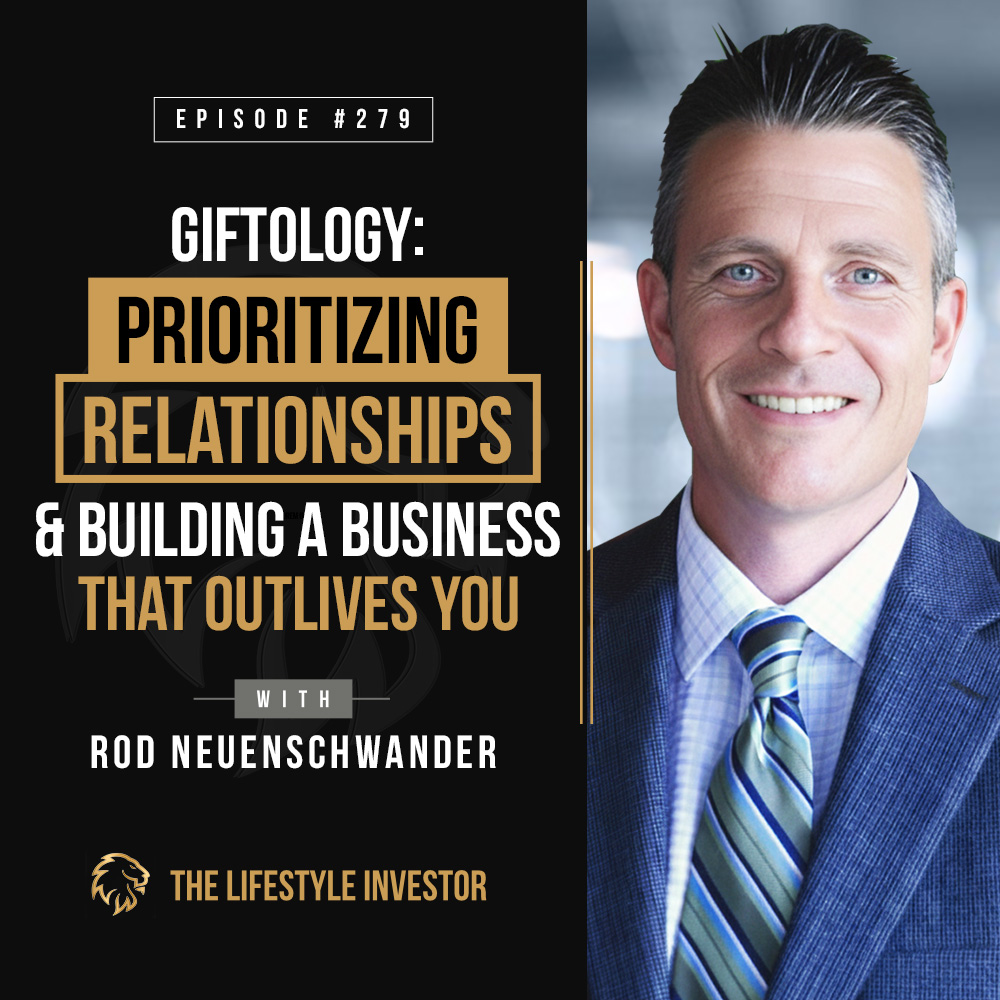
Giftology: Prioritizing Relationships and Building a Business That Outlives You with Rod Neuenschwander – EP 279

From a Huge Exit To Reimaging IT & Cybersecurity with Bill Tyndall – EP 278