![[Justin Donald] - Optin Preview](https://lifestyleinvestor.com/wp-content/uploads/2020/12/Justin-Donald-Optin-Preview-e1607533704966.png "[Justin Donald] - Optin Preview")

![Logo 1 Gold horiz [Converted]](https://lifestyleinvestor.com/wp-content/uploads/2019/08/Logo-1-Gold-horiz-Converted.png "Logo 1 Gold horiz [Converted]")
Interview with Dave Wolcott
How to Build Wealth Like the Top 1% with Dave Wolcott
Have you ever been told that maxing out your 401(k) and diversifying into stocks and bonds is the safest path to wealth?
Today, I’m speaking with Dave Wolcott—entrepreneur, investor, and founder of Pantheon Investments—who breaks down how the wealthiest people really invest. After following the traditional financial advice and feeling stuck, Dave realized there was a better way to build wealth through alternative investments. He has since dedicated his career to helping people unlock the playbook that the top 1% use to grow and preserve their wealth.
In our chat, Dave dives into his personal story of leaving corporate America, discovering financial freedom through alternative assets, and creating a strategy that combines mindset, relationships, and investments. He also shares how he’s passing these lessons on to his children and clients to help them preserve generational wealth.
In this episode, you’ll learn:
✅ How the wealthiest people invest—and why they only allocate a small percentage to the stock market.
✅ Tax-free passive income through smart asset repositioning and alternative real estate investments that outperform typical 401(k)s and Wall Street options.
✅ Dave’s 5 Phases of Holistic Wealth—a step-by-step strategy to build, protect, and multiply wealth while maintaining a balanced and fulfilling life. You’ll discover how to shift from active income to massive passive income streams, allowing you to create financial freedom.
Featured on This Episode: Dave Wolcott
✅ What he does: Dave Wolcott is the CEO of Pantheon Investments helping investors build legacy wealth and achieve unlimited freedom through developing an alternative wealth strategy like the top 1% that includes infinite banking, and alternative assets such as commercial real estate, oil and gas, and self storage.
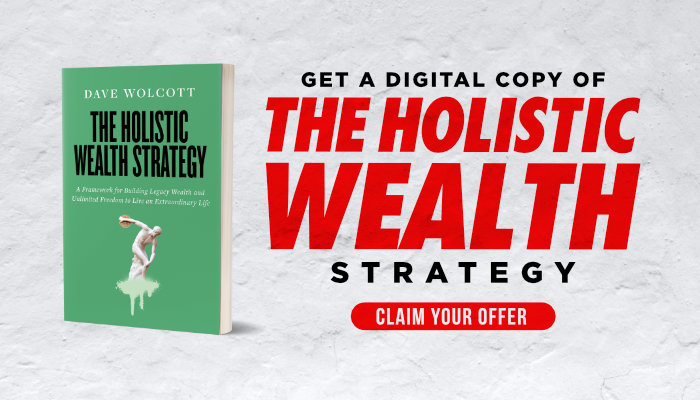
He’s the author of “The Holistic Wealth Strategy, a Framework for Building Legacy Wealth and Unlimited Freedom to Live an Extraordinary Life” and the host of “Wealth Strategy Secrets of The Ultra-Wealthy.” Dave is also an active and passive investor in over 3,200 doors, 400 self-storage units, 160 oil wells, and Merchant Cash Advance assets with a combined value of over $2.5 billion across the US.
💬 Words of wisdom: “If I own a thousand bucks of Tesla stock, all I’m betting on is that that stock can go up in value. But we all know that it can actually go sideways, it can go down. But if you invest in something like cash value whole life insurance, it’s a complete multiplier. It provides tax free growth. It provides legacy planning where you can give it to your heirs completely tax-free. You can collateralize it against loans, you can borrow against it. And the principle still remains intact.” – Dave Wolcott
🔎 Where to find Dave Wolcott: LinkedIn | X/Twitter
Key Takeaways with Dave Wolcott
- From Marine Corps to Financial Freedom
- How Alternative Investments Changed Dave’s Life
- What the Wealthiest People Know About Investing
- Is Your Financial Advisors Leading You Astray?
- The 4 Pillars of Holistic Wealth
- Teaching Family Wealth Values
- Why the 1% Don’t Trust Wall Street
- How to Reposition Your Assets for Passive Income
- Building a Bulletproof Tax Strategy
- How to Create Massive Passive Income
Inspiring Quotes
- “If I own a thousand bucks of Tesla stock, all I’m betting on is that that stock can go up in value. But we all know that it can actually go sideways, it can go down. But if you invest in something like cash value whole life insurance, it’s a complete multiplier. It provides tax free growth. It provides legacy planning where you can give it to your heirs completely tax-free. You can collateralize it against loans, you can borrow against it. And the principle still remains intact.” – Dave Wolcott
- “Your net worth is equal to your mindset IQ, plus your financial IQ, plus your relationship capital, plus your physical capital.” – Dave Wolcott
- “Investors should ask why. They should not be afraid to ask their financial planners or whoever they’re getting advice from, why.” – Dave Wolcott
- “You could be one relationship away from that biggest deal of your life and you don’t even know it.” – Dave Wolcott
Creating Tax-Free Wealth With Whole Life Insurance
Resources
- Pantheon Investments
- Pantheon Investments on Instagram | LinkedIn | YouTube | Facebook | X/Twitter
- Dave Wolcott on LinkedIn | X/Twitter
- The Holistic Wealth Strategy: Your Roadmap to Financial Freedom by David Wolcott
- Robert Kiyosaki
- Rich Dads CASHFLOW Quadrant: Rich Dads Guide to Financial Freedom by Robert T. Kiyosaki
- Cameron Herold
- Charlie Garcia
- R360
- Tiger 21
- Michael Cole
- SPIVA
- Family Wealth–Keeping It in the Family: How Family Members and Their Advisers Preserve Human, Intellectual, and Financial Assets for Generations by James E. Hughes Jr.
- Tom Wheelwright
Tax Strategy Masterclass
If you’re interested in learning more about Tax Strategy and how YOU can apply 28 of the best, most effective strategies right away, check out our BRAND NEW Tax Strategy Masterclass: www.lifestyleinvestor.com/tax
Strategy Session
The Lifestyle Investor Insider
Rate & Review The Lifestyle Investor Podcast
If you enjoyed today’s episode of The Lifestyle Investor, hit the subscribe button on Apple Podcasts, Spotify, Stitcher, Castbox, Google Podcasts, iHeart Radio, or wherever you listen, so future episodes are automatically downloaded directly to your device.
You can also help by providing an honest rating & review over on Apple Podcasts. Reviews go a long way in helping us build awareness so that we can impact even more people. THANK YOU!
Connect with Justin Donald
Get the Lifestyle Investor Book!
To get access to The Lifestyle Investor: The 10 Commandments of Cashflow Investing for Passive Income and Financial Freedom visit JustinDonald.com/book
Read the Full Transcript with Dave Wolcott
Justin Donald: What's up, Dave? So great to have you on the show.
Dave Wolcott: Hey, Justin. Really grateful to connect with you and your audience.
Justin Donald: Yeah. This is going to be fun. Well, there's a lot that we have in common. We just had a chance to interview. You interviewed me on your show, and I felt like just what we talked about was so perfect for this episode for my audience here. And I'm excited to dig into it because I think I found someone that might be more aligned, more similar in thinking and everything in you than anyone else. So, this is going to be a ton of fun because we can dispel some rumors about how most of the wealthy invest. We can dig into some of the stats on how the wealthiest people invest. But I also want to talk a bit about your story because you've been on both sides of the fence here. You've been in corporate America, you've been an entrepreneur, and you've also been an investor and you're currently an investor. And so, yeah, tons to talk about, right?
Dave Wolcott: Yeah, absolutely, Justin. Really looking forward to it.
Justin Donald: Well, like me, one of your greatest influences in life was Robert Kiyosaki. And it's cool seeing the impact that he's had on so many over the years but I think that my biggest ahas and my biggest source of taking action to like get in the game was because of him. And I think you had said the same thing, right?
Dave Wolcott: Yeah. I took the purple pill and really, for me, Justin, I was raised in a middle-class family, probably like a lot of listeners, right? And I was told that the recipe for success was go to school, work hard, get great grades. You'll get a job and then life would just work out. And that was the recipe for success, right? So, I kind of followed down that path, went to college, and then had the opportunity to do the ROTC program in the Marine Corps, and serve my country in the Marines, which was really a phenomenal experience. And I got to learn some things there, Justin, that they just don't teach anywhere else in the world, things such as teamwork, leadership, and integrity. But once I transitioned from the Marines, I got into corporate America, and I really just lost that sense of purpose, sense of mission. It really quickly kind of became a grind.
And then at the same time, I know you'll appreciate this as a family guy as well is that we had an 18-month-old toddler at the time. And then on October 24th, 2000, my wife and I welcomed triplets into the world and literally quadrupled the size of our family overnight. And so, the first thing that was going through my mind, Justin, was like how am I going to provide for financial security? It's a $1 million to raise a kid. And now that's just four plus retirement, all these other things I wanted to do in life. And so, the first thing I did was I sat down with my financial planner, and all he could tell me was, “Max out your 401(k). You're going to make a 7% average over the long term but that's great. You'll do fine. And you have kids. No worries. Put it in 529 plans. You'll get some state tax benefits. You'll do great.”
So, it was right then, Justin, that I just said, "You know what? This is not for me. I had a much bigger future ahead of me.” And so, it put me on this obsessive journey to figure out how the top 1% were actually building their wealth. So, I went on to actually, in 2000, I started investing in alternative deals in real estate, in private equity. I got into oil and gas, retail, raw land, you name it, single-family, multifamily, all kinds of different asset classes over the years. That proceeded to go well. I built a tech business. In the meantime, I had an exit from that. And fast forward to today, I really created Pantheon, and it's really all about helping other investors to just dispel these myths about how to really build wealth, what does wealth really mean, and then trying to provide access and opportunities for people so that they can live their dreams and their best life.
Justin Donald: I love that. And here's the thing. We both had this profound impact from Cashflow Quadrant by Robert Kiyosaki, but it was more of an aha like, "Wow. I didn't realize there was this quadrant. I didn't realize where I existed in this quadrant, and I actually have choices that I can move.” But there was no blueprint on how to go from one quadrant to the next. There is no playbook. There is no how to do it. So, the epiphany was, "Wow, this matrix exists. That's cool. I need to make some moves.” And, I mean, basically, I've done something very similar to you where I spent years of my life diving in and doing these deals and learning in the world of alternative investments and copying after family offices and the wealthiest people and learning their playbook.
And that's why I wrote the Lifestyle Investors to give the playbook the how. And you've done that with your book, too. So, I'd love for you to share a little bit about your book and why you started it, and kind of how it's also a playbook to creating wealth the way that the wealthy do it.
Dave Wolcott: Yeah, 100%, Justin. And the genesis is actually really interesting because I was trying to articulate this and I know you can relate to this as well as many of the audience and listeners out there is that oftentimes we're saying why you should invest in alternative assets or do these different things. And everyone, let's just face it. I mean, 95% of us out there, we all learned from Wall Street and typical financial planning and their version of building wealth is stocks, bonds, mutual funds, 60/40 split. That's what they really talk about. But what I tried to do is just really make something very simplistic that people could follow and really create a framework. So, it all starts with a vision because if you don't have a target, you're going to miss every time. Right? So, getting crystal clear on what that looks like.
So, if you're a lifestyle investor, do you know what your lifestyle is going to look like in ten years and 20 years? Do you have a full like vivid vision from Cameron Herold, right, that really outlines how it's going to feel, how it's going to look, the relationships you're going to have, how are you going to be? So, getting real good clarity on that is really foundational for you to start the journey because that's what's going to help you bust through the walls and really make progress. And then we have five distinct phases, Justin, that you can go through. And the first one, it really all starts with mindset because if you've been told by your financial advisor that investing in some alternative asset is risky and you're worried about that, you're never going to get out of the starting blocks. Okay.
And I know that you pushed really hard and did some different things. I did that as well, right? And I really learned a lot about myself. One of the gentlemen I had on my podcast, Charlie Garcia, he runs R360, which is a centimillionaire community.
Justin Donald: Yeah. I know Charlie.
Dave Wolcott: Yep. 130 members, average net worth 400 million. And the number one characteristic that he'll talk about is actually self-awareness. So, really understanding yourself quite well, understanding those limiting beliefs that you might have. And then starting to understand once you have your vision, you can create goals, you can create habits to support those, look at the relationships, the top five people just like Jim Rohn talks about that you surround yourself with. I know you're in a number of masterminds. I am as well. Are those relationships kind of taking you there? So, that's really phase one. And I'll pause here but if you don't have your mindset right into an open mindset and you have a fixed mindset, this is not for you.
Justin Donald: Oh, it's so good. And it's funny that you bring up Charlie Garcia. Being in Tiger 21, I've gotten a chance to connect with him, and I know he has since left and started this group, but his partner, Michael Cole, lives here in Austin, and we're actually getting together on Friday. And he's an amazing guy, too. If you haven't got a chance to connect with him, he's just awesome and helps run R360 with him. And like you said, getting around other like-minded people, like finding the people that can help you have the mindset shifts, And these pivots is so important. And being around the people that have the track record that they have done the thing you want to do. So, I like what you're talking about with your first step.
I'd like to dive into that first step a little bit more because I remember early on I believed and I know a lot of my friends believed that the wealthiest people made all their money in the stock market and that 60/40 split that's supposed to be the safest allocation, stocks-to-bonds, was one of the riskiest, worst performing in the last 100 years. Just what, two years ago, right?
Dave Wolcott: Yeah.
Justin Donald: Which is interesting to see. And so, it's not always as safe as people think but the problem with having all your money in any single asset class is that there is concentration risk. And the wealthiest people don't do that. They grow their wealth via diversification. They may have made their wealth via concentration but they grow it via diversification. And so, I'd love to know some of your findings because I've been saying for years, based on the data, that the wealthiest people only have about 15% to 25% of their net worth in the stock market, and usually that's because they want to leverage against it to buy alternative investments so not having a sale, using debt to buy alternative investments. And it's quite comical that they're called alternative when the wealthiest people use them as their primary investment vehicle. Somewhere between 50% and 59% is what the recent data for 2023 shows across the board for the wealthiest families in alternative investments.
Dave Wolcott: Yeah. Once you really start to unpack this, Justin, it really becomes quite clear and very simply put. And again, I don't want to necessarily bash financial advisors. I'm sure they're doing some great things out there. I'm not certified as one myself but the way the system is built is that 90% of them, the way they make their fees, it's assets under management. So, they're only going to be recommending to you products that fall into there because that's their agenda. And what I find is that that's so not aligned towards investors, right? Whereas when you get into private equity, it's mostly done on a performance base. And you and I both have been in sales backgrounds before. You should get rewarded and compensated based on what you actually deliver.
But meanwhile, these guys in the entire industry, which is almost criminal, frankly, is that even when the market is going down 20%, they're still collecting fees on you, right? So, it's a great business model for them but sadly it doesn't really help you. And another thing I know you're familiar with this as well, but according to SPIVA, only 88% of financial advisors even beat the S&P 500 index. So, what type of value are you getting for what you're paying in actual fees? And to your point, when you're studying really the ultra-wealthy and the top 1% who are really the best of the best in this game, how are they allocating capital? And we're typically seeing it that, yes, the public equities positions are actually much more defensive in nature where they just don't want to lose capital so much more low risk and certainly doing some margin loans.
We're also a big fan of cash value, whole life insurance. We actually help clients with that as well, which is a big place that, and in fact, I believe it's up over 40% this past two years, contributions into cash life insurance plans because of the uncertainty and kind of turmoil in the market. But it's a key strategy that a lot of family offices use as well.
Justin Donald: Yeah. And this is where they might use this as like the replacement for their bond portfolio or as a larger slice of that bond portfolio. Yeah. So, it's interesting because it does have a guaranteed return, which is nice. And a lot of the wealthiest families have developed a family bank. They use this to borrow against to purchase assets, to pay for education, to purchase homes. And I think it's a really smart move. It's something I've been talking about and using for what? Over 20 years now for me personally.
Dave Wolcott: Yeah. Well, one thing I think that's really cool that the wealthy and savvy investors do very well, Justin, is that the world thinks in a very linear fashion. Right? So, you're looking at a stock. If I own a thousand bucks of Tesla stock, all I'm betting on is that that stock can go up in value, right? But we all know that it can actually go sideways. It can go down. But if you invest in something like cash value, whole life insurance, it's a complete multiplier. It provides tax-free growth. It provides legacy planning where you can give it to your heirs completely tax-free. You can collateralize it against loans. You can borrow against it, right, and the principle still remains intact. And there's like a dozen other different things. But the important lesson for people to think about is every time you deploy one hard-earned dollar of capital, think about what it can do for you, right? And much more than just the return. Can we get it into a multiplier? Because that's what actually becomes exponential. And you can create a snowball.
Justin Donald: Yeah. No doubt. And we'll get into generational wealth and what happens over time, and why this is even a good strategy to preserve family wealth. Right? So, definitely want to talk about that. I want to hit on one other thing, though, because you were talking about fees and you were talking about the misalignment, which I've been talking about for years. It to me is just completely, just unreasonable to have a financial product or a financial industry that is based on other people making money when you're losing money. So, on the alternative investment side of things, we talked about how it's more performance-based. And there are these splits. You've got admin fees, which are very low and then you've got your performance-based or often referred to is carried or carried interest where people make money. These sponsors make money based on how well they perform. They get a percentage of the performance.
And in many cases, their percentage is after it should be after you return all your money but it's also after in many cases, the fees, which is pretty cool. And so, each group does it a little bit differently but I think it's important to recognize that there are more aligned ways to invest. And that's why you see the wealthy investing primarily in alternative investments and not for them, the alt, the alternative investment is actually the stock market, because that is a smaller percentage for them.
Dave Wolcott: And I'll tell you another why. I mean, just to kind of break this down, Justin, the way I see it is it's actually a three-dimensional return when you invest in alternative assets. And that's really our investment thesis is that we're looking for tax efficiency, passive income, and forced depreciation all on one asset. But if I go and do some angel investing, you're just looking at one dimension, right? You're looking for some big upsized return. If I'm investing in stock, you're just really hoping it's going to kind of go up in nature. But these big families, I mean, you can imagine the tax bills at nine-figure wealth, so you have to constantly be working on that. And that's why it's this cycle where they're buying the assets that are going to reduce their taxes, keep creating passive income, and then you have exits periodically.
Justin Donald: Yeah. Smart way to do it and there's no doubt that there is a playbook to growing wealth over a period of time. And if you can teach that playbook to your heirs, to your dependents, then it can continue on. And we see it very rarely with the Rothschild family, with the Rockefellers, but almost more than not I think we're talking about this on your show, but 80% of families in generation two lose all the money, right? And 90% in generation three. And so, I think it's important to recognize that not only is it a focus like when you accumulate wealth, it's not just about the money. It's about the education around the money, the values of the family that supersede the money. And I'd love to hear you speak on that for a bit.
Dave Wolcott: Yeah, 100%. Well, we run a virtual family office and also another internal mastermind group, and we're helping people actually build out family constitutions, right? And creating governance and structure around all this so that you can pass that on to future generations because, as you said, I mean, you could have all the money in the world, right? But if you're not really utilizing it the right way, it's going to evaporate really quickly. And I can share with the audience, I mean, my kids now. So, my oldest is 25 and the triplets are actually 23 right now. But having values, and when we have our annual family retreat, those values are what cut through everything because they all want to be independent right now. They're all doing different things and everything. But we can always come to that common ground of having the values and everything. And that cuts through a lot of the differences. And I think that's what's going to be able to help them make decisions when I'm not around that they can say, "You know what? This is the right thing to do. This makes sense.”
Justin Donald: Yeah. They need to be equipped when inheriting family wealth. If you've read any of the books, the book, Family Wealth, I mean, there are tons of them out there on this that if they're not equipped, they will run through all the money. And we never know how long our time is going to be so we need to be teaching these principles early and often.
Dave Wolcott: Yeah, for sure.
Justin Donald: Now, you left off on kind of like step one here. I'd love to dig into some of these other steps. And by the way, we've probably like commandeered some things, gleaned some things from some future steps but I still love to get through them.
Dave Wolcott: Yeah. It's all good. So, phase two, I think you’re going to like this, Justin. So, I really broke down for the audience out there, just think about it this way. This little equation, your net worth is equal to your mindset IQ plus your financial IQ plus your relationship capital, plus your physical capital. And physical capital, I mean, your health, okay, because you could have all the money in the world but if you don't have your health, you'd only have one dream, okay. So, that's what's got to carry us through all of this. And then just like when you started your journey and I started mine, it was all about financial IQ, pouring through books, learning from others, spending time in masterminds, investing in ourselves as your number one biggest asset.
I've always gotten a 10X, 100X return when I invest in myself, so why should I go invest in someone else's company right away? I can make the biggest changes right there, right? So, I think in this holistic way, and again, we call this the Holistic Wealth Strategy because you need to be thinking about your life 360 degrees and all those things that really matter to you. But getting smarter on your education, listening to great podcasts like Justin's and others that are out there, constantly expanding your mindset with a growth mindset, and again, having health. And think about relationships. I mean, you could be one relationship away from that biggest deal of your life and you don't even know it.
Justin Donald: That's right.
Marco Mereu: And the other thing I'd like to impress upon people is that there were times in my life during my journey where I was like, “I'm so into this. I want to invest more. I didn't have capital.” I ran out of capital. But what can I do? Well, I can constantly be learning. I can constantly be growing. I can constantly be creating newer, bigger, better relationships that expand into different opportunities that could be maybe a bartering opportunity, all kinds of different creative things, and creating resilience and resourcefulness.
Justin Donald: Yeah. I think that's powerful. I love hearing that. And I do think you've got to invest in yourself first. And what you're saying just resonates so much. Let's dig into phase three.
Dave Wolcott: Yeah. So, phase three, as we go through this process, right, it's not only about multiplying your wealth but it's also about preserving your wealth. So, we want to build a team and we want to create an infrastructure. So, phase three is our all-around creating an infrastructure. So, many of us are constantly thinking about that next deal and where we're going to make the most money and everything. But do you have a proactive tax strategy in place? I fired five CPA firms over the years, caused me a lot of pain. You know, writing big six-figure checks is no fun. And I finally figured it out. And last year, I paid 4% in taxes. Tom Wheelwright, obviously, is one of the greatest thought leaders in the space about thinking about tax strategy. This is such an opportunity for people. They just don't even realize.
If we could get you to say a 20% return and we could then reduce your taxes by 10%, 15%, 20%, now think of add that to it. And now you're talking about like, "Whoa, I'm now at 30% to 40% of my return.” So, tax strategy is really important because that's, number one, infinite banking is key. We've really talked about this strategy a little bit but adding velocity to your overall portfolio. So, I take all of my passive income that comes in from all these deals and I don't need to live off of all of it so I recycle it right back into the policy until I get my next tranche and then I'm liquid. I have dry powder for when great opportunities come. And that's also where I keep my sleep-at-night capital in a protected place that's even safer than banks, right? It’s been around since the Civil War.
So, I think that's important as well. And then, of course, these other key areas such as asset protection and estate planning and again going back to what we were talking about earlier, if you talk to your financial advisors, "Sure. I have an estate planner. I'll help you. I have a lawyer. Let me get you the referral.” I kid you not, I've spent 20 years really trying to find the people who they work with business owners, investors, entrepreneurs, and understand this type of strategy. It's a whole different way to look at things. How they're protecting assets, how they understand your tax strategy, how they understand your investing strategy with passive income. Now, the only downside is you go try to get a loan from a traditional lender and they say, "This is crazy.” You've really got a ton of money but the way you're structured they don't like it, right? But these things are really important, the infrastructure. So, that's really phase three.
Justin Donald: Yeah. And you're talking about the estate plan, getting it out of your estate using a domestic asset protection trust, adapt, or some product like that, which I think is incredible. We need to do it. Like you, I spent a long time trying to find the right attorneys that specialize not just in estate planning but estate planning with the wealthiest people in the world. I think that's important because if they can handle someone playing it at the highest level in the billion-dollar category, a billionaire, then they most certainly can handle mine. And I'd rather be bottom of the food chain than top of the food chain with any sort of provider like that. I want to know that they've handled every situation under the sun.
Dave Wolcott: Yeah.
Justin Donald: And you brought up so many other points on just velocity of money, which I talk about. And I think that's so important. But with tax strategy, I think people don't often see the long-term impact. So, I get the question all the time, “Justin, what's the best investment you've ever done?” And most people think I'm going to say an actual investment, but the best investment I've ever done is invest in world-class tax strategy because the money that you save that you then can invest, let's just say conservatively at 15%, and there's tons of alternative investments where you can conservatively get 15% like that'd be a super low-risk deal. You'll notice, like if you study the charts over the last 30 years, you'll see that generally alternative assets outperform public equities by 50% plus, and really kind of fall in that 15% range. Okay.
And so, you think about that and you think about the compounding of just saving $30,000 a year in taxes over the course of ten years. With 15% return, you're over a million bucks. Over 30 years, you're over $13 million. And that's something that could be ongoing. And for a lot of you listening, you can save a lot more than $30,000. So, you're speaking my language. I love all the stuff you're talking about. Let's keep going. What's phase four?
Dave Wolcott: Okay. So, phase four is fun. And I got to tell you, I guarantee that as many of your listeners out there love you and what you're talking about, they have more than 50% of their assets tied up in qualified plans or some types of public equities, right? So, phase four is actually what we call asset repositioning. So many people have great opportunity to take that old IRA, put it into a self-directed IRA, right, and then start investing in some of these alternative opportunities. I know you're a fan of private credit. We have a private credit opportunity as well and it's amazing. Strong double-digit returns, low risk, non-correlated to the market. Fantastic, right?
And just as an example, so if you're sitting there and you've got qualified funds that are earning at best a 7% return over the average, you could literally convert that into an SDIRA, put that into this private credit fund, and triple your money, which means that the acceleration you can get on that from doubling your money, it's like half. It's like cut in half. So, those numbers are really big. And then we also find that so many people are under that old myth where paying off your house earlier makes a lot of sense. So, we have trapped equity in our homes across the country. And you know this, Justin. What's the rate of return on equity in your house? It’s zero.
Justin Donald: Well, it's nothing. Yeah.
Dave Wolcott: It's a goose egg, right? So, if I could actually even at today's rates at 7.8%, I could leverage some of that money right now, pull it out, pay 8%, does a number of things. So, first of all, it actually increases your mortgage interest deduction so lowers your taxes. It also reduces your risk from creditors because now the bank actually owns more of the asset than you. And now I could take that capital, that 8%, and let's say I'm putting it into something that's 20% plus. So, even with the arbitrage, I've turned idle capital into something that's returning. So, I think that's a really great opportunity. And granted, people need to think about what their own risk tolerance is, what makes sense for them, and certainly bet on something that they're confident in.
But those are some great opportunities for people to really reposition. We also have as another example, we have an oil and gas fund. And a lot of people don't realize that active income can be offset by oil and gas. Again, another asset that's non-correlated. So, if you make that investment and we do this in our business every year into oil and gas, it's like you're going to pay a check to the government or you could pay it into this investment that has a yield to it. So, being kind of smarter and repositioning that capital that you do have into higher performing yields.
Justin Donald: Yeah, I love all that. I think it's great. I love that you're talking about finding ways to get into the alternative game even through qualified plans. And by the way, on some of these solo Ks and for and Roth IRAs, I mean, what a great time to get into private credit where typically you're going to pay ordinary income, short-term capital gains. But inside of these qualified plans that are tax-free, if you've done like a backdoor Roth or whatever, now you're getting that full return and a lot of these deals, I mean, you got to be careful, of course, with any investment. And not all private credit deals are made the same. You invest in a fund, you're already de-risking because you have multiple deals under that entity versus a single deal. But you also, if done correctly, have low leverage, have high collateral, and many times as 2 or 3 or 5 to 1 for the capital that's in. So, it's very risk-adjusted, very de-risk from that standpoint, which I love. And just I couldn't agree more on so many of the other things that you've been talking about.
Dave Wolcott: Yeah. And I'll throw another one out there to really spice things up, Justin, and I know you'll appreciate this. Again, this isn't for everyone. I'm not a tax consultant or anything. But look, in my journey, I was really struggling with how could I get more capital because I became more and more confident as an investor in what I was doing. So, I looked at that 401(k) money, and instead of even doing a self-directed IRA, I said, "You know what? What if I actually did the most taboo thing that there is?” And I sold it and I paid the penalty and paid the taxes. Okay. So, I went through and I'll actually share this with your audience if anyone is interested but we have a 401(k) exit calculator. Okay.
Justin Donald: That's cool.
Dave Wolcott: So, if you take 100K of your principal and let's say you paid 10% penalty and we'll even factor in 35% in taxes. So, now you have a net investable 55K. And now if I invest that for the next 20 years into let's say an alternative asset or real estate earning 20% versus had I left the capital in there growing at 7% marking to the market, what do you think the difference is, Justin?
Justin Donald: Oh, gosh. Well, it's got to be exponential. So, right there you're talking about a 13% swing except that over time it's going to be much greater than that. So, I'm going to imagine you're probably at a 5X differential.
Dave Wolcott: Yeah. So, I'll help you out. So, literally that 55K over 20 years, assuming a 20% compounded rate and of course this is being tax efficient, grows to $2.1 million. Had I left that in the 401(k), that same amount is 388K and then after taxes and fees, you're at 250K.
Justin Donald: Yeah. That's significant. Even greater than a 5X differential, which doesn't surprise me.
Dave Wolcott: Yeah. So, I think the lesson here is to just investors should ask why, right? They should not be afraid to ask their financial planners, whoever they're getting advice for, keep asking why. It doesn’t really make sense to defer taxes. I mean, that's another thing I really struggled with. They said, "Go ahead and keep deferring your taxes.” So, what? They assumed that you're going to retire poor, right? But it doesn't make any sense. I'd rather pay taxes on the seed rather than the harvest right now, and then get into something more tax-efficient.
Justin Donald: Yeah, and lowest taxes right now. I mean, the taxes are great right now. They're likely only going to get worse. The government deficit is likely to grow. I mean, there's just all the reasons in the world why the tax burden is going to be greater in the future anyway. So, I cannot be convinced that I should defer those taxes until later.
Dave Wolcott: Right.
Justin Donald: What about phase five?
Dave Wolcott: So, phase five is the last one. And this is where you fit in, right? It's all about building massive passive income. So, creating multiple passive income streams, diversified assets as we've kind of talked about. And so, this is the fun one where your mastermind kind of comes in or looking at alternative options that people can really, I think, accelerate their wealth and really in an asymmetric way, meaning that you've got a greater yield and lower risk than just being subjected to the volatility of the stock market.
Justin Donald: Yeah. That makes a lot of sense. I know you're a big fan of investing in people, investing in relationships, investing in education, masterminds. You're in a bunch. You have one. I know you see the value of it. I'd be curious to know the impact as you've seen it over time. We're talking about getting the passive income but I also think you need to be around the people that are also looking to do the same thing but have experience and have already done it at a high level for years. And that you have access to deals that are de-risked, that aren't retail type of investments because as I tell my community, most deals are bad.
You should actually be saying no way more than you say yes. If you want to do well in life and in investing, say no almost all the time and be very selective with where you say yes. But get around people that are really good at vetting deals, that have experience investing themselves, and that have a track record and have some deal flow that they can offer you so that you don't have to do all the legwork yourself.
Dave Wolcott: Yeah, 100%. And we mostly think of leverage in terms of getting some kind of debt to enhance the returns on our deal. But this is really an ideal piece of leverage where you're leveraging people's experience and you can get into these assets and oftentimes I'll talk about this with investors is they get excited about something like, let's say, real estate and they want to invest in it. Well, your time is your greatest asset. So, do you want to be an active investor? It means that's a job. I mean, you have to really think about that, right? So, I would rather leverage a team that has tons of years of experience. You have a professional asset manager. You have a professional acquisitions guy who even uncovered the deal in the first place that you would never be able to because he's been in that market for 20 years, knows everybody and you were able to find that. So, I think that's a really a great form of leverage for opportunities.
Justin Donald: Yeah, I love it. Well, I'm just so thrilled we've been able to kind of spend some time going over the things that we're both passionate about that I think the world needs to know. Right now we're in a place where Wall Street controls the financial education. They control them in schools. They control it through financial advisors. The vast majority of what people hear is going to be geared towards what makes the financial services more money. And that is where the masses put their money. But that's not how the wealthiest people in the world do it. And so, I'm glad that we can spend some time kind of highlighting what did the top 1% do? What did the top 0.1% do? What did the top 0.01% do? Because this is where we want to master. This is where we want to major in is like this education, these strategies, this asset allocation. And we have had just a ton of fun talking about it. And you're a wealth of knowledge in this space. I love it.
Dave Wolcott: Yeah, 100%, Justin. Really agree and that's really my mission is to help educate and create more impact for people so that we can ultimately make the world a better place. And having that knowledge plus taking action is extremely powerful. So, it's great that you do the show. Kudos to you. And I think we need more of this out there so people can kind of take control. It's also part of control, right? It's like take back control of your life and create that life that you really want to live.
Justin Donald: Yeah. No doubt. And it's interesting. I just shared a slide in the Lifestyle Investor Mastermind, like in our community space that basically broke down where the wealthiest people's wealth comes from. And so, it starts at like the 99%, 98%, 90%, 80%, 50%. It goes all the way down to 1%, 0.1%, 0.01%, 0.001%. And the interesting thing is, as you climb down, this probably is going to make a ton of sense to anyone listening, right? The more you're in the masses with everyone else, the more you're in the 99%, the higher it is that wage is the largest contributor to wealth creation. The closer you are to the 0.1%, you transition from wage to business income, and then you transition from business income to investment income.
And so, once you get down to the 0.001%, it's almost all investment income. So, wage disappears and it's just investment income and business income. And it's fascinating that literally from 0.1 to 0.001, the shift from business income to investment income is even like a huge flip-flop, right? It's still weighted to investment income first, business income second, but that investment income category just keeps growing the wealthier people are.
Dave Wolcott: Yeah.
Justin Donald: Pretty cool stuff. So, Dave, where can people learn more about you and all the cool stuff you have going on?
Dave Wolcott: Yeah. If people are interested, they could get a free copy of the book at HolisticWealthStrategy.com, and that's the best place to start.
Justin Donald: Love it. Well, I'm glad we got a chance to hang out. Love your story. Love all that you're doing for the world. I mean, I feel like you and I could literally just talk and hang out for hours, and I look forward to the next time we connect. I love ending every episode with a question, of action to our audience. And my question is the same every week. And here it is. What is one step that you can take today to move towards financial freedom and really move towards living a life that you truly desire? So, it's on your terms. It's not a life by default. It's a life by design. And I just beg of you, what is one thing, pick one thing that you learned from Dave today that you can implement today to move towards financial freedom. Thanks, and we'll catch you next week.
Sign up to receive email updates
Enter your name and email address below and I'll send you periodic updates about the podcast.
Keep Learning
How to Avoid Leaving Millions on the Table When Selling Your Business with Stephen Scoggins – EP 281
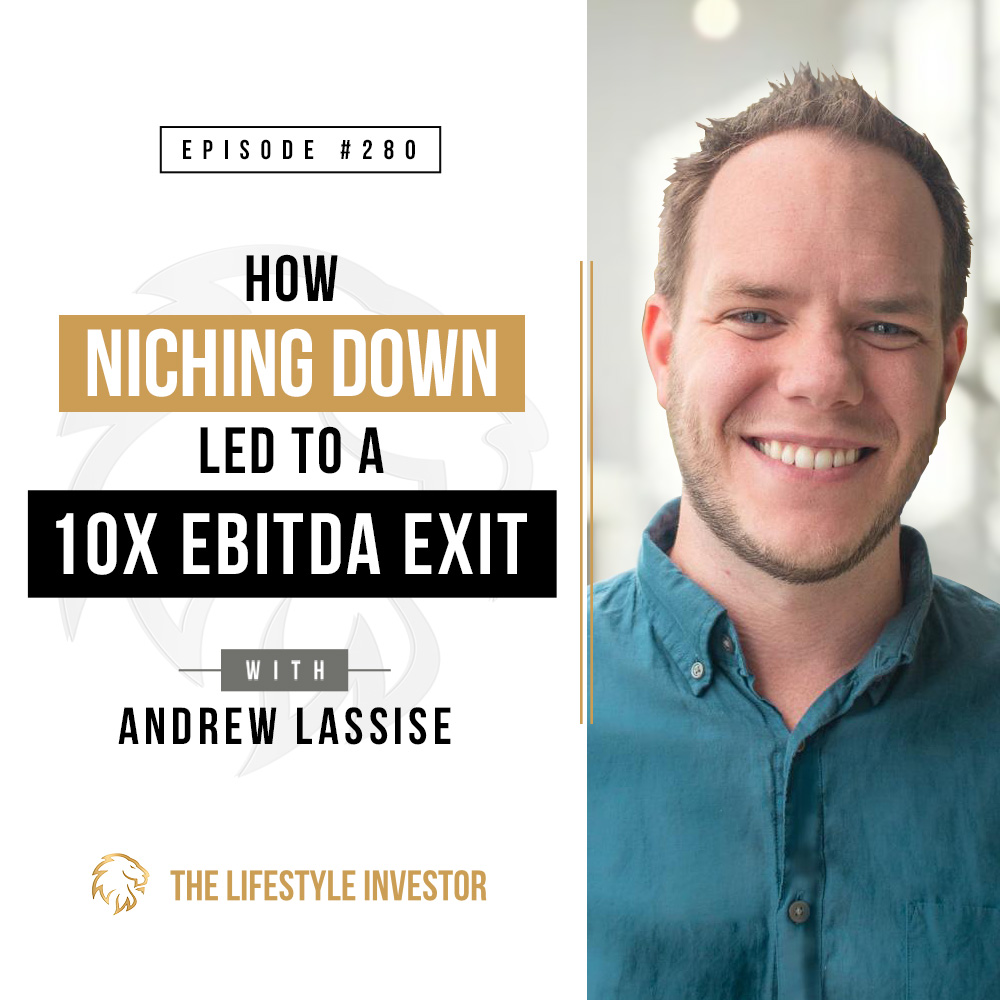
How Niching Down Led to a 10x EBITDA Exit with Andrew Lassise – EP 280