![[Justin Donald] - Optin Preview](https://lifestyleinvestor.com/wp-content/uploads/2020/12/Justin-Donald-Optin-Preview-e1607533704966.png "[Justin Donald] - Optin Preview")
![Logo 1 Gold horiz [Converted]](https://lifestyleinvestor.com/wp-content/uploads/2019/08/Logo-1-Gold-horiz-Converted.png "Logo 1 Gold horiz [Converted]")
Interview with Christopher Zook

Tony Robbins’ Co-Author Reveals the Secret to Investing Like the Wealthy with Christopher Zook
Did you know less than 1% of companies are publicly traded? While most investors obsess over stocks, the ultra-wealthy are quietly building fortunes in the other 99%. Today, we’re unlocking their playbook.
In this episode, I’m talking with Christopher Zook, Founder of CAZ Investments and co-author of “The Holy Grail of Investing,” which he co-authored with Tony Robbins, to explore how the wealthiest individuals invest differently. From private equity and real estate to professional sports ownership, Christopher reveals the strategies they use to create cash flow, reduce risk, and build lasting wealth.
We break down why private markets consistently outperform public markets, the power of true diversification beyond stocks and bonds, and how to align your investments for maximum upside with minimal risk. Plus, Christopher shares game-changing insights into new legislation that could make these opportunities accessible to more investors than ever.
If you’re ready to rethink your approach to investing, this episode is packed with actionable insights.
In this episode, you’ll learn:
✅ How new rules around accredited investors are opening up private markets to more people, including the ability to invest 401(k) and 403(b) plans in private opportunities.
✅ Why GP Stakes are one of the hottest private equity trends of the past decade, how he became a first mover in the space, and why this investment offers a stronger risk-reward balance and reliable cash flow.
✅ How big family offices and high-net-worth investors think about capital allocation, risk management, and building generational wealth away from the volatility of public markets.
✅ How Christopher is entering the rapidly expanding world of sports investments, why it’s poised for massive growth, and what it means for investors looking to capitalize on this emerging trend.
Featured on This Episode: Christopher Zook
✅ What he does: Christopher Zook is the Founder, Chairman, and Chief Investment Officer of CAZ Investments, one of the largest Private Equity allocators in the world. He has more than 30 years of experience investing in both traditional and alternative asset classes. In 2001, Zook founded CAZ Investments which curates exclusive investment opportunities for a global network of investors that spans all 50 states and 19 countries.
In 2019, Christopher was appointed by the Texas governor to serve on the State of Texas Pension Review Board, where he serves as Chair of the Investments Committee. Christopher is a lifelong Houstonian, and his greatest joy comes from being married to his high school sweetheart, and spending time with his son, daughter-in-law, and grandson.
💬 Words of wisdom: “One of the things that is so important and the big family offices fully embrace and just very sophisticated investors in general, they fully embrace the concept that the only free lunch in the world of investing is diversification.” – Christopher Zook
🔎 Where to find Christopher Zook: LinkedIn | X/Twitter
Key Takeaways with Christopher Zook
- Intro to Christopher Zook
- The secret diversification strategy of wealthy families
- Why private markets outperform public markets
- The power of non-correlation in investing
- How GP stakes create unique alignment for investors
- Professional sports: A legal monopoly with untapped potential
- The rise of institutional ownership in sports franchises
- Emerging legislation for accredited investor access
- Why 401(k)s could soon include alternative investments
- Christopher’s bullish stance on energy investments
The Holy Grail of Investing
Inspiring Quotes
- “The power of the network is the network. And so, being able to partner with other networks that are very powerful enables us all to be able to win together.” – Christopher Zook
- “Having access to very high-quality institutional opportunities that are truly non-correlated to the rest of the portfolio, that is the holy grail of investing,” – Christopher Zook
- “Where there’s good alignment, there’s usually good decisions. Where there’s bad alignment, there are frequently not good decisions.” – Christopher Zook
- “We spend so much more time talking about the downside. We know the upside will take care of itself. That’s where we really encourage people to focus is what could go wrong, not get all excited about all the things that could happen if everything goes right.” – Christopher Zook
- “In 34 years of investing, I’ve never, ever seen a better risk reward than GP stakes because it’s a contract that guarantees you a cash flow stream by the investors in those funds.” – Christopher Zook
Resources
- CAZ Investments
- CAZ Investments on LinkedIn
- Christopher Zook on LinkedIn | X/Twitter
- The Holy Grail of Investing
- JP Morgan Private Bank
- UBS
- Goldman Sachs
- KKR
- Tony Robbins
- Ray Dalio
- Harry Markowitz
- Hans Box
- NFL
- Major League Baseball
- NBA
- National Hockey League
- Major League Soccer
- Amazon Prime
- Arctos
- Fenway Sports Group
- Paris Saint-Germain
- Aston Martin Formula One
- Apple
- Golden State Warriors
- Jerry Jones
- Boston Red Sox
- Pittsburgh Penguins
- Harris Blitzer Sports Entertainment
- Philadelphia 76ers
- Prudential Center
- New Jersey Devils
- Sacramento Kings
Tax Strategy Masterclass
If you’re interested in learning more about Tax Strategy and how YOU can apply 28 of the best, most effective strategies right away, check out our BRAND NEW Tax Strategy Masterclass: www.lifestyleinvestor.com/tax
Strategy Session
The Lifestyle Investor Insider
Rate & Review The Lifestyle Investor Podcast
If you enjoyed today’s episode of The Lifestyle Investor, hit the subscribe button on Apple Podcasts, Spotify, Stitcher, Castbox, Google Podcasts, iHeart Radio, or wherever you listen, so future episodes are automatically downloaded directly to your device.
You can also help by providing an honest rating & review over on Apple Podcasts. Reviews go a long way in helping us build awareness so that we can impact even more people. THANK YOU!
Connect with Justin Donald
Get the Lifestyle Investor Book!
To get access to The Lifestyle Investor: The 10 Commandments of Cashflow Investing for Passive Income and Financial Freedom visit JustinDonald.com/book
Read the Full Transcript with Christopher Zook
Justin Donald: Hey, Christopher, great to have you on the show.
Christopher Zook: Thank you so much. Glad to be here.
Justin Donald: Yeah. This is going to be fun. We've been talking for a bit. And by the way, I'm such a huge fan of you, the work you've done, your team, many of the team members I've met over the years. Shout out to Clark because I think he's amazing. We were chatting about him off-air, but you have built an incredible team and an incredible organization.
Christopher Zook: Well, thank you very much. It is a team sport and we feel like we've got good players on the team and good coaches and we're excited about what we're doing and we're excited about the future.
Justin Donald: Well, I'm excited about our time today and all the cool stuff we get to get into. And I also want to give you a thank you because as partners with the Lifestyle Investor Mastermind, we've been able to do a lot together. And you guys have been very generous to us with preferred terms and just all kinds of cool things for our community. And so, we're appreciative of that. We're appreciative of the minimums that you've given us. And just a lot of TLC so thank you.
Christopher Zook: Yeah. You're very welcome. And we love partnering with groups like this because of the fact that we say it all the time, the power of the network is the network. And so, being able to partner with other networks that are very powerful enables us all to be able to win together.
Justin Donald: That's right. Well, I'm excited to visit you and come to my first-ever annual shareholder meeting that you guys are doing for your investment community and your funds in January. So, I know I think this is your ninth year running, but it'll be my first.
Christopher Zook: Now, it is a very big event. It keeps getting bigger, which is a little daunting, but it's very popular. We have people fly in from all over the world literally to come for a couple of days to learn a lot about what's going on in the world and the major themes that we're involved in. And so, we're excited that you're going to be able to make it to Houston this year.
Justin Donald: Yeah, can't wait. And one of the things I think it'd be fun to start with here today is this whole world of alternative investments. Back in the day, years and years and years ago, there wasn't this transparency into the way that the wealthiest people invest their money. A lot of people are a little bit more secretive with how they invested. There weren't kind of the surveys and the data that now exist for how the wealthiest people invest their money. And so, I think most people grow up thinking, "One, I need a financial advisor. Two, I need to have a 60/40 split between stocks and bonds." And then that's considered diversified.
But the wealthiest people have a whole different idea of diversification that is way more diversified than that. And generally, the public equities or the stock market is only a fraction of it. It's only 15% to 25%. Maybe in a boom year it goes up to 29% or 30%. But most of the time, the sweet spot is kind of that 20% to 25%. So, where on earth is all the rest of the investment dollars and capital that these family offices or the groups that manage money for the wealthiest people? Where does it go?
Christopher Zook: The reality is the bigger the family, typically, the less their wealth is in public plain vanilla securities that basically everybody else can buy. There are obviously exceptions to that. But generally speaking, if I gave anybody just $100 million in cash and said, "What do you want to do with it?" the first thing they're going to do is to want to make sure that they have enough of it set aside that they never have to worry about getting wealthy again. And then they're going to want to have a little bit of money in that mom apple pie and kind of plain vanilla investments. And then they're going to have a whole lot of stuff in their portfolio that only wealthy people get to do. And that, of course, can be a very significant mixture depending on the psychology and the objectives of the particular family and all of those other suitability issues.
But when you start thinking about what each family is really looking for, it's really always going to revolve around a couple of things. They're going to want cash flow and they're going to want to have growth and they're going to want to be able to do so with as much predictability as possible. And one of the things that we can all agree on is that the public stock markets are usually not that predictable. There are periods of time that they're just predictable because they go straight up or they just go down straight down. But most of the time they just gyrate. And a lot of people are like, "I don't need that kind of noise in my life. I already have enough money." So, they're going to invest in everything else. They're going to invest in real estate. They're going to invest in fixed income, private credit.
They're going to invest in venture capital, the next opportunities that the world is going to create. They're going to invest in so many other different variations alongside the traditional buyout world, as well as just the private company world that we have. A lot of people don't realize this, but 90 plus percent of the companies over $100 million in the United States are private companies. So, that means there's only the small amount to choose from. Some of them are massive, obviously, NVIDIA or Apple, Amazon, etcetera. But the rest of the economy comes from the other 90% that are not trillion-dollar-plus companies. And so, naturally the average very affluent investor, they get that. They understand that. They want to be exposed to the real economy that's going to come through the alternative investment universe.
Justin Donald: You know, it's interesting. I read a statistic recently that basically said that less than 1% of all the companies in the world are available in one of the public markets, one of the stock markets, less than 1%. That is mind-boggling to think about that you're limiting your investment opportunity to such a small percentage. Because if you said that and, by the way, this is your livelihood like building wealth and retirement and all these things. You talked about the stock market not being either the two main things of diversification and I would even say just like utility today, right? Like, the cash flow that you use today, it gets tied up. There are very few things that actually give you that cash flow.
And so, I was reading some of the Family Office reports. I'm a client of JPMorgan Private Bank and so I get their information and UBS and Goldman and KKR, some of these other big PE firms. And then there's tons of just Family Office data that's out there. There are groups that will aggregate this data from the single family offices or from multifamily offices that represent families that are sent to millionaires, 100 million net worth or above. And the spread what I'm noticing is it's really anywhere from about 44% or 45% to 59% of net worth of the wealthiest people in the world, or specifically even in the U.S. if you want to segment it, is in alternative investments, and that number is growing. So, the number in 2021 was less than 2022 is less than 2023, and we won't get the 2024 numbers until around April, May of next year. But it will be interesting and I suspect that we will have more money in each of these categories of alternative investing.
Christopher Zook: I agree with you and it's only logical. And for the audience that maybe have not seen the statistics, we talk about it a lot in the book that I wrote with Tony Robbins. But the amount of outperformance, looking at private equity compared to public equity has been just astronomical. And you're talking about 30, 40, 50 times, depending on what time horizon you look at, more money in your pocket by investing in private equity than if you invested in public equity. We've had a really good public stock market. But the reason is logical. If it's going to be daily liquidity, you're going to give up something to get that liquidity and usually that means the performance is not going to be able to keep up with what is happening in the private markets.
And you're going to have to give up something to get that performance and that is you can't sell it every single day. You may not have zero liquidity, but you're not going to have daily liquidity. And there's all kinds of things within the ranges there. But the more that people understand that they don't need every single dollar to be available tomorrow, right, they have the ability to invest in a more sophisticated way, in a way that should deliver over time a much better return for them.
Justin Donald: Yeah. And so, to pile on to that, when a financial advisor says, "Hey, you're diversified at a 60/40 stock-to-bond split," which by the way, was one of the worst performances of any split the last few years over, you know, out of the last century, right? But that apparently is diversified. But to the family offices, when they say, "Hey, here's the money that we need liquid," they're actually talking about a percentage that's usually 5% to 15%. That would be cash or cash equivalents. And then they have another bucket that's 5% to 15%. That would be fixed income that they could liquidate if they needed to. It's probably at different durations. And so, the way that they do it, it's based on private equity, it's based on private credit, it's based on real estate and a handful of other things.
But I think it's important to point out that for the last 30 to 50 years, probably beyond, private markets have outperformed public markets by over 50% performance, which in a single year is pretty substantial. But even for the people that are pro, you know, having all their assets in the stock market, which I think is pretty risky even for the people that are pro, that scenario, I don't think they consider the gravity or the impact, the exponential impact of what that means over a 10-year or 20-year or 30-year period of time when you're saying 50% greater year in and year out. And I'd love to hear you speak to that because you've seen it firsthand since you've been in the investment space for over 30 years. By the way, you've been both on the public side and the private side, right?
Christopher Zook: That's right. And we can invest in anything anywhere at any time. So, we never have to choose one over the other unless we really believe that's the best place for our personal capital. And that's the reason why the firm started 24 years ago was to be in a position to invest our capital, whatever was the best opportunities, wherever those opportunities are. Sometimes it is better in the public markets to take advantage of a specific opportunity. Most of the time it's better in the private markets to take advantage of that. But we always will consider both because it's just assets and we want to invest in the assets from the best way that we possibly can. The key to what you said, I'll unpack it a little bit and put it this way, I was on the phone with somebody the other day.
This was probably two weeks ago, and they were, you know, one of our team had someone and we were talking to them about what they were doing. They said, "Oh, I'm totally diversified. I'm totally diversified. I own Microsoft. I own Amazon. I own Apple. I own NVIDIA. And I mean, I'm diversified. I got plenty." No, no, no. Sorry. You don't. In 2022, that portfolio was down something like 57%. I think I left out Meta from that equation that they owned. So, you're talking about a 50-plus percent decline. And the problem is most people don't have the stomach to ride out those kinds of losses and not throw in the towel, so to speak, which causes them to miss out on the recovery. Some people do, and that's okay. But having that much concentration is just going to dramatically increase the volatility, is going to dramatically increase the risk.
And so, one of the things that is so important and the big family offices fully embrace and just very sophisticated investors in general, they fully embrace the concept that the only free lunch in the world of investing is diversification.
Justin Donald: That's right.
Christopher Zook: So, that's easy to do if you can get it. The problem is most people just look at the effectively negative selection bias. You made the statement that 1% of the companies are public that are available to be purchased in the world. Well, that means you only can pick from that very small pool. Well, sometimes it's really good companies, but sometimes it's not. And many times, they're much better in the other 99% that you would want to invest in. But no matter what you do, you want to have that diversification. Diversification comes from not just having 20 securities in your portfolio. It comes from having things that don't correlate with each other. And correlation is a term that a lot of people use and they really don't understand.
So, it's just simply how much do things move together in the same direction at the same time. I use the example, I'm a golfer, right? If I owned a golf shop and all I sold in my golf shop were umbrellas, then on rainy days, I'm going to sell a whole lot of umbrellas and every other day I'm not going to sell many, really much of anything. And if I also sold sunscreen, on the other hand, well, then on sunny days, I'm going to sell a lot of sunscreen, very little umbrellas. But if I sell both, then on the average day, I'm going to sell something. And what it's going to do is maybe I end up in the same place but I have a much smoother route to get there.
That is the benefit of what Tony and I referred to and Ray Dalio refers to and Markowitz referred to as the holy grail of investing or modern portfolio theory, which is 8 to 15 less correlated assets that truly have things that are zigging and zagging at different times. That is what provides people the peace of mind and usually much better returns while they get less volatility. And the challenge is most people don't know where to get it and they don't have access to truly institutional quality. And I got to tell you, that's the thing that drives me more, gets me more upset than just about anything else, is when I talk to people around the country and literally they're investing in something because they heard about it in the locker room and it's going to be this well in South Texas and it's going to be great.
And it's just something that every single person that has any sense about that industry has passed on. But that's what is getting to them so they think it's a good idea and they invest in it. Usually, it doesn't work out very well and that's very unfortunate. So, having access to very high-quality institutional opportunities that are truly non-correlated to the rest of the portfolio, that is the holy grail of investing, if you will.
Justin Donald: Yeah, and I love that. And I want to talk a little bit about the book because it's a fantastic read and I'll get to that in a second but you had said something that I just want to point out. I had mentioned that I had read that less than 1% of all companies are available on the stock market or one of the stock markets. You can say it for U.S., U.S. private companies versus U.S. public companies. You can say it worldwide as well. But specifically, 25 years ago, there were closer to 10,000 companies, probably a little over that, right? And so, now we've dwindled down to 4,000. Part of that, probably the issues with regulations and all the things you can and can't do once you're publicly listed, part of it, though, is maybe even the toll it takes on you as a company to go through four years and $40 million in cost to actually become a publicly traded company.
And so, I just feel like to have all your eggs in that single basket, it's funny to me hearing anyone say, "Oh, you're diversified," because to have all your money in the stock market, to me, is the riskiest darn thing I've ever heard. That's like all of your money in crypto or all of your money in whatever the asset classes, all your money in early-stage companies. It's highly risky. It's super volatile. You could have a really good vintage or really good season and everything's great and then literally the next season it could tank and it could be wiped out. And so, I just think that that's really important. But I'm a huge Tony Robbins fan. I've taken every program and course and leadership, you know, like whatever it is, boot camp, everything he's ever done.
I've gone through the ranks of his leadership development, and I think the world of him. I've read all of his books. And so, this book is my favorite. It's the best one I think that you guys wrote this together. I think it's the only one you wrote together, but I think it's the best of his books. But I also think it gets at the heart of what is missing today, this lack of education, this lack of information. It's really what's the best way of saying it? You know, we're democratizing this alternative investment asset class that most people don't even know exists. So, there's like this marketing campaign to let people know, "Hey, this is there." And then also we're democratizing in a way that you actually can get access to it.
Christopher Zook: And that's really what we wanted to accomplish, because the fact that there are so many people out there that would benefit from what's available in the private markets and ultimately what has because of some various reasons, there's no real strong folks out there talking about it to the rest of the population other than the very, very, very wealthy and the largest institutions. So, what we set out to be is to become the voice of the private markets. And to do that, we utilize the very high profile of Tony to be able to get this out to the world. But it is a very educationally driven book.
Our goal, which I've been told that we accomplished fairly well, is to make sure that people whether they have no idea what a GP stake is or why you would want to own a professional sports team or what is enterprise software, how does it work, for those who have no knowledge whatsoever, it's very educational and they can follow it and understand it. But those that are very sophisticated can also benefit from that as well. And that's the first half of the book. In the second half of the book, everybody can benefit from regardless of their level of sophistication or knowledge or experience because we interview 13 of the top investors in the world. And we understand how they got to be who they are, where they are, what has separated them from the crowd.
And so much of that information is applicable regardless of what somebody does, what their business is, the investments that they make, etcetera. It's just great words of wisdom, which I benefited from a great deal. I knew these people beforehand, but I really just loved hearing more of their story of how they became this world-class investor and built this world-class firm that they have obviously put together. So, really enjoyed it. It was a lot of work, but it's something that I think everybody would benefit from reading. But going back to your point about democratization, one of the things we wanted to do is democratize not only the information but also to work very hard with Congress to be able to pass legislation to where people that right now, in order to be an accredited investor or qualified purchaser, it's based on income or net worth or both.
We felt like that's not the right way to do it. There's a lot of great people out there that are really, really smart, but they have chosen to work in academia or they've chosen to work in non-for-profit or they're just really smart, but they haven't had enough time to accumulate. And so, they're not allowed to invest in the same stuff that very, very wealthy people that may not have a clue are allowed to invest in. So, right now, there's a bill that has passed the House and there's a bill that's been introduced in the Senate that's a sister bill to allow basically to tell the SEC to create a test that would then allow people to take that test and become an accredited investor, not by their income, not by an arbitrary net worth number, as though somebody is like really, really smart if they're above this one digit, right?
It's like no. Take the test. Pass the test. It's like a CPA exam or CFA exam, etcetera, and then you can invest in whatever the most sophisticated investors are allowed to invest in. So, we're really excited about that. We feel comfortable that either in the next couple of months or after the new administration takes over that we'll be able to get that bill passed and really open the doors up for literally hundreds of thousands of investors, millions of investors to do something they've never been able to do before.
Justin Donald: Well, I think it's incredible that you're making this difference and doing these things. You know, I feel like the SEC put this rule in place way back when more as like a protection mechanism so that older people didn't get taken advantage of but it's being abused and it's not being updated. And I think this is great. And by the way, you shouldn't need to be an accredited investor to have the options to invest in private companies. You shouldn't need to be an accredited investor, meaning $1 million in net worth or $200,000 individually, 300,000 as a married couple, qualified purchaser, $5 million of investable assets. And so, you look at each of those and you're right. It's actually lunacy to say, "Oh, because you've achieved this, now you're just that much smarter." That's just not how it works.
And by the way, think about all the other tests that you take in the financial services to be able to do the different things. They are all based on tests and certifications and different benchmarks. So, I love that you're pushing this.
Christopher Zook: Well, it's something, too, where we feel like it's best for investors to allow them to control more of what happens to them over the course of their life. And we're big about freedom and we want people to have the freedom to be able to do what they want to do, to be able to invest in their future. We also do understand the need for investor protections, which is we don't want people who don't know what they're doing to be taken advantage of by people that are not scrupulous. So, it is something where we want people to be able to do things if they're willing to invest the time and energy in order to be able to be qualified to make those decisions and understand the difference between this opportunity and that opportunity, but at the same time, to have it be arbitrarily set by a dollar amount that could have nothing to do with it.
Maybe they had someone pass away and give them a bunch of money. Now, all of a sudden they're sophisticated. That doesn't make any sense. It's got to be that they've actually studied, they understand, and they are prepared to make good, intelligent decisions of what to do with their money. And then also, the other thing that we're very excited about, it's already been in the process but it's becoming more closer to mainstream is the ability for people to invest their 401(k) plans or 403(b) plans into private markets, which has not existed before. So, we already have some of the steps in place to be able to see that occur because of the Labor Department rulings but we need to see more coming out of probably legislation, and that would enable literally tens of millions of people to invest in alternative investments, private markets that have never been allowed to before.
And that's one of the reasons why we do believe that the private markets are going to continue to grow. And obviously, we want to benefit from that as an owner of the firms that manage that money because obviously, that's part of their business model. We think that's going to be beneficial for everybody, the investor, and also the firms that are managing that capital.
Justin Donald: Well, it's a shame that it doesn't exist right now. And Wall Street's basically had a stranglehold on qualified plans, everything under the sun of like what you're allowed to and not allowed to invest in. And, yes, you can self-direct but not everyone can self-direct, but a lot of people can and you should look into it because it opens up the playbook and it opens up the options. But it is a shame to think that some people and some companies kind of hold their employees' investments hostage and they're missing out on so many good opportunities. And I'm just excited that you guys put this book out because I've been teaching people how to invest in alternative investments for about 15 years. I mean, this has been my world.
I've been investing for about 25 years, but 15 in alternative investments. And I've been kind of coaching people over the years and even through the Lifestyle Investor mastermind and this education company and brand that I've built. Like, this has been like the things that you talk about, I've been teaching it for years and years and years. And so, when your book came out, it was like, "Hey, this is validation." We've been talking about it and we're some of the only people out there talking about it. So, now it's great that louder voices are out there teaching it and you guys are just validating that this is everything that I have believed it is. And I've seen it firsthand because my dollars have been in it.
Christopher Zook: We're really glad to be able to be part of the solution of helping people to understand what's available to them, know more about what it means to invest in it, and then obviously give them in a variety of ways the ability to do so. Life is about helping others accomplish their objectives and their outcomes. Obviously, we want to do well also but the more we help other people achieve what they're seeking to accomplish, obviously, that's great and we feel great by doing that. But more than anything else, we just think it's the right thing to do to not keep this knowledge just contained among a few. We think it should be spread out across the entire scope of all of the investor universe.
Justin Donald: Yeah. Wealthy people are going to always figure out a way to make money. Let's open up the playbook so more regular people can actually move into the higher echelons and build an incredible life for their family, have some legacy. I mean, I believe most legacy is actually values that you pass down, but it's nice if along with the values, you can pass down some tangible assets that can really help someone's life out as long as we're not doing it in a way that prohibits them from being a good citizen and a good neighbor.
Christopher Zook: That's a whole different topic about what is too much versus not enough. And that's a whole podcast by itself.
Justin Donald: No kidding. Well, what I'd love to get into, you mentioned something earlier, and I'm a huge fan. You said GP stakes. And I think most people aren't going to know what GP stakes are. I'm a huge fan. I'm an investor in a number of GP stakes funds. Can you explain that to us? And really I would say that there's been a recent popularity just over the last couple of years, maybe a few years. And I'd love for you to explain that, explain even the rise in popularity of GP stakes.
Christopher Zook: So, I'll explain the popularity rise first and then I'll come back and make sure everybody understands what it is. But about ten years ago, this asset class really didn't exist. And over the last decade basically, there's been this enormous growth in private markets. And because of the growth in private markets, it's created a need for what is referred to as a GP stake to provide companies with growth capital, other reasons as well, but primarily with growth capital to be able to keep up with their growth. I mean, everybody listens to this if they're involved in business, they understand that if your business is growing quickly, you've got to feed it. There's costs associated with that growth and the investment management business is no exception.
So, what I try to explain to people is this. If you're going to manage a private equity fund, typically, let's just say you raise a $1 billion fund, you're going to charge your clients in that fund the standard 2 and 20, right? The 2% management fee, which means you're going to get that no matter what, and then the 20% of the profits that you create for them. That is the standard industry. And obviously, there are some that are higher, some that are lower. But that's just kind of what people know is the 2 and the 20, right? So, your billion-dollar fund that you raise, you're going to make $20 million a year for managing it, and then you're going to hopefully create $1 billion in profits and double the money from 1 billion to 2 billion. Well, obviously, if you get 20% of that profit, that means you're going to make $200 million.
Well, that's a lot of money. That's a really good business model because you just made $220 million a year for probably five years. So, now you've made a hundred million in management fees and you make $200 million in carried interest, the 20% of the profits. Well, that's $300 million. But you also put some of your own money in it. And the normal is you're going to put about 20 million into a $1 billion fund personally out of your own pocket. That creates alignment. And we have a saying as a firm, "We're freakish about alignment." So, you want to be aligned, right? So, you put 20 million of your own money in it. Well, that 20 million is going to be tied up until it harvests. And these are not one-year investments. These are five-year, seven-year, eight-year investments, typically.
So, over the next five to seven, eight years, you're going to make 320 million because, by the way, your 20 million is going to double also. You're not going to charge yourself a fee or a carry. So, now you're at $320 million. That's a really, really good return. The odds are good. You're not going to stop there. You're probably going to say, "You know what? I'm going to go raise a $2 billion fund." Well, you go do that. Now, you're going to make 40 million a year and you're going to make 20% of the $2 billion of hopefully profit that you're going to create. And all of that sounds great until you look up and you go, "Oh, I got to write a check for $40 million." That's the GP commit, as it's called, the commitment by the general partner. GP is general partner.
The general partner commits $40 million. But you haven't gotten your $20 million back yet. Like, holy cow, what am I going to do now? I got to go find someone else to give me capital to help me put up the $40 million. Most of the time that will come from selling 10 or maybe 15 or maybe even 20% of your business to a third party that can also help you grow faster. So, maybe your next fund is not $2 billion. Maybe it's $3 billion. Maybe it's $5 billion. And if they can help you grow faster, that's a wonderful partnership because everybody is aligned to make the business as valuable as possible. And the way that that's going to happen is by growing the company. Well, you look at firms that, you know, a good example, there's one firm that we invested in. They went from 1 billion to 3 billion to 5 billion to 10 billion in their fund sizes in literally ten years.
Justin Donald: That's unbelievable.
Christopher Zook: Well, they're now not writing a $20 million check. In their case, they actually usually put up 5% themselves, really freakish about alignment. So, they put a $50 million check up. Well, when they did their $10 billion fund, that's a $500 million check.
Justin Donald: Wow.
Christopher Zook: Which you don’t just find under the seat cushions. You got to go get that money. All right? So, what happens is as these firms are growing and they’re all growing because of the growth of private assets for the reasons we talked about earlier, and more adoption from high-net-worth investors and family offices and institutions, they needed capital. So, this creation in really 2013, ‘14, ‘15, it became much more mainstream that it was very good idea because one plus one was going to equal a lot more than two.
And so, we’ve seen the industry grow dramatically. It’s still not that big. A lot of people get confused about this, but the total amount of money deployed in the strategy is round numbers around just under $100 billion, not even that much, but just using round numbers. $100 billion, that’s not even one-tenth of the market capitalization of many publicly traded companies. That’s the entire amount of money that’s gone into the industry.
So, we’re not done with this trend. This is a theme that we believe is going to persist for many, many, many years, probably decades. But we were very early adopters. We started investing in this space in 2013, ‘14. And we’ve been able to grow into one of the largest allocators of capital in the entire industry today because we were first movers. We understand it. We know what to invest in. We know what not to invest in. And we kind of know where all of the levers are that you need to have an understanding of to know what’s going to make it a good investment or not a good investment. But it’s really just great investment.
Justin Donald: And as an LP or limited partner, as an investor, I love hearing people putting in 5% of the fund size because I’m like, you are pot committed, you are confident. Your money is tied up in this thing. And I want to know how much you personally have in, whoever the GP, whoever the general partner is. Like, I want to know all the numbers because I want to know how much skin you have in the game. Because if you have enough, you’re going to do whatever it takes to make sure this thing succeeds. And that gives me a lot of peace of mind as an investor.
Christopher Zook: And it’s exactly the way I think every one of your audience should think, because there are so many funds out there, and I mean funds that are household names where the portfolio managers of those funds have literally zero of their own money invested in their own fund. When we look at our firm as an example, I built it around being freakish about alignment to where our shareholder group, our firm, my family, collectively, we have over $650 million of our own money invested in our own vehicles. And we’re the largest investor in everything we do. So, if that is the case, it doesn’t guarantee it’s going to work, but it does mean that we’re aligned.
And so, every one of you who’s watching this podcast, whenever you’re considering any investment, ask the question. It’s not being too personal. It’s your right to know, why should I invest with you if you’re not investing in yourself, right? How much do you have of your own money invested in this? And if it’s a very small amount of their net worth, yeah, they care, but it won’t change their lifestyle. It doesn’t mean that everybody has to have bankruptcy if they don’t do well. All right, that’s not what I mean by that.
But if they have great alignment, it means, and I actually have a favorite saying, where there’s good alignment, there’s usually good decisions. Where there’s bad alignment, there are frequently not good decisions. And maybe be even a little more blunt with that, where there’s bad alignment, typically, there can be very bad decisions that are made. So, we really try to strive for alignment with our investors. And we would encourage you to do the same when you’re considering anybody to invest with.
Justin Donald: Yeah, that’s great. I built this vetting deals course with a good buddy of mine, Hans Box. He’s part of the Lifestyle investor Mastermind. And so, we did a whole day on this and turned it into a course that people can purchase. And I’m so proud of the product and the content. But we spent a whole day going through what to look for, questions to ask. How do you vet to make sure that you’re getting all the info, that there’s alignment all the way through, alignment and capital in from the GP’s alignment and fees based on what is market? And there’s just so many ways that the LPs, the limited partners can be taken advantage of if you don’t know what you’re doing.
And I like to call them retail investments, investments that appeal to a retail investor that have egregious fees and egregious terms and no money or very little money put in by the GP. There’s just horrible splits, catch-ups, like just all kinds of things that you can offer this really high pref or preferred return, but with a catch-up in there that may be higher than industry norm, you’re actually chewing away at this. And if you actually pro-forma it out, it’s actually a worse number than maybe a preferred return that’s 2% or 3% or 4% less.
Christopher Zook: I’ll tell you a fun story that’s a sad story, at the same time. I had an investor, been with us for a long time, invested with a buddy who just played golf with, really good guy. It was like, okay, he’s going to do me fine. Didn’t really pay attention much to the details, invested, came back, and said, “I was really pleased that I did this five years ago because I made 1.4x on my money.” I made my, whatever it was, million dollars turned into a million-four. And I was like, “That’s really interesting. Have you looked into the details behind it?” And he goes, “What do you mean?” I said, “Well, over that period of time, what was your internal rate of return?” And he goes, “I don’t know what that means.” I said, “Well, that’s your first problem.”
So, again, you know what that concept is, internal rate of return, which is the time slices of all your returns, etc. And we can do that in more detail another time maybe, but the internal rate of return is what has been your return on the investments in percentages, not just my million turn into a million-four. But in this particular situation, when I helped him look at the numbers, because of those egregious fees that you just talked about, literally, the sponsor of that fund made 80% of return over that period of time and kept half of it for themselves and 40% for the investor.
Justin Donald: Oh, my goodness.
Christopher Zook: And they had almost no money of their own in it, which meant they had basically no risk and got half of the upside. And the investor had half of the upside and 100% of the downside. That just should not be the way that it works in this world. Unfortunately, if investors don’t have access to programs like yours and people like you that can give them counsel, they’re just going to be subject to, unfortunately, some really bad actors out there who doesn’t mean they’re bad people. It just means that they’re a lopsided and serious conflicts of interest as opposed to being freakish about alignment.
Justin Donald: That’s right. Well, think about it this way, if you’re not aligned, then the most honest, most wonderful person under stress and in a bad market situation has the ability to do what the docs allow them to do. So, it’s already giving them permission to make moves and decisions that are at the detriment of the limited partner of the investor. So, I just think it’s important to recognize even when it’s like, hey, we trust these people. They’re good, they’re honest. Yes, they are good and they’re honest in a good circumstance. And then if you throw in a COVID or you throw in a Great Recession, you throw in any sort of like crazy market situation where, basically, they’re one move away from bankruptcy, they’ll do whatever it takes to stay afloat. And I just think most people don’t think about that.
Christopher Zook: I would agree. It’s just important for people to understand what they’re investing in, why they’re investing in it. One of the things we take really significant pride in is when people invest with us is they really do understand the why behind it. They may not agree with our why, but they understand why we’re doing it, why my dollar is the first dollar in, and why we’re the largest investor in it. Because of a particular theme, a particular opportunity set that we see, that is what we’re investing in and if people can get that, then it gives them the ability to understand what could go wrong as well as what could go right.
And one of the things we always do, and you may talk about this in your course, but what we use and it’s been the cornerstone of all of our investing approach for 24 years is what is the worst-case scenario. If we can identify that and we can live with that worst-case scenario, then the upside will take care of itself. And it’s something we’re really proud of because over the last 24 years on all realized and unrealized investments in the private markets, we’ve made money on 96% of those investments because we spend so much more time talking about the downside. We know the upside will take care of itself. That’s where we really encourage people to focus is what could go wrong, not get all excited about all the things that could happen if everything goes right.
Justin Donald: I love that approach. I try and teach people all the time that instead of going into a deal saying, this is a great deal, you got to enter every deal. This is a bad deal and unless you can prove otherwise, you don’t invest. And I do think that protecting that downside risk is imperative.
Now, something I want to point out, because I don’t know if this was clearly articulated, but in GP stakes, as an investor, you’re getting a percentage of the fees. So, if they’re making 2% every year, you’re getting a percentage of that 2%, and then you get a percentage of that carried interest or what you make off of the profit. And so, a GP stake gets both. You’re making money every year in real time, and then you’re making money on the profit, but then inside of a fund structure. So in the event that a deal doesn’t go well, you have 10, 20, 30, 50 other deals that kind of balance it out. One other– yeah, go ahead.
Christopher Zook: No, I was going to say is that, just to build upon that, the way we try to explain it to people is exactly what we just described is about alignment. So, we’re shoulder to shoulder with the management teams of these companies that manage these assets. So, we do get our share of the management fees which are contractually obligated and give us all this downside protection. And then we also get the optionality of the carried interest because if they do a great job and perform really, really well, we’re going to get a piece of the profits. And then we’re also going to be participating in the growth of the balance sheet, paying no fee and no carry. We’re going to get the growth of that at the gross returns.
And when you take all three of those and add on top of it, the growth of enterprise value, that’s where we get significant return opportunities, but we also get cash flow along the way and predictable cash flow along the way as well as the growth of that cash flow. There’s one of the firms we invested in, when they had 6 billion in assets under management. Today, they have 103 billion in assets under management. Needless to say, the company’s worth a lot more now than it was then. And we’ve been able to benefit in growth of cash flow, growth of income, the growth of the opportunity from carried interest as well as, obviously, the growth of the balance sheet as well.
And that’s why I’ve been quoted many, many places saying in 34 years of investing, I’ve never, ever seen a better risk reward than GP stakes because it’s a contract that guarantees you from the contract, a cash flow stream by the investors in those funds. That obviously comes as long as the contract is fulfilled. And then from there, we have the ability to take care of the upside or some of the investments we make, not all of them, but to where we’re going to get back at least 80% of our money just from those contractually obligated management fees. And when you think about that being your worst-case scenario, the upside will definitely take care of itself.
Justin Donald: Yeah, no doubt. Now, you gave the example of people starting new funds and you coming in with the capital here to help start it. There’s another example or scenario that exists where people are struggling and they don’t have the money. They’re not trying to raise a new fund. They’re just in a bad situation. And I’m curious if this is a scenario where you guys will invest in GP stakes, because sometimes, some of the best deals that you’ll find are distressed situations, but the assets are really good and you really can create a win-win instead of like wiping out all the previous investors.
Christopher Zook: So, we typically would not do that in ownership of the management company because the growth of the management company is going to be dependent on performance. And if their performance has been really, really struggling and they have a distressed situation, it’s hard for us to see how that business is going to turn around and all of a sudden, raise a bunch of money from investors who are going to look past that poor performance. But what we will do is we will partner sometimes with GPs to be able to help them through some of those assets that are struggling. We won’t do that through our GP stake strategy, but we would do it through some of our other opportunities and other vehicles that would be much more focusing on distressed.
And we have entire vehicles that do nothing but dislocations. And so, we’re able to come in and be that rescue capital, if you want to call it that, or strategic capital that can give them the opportunity to survive, to fight another day. But those situations are very different than traditional GP stakes. We’re going to look at them in completely different buckets of capital and with its completely different risk profile because they certainly are going to have more downside if something is distressed, but we are ultimately, in everything we do, we’re looking for value and we’re looking for the opportunity to buy assets at very attractive prices.
Sometimes, that’s buying an amazing company for a fair price. And sometimes, that’s buying a good asset that has a bad balance sheet, and we’re able to help rescue that. Whether you talk about things we’ve done in secondary transactions and other things where you’re able to buy from people that just need liquidity, then secondaries is a great example of where somebody just has a problem and we’re able to facilitate for them the ability to get capital. We’re obviously going to get paid very well to do that and we’re going to demand high returns if we’re going to go into something that’s a little bit messy like you described.
Justin Donald: Yeah, I appreciate you clarifying that. And I figured that it was a different vehicle being the case. But something I do want to talk about, I’m a huge sports fan. I played sports growing up. I still play sports. I probably play harder than I should at my age, and I tend to get injured more than I probably should, but I love it. I love the competitive nature of sports.
And so, one of my favorites, because I’ve always wanted to invest in pro sports. So, one of my favorite things that I’ve been able to do is have the relationships and get the access to be able to invest in some of these pro sports teams. And there are very few groups that do it. You guys do it. And I’d love to hear your thoughts on pro sports. I think we can take this in a few different directions. So, maybe we talk pro sports in general, and then eventually, I want to drill down to some of the new, it’s not even legislation, just the new, I guess, rules of engagement where private equity now can come in and invest in a minority stake in the NFL, in these NFL teams.
Christopher Zook: So, I’ll answer the question by taking one step back and I’m going to take it to a higher level first because everything we do is based on a theme. So, people hear that we own over 30 different professional sports franchises, pieces of them, and they think that we do it because it’s cool and it’s interesting. Well, it is cool and it is interesting. And that’s not at all why we own them, though.
The reason why we own them is cord cutting. The theme is the change in consumer behavior, specifically how people are moving away from broadcast and cable to streaming services. And everyone on this podcast will totally understand that is why people know that’s happening. They’re going to agree with that. Well, if that’s the case, there’s money to be made from that transition from broadcast and cable.
And the challenge is for an advertiser, it’s very difficult to reach their audience if they do not have the ability to do so on broadcast and cable. So, they have to go to live events. Well, in 2005, 15 of the top 100 watched programs live were sports. Well, because of this phenomenon of cord cutting, literally, in 2023, 97 of the top 100 live events that were watched were sporting events.
Justin Donald: Wow.
Christopher Zook: So, we combine that with the rule changes that have occurred over the last five years. In 2019, for the first time, institutional investors were allowed to buy stakes in Major League Baseball, then the NBA, then the National Hockey League, then Major League Soccer, talking about North American sports leagues right now. Literally, at no time before were you ever allowed to buy it, in recent history, if you were not an individual, they used to call it the two-legged rule. You had to walk on two legs or you couldn’t buy it. And so, any entity was not able to do that.
Well, that changed because the value opportunity of cord cutting means that the needs of these teams for stadium development, for acquisitions, for platformization, those kinds of things, they needed to have more capital. And as the value of these businesses grew, you had very few people that could provide that much capital, so institutional ownership was a logical conclusion.
So, starting in 2019, ‘20, ‘21, after a long time of diligence, 18 months plus of diligence, we started getting very, very involved in professional sports of all types, primarily here in North America. And the reason for that is most people, I did not know this at all, most people have no idea, when you own one baseball team or one basketball team or one soccer team in North America or an NFL franchise, you own your respective share of the league. So, in the NFL, one thirty-second of the entire league.
It doesn’t matter if you’re in last place or first place or stuck in the middle, you’re still going to get your share of the profits of the league itself. It’s owned by its members. This year in the NFL, publicly available information, it’s estimated to be $460 million per team that these firms will get, these franchises will get. Before they ever play a game, before they ever sell a ticket, a hotdog, a beer, a sponsorship, doesn’t matter. They’re going to get that to start off. That’s true for the other leagues as well.
So, it’s a very different business model than most people think. And they think of 40 years ago where it was just a trophy asset that you just owned because you wanted to tell your friends that you owned a piece of a team, right? Now, these are big, massive businesses and you’re talking about multibillion-dollar contracts for people to be able to broadcast, to advertise on those broadcasts to opportunities for those live events.
Interesting stat for people, the number one day for Amazon Prime sign-ups is not Black Friday, etc. It’s every Thursday night in the fall because they own the rights to broadcast NFL Thursday Night Football, which means the only way you can watch your favorite team is if you’re a Prime member. So, those kinds of things are driving the revenue opportunities and the growth for these businesses. We want to own and be able to benefit from the cord cutting phenomenon. And obviously, now, for the first time, it’s still being finalized, but we’re going to be able to own stakes in NFL franchises in addition to everything that we own in North American sports.
But we also do own some things in Europe. We own some piece of Liverpool and alongside our partners at Arctos and and Fenway Sports Group. We own pieces of teams like Paris Saint-Germain. We own a piece of Aston Martin’s Formula One team. So, we’re able to own some of these amazing iconic assets that are benefiting from these very significant secular tailwinds. And we just love owning these assets alongside these partners and many others like them.
Justin Donald: Yeah, I love hearing the inside scoop here. Brilliant move by Amazon locking up the streaming rights on Thursday Night Football because number one, they’re going to make a killing just on that, right? Whoever controls the eyeballs makes the most, right? Hence the reason, NFL is the– every team of the NFL is going to be worth more than any of these other teams and any of these other leagues.
But you’ve got a captive audience now, right? So, you’re making all the money over here, so much easier to sell to people now that they’re members. It’s a brilliant, brilliant play. But I’m curious from your standpoint, like right now, NFL is head and shoulders above everyone else for team valuations, right, and Cowboys being at the top. And then from there, NBA and then Major League Baseball and then NHL, National Hockey League, and then MLS Soccer, right?
And I’m curious, if you see that shifting at all, I’m curious if you see like who you see as maybe the next tier below it, is there anyone else? Is e-sports kind of the next thing? Is pickleball the next thing? I could see a case, pickleball is probably more wishful thinking. I love it. I love to play, but I can’t wrap my mind around investing in it. But I’m just curious your thoughts on that.
Christopher Zook: There is definitely going to be continued growth of lots and lots of different sports because where that content lives in the world of cord cutting, it’s going to be demanded by different audiences and obviously, the advertisers are going to want to go wherever the audiences go. So, there are definitely going to be a shift over time, but we think it’s a rising tide lifts all boats. It’s not like people are going to stop advertising on the NFL to go advertise for pickleball. It’s just not going to happen. But they are going to advertise maybe at both, right?
Now, just to be very clear, we’ve looked at like dozens of opportunities to invest in pickleball and we’ve not found anything yet to invest in that meets our criteria, that does we want in the future. But for so many of these things, they just don’t have the followership to make them that significant growers, but that’s not necessarily true. Obviously, Apple did the big sponsorship with Major League Soccer. So, even while soccer here in the United States is not anywhere like it is around the world, it is growing very rapidly and everything is relative.
So, if you’re able to see viewership go from X to 5x, well, then obviously, the advertising dollars are going to follow. That’s going to drive the profitability, which drives the team valuations, etc. So, there are opportunities across the board. But what you identified is very true in that the NFL does more than double the amount of revenue of the other leagues, the next two, NBA and Major League Baseball. But you can make money across the entire spectrum because it all depends on what price you pay and what ultimately it’s a– like any other investment. What price are you paying for revenue? What price are you paying for profitability and for enterprise value growth?
The other thing that’s really unique about all of the North American sports is that they are legal monopolies. Nobody is allowed to compete with you in your particular local area. So, you have these very significant protections. And it’s not just about these big national media contracts. You do have the ability to monetize your local rights and you can do those in a very significant way.
The Golden State Warriors, which we are partners with as well with Arctos, that is the situation to where literally, their suites are so much in demand for very expensive pricing. They have like a five-year waiting list for the suites around the arena. So, those are all local revenues. Then you add the name on the stadium. Then you add, of course, your season tickets. Then you add your episodic opportunities.
But the other thing is not just the sporting event itself, you own all the other live content, the concerts that are coming to your stadium, the ability to own real estate around your stadium, to be able to diversify the platform, which could include e-sports as an example or other adjacencies. So, we love the fact that these are now run like businesses by business people.
And obviously, Jerry Jones has been such a great example of that, of how he took that franchise and made it much more than just the football team itself. It is a massive business enterprise and obviously, he’s been rewarded. And the other owners across the league have obviously benefited from their efforts as well to increase the value for the overall business, the overall enterprise. We obviously love the opportunity that appears to be in front of us, assuming it all gets finalized, that we’ll be able to invest in the NFL and be part of that magnificent sport.
Justin Donald: Yeah, it’s amazing. I mean, if you think about it, NFL makes the most money. They own the media rights, and that’s the key. How do you own the media rights? You own the media rights for anything, you’re going to do very well. And I know that with some of the new terms and everything that’s being finalized with the NFL, and I know technically, it’s not finalized yet, even though a lot of people think it’s a done deal. So, I get that there are things you can and can’t say, but I’d love to hear your thoughts about being able to invest in, because before, you couldn’t.
So, at one point, you couldn’t invest in any pro sports, any pro sports teams, leagues, anything. And then, there’s the trickle effect has happened, and now, we’re on the cusp of being able to invest directly into a minority equity position in these NFL teams. So, I’d love to hear your thoughts on this just from what you are allowed to share.
Christopher Zook: Sure. So, what is publicly available that I can share is that the preliminary approval for very specific investment firms to be able to invest in the NFL teams with very, very specific rules has already been passed, and they’re going to finalize those, we believe, in mid-December. That is likely to occur. We believe it’s going to occur, but it hasn’t been finalized yet, as you stated.
But we do expect there to be transactions that occur possibly even by the end of the year. So, this is literally in the next month. We think that there could be some transactions that happen. Then we expect in 2025, you begin to see a lot more activity. And most of these transactions will be tied for a couple of different reasons, either because of the fact that franchises want to become more of a platform.
One of the things that has been very common is where firms will sell a stake in themselves in order to make an acquisition another sport. So, as an example, Fenway Sports Group, which owns the Boston Red Sox, Fenway, a piece of Liverpool, a bunch of other assets, one of things they wanted to do is to buy the Pittsburgh Penguins in hockey. So, they obviously got capital to be able to make that acquisition.
Harris Blitzer Entertainment is another good example where they own the 76ers. They also bought the Prudential Center, which obviously is a big real estate platform there. But they also have teams across, the New Jersey Devils in hockey. So, we’re seeing that across multiple different firms that are now realizing the diversification benefits.
Because if you think about it, it’s very logical. You’re able to get one ticketing central office, you’re able to get one event planning office, one marketing team, one advertising. All of that works together better if you have more critical mass, you get more efficiency that improves your profit margins. It enables you to obviously be able to grow your business faster.
Another good example is the Sacramento Kings. They actually bought the Minor League Baseball team in Sacramento, which everybody was like, why would they do that? A) It was a very successful minor league franchise. But also, now they have locked down effectively almost all live events in the Sacramento area, that gives you pricing power. It gives you the ability to have one marketing team that’s going out and selling sponsorships. There’s so many benefits that come from that.
We expect that to be true in the NFL. We expect to do a lot of investments in stadium upgrades and stadium renovations and also, along the world of technology. The technology landscape, this is something most people do not fully appreciate. There is going to be a time very soon. I have a two-year-old grandson. At some point, he’s going to decide he’s a football fan. Whenever that happens, by that time, it happens, I’m probably going to be able to poke on my phone a couple of keys and to be able to pay five bucks to be able to have his face and his name on the quarterback’s head and jersey. Okay? That is a very different fan experience for my grandson to be able to watch himself play quarterback for X, Y, Z team. Well, how many grandfathers will pay five bucks more per game to be able to do that, and parents, etc.? That’s a whole new revenue source that doesn’t even exist today that these teams are going to be able to monetize using this technology because they own the content, which is so valuable.
Justin Donald: I love it. Well, Christopher, I’m so excited that we could tackle all these different topics. And you’re a wealth of knowledge. We didn’t even talk about energy. You live in the energy capital of the world in Houston. We didn’t even get to that. But I just want to thank you for the time that you spent with us here today. This has been just a wonderful, wonderful session.
I love learning. I’m an eternal student as everyone who listens to me knows. But where can people learn more about you, about CAZ, about The Holy Grail of Investing? Please give us all the spots that we can find out more.
Christopher Zook: Sure. So, I’ll comment on energy first. We are in the energy capital of the world, which is Houston, Texas. I can tell you, I’ve lived here virtually all of my life. And the opportunities in energy right now are the best that I’ve seen in 40-plus years. It is truly one of the most unique opportunities where we’re buying businesses at literally three and a half times cash flow for reasons that have nothing to do with economics and have everything to do with things that are non-economic.
So, we are so all in on energy right now. And we’d love to talk to people about it. They can learn a lot more about everything we do at CAZInvestments.com. My initial is Cristopher Alan Zook, so C-A-Z Investments dot-com. The Holy Grail of Investing, obviously, there’s lots of other places you can go to learn about that. HolyGrailofInvesting.com is the website there. And clearly, we would love to engage with anybody and be helpful in whatever way we can be.
Justin Donald: Well, thank you so much. This has been a ton of fun, and I look forward to seeing you here in just a handful of weeks. So, thanks for making the time. This has been a great session. It’s actually one of the longest podcast episodes that we’ve done. So, I appreciate your generosity with your time because I know you’re really busy.
Christopher Zook: I’m happy to do it, and I really appreciate you having me. I look forward to seeing you in January.
Justin Donald: Wonderful. I want to end this episode with a question that I ask everyone every week. So, if you’re watching this, if you’re listening to this, my question is the same every week. What is one step that you can take today to move towards financial freedom and move towards a life that you truly desire, one that’s on your terms? Most people live a life by default, and I know most of you, if not all of you, want to live a life by design. So, what is one thing that you can take from what Christopher talked about today to move you one step closer? And please take action on that one thing. Thanks. And we’ll catch you next week.
Sign up to receive email updates
Enter your name and email address below and I'll send you periodic updates about the podcast.
Keep Learning
How to Avoid Leaving Millions on the Table When Selling Your Business with Stephen Scoggins – EP 281
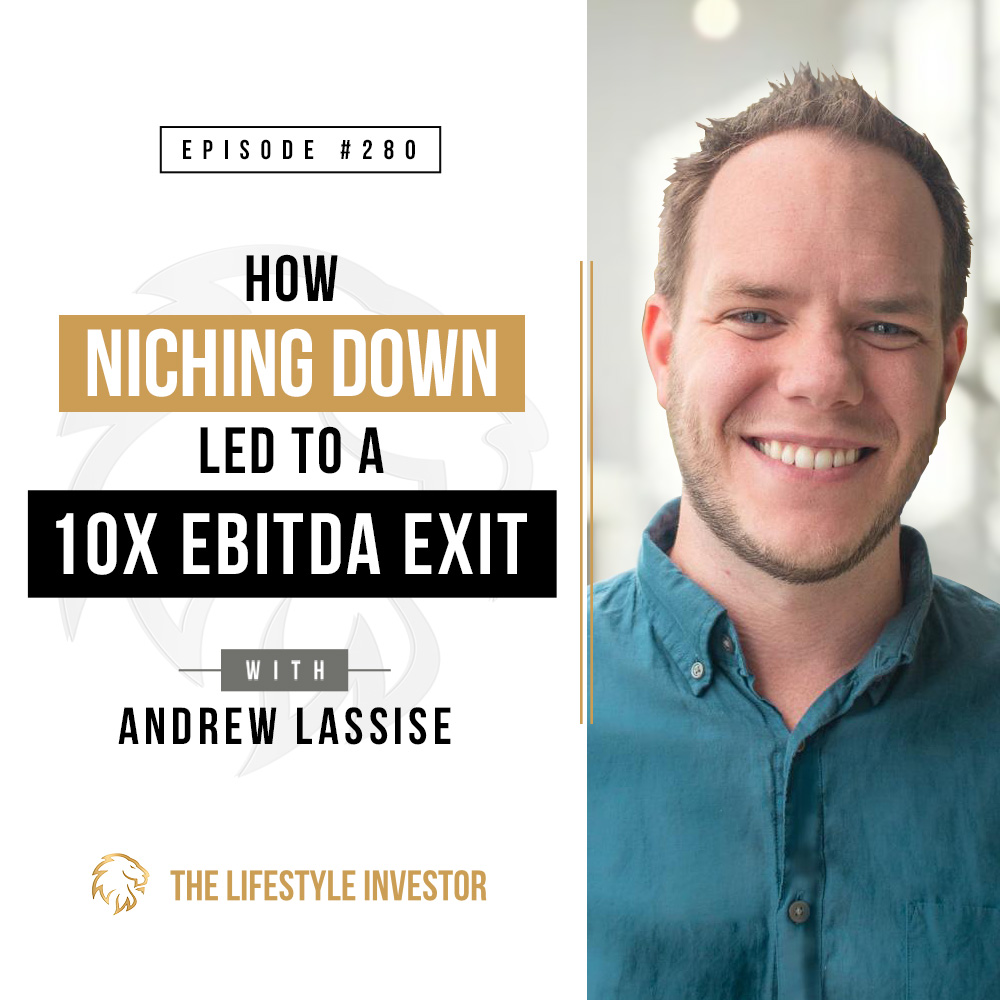
How Niching Down Led to a 10x EBITDA Exit with Andrew Lassise – EP 280