![[Justin Donald] - Optin Preview](https://lifestyleinvestor.com/wp-content/uploads/2020/12/Justin-Donald-Optin-Preview-e1607533704966.png "[Justin Donald] - Optin Preview")
![Logo 1 Gold horiz [Converted]](https://lifestyleinvestor.com/wp-content/uploads/2019/08/Logo-1-Gold-horiz-Converted.png "Logo 1 Gold horiz [Converted]")
Interview with Bill Tyndall
From a Huge Exit To Reimaging IT & Cybersecurity with Bill Tyndall
Businesses are implementing AI faster than most entrepreneurs realize. But the best opportunities aren’t always in cutting-edge startups. In many cases, the best returns are in legacy businesses that haven’t kept pace with the innovation curve. Understanding that gap—and how to close it—has defined the career of today’s guest.
Bill Tyndall is the founder of Tynrose, a holding company focused on modernizing legacy businesses through digital transformation, data, cybersecurity, and AI. After launching Electric in 2016, which revolutionized IT support for SMBs, he had a huge exit with a billion-dollar valuation just four years later.
You’ll hear how Bill’s newest venture, Tynrose, builds platforms that don’t just implement technology; they reimagine it and help companies move beyond patchwork solutions and into scalable solutions that are built to last in the digital world. His approach challenges outdated models and reframes what’s possible when businesses stabilize their technology, leverage clean data, and deploy AI with intention.
In this episode, you’ll learn:
✅ How SMBs and legacy businesses may offer better AI-driven returns than tech startups.
✅ Why Bill decided to start a new business after his huge exit, and what creating a legacy with his businesses means to him.
✅ Why AI is really just a capacity expander for humans and what the future holds for IT and cybersecurity in an AI-driven world.
Featured on This Episode: Bill Tyndall
✅ What he does: Bill Tyndall is the founder of Tynrose, a holding company focused on acquiring and modernizing legacy businesses through digital transformation, tech support, cybersecurity, and AI. After launching Electric in 2016, which revolutionized IT support for SMBs, he had a huge exit with a billion-dollar valuation just four years later and now builds scalable platforms designed for long-term value creation.
💬 Words of wisdom: “AI will completely change the way that our industry works over time. If you are building your business off of the commoditized help desk, you’re gonna be dead in two years.” – Bill Tyndall
🔎 Where to find Bill Tyndall: Website | LinkedIn
Key Takeaways with Bill Tyndall
- Why Legacy Businesses Lag Behind Innovation
- IT and Cybersecurity Is Just the First Phase
- How Data Reveals Hidden Inefficiencies
- Solving the Biggest Problem With Tech Support
- The Cost of Bad Data & Operational Inefficiency
- A Jack of All Trades Won’t Scale Faster
- The Struggle to Keep Up with the Innovation Curve
- Staying Focused Beats Doing Everything
- Tynrose’s Cost-Effective Strategy To Hire Talent
- Choosing To Keep Working after A Huge Exit
- True Legacy: Making an Impact With Your Business
- AI is a Capacity Multiplier, Not a Savior for Bad Companies
- The Positive Disruption for AI in Legacy Businesses
- Where to Learn More from Bill
Why a Huge Exit Didn’t Lead to Happiness
Inspiring Quotes
- “You can buy a business that today has a 23% gross margin. It might be spitting off 5%, whatever it is. You don’t even have to do anything different. You just have to wait for the technology to get better and then adopt that technology and that gross margin is going to go up.” – Bill Tyndall
- “AI is not going to be the savior of a bad business. It’s gonna make a good business better, and it might make a bad business a little bit better. But at the end of the day, AI is really a capacity expander for humans.” – Bill Tyndall
- “I love to build not just to see what’s possible, but I also just love people. I am so deeply curious about what happens when you work to create an environment where a human can be the best version of themselves.” – Bill Tyndall
- “Once we have a stable environment for these clients with good data, you would be shocked what happens when you have a good data practice.” – Bill Tyndall
- “You would be actually shocked if you heard the number of hours that are wasted each day with technicians Googling how to solve an issue that somebody’s trying to solve.” – Bill Tyndall
Resources
- Tynrose
- Tynrose on LinkedIn
- Techvera
- Techvera on LinkedIn
- Bill Tyndall on LinkedIn | X/Twitter
- Vinod Khosla
- Khosla Ventures
- Power BI
- Looker Studio
- Microsoft SharePoint
- Microsoft Azure
- Elon Musk
- Thrive Capital
- General Catalyst
Want My Team’s Help?
- Tax Strategy Masterclass
Learn the 28 most effective tax strategies the wealthy use to save thousands.
lifestyleinvestor.com/tax
- Free Strategy Session
Get a personalized roadmap to financial freedom.
lifestyleinvestor.com/consultation
- Lifestyle Investor Newsletter
Join The Lifestyle Investor Insider for curated investing insights.
lifestyleinvestor.com/insider
Rate & Review The Lifestyle Investor Podcast
If you enjoyed today’s episode of The Lifestyle Investor, hit the subscribe button on Apple Podcasts, Spotify, Stitcher, Castbox, Google Podcasts, iHeart Radio, or wherever you listen, so future episodes are automatically downloaded directly to your device.
You can also help by providing an honest rating & review over on Apple Podcasts. Reviews go a long way in helping us build awareness so that we can impact even more people. THANK YOU!
Connect with Justin Donald
Get the Lifestyle Investor Book!
To get access to The Lifestyle Investor: The 10 Commandments of Cashflow Investing for Passive Income and Financial Freedom visit JustinDonald.com/book
Read the Full Transcript with Bill Tyndall
Justin Donald: What’s up, Bill? Good to finally have you on the show.
Bill Tyndall: Oh, I know. It’s been a long time coming. I appreciate you having me on.
Justin Donald: Yeah, well, I’ve been talking about having you on for a couple of years, ever since we first started hanging out and I was an early investor in Tynrose and I’m like, we’ve got to tell people all the cool stuff you’re up to. And life just kind of gets away from you sometimes. So, I’m glad that we finally circled back and we got you here today.
Bill Tyndall: Yeah. Well, I appreciate it and appreciate all this support that you had over time with us as well.
Justin Donald: Well, I love what you guys are up to. And so, it’s funny, I just got back from a Lifestyle Investor white glove trip experience to Japan. So, I’m just kind of getting my bearings back. So, this is our first episode back since I’ve been traveling. And it was just a killer, killer trip. And being there, I mean, so it’s a totally different experience, like a beautifully clean nation, highly efficient in so many regards, and it’s like the perfect segue into what you guys are doing with Tynrose and like what you saw from an efficiency standpoint from like these old legacy businesses to the new modernized version of what you’ve been able to build. So, yeah, I’d love for you to talk a little bit about Tynrose.
Bill Tyndall: Yeah, 100%. Well, at some point, we’ll retouch on Japan and how incredible that was that you guys went, where we have a big belief in what we think of as unique experiences and neuroplasticity on the brain and really try to ingrain that in our culture. We just actually had a few employees in Japan over the last couple of weeks as a…
Justin Donald: Oh, nice.
Bill Tyndall: But yeah, for the short, to catch everyone up on Tynrose, Tynrose is a holding company. So, we think about it as a permanent capital structure with a really simple mission which is making digital transformation and technology more accessible to what we think of as like the legacy small to medium-sized business. So, the underlying thesis is that although billions of dollars are getting poured into technology every day, that’s incredible. And there’s so many efficiencies that can be had.
But when there’s 15 products that all do the same thing and those products happen to be incredibly difficult to roll out, you end up with a world where the assessment and deployment, and then therefore, management of this technology ecosystem is actually more complex than it’s ever been. And so, the world that is built to the platform, so to say, that’s really focused on supporting that assessment deployment management, like when we think about the core platform, it’s shattered into a hundred independently owned small businesses, and they’re called managed service providers, MSPs, for others.
And so, when the average business in that space is sub-20 employees, you have a hundred thousand independent ideas about how that should look, et cetera, and so, Tynrose is really focused on, hey, how do we create an incredible experience generated consistently at scale for these businesses? How do we do it across markets? And we really do that by thinking about acquiring businesses that fit a number of specific parameters for us. But then we have a very large focus on organic growth inside of that business as well. So, how do we both organically expand and then find serviceable, addressable marketer scope expansion through really strategic acquisitions over time?
Justin Donald: Yeah, I love it. I love the thesis. And when you think about– so everyone’s probably heard of SaaS, software as a service. But I would imagine most people have probably not heard of IT as a service, because you guys are really pioneering that and you’ve got this whole idea of delivering exceptional IT as an experience, like you’re showing as a service, right? Like we’re going to provide this, but then cybersecurity as well. In fact, I was just listening to an interview with Khosla, the founder of Khosla Ventures, talking about how he was super early days on this type of knowing that cybersecurity and protecting data was going to be of the utmost importance.
And it’s so great seeing that that is what’s happening and that you guys have really been front runners before it was ever mainstream. And even AI, I mean all of this that you have components of AI that just fold into everything you do, so you can make the same argument that not only were you on the cutting edge of cybersecurity and IT as a service, but also the incorporation of AI into those platforms.
Bill Tyndall: Yep, 100%. 100%.
Justin Donald: So, I love it. And I’d love to kind of talk about this market as you see it. Like when I first started talking to you and we first started becoming friends, I was like, you’re onto something and you had a great track record before. You’d had a billion dollar exit in a previous company that you had co-founded, which we probably should talk about, because I think that background is pretty relevant here. But when you started talking about IT as a service and I was already heavy investing in AI from 10 years ago, robotics, cybersecurity, like all those, they were in my purview already. And so, when you talked about this, it really resonated.
Bill Tyndall: Yeah. Well, I love that, and obviously, so many conversations have happened for us, just about the intersection of all these things, and I think one of the exciting things outside of the fact that the tailwinds are just continuing to get stronger, particularly when you look at cyber. I mean, cyber right now, there’s a massive war going on in the dark world of cyber. And we talk about all the positive benefits of AI coming into business. And the reality is, there’s just as much, if not more innovation happening by the bad actors as there are by the good guys right now.
Justin Donald: For sure.
Bill Tyndall: Cyber is going to be a very large area of focus, both on the defensive and offensive when we start to think about that, I think, over the next couple of years.
Justin Donald: Well, and even from like, the Department of Defense, it’s like the number one area they’re looking at to protect our country. So, from a governing body standpoint, that is number one.
Bill Tyndall: Yeah, and it has to be, I mean, when you look at it, the amount of data leakage that’s happening to people all over the world, whether it’s China, Russia, North Korea, there are a lot of open holes and it’s not just hacking. It’s also, some of it, people just don’t even realize how easy it is to actually let people infiltrate your business. And I’m a shareholder and big supporter of a couple of businesses doing some really interesting things and what we think of is human risk management and more of these ancillary sections. Like, not even about the tools that we buy, but how are we using them? How are they connected?
So, there’s a lot of great stuff, but I think one of the other really cool topics that you kind of touched on for a second is, yes, we do IT. Yes, we do cyber. We think about the business more today and our impact with our clients is, as really like a digital transformation provider. How do we take you from what we think of is? And today, the main businesses is IT and cyber, and we really call that phase one of digital transformation. How do we get you in the right technology using it properly, doing that securely?
But once you have this phase one stable environment, the question really becomes over time is, okay, well, how can we then take that offering and how can we actually put it into the next thing, which everyone talks a lot about, which is data insight? How do we actually say, hey, you’ve got this stable environment, plenty of good data in there, let’s start to roll out a Power BI or a Looker or one of these tools so we can start to help you better understand like what’s actually happening inside your business.
And then, so we call that stabilization phase data insight, and once we have a stable environment for these clients with good data, you would be shocked what happens when you have a good data practice. And I’m happy to dive in on a couple of examples that we can…
Justin Donald: Yeah, please do.
Bill Tyndall: In our business, you can think about phase three, which is actual innovation. How do you then take good data from a stable environment to uncover all these just mass inefficiencies in business? And I know we’ve talked a couple of times about how we’ve changed the gross margin profile of our own business and…
Justin Donald: Oh, and your gross margins are industry leading. In fact, I’d love for you to even just touch on that because I think, most people would be happy with gross margin, like approaching 30%, right? And you guys are north of 40%, I think your high 40s with basically a path or at least a recognized way to get to 50% or 60% gross margin, which is unheard of, right, in this industry.
Bill Tyndall: Yeah, it is. But the reality is and then something that’s just really excited about being on this podcast, I know a lot of people in this that are listening in or probably interested in acquiring businesses, et cetera, the reality is, yeah, we’re doing a lot of really special stuff, like we are, what I like to think of as a hammer and not a nail when it comes to innovation. But the reality is, as businesses adopt technology in this space, it’s expanding the capacity so rapidly of people like what a technician could do five years ago in comparison to today with just the integrations available, et cetera? I mean, it’s wildly different.
But yeah, as you were saying, I mean, when we got into this space, the gross margin of this business really was fluctuating somewhere between like a mid-20s to sometimes we’d be able to crack the 30 barrier, and that’s pretty standard in our industry. But through stabilizing the environment, running a good data practice without even building any like really significant automation, I mean, the amount of things that were just uncovered of, of mass inefficiencies in our space, and like a really great example I’ll just give really quickly is, so we built out this Power BI instance and it allows us to see profitability by client, by technician touching that client, by ticket that technician did for that client any given moment of the day.
And so, when you start to look at some of this correlated data and you hear inside of a team, like hey, we’re really at max capacity right now. We’re feeling, but when you look at the math, well, something doesn’t add up here. And for our business as an example, this is the entire IT industry. Tickets come in and they go to humans, whoever, and it’s usually first human available. The problem is, and I’ll give a non-IT example of this, I think, will resonate with a lot of people. Like, if you were to send a financial request, you want me to build out a spreadsheet and you just send it to me and I decide that I’m going to be the one that does it. Like, I could probably get that done. But if we send it to my CFO, it’s probably done in 15 minutes.
Justin Donald: Right.
Bill Tyndall: And so, we had identified that we had this mass capacity inefficiency in our business because people were taking tickets and rather than passing them to the right person, which is really just what are your certifications coupled with, are you available right now? We had people googling, and you would be actually shocked if you heard the number of hours that are wasted every day with technicians googling how to solve an issue that somebody’s trying to get solved.
Justin Donald: That’s fascinating, just that one little shift in framework of first available to most qualified, right?
Bill Tyndall: 100%. And it’s a great example, measure twice, cut once.
Justin Donald: That’s right.
Bill Tyndall: The first available might be able to get there five minutes faster. But if it takes not only an hour longer, but it’s not done properly, now you have a bad experience and you’ve just completely wasted that capacity. So, yeah, and there’s endless examples. I mean, in our industry, there’s about a thousand tasks that we do on a daily, weekly, monthly basis, and every single one of those tasks lives somewhere on an automation scale.
Justin Donald: Well, let’s get back to this earlier topic when we were discussing on data aggregation because I think, first and foremost, most companies, even though they have data, they’re not aggregating it, they’re certainly not synthesizing it, they’re certainly not making decisions based on it most of the time. And I think, depending, if your systems are set up to capture the data, you still have to have people or at least outsourced firms that are experienced in reading that data, right? So, I’d love to hear some of these examples of things that you’ve done in that space.
Bill Tyndall: I mean, we have so many examples. We have so many examples. And I mean, I’ll take it even starting for ourselves, but I’ll give a couple of examples really quick, actually, about some of the frustrations that we see with people trying to roll out data practices. And I mean, this story is so common, particularly, actually, for businesses that are in a changeover. So, you’ve just bought a business, you’ve got all these ideas about modernizing, and you try to roll out Power BI, spend 300 grand on it, just totally fails.
And we spent a lot of time inside of our business really talking to our clients and ourselves about this concept of respecting the phase. Like, you cannot have a data practice without a stable environment. And like an example would be, we have a friend whose business, they’re a client of ours now, but the CEO had called me. He was like, man, I don’t get it. We’ve tried twice now to roll out Power BI. It’s totally failed. We spent all this money. He’s like, will you come? Will you come to our meeting and just hear and give us your advice?
And we got 10 minutes into the meeting and I stopped them, because, they were talking about having three independently running SharePoint instances with entirely different data schema. And I was like, “Well, of course, Power BI failed. Like, how are you? Like nothing here is clean. Like the business is functioning because you guys have different teams working in these different things. But until you guys consolidate down to singular versions with agreed upon data schema, like you’re making your job, you’re making your world of data impossible, because you constantly are feeding it bad data. You have no consistency in all of this.
And reality is, is you can spend a million dollars on Power BI, but if you have bad data, if you have missing configurations, just blatantly incorrect, more or less like data inputs, it’s impossible. You’re just feeding bad data into a bad system. And so, we’ve spent a lot of time helping people to honor the phase. Hey, how do we get you into a stable environment? How do we help you to understand what good data looks like so that we can go onto those second pieces? But example for us, going back to this, this idea of what good looks like, once you do have a stable environment, and then whether you’re a Microsoft shop or a Google shop, a lot of people use Looker on that on the Google side, Microsoft and Power BI on the other side.
But once you have it and you have a system, and for us, we have an internal team that really focuses on a lot of this stuff. And so, once you’re able to start to ingest a lot of this information up into a data lake where we keep everything up in Azure, we’re a big Microsoft fan. And once you’re able to do it, I mean you can start to integrate it with your ERP, your different ticketing systems. And for us, like going back to it, everything for us, when we think about how we make decisions inside of that, in that business specifically, it’s what’s the problem? What’s the solution? How much does it cost us? And what’s the ROI? That’s every discussion that we have.
And so, our Power BI instance is directly more or less set up against tasks that we’re doing on a daily basis, coupled against job costing. It doesn’t matter necessarily that we do it a thousand times. If it only costs us $10, it doesn’t matter. But if it costs us a million dollars, yeah, like a great example, another one of these for us in our business was looking at this concept of routing those tickets that I was telling you about to the right people. We do 10,000 tickets in a month. It was taking, when we got into this business, routing. So, figuring out who the right person was with the theoretical certifications was taking us seven minutes. We were spending 70,000 minutes a month, playing traffic cop. And these are just things in all businesses that you just don’t even think about how long it takes to route, to then do the thing that you’re actually tracking your SLA against.
And so, to us, that’s the real beauty of coming into this world that we’re in right now, which is data. Data is everything, and every business is a data company. It doesn’t matter if you’re a plumbing company or you’re open AI, like we are all plush with data. The question is just helping to get to a place where you can actually understand what your data is, how to look at it, how to think about it, and how to actually make changes based on it.
Justin Donald: Well, Bill, there’s so many different directions, I feel like you could take this business. I mean, there’s the direction that you went, which is acquiring companies and laying out your protocol. There’s consulting, right, for other companies that need it. There’s actually like servicing the end result, right? The IT tickets for these other companies. And I’m not sure if you’ve actually incorporated all of this. I mean, there’s actually a couple other verticals you could go as well, right?
But was it one of these things where it’s like, let’s do all these things? I remember my first big business was a single-family home maintenance company. And I remember, anytime, anyone wanted something, we’re like, yes, we can do that. And so, we’re the provider that offers everything. You need a roof, sure. You need plumbing, we got you. You need electric, yeah. Fence? Oh, we’ve got it. Pool cleaning? Yeah, I mean we made so many mistakes doing that. So, I’m curious like how you got clear on the direction for Tynrose, because you could make money in 5 to 10 different verticals.
Bill Tyndall: Yeah. Well, and so, the short answer of that is we will, but not as a cohesive unit. And so, Tynrose is the holding company. Below that, we have operating businesses. And so, Techvera is our primary operating business. It’s our mainstay managed service provider. So, in that business, they do IT cyber, like that is it. We have a specific ideal customer profile that’s businesses between 20 and about 250 employees, a number of different industries ranging from manufacturing to movie production studios. Like, we have very specific verticals that we happen to work in and that allows us to organically expand that business really, really well.
It also helps us to think about inorganic growth of, hey, are we trying to strengthen a current vertical that we’re in? So, are we trying to get more serviceable, addressable market in the current world, whether it’s geo-based or whether it’s just that ideal customer profile? Or are we trying to expand into a new vertical and we want to incorporate that into further grab market share in other areas? But so, when we then talk about those different buckets, the stabilization phase, like we really think about Techvera stabilization.
And so, that business is entirely focused on a very specific scope. We think about that entire business and we think about all businesses for that matter, no different than a technology product. You have a technology product. It is a certain number of features. You can’t be all things to all people. And, we’ve talked about this with my last business and that was the tech companies we talked about, but everything comes down to consistency. You cannot deliver incredible experiences. You might be able to deliver incredible experiences by saying yes and getting it done, but as somebody who said yes to everything, and we were just joking about house stuff, but like we had the same guy, who did our landscaping, build a fence and build a gate. And guess what? I’ve had problems with that gate for about two years.
Justin Donald: That’s right. Jack of all trades is usually not a jack of all trades.
Bill Tyndall: Master of none. So, everything that we do inside of a business unit comes down to, we have to be the best at that thing. And so, under Tynrose, there are other businesses that will exist as well. We’re actually in the process of launching what we call Tynrose Digital, which is really focused on these AI services. Primary focus for us with that team, as of today, has been really focused on us as the initial client. How do we build data insight and automation into what we do? And then packaging that up to actually deliver to our hundreds of clients today. And so, everything for us is about really staying in a lane, working that lane really tightly, trying to say no more than you’re saying yes to everything so that you can actually scale out that scope. Otherwise, I mean, yes, you can scale a jack of all trades, but I mean, you get to any meaningful scale and it starts to fall apart. And for us, our goal is to really take this to be like the industry leading, holding company across a number of these different segments. And we really think about that as like supply chain investing, but can’t do it trying to be everything to all people.
Justin Donald: That’s right. Well, I like that you’re narrow and you know who you’re looking for. I think, talking about building and scaling in the digital age, we’ve got a lot of entrepreneurs that listen to the show and watch this show. So, my experience is a lot of entrepreneurs really struggle modernizing operations. So, let’s say that you bought a mom and pop business, or let’s just say you started your own business, right? I think, there’s a ton of opportunities out there, a lot of options. I think most people don’t even realize all the options. You’ve got AI-powered options at almost every corner, but what are some of the first steps that business owners should take to future proof their company and stay competitive in this? We talked about how the world is changing, like innovation is as fast as it’s ever been. So, how can people stay ahead of that curve? And what’s the first steps to have a competitive business in a fast-changing digital world?
Bill Tyndall: Yeah. Well, I mean, we had said that we’d talked a little bit about the last business at some point as well, and I think it’s a phenomenal example. So, I wish that I could have hold up a graphic for this really quick, but I’ll just use my hands for the illustration. But when you think about what’s happening in the world and we think about innovation, the innovation curve, especially with AI now, I mean, it’s non-linear. It is accelerating at a pace like we have never seen.
But the problem is, is the adoption curve. And so, two different situations, when you’re starting a business today, I more or less have the ability to start wherever the current adoption curve is. And that’s even thinking about things as simple as QuickBooks. Like, 20 years ago, you had QuickBooks Desktop and you’re running a local server, whereas now, there’s even cloud and all these other options. But so, you have this innovation curve, but the problem is for the legacy businesses, I mean, you’re stuck on an adoption curve.
And that gap, that delta is getting larger every single day. And so, for my last business, like the reason why I like to say this as an example, so we spent over or we funded over $200 million to build that business. I could probably rebuild that same company today. Starting from scratch, I could probably rebuild the same thing with 10 million bucks.
Justin Donald: Oh, my goodness.
Bill Tyndall: And exponentially, smaller team.
Justin Donald: That’s unreal.
Bill Tyndall: And so, when you think about that, it’s done two things. One, it’s massively decreased, the barrier to entry to come in, be a new player and build something, I mean, with all this vibe coding stuff. But two, as you were saying, like it’s really also created tremendous opportunities for people to start to modernize. And when we go back to Tynrose, our entire business simply put is like, how do we catch people up to the innovation curve? It’s an endless cycle because as soon as you catch up there, technology’s changed. It’s modernized again. So, we’ll have a business, I say, until Terminator enslaves us all and we’re now lost. But really, what I tell people is start with the basics. Look at the most basic things in the business.
And the reality is, for those out there that are looking at buying businesses, whether it’s physical brick and mortar retail or whether it’s some kind of online business, look at the basics. Like, what are we using for the core systems? Email, communication, finance, like look at these core fundamental platforms.
Justin Donald: CRM.
Bill Tyndall: CRM, all these different components and say like, okay, well, hey, what do we have here? How’s it been used? Are we leveraging automation, these different types of things? And reality is, if you’re not a technical founder, like there’s a reason why business, there’s a hundred thousand competitors to our business, they’re all small mom and pop shops for the most part, but there’s a reason why there’s so many of them, and it’s because it is incredibly difficult to keep up with this stuff. And so, like, I always advise, like, hey, go get a consultation from somebody. Let them come in and see how you’re set up right now, because if it doesn’t feel right, it’s probably not. And even if it does feel right, it could probably be exponentially better.
And so, we spend a lot of time with businesses who are coming to that phase. We’re seeing a ton of generational handover right now. Whether it’s son or daughter takeover the business or search funder or whoever it might be, we’re seeing it all the time. And I mean, you would be shocked how many locally hosted on-prem email servers still exist in the United States. It’s a very large number.
Justin Donald: Wow. Yeah, it’s fascinating to think about that and we are living in an era where the largest wealth transfer in the history of the world is in process right now, between now and the next 15 to 20 years, somewhere between 80 trillion and 106 trillion, those are the numbers that I keep reading, is going to transfer from baby boomers to millennials. And many of these millennials don’t want these businesses. They’re selling them to someone else. There’s great opportunities to buy them.
Some of these businesses are just going to get shut down. So, it’s like, if you know what you’re looking for and you can niche down and you can figure out what you can be best in class at, there’s going to be incredible opportunities. Like, for you, you know exactly what you want, down to the number of employees, the amount of revenue, the exact industries, too specific industries, and you’re like, hey, it’s game on for anything here.
Bill Tyndall: Yeah. On for us, and we’re obviously very specific with how narrow we focus, but going back to data, our acquisitions are data-driven decisions, I mean, we’re looking at scope gap, serviceable, addressable market gap. So, who we should be buying and when we should be buying them is abundantly clear to us. And that’s a really large strategic gift to us. And being able to move fast, have the right conversations, yeah, it’s a blessing.
Justin Donald: Well, and I think you made a really ingenious move that you kind of started looking at your business top down. You’re like, hey, if we can scale this thing the way I think we can scale it, then we’re going to need people and the demand is going to be really great, where can I go to source these people? And so, you did some homework, you figured out where the best technical schools are, you had some great relationship building and business brokering with government officials and entrepreneurs. I’d love for you to tell the story because the mecca for IT is probably not where everyone thinks it is. It certainly wasn’t where I thought it was. I mean, I could win the trivia now because I know where it is, but tell us about that because that’s cool.
Bill Tyndall: Yeah, well, so I’ll give a little bit of backstory as well. So, once again, in the last business, we went from two of us to 500 people in four years. I mean, it was nuts. And the vast majority of them were New York City. And so, I mean, it was just so expensive to run that. And separate of that, when you look at how our industry does a lot of business, we as an industry heavily outsource to BPOs. And we should touch on that actually for a second because it’s federal issues in that.
And so, BPOs are a business process outsourcing. So, this is all the outsourced work people do in India, the Philippines, Argentina justified because it’s a fourth of the cost. And so, you can scale exponentially with that. But there’s two problems with that. First problem is that there’s consistency issues when you look at going abroad. It’s difficult to generate a consistent incredible experience in that world. Second language, oftentimes, just inconsistency. They’re working on other businesses. And so, the cheap option has a lot of inconsistencies and also a lot of security risks. So, we can talk about that.
Justin Donald: Totally.
Bill Tyndall: Because I was actually pretty shocked. And then New York City, I mean, you’re paying so much. I mean, it’s just such a heavy cost burden to scale that team. And we’ll talk about Tulsa, which is what you were just referencing, but the cultural differences between those two cities is also huge. I mean…
Justin Donald: Night and day.
Bill Tyndall: When you think about New York City and you think about one of the most important cost considerations, it’s employee turnover. It is really expensive to turn over employees. You have gaps, you have to hire. Maybe you’re using recruiters. And then New York City is the example, if you work at the same business for more than four years, you have no ambition. And in Tulsa, which is our primary hub now, when you look at it, you don’t work for the same business for more than four years and you have no loyalty. And so just…
Justin Donald: Got to love that.
Bill Tyndall: Really interesting cultural differences between those two markets. But bigger as you were going down is we were really looking for a city back when we were starting Tynrose. I knew that I needed a place in the United States so it was not New York City prices, where we could recentralize everything back to the US. Because going back to cyber, one of these big issues, it’s become pretty clear and you see this, you may have read about this in the news and they kind of like brush over it. But China, Russia, North Korea deeply infiltrated these BPOs. And when you think about level of access they have to your business, as a help desk, I mean, they’re remoting into your computer, they have the ability to grab information, to push information, when it goes from security risk to us, like there’s a very large liability in actually working with BPOs, particularly for our industry, which hold the keys to the castle for all these businesses.
And so, part of our responsibility was bringing all that back to the US. And so, we were looking for a market. We ended up meeting some guys at a local fund here in Austin where I live, the guys from S3. And I was meeting with one of these partners, and I’m telling him what I want. He just starts laughing. He’s like, have you ever heard of Tulsa, Oklahoma? I was like, I’ve never even thought about that city before in my entire life. And he was like, you should go up there. It’s actually one of the largest NSA feeder hubs in the nation. And I was like, NSA, are we…
Justin Donald: Pretty crazy, right? You’d never guess it.
Bill Tyndall: You never guess it.
Justin Donald: I, I love the S3 guys. They’re always a step ahead. They were the first money in one of our other businesses that’s done really well.
Bill Tyndall: Incredible guys. Incredible funds. Super smart. And so, they said, you should go up. And I went up there and I met with some of the guys from Tulsa University. That city has programs from GED-based trade schools all the way through PhD programs, specifically for cyber and infrastructure. I’ll never forget this, I went up there and met with some of these PhD students and I was asking them about their thesis and what they’re working on, and they had more or less, one of the guys had literally, his thesis was on more or less building what we had built at the last business.
When I asked him all these questions and I was like, shoot, this kid’s really sharp. And I was asking the teacher, I was like, how much is this kid going to make out of college? And he told me the number, I just gasped. I was like, we would literally be paying four times that much for this guy in New York. And so, we ended up doing it. Yeah, we had a lot of help in building out the infrastructure and program for the space. Our goal over the next 18 months is we’ll probably hire another like 130 people in Tulsa, all coming from these programs that we’ve worked with.
And so, yeah, finding a talent pool in any professional services business is one of the biggest barriers to scale. I mean, you can only grow these businesses. One, you have to figure out how to do sales, which is a hard thing in itself. But once you figure that out, it’s all about how do you manage more or less your revenue forecast to bent against your ability to hire, train, and retain talent. Because if you get out of whack there, I mean, you end up with service degradation. Service degradation is churn. Churn is a problem for any professional service business, so…
Justin Donald: I’ve got an interesting question, and this is a question I love asking people that I have on the show. You presumably didn’t have to work again. I mean, I don’t know exactly what your take home was. You have a billion-dollar exit. You’ve brought in $200 million to be able to build out what you need to build out. I think it’s a fair assumption to say, you’ve done pretty well for yourself. I know you’ve got an awesome Aston Martin you love to drive. I know you like really expensive wine, like I do. I know you’re a travel fiend, and pre-twins, you’re globetrotting. Now you’re a little more grounded, but I think it’s fair to say you probably could’ve at least taken a ton more time off, maybe not ever work. So, why did you even say, hey, let’s jump back in the driver’s seat, let’s start another business, and let’s get after it?
Bill Tyndall: Yeah, so there’s two big pieces. And so, one, I did take a year off after the last business. I took a year off.
Justin Donald: That’s good.
Bill Tyndall: And I’ll just be real about it. I know we’ve talked about this, but after selling out of that business, I’ll never forget, I think I told you the story about me buying the Aston and we had worked our butt off in the last company. We were working 18 to 20-hour days at certain points, six days a week. And when I finally sold out, I had everything that I’d ever wanted. I grew up in a really poor family and I had just gone through building that business and said like, when I have money, like it will all be okay.
And I got that car and I sat in it. I just cried for an hour and not like happiness. I was like, oh, my gosh, I’m so empty. And so, I spent a year really doing a lot of personal work, thinking about myself and connection and all these things. I mean, as you built, it can be really lonely being the builder. It’s really, really difficult. And so, I took that time and I thought about it. I was like, I’m going to just go and travel all the wine regions around the world. We’re going to do this.
And then the next thing you know, three months into being done, I’m sitting there and I’m like writing down on pieces of paper, like all these business plans, and I’m just like mentally and emotionally back into it. And I had had a conversation with another friend about this. I was like, man, why am I just struggling to not do anything? And he said it really, really well. He’s like, look, builders will always build. It doesn’t matter if you’re building a sandcastle on a beach somewhere, like you cannot sit still and you’re not a golf guy. Like, you’re not going to just retire and do it.
And my truth is and my reality is I love to build, not just to see what’s possible, but I also just love people. Like, I spend every single week, every single day, I do virtual coffee meetings with employees and not to talk about the business, but to talk about their lives, what’s going well, what’s holding them back, and to just really challenge them to really see what they’re made of, because I think and this is just a personal thesis and philosophy right now, but I am so deeply curious in what happens when you work to create an environment where a human can be the best version of themselves and what does that do to output.
And so, I had talked about putting a sticky note on Japan earlier, but we encourage our employees to travel, to do service because our general philosophy is we will be a better business, we will deliver better services if we have incredibly well-rounded individuals. And so, for me, so much of this, I come back for the people. I love the digital transformation space. It’s a massive opportunity. It’s going to make us all a ton of money, but really, so much of this is the people for me, and it’s just such an incredible experience.
Justin Donald: Well, that’s how I am, too. I just love people. I love building. Like you, I took a year off and I knew I was eventually going to do something else, but it was very therapeutic for me to take some time off and figure out, like, what is meaningful enough to me that I’m going to pour hours of time, my heart, my sweat, my tears into it? And so, I do think if you take enough time to clear the palette and just have a blank canvas, I think you’ll eventually come to terms with what a really fun and challenging and interesting next step is.
But some of the questions that you bring up kind of wants me to, like, I feel like I want to move to like a legacy mindset question for you, like beyond business, so building beyond the success of a company. If you’re talking about long-term thinking, long-term leadership, lasting impact, you’re a guy who’s built multiple companies. I have done the same. I’m curious how you would define legacy and how that shapes the decisions that you make today, especially as a new father.
Bill Tyndall: Yeah, so there’s a few pieces to that. And we’ve talked about this a little bit, but I think that there’s a real opportunity in this world to move away from what I call them firework companies. It’s all fair and good to build something, trying to sell it in five years. I mean this private equity business is a phenomenal business category, great returns, but like, are they really doing anything to benefit the industry? It’s mostly farming. Like, you buy something, you harvest it, you sell it to the next person.
And for me, in building Tynrose and our portfolio, I really think about it so much more as almost like a standard oil. It’s like, look, there’s the ability to continue to scale this and not just build something that becomes this dominant platform in an industry that will continuously evolve over time. But going to the question specifically of legacy and like what that means to me, it’s being able to build a business where you can have employees that are with you for 10 years, 15 years, and their kids can then come and join that business over time and like we have– so I mean, from the business that we’re in today and with how we’ve scaled it over time, I mean, this business, Tynrose, has only been around for a few years now.
I have people in this business that have worked for me for a decade and it’s so incredible to think about this world where we can build, we can go back to building and being the business that helps you buy your first house, creates this opportunity to help send your kids to school. And going back to me now as a parent, it’s also being able to create a world where and with how we structured this business, I’m the majority shareholder, and the goal is for them, like, why we structured it that way is like, the mission of this business, incredible experiences consistently at scale. Being this, this business that’s focused on making technology more accessible, like I will not let anybody sacrifice that mission, ourselves, anybody.
And so, I would love to see a day, and it’s funny, I was talking to the twins and my oldest the other day. Obviously, the twins are 19 months, so they don’t understand. But this idea of like, look, one day, whether it’s the business and we still have it and nobody’s offered us an exorbitant amount of money that would be an offer I couldn’t refuse. But I would love to see either one of my kids or one of my employees take over this business one day and to me…
Justin Donald: That’s cool.
Bill Tyndall: To me, that’s the greatest thing. But I will say as just a caveat on legacy, I think that legacy and impact also go far beyond, like what I do just directly inside of Tynrose and how we think about scaling it. And there was a great example of this the other day. I got a call from somebody who worked for me, hasn’t worked for me for five years, but he called me and he had started his own business. And he called me, he said, “Hey, I just want to thank you for all the time that you spent because I wouldn’t be doing this if it wasn’t for you.” And to me, there’s tons of people that you touch. I mean, we may have had 500 employees at scale, but we had hired a thousand people over time. We had touched so many people.
In this business, we’re a little over 200 employees now and there’s so much impact, but to me, and this goes back to this idea of how we think about people, like if we can help you break the chain in your life, who knows what the background was that you came from, but if we can help you to just be a little bit better as a parent, as a husband, as a community member, I mean, that to us is legacy. It’s how are we actually driving a lasting impact, both inside of the business that we’re doing and in the communities that we’re around.
Justin Donald: I love it. You know, it’s so funny, I feel like, that could be such a great segue to wrap things up, and you answered it so beautifully. I love your answer of like, hey, let’s make families better. Let’s find ways to get our kids involved in the business. It is so cool. And the more I started thinking, the more I’m like, you know what? With, I guess, the surge in AI, I’m like, we probably should wrap things up talking a bit about AI and not legacy today, since this is an AI-based business. And the role of AI in decision making, I do think AI shaping the way companies operate, the way that leaders think, the way that leaders are making decisions ultimately. And you’ve been leveraging AI since before it was mainstream. I’ve been investing in it before I was mainstream. I wasn’t leveraging it, though. You’ve actually been leveraging it. So, how do you see AI reshaping business strategy and the role of leadership over the next few years?
Bill Tyndall: I mean, it’s going to be massive, but I also want to say that there’s a caveat to that and the reality is this has happened throughout history. I mean, we are in a new industrial revolution right now.
Justin Donald: That’s right.
Bill Tyndall: But just as everybody was terrified of forward creating the assembly line and all these jobs going, all that did was expand the capacity for humans to make more stuff. And for us, and we spend a lot of time talking with our team, like AI is not going to be the savior of a bad business. It’s going to make a good business better, and it might make a bad business a little bit better. But at the end of the day, AI is really a capacity expander for humans. It’s faster at siphoning through data, it’s faster at making decisions, it’s faster at getting the root cause. There’s all this stuff around the genetic AI, all these different pieces, like it will change the way that we all work. If it hasn’t already, it probably will.
And so, for our industry, and actually, I’ll take a step back because once again, a capacity expander for humans, but AI is not a binary concept, and automation in itself is not a binary concept. Automation in itself, depending on the industry that you’re in, the work that you’re doing, I mean, it lives on a 0 to 10 scale, 0 fully manual, 10 fully automated. And our industry is a great example. Of those thousand tasks that are done, yeah, every single one of those tasks will live somewhere on a 0 to 10. And the reality is, there’s really no zeros anymore other than having to send somebody on site to go build out an office. And fortunately, Elon Musk’s robots aren’t doing that for us yet.
Justin Donald: Not yet.
Bill Tyndall: These last dancing ones, but…
Justin Donald: Folding laundry, at least, we’re coming a long ways there.
Bill Tyndall: Yeah. But at the end of the day, AI will change the way that we do work by expanding the capacity of how our technicians can go. And so, what we see, and this is really how we’re going to be going from this 40% gross margin up into the 60s is when you can actually start to leverage AI to ping against these different data sets, and then infer based on historical SOPs or whatever it is and to actually execute on that. I mean, you were talking about industry-changing capabilities, real-time support with accuracy, and it still feels human. Or even the work of proactive maintenance, I mean, there’s so much great work to be done, but most of this stuff in our industry still lives between call like a 3 and a 6 in terms of automation.
So, the inference, somebody’s asking a question or somebody’s saying, hey, this thing’s not working. So, we then have to get that. We’re then siphoning that against more, or we’re comparing that against device level data, network level data. And you can build a lot of AI into like, hey, I think that this is what’s going on, but oftentimes, we still need humans to more or less go in it and take certain types of actions. And so, AI will completely change the way that our industry works over time. And I tell this, I’m very vocal. I was at a summit the other day. And we’re having a very, very deep discussion about this, where if you are focused and you are building your business off of the commoditized help desk and like that is your primary thing, I’m like, you’re going to be dead in two years. We will drive costs of that into the ground.
And so, I’ve been really vocal in helping people to understand how their industry also and our industry has to change with how we think about providing value, because AI will lower the costs across the board in all these areas. So, you have to figure out how you’re going to continue to drive value for clients in a way where they will pay you in a world where that makes sense, and so…
Justin Donald: For sure. And with a good customer base, our audiences, a lot of entrepreneurs and investors and people that aspire to be entrepreneurs and investors, where do you see the biggest near-term opportunities to integrate AI for better returns or smarter decision making?
Bill Tyndall: I gave a great talk on this the other day, and this is probably perfect for the people listening here. My whole thing is, look, you can go out and make tech investments all day long. There are plenty of incredibly smart people that are doing it. My whole thing is, look, go invest in funds or find little niche areas that you love, but in my opinion, the largest outsized returns right now on investments made in the legacy industries will be positively disrupted by this technology.
And we touched on it a little bit earlier, but you can buy a business that today has a 23% gross margin. It might be spitting off 5%, whatever it is. You don’t even have to do anything different. You just have to wait for the technology to get better and then adopt that technology and that gross margin is going to go up. I mean, it could go from 23% to 30% to 35%, but you’re buying a business today or you’re running a business based on a specific profile. And so, being able to invest in that business and then being able to just benefit from surviving and adopting over time, I mean, you’re talking about being able to create outsized returns. If you can buy a business for two times, three times, whatever it is, and now the gross margin profile, and therefore, also profits are now putting you into a different bracket.
I mean, you’re talking about these outsized returns that, in my opinion, are just a little bit easier to find. And the reality is law firms, accounting companies, IT companies, cyber companies, plumbing companies even, you’re in Austin as well, dock repair companies, everybody will have the ability to do it. And like, I think that that is where the largest asymmetric returns are going to happen. Yeah, you’re always going to have outliers in tech and there’s a lot of AI, but to me, it’s understanding the thesis of positive disruption of AI in legacy businesses.
Justin Donald: Yeah. And think about it this way, for those of you that are tuning in here, most people are looking for a business that they can then scale and have, maybe through M&A they’re scaling or maybe through new customer acquisition. We’re talking about doing nothing different except adopting better technology, probably more AI-powered technology that’s going to double, triple, quadruple your profit. Like, it’s pretty exciting.
Bill Tyndall: It’s incredible.
Justin Donald: Yeah, I love it.
Bill Tyndall: It is an incredible time to be in business. And the funny thing is you’re starting to see venture actually coming into this space as well.
Justin Donald: That’s right. That’s right.
Bill Tyndall: It’s the time with the Thrive guys and guys over at General Catalyst. There’s a bunch of other funds who are considering coming into the space because they see the same thing. The same thing, it’s going to be great returns.
Justin Donald: Well, Bill, where can people learn more about you and Tynrose?
Bill Tyndall: Yeah. So, they’re always welcome to go to Tynrose.com. It’s fairly blank because we really work more under the operating business that I was talking to you about, but Techvera.com for anybody out there that’s building business, buying businesses, and they’re really looking for a partner to do it. We work with so many incredible searchers who are taking over businesses and are really looking for a partner to help figure out, hey, what’s our strategy for modernizing this thing? We do it all the time. Techvera.com is the best place.
You can find me obviously on LinkedIn. I don’t use any other social media. But find us on LinkedIn. Find me, feel free to shoot me a DM to either talk about M&A strategy, because we also are a very, very interesting group just with how we’ve done that over time. So, I spend a lot of time talking with other people who are buying businesses, running them. Always happy to chat.
Justin Donald: I love that, and it’s been so much fun having you on. I just want to encourage, if you’re watching this or listening to this, I would just encourage, if you’re wanting to buy a business, like Bill is as great of a guy as you’re going to meet, knows the space well, high integrity. So, if you want to buy a business, I would be talking to him. If you want to sell a business or know a business that is up for acquisition, I would talk to him. If you have kids or you specifically want to get into this space, what a great place to be able to do that at Tynrose. So, I just highly recommend if you have any inkling in you that’s wanting to acquire, sell, learn, grow, anything in IT services and cybersecurity, Bill is your guy.
So, thanks for joining us here, Bill. This has been awesome. And I love ending every episode we do with a question for our audience. So, if you’re tuning in here today, what is one step you can take today to move towards financial freedom and really just move towards living the life you truly desire on your terms? So, not by default like most people, but a life by design. What’s one thing you can take from Bill today to help move you in that direction? Thanks, and we’ll catch you next week.
Sign up to receive email updates
Enter your name and email address below and I'll send you periodic updates about the podcast.
Keep Learning
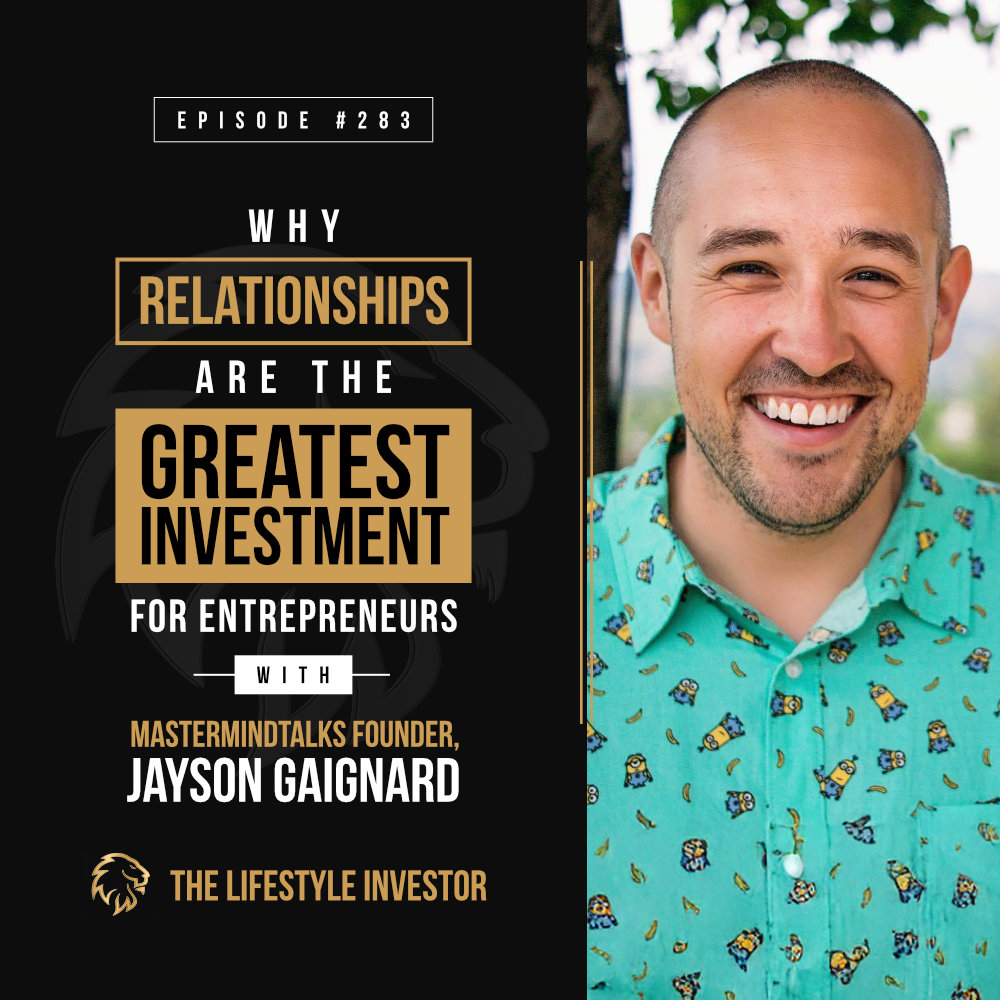
Why Relationships Are the Greatest Investment for Entrepreneurs with MastermindTalks Founder, Jayson Gaignard – EP 283
From a 9-Figure Exit to Inspiring the Next Generation of Entrepreneurs with Scott Lingle – EP 282