![[Justin Donald] - Optin Preview](https://lifestyleinvestor.com/wp-content/uploads/2020/12/Justin-Donald-Optin-Preview-e1607533704966.png "[Justin Donald] - Optin Preview")
![Logo 1 Gold horiz [Converted]](https://lifestyleinvestor.com/wp-content/uploads/2019/08/Logo-1-Gold-horiz-Converted.png "Logo 1 Gold horiz [Converted]")
Interview with Ben Reinberg
The Wealth Formula: Hard Assets, Leverage & Passive Investing with Ben Reinberg
If you want to build long-term wealth and protect your money from market volatility, today’s guest has the tools to show you how to do it by using hard assets and smart investing strategies.
Ben Reinberg, is one of the leading experts in commercial real estate and the founder of Alliance Consolidated Group, a firm he built from scratch to become a $500M empire that has managed billions in transactions across medical offices, industrial, and multifamily real estate. In his newest book, Hard Assets and Hard Money for Hard Times, he lays the blueprint for building a hard asset empire.
With over 30 years of experience, Ben explains why real estate is the best vehicle for building wealth, how to invest passively by focusing on your niche, and why leveraging relationships is the key to long-term success.
Whether you’re an experienced investor or just starting out, this episode is packed with invaluable insights that can help you grow and protect your wealth.
In this episode, you’ll learn:
✅ The one real estate asset class that will have the biggest opportunities in 2025—and why most investors are overlooking it.
✅ How Ben turned a single deal into a 3X return—and the investing strategy he still swears by today.
✅ The 3 most powerful wealth levers you can use to scale your investments faster—with less of your own money.
Featured on This Episode: Ben Reinberg
✅ Who is Ben Reinberg? Ben is the CEO and Founder of Alliance Consolidated Group, a real estate investment firm specializing in medical office, industrial, and multifamily properties. With over $500M in assets under management, Ben is known for his expertise in acquiring and managing cash-flowing assets that generate long-term wealth. He is also the host of the I Own It Podcast and author of the upcoming book, Hard Assets and Hard Money for Hard Times.
💬 Words of wisdom: “If you want something more powerful than money, it’s leverage. And leverage could be improving your health, improving your mindset, improving your relationships. All of these will help you in building wealth.” – Ben Reinberg
🔎 Where to find Ben Reinberg: Website | LinkedIn | Instagram
Key Takeaways with Ben Reinberg
- How Ben Reinberg built a $500M+ real estate empire
- Why commercial real estate creates generational wealth
- How Sam Zell was a great role model for Ben and Justin
- The best real estate opportunities for 2025 & beyond
- Focusing on your niche with passive investing will produce wealth
- The biggest mistakes investors make & how to avoid them
- Why relationships, partnerships & leverage are critical wealth levers
- The genesis of Ben’s book: Hard Assets & Hard Money for Hard Times
I Treat Every Investor Dollar Like My Own
Inspiring Quotes
- “The day we don’t value a penny is a day we shouldn’t be doing this.” – Ben Reinberg
- “Tough times don’t last. Tough people do.” – Ben Reinberg
- “If you want something more powerful than money, it’s leverage. And leverage could be health, improving your health, improving your mindset. It could be improving your relationships.” – Ben Reinberg
Resources
- BenReinberg.com
- Ben Reinberg on LinkedIn | Facebook | Instagram | YouTube | X/Twitter
- Alliance Consolidated Group
- Hard Assets and Hard Money for Hard Times by Ben Reinberg
- I Own It Podcast
- Alliance
- Sam Zell
- Blackstone
Tax Strategy Masterclass
If you’re interested in learning more about Tax Strategy and how YOU can apply 28 of the best, most effective strategies right away, check out our BRAND NEW Tax Strategy Masterclass: www.lifestyleinvestor.com/tax
Strategy Session
The Lifestyle Investor Insider
Rate & Review The Lifestyle Investor Podcast
If you enjoyed today’s episode of The Lifestyle Investor, hit the subscribe button on Apple Podcasts, Spotify, Stitcher, Castbox, Google Podcasts, iHeart Radio, or wherever you listen, so future episodes are automatically downloaded directly to your device.
You can also help by providing an honest rating & review over on Apple Podcasts. Reviews go a long way in helping us build awareness so that we can impact even more people. THANK YOU!
Connect with Justin Donald
Get the Lifestyle Investor Book!
To get access to The Lifestyle Investor: The 10 Commandments of Cashflow Investing for Passive Income and Financial Freedom visit JustinDonald.com/book
Read the Full Transcript with Ben Reinberg
Justin Donald: What's up, Ben? Good to have you on the show.
Ben Reinberg: Justin, thank you so much for having me. What a privilege to be on your show and look forward to adding a lot of value to your audience.
Justin Donald: Well, it's fun just catching up prior to going live. And we share a lot in common. We know some similar people. You've got some investment properties here in Austin. We're both from Chicago. Your wife went to UofI. I went to UofI, so University of Illinois. And, yeah, it sounds like we talk very much the same message on the importance of buying hard assets. And for me, I talk a lot about cash-flowing assets, but not all assets need to cash flow. But I do think that there's a beauty to having some cash flow to get you to where you want to be so you can buy your time back.
Ben Reinberg: You know what's interesting? I was telling someone this the other day. When you meet people from the Midwest, exceptionally from Chicago, when you meet people from Chicago, there is an automatic bond that goes on. It's incredible.
Justin Donald: Oh, yeah.
Ben Reinberg: I could meet them like all over the country, anywhere in the world, you meet someone from the Midwest, you connect.
Justin Donald: That's right.
Ben Reinberg: Then you go a deeper level. You meet someone from Chicago. It's almost like you've known them for years. It's incredible the connection that you have. So, grateful to be here. You know, it's fantastic to talk to another Chicagoan and be able to connect, and especially connect about real estate, commercial real estate, talking about cash flowing assets, and really helping your audience achieve well. That's why I'm here.
Justin Donald: Well, I love it. Well, this is what I love talking about. Every week we put out an episode with the goal of helping people. There's a line that I give at the end. It's a question. And my question is to always move people towards a life on their terms, a life of financial freedom, and what would that look like and what are steps you can take today? And you and I created financial freedom in a very similar way through commercial real estate and we're able to grow our wealth through that product. And I'd love to talk about it. I'd love to talk about, first and foremost, how did you get into commercial real estate? And now you're very well known in that space. So, generally, to have a strong reputation, you have to be a strong performer. You need to perform well for your assets, for your investors, etcetera. So, I'd love to hear some of that story.
Ben Reinberg: Well, you know what, it's funny. I kind of look back and today's my birthday. Just turned 55.
Justin Donald: Happy birthday!
Ben Reinberg: Well, thank you. And the reason why I brought it up is on my birthday I reflect a lot. And turning 55 really said, "Wow, I've been doing this for over 30 years. Like, how did it happen?" And I look back, Justin, and I was that kid from Chicago with a lot of grit like we all are. And I realized looking at our city like Sam Zell, who I know you know and the Crowns and the Pritzkers and all these incredible icons. We had so many successful commercial real estate people that invest all over the world and just were tremendous, incredible, successful people. And I looked at it and I said, "How do people build wealth?"
Now, when I was growing up in the 70s and I was born 1970, there was no Internet. It's encyclopedias, it was knowledge, it was asking questions. And so, you go through life and you look at it and you see people driving by Mercedes and looking at people and reading the Chicago Tribune and the Chicago Sun-Times about deals going on and wealth and buildings people. And I said, "Well, how are people doing this? How are people building wealth?" And it was through commercial real estate. And so, I kind of did a deep dive and said, "That's who I want to be." I graduated from Indiana University in accounting. I got my CPA. I graduated college.
The deal was, "Hey, go get a job. There's a recession." And the goal was to live in downtown Chicago to eventually start a life and to be where that density was. And so, for me, I said to myself, I said, "I have nothing to lose. I'm going to risk and I'm going to start a company, a commercial real estate company." But for me, being green, what I did, Justin, is I became a principal. I wasn't a broker. So, it wasn't like I was cash flowing and I had all this money. My first deal, I bought an industrial building in Northbrook, Illinois in Chicago, and that was my first deal is 95,000 square feet. I syndicated. I practically 3X the return in about three and a half years with our investors and it launched me.
And that one deal taught me so many incredible lessons that I never forget today. And one of the things I'm very proud of is I never forget where I come from, Chicago. I never forget how I treat investors. We give investors a white glove experience, a seven-star experience. It's so important to me. I treat and value every penny everyone's ever earned. I use an example in Chicago. I said imagine your father or an uncle or a friend or colleague taking the train to downtown Chicago from one of the suburbs that you live in, north, south, west, or whatever, driving into the city to work and grinding and they're building up their income. Maybe they work for someone. Maybe they have their own business, whatever it is.
Well, every dollar that they earn, every penny that they invest with you, is really a privilege. And I take that privilege and I turn into profits because it motivates me and my entire leadership team, my entire company to perform because it's that foundation of valuing the dollar and how hard that person worked that man or woman to earn it means something to me. And I never forget that. And I preach that to my staff. I said, especially my leadership team, I said, "The day we don't value a penny is a day we shouldn't be doing this." And it hasn't stopped. And so, for me, that's the foundation of how I do business, how I look at things, and it's the relationships I build. And what that does, it creates the sustainability to be in the business for 30 years because I get a lot of questions.
How have you been in it for so long? It's a tough business. How do you generate returns? How do you underwrite deals? And it's an art, but it doesn't happen overnight. This is a marathon business, Justin. You have to grind. You have to show up everyday to work. You have to be focused. You have to build resources. You have to be resilient and persistent that tough times are going to come. You're going to have a storm and then there will be sunlight at the end of the storm. How do you deal with it? And so, I have a saying, "Tough times don't last. Tough people do." And there's no more relevant statement than in commercial real estate because, and I tell this to everyone, cash flows go up and down like moguls.
And I'll tell your audience, especially if you have some investors out there, is that if someone tells you differently that cash flows are going to ascend, now, I have a lot of deals where it has ascended and we've done very well. But I could tell you over a long-term career you're going to have cash flows that go up and down. And the key to commercial real estate is the ability to hold and the ability to hold the ride through cycles, ride through different challenges you're going to go through. Make sure you have enough reserves and make sure you have a great team of people handling these assets like we do in Alliance. We have 200-plus years of leadership team outside of me.
So, for me, it was that foundation I learned when I was a young man. It's that financial background. It's that grinding. It's that Chicago grit and work ethic. I mean, Justin, there's no better work ethic than people where we're from, and that is a big advantage when you're a fiduciary of capital because that's who I bet on. When people ask me, like, who do you invest with? And I tell people, I invest with people that are great at solving challenges because anyone can pay your preferred return every quarter. But when the chips are down or there's an issue with the tenant or tenants or a property or we went through a hurricane in Savannah, Georgia, one of the cities we own in, and the roof came off in a hurricane and we ended up fixing it. It took a while.
I sold the building, great profit, and everyone won. But it's challenging. And it's also how do you deal with fear? Because commercial real estate will put the fear of God in you in certain instances, and you have to be that resilient, that thick skin. And so, my background being from Chicago and grinding and not coming from money and wanting to become who I have become and I envisioned it and worked towards it. It didn't happen overnight. It was a process and it's always a process. And so, I've learned and I've learned. And one of the things you touch on that is your lifestyle, is a lifestyle investor. And so, I incorporated years ago, health. I mean, when I had kids, I was eating off their plate and I was gaining weight.
And I took a step back and I said, "If I don't start working on my health and working out and getting into it and focusing on that, what good am I going to be to my investors, my employees, my family, etc.? So, I really got into health and fitness a while ago. I trained with a trainer five days a week out here in California. I eat very healthy. But also, one of the things I learned as I was younger to develop is I started working on myself and my mindset. I started meditating. I started realizing how I wanted to show up in life and treat people and bring that energy to audiences. And it allowed me today to grow to the person I am. And we've done billions of dollars of transactions and amazing leases and made investors a tremendous amount of money and we still do.
And we've got incredible things to invest in. But for me, I'm at the point in my career where I do a lot of mentoring and teaching people in our business that kind of lean on me. And so, I'm excited because like I was telling you off the air is I established my personal brand about a little over three years ago. We have a new TV show. It's a spinoff of my podcast, all these different things, and the new book that we talked about coming out. We'll talk a little bit more about that, but all these things have evolved because of that kid from Chicago took a chance and believed in himself, and he had people along the way that helped him get there.
And so, now it's my time to thank all those people that helped me get there and give back my knowledge and give back my time to create impact and really tell people some of my secrets, some of the things I do, how I live my life, how I start my day, the different things I do to create success. Because I don't think there is a blueprint for people out there talking about this in certain ways. And I felt that when I first got in the business of building wealth and especially in commercial real estate, no one really helped me develop. No one really said, "Ben, here's the roadmap. Here's things you have to consider." I had to go through trial and error. I had to go through examples. I had to figure out what asset classes made sense for me.
And so, for me, I kind of opened up my kimono, so to speak, and said, "Well, here's what I did and here's things you could do, and here's things you got to think about." So, if I can get someone up higher on the learning curve to get started to build wealth, then I've done my job.
Justin Donald: Yeah. You and I, we have a very similar upbringing, humble beginnings, working hard, figuring it out, trying to read and consume content and meet people that were playing the game of business in life at a higher level. Sam Zell was a great role model, it sounds like for both of us. I had the pleasure and luxury of having met him and spent some time with him and you actually even got some time with him the year that he passed away. But what a lot of people don't know is Sam was the largest owner. So, most people are never going to be the largest owner of any real estate sector or asset class. He was the largest owner of, number one, apartment complexes; number two, office; number three, mobile home parks. And he ended up selling offices right before the Great Recession.
Ben Reinberg: Yup.
Justin Donald: Sold a huge position. I don't know if he actually sold all of them but he sold a lot of his apartment complexes to Blackstone. And then his mobile home parks he never sold. And so, that part of me getting into mobile home parks, which is my story on the commercial real estate front is that. It's like that was the one asset class even when I spoke to him, he said making the decision to get in here and start pursuing commercial real estate. This is the best decision I ever made. Buying the first mobile home park was the best investment decision I ever made. I would imagine you'd say the same for your Northbrook industrial storage unit, which is it's cool to hear. I'm curious what all commercial real estate assets you have owned.
Like, what are your favorites? And really think about today, 2025. We could even think out to 2026. But like right now, what should we be paying attention to? No one has a crystal ball, but what are you paying attention to?
Ben Reinberg: Yeah. And I want to answer. I do want to touch on Sam Zell because he did have an impact on my career. I know like yours as well, and God rest his soul. He pulled me aside one time and he said, "One, always focus on yourself and your mind." He said, "And never give up. Be persistent. And if anyone tells you, you can't do it, you can." And it was one of those moments when I was younger in the business and I'm looking up to a guy like this, like you said, and just a tremendous icon in our business and from Chicago. And having him said that to me and I've had a lot of people pour into me, but especially when he said that to me,
I never forgot it, and yet a lot of the things people say. And so, to get back to asset class, I love this question. 20 years ago we decided to get into medical office. I'm one of the leaders in medical office. It's a huge niche of mine. I love medical office. I thought I was going to be like Sam. I thought I was going to buy big skyscrapers. I started buying large office complex when I was younger and it was tough. It was tough because when the recession happened, I really learned like, "Oh, my God," like rents can't compress and TIs are through the roof and we have vacancies and how are we going to figure all this out?
So, we sold our office complexes and we said, "You know what, we're going to stay in office. We got to get into something else," and medical office came about and I said, "The human body is never going out of style. So, we're going to get more and more into medical office," which we did, and became a leader. And we still do it today. We have the Alliance Medical Fund, which is doing phenomenal for investors, and we still have room for people to come in, which is really cool. And then we do industrial. We kind of took a pause on industrial last few years with this last administration, and we're going to open it back up in the summer, which I'm really excited about because I love industrial. It's interesting about last year I was on vacation.
It was about a year ago and it was in December. And I saw all my colleagues from Chicago around the country that were about to struggle with multifamily and I said, "This is a really good opportunity with our pedigree, our resources," and we've been kind of circling the multifamily for a long time. And I said, "I think we open a multifamily division. We help investors. We use our knowledge of real estate fundamentals, not overleveraging and looking at rents and how we're going to add value and all these things we've learned for the last three decades. And we're going to open up a multifamily division." So, we did that this summer. We hired someone that's running that division and staff, and they're doing phenomenal. And it's great. We think there's going to be a lot of opportunities in multifamily for us to invest with.
Justin Donald: Do you think distressed or you think...?
Ben Reinberg: I think it's going to be both. I think you're going to have some distress. I think sellers are going to have to be motivated where the cap rates are going to be a little bit higher than people are accustomed to with the cost of capital. I'm excited about this new administration coming in, to be honest, because I feel...
Justin Donald: Pro-business.
Ben Reinberg: Pro-business, producing energy, which is huge in this country, in this world is I feel going to create pressure to lower interest rates and really help this economy. And so, I'm bullish on it and I'm excited. So, we do that as well. And then we're into technology as well, working out a few things to provide great liquidity to investors as well. And so, these are really the asset classes we currently plan. We're office industrial and retail experts. We don't really focus much on retail. We kind of took a pause since the Internet grew. We still own some great retail properties that investors do really well and service centers.
But day to day, what we're looking at now currently in 2025 is medical office, deploying more capital out of the fund, raising more capital for the Alliance Medical Fund, which is doing really well. We pay great returns. And then multifamily and opening up that division and then eventually industrial. So, those are kind of three food groups we're doing for investors out there that want to invest but also have the ability to see like what does it look like with a history like ours. And so, very excited to offer that to the public.
Justin Donald: Yeah. I love hearing what you're optimistic about. You know, for me, I've been very heavy mobile home park and industrial for quite some time. I got out of my last multifamily deal and I was pretty heavy in multifamily probably for, let's see, I've been out of everything multifamily maybe except one deal for about three years now. But I was pretty heavy in for maybe 8 to 10 years before that. So, I feel like my timing was really good there. And then I shifted to industrial as that's been booming. And then I got started in mobile home parks. So, I just have always had a sweet spot for those. I understand those better than anything.
Ben Reinberg: All great asset classes to be in so for everyone out there. And people ask me like, "Well, how do you pick a niche?" And I always tell people, "Start local." I know we have the Internet. And in my career, based on the age I'm at, when I started, it was a local business. Regional business used to drive the properties and no one was flying. And it was a different world. But now you can buy anywhere. But I always say like such a commercial real estate, if you could buy locally and kick the bricks and mortar and get started and go on the learning curve, that's the best way to get started if you're going to invest. I always like to say invest passively, especially. So, people ask me that. Like, "Why invest passively?" Well, I think our business is very sophisticated, okay? And you have to be in the water full time to really...
Justin Donald: And I'm going to say it gets more sophisticated every day as well.
Ben Reinberg: Yeah, absolutely. It's so well said. You're absolutely right. So, getting in the water, especially the deep water every day in commercial real estate is so important because you've got to be present. You've got to be there. You've got to keep learning and growing. And these are the things that investors benefit from experience because it's a marathon business. You get better as you get older. It's like wine, our business. You just keep aging and you get stronger and stronger and you learn from mistakes and how to deal with things. It's how do you solve challenges like I brought up before.
But what's great about the business is if you can invest passively and leverage into your alliance or a company like ours, it's tremendous benefit because we've been there. We understand it. Because when you invest on your own and I found this with some investors because they call me like, "Yeah, that was a bad decision. I don't know how to negotiate the lease. I don't understand this. How do I do with improvements?" And it could be a lot of it... So, we're a bunch of doctors and other people around the world that invest with us. What ends up happening is it's called opportunity cost. It's that time that takes you to manage a property, deal with issues, deal with lenders, manage your capital, all these little things that we do at Alliance for our investors.
And what's interesting is that I talk about opportunity costs. I say it to people, "Think about it. If you're an expert in technology, you're an expert in whatever you do, you're an insurance broker, you're an attorney, you're an accountant, if you focus on what you do best and you build money from your job, you can invest passively and keep growing and growing your wealth." And for me, it's like I don't go even though we have a lot of medical tenants, I don't go and perform surgery. They do because I pick my lane. And so, there's two things that I've learned is invest with smart money, which is really important, and also focus on your niche. You get rewarded for focus in life.
I see a lot of people saying, "I got ten businesses and I got this and I got that," and it's great and I'm sure it's wonderful but pick a niche to really focus on and you get rewarded personally and financially. And so, that's something that I talk about. It's something in my book. It's important to really, really focus on a niche. And so, I encourage everyone out there that's listening and all your listeners is if you can invest passively with a great sponsor, you're winning because when you look at over a long period of time, you're going to make money with good sponsorship. And that would be my advice to everyone out there is know who you're investing with, build a relationship.
My investors from around the world, they call my investor relations firm, but they can also call me. It's a very personal business. I talk to everyone I can as much as I can, and that's what I enjoy. And so, for everyone out there listening is the thing that's great about commercial real estate is this country supports commercial real estate with tax benefits.
Justin Donald: Yeah, we do.
Ben Reinberg: Know all the senators out there. The 1031 laws are not going away. They all do 1031 exchange. Most people don't know that. And so, there's a lot of people, especially in the government, that support commercial real estate. You have a president who was a commercial real estate mogul, and so it's a great diversification asset class along with other asset classes. And these are all the things I talk about in the book of what different hard assets you can invest in, but also how to invest and how to invest prudently as you go through life.
Justin Donald: Yeah. I think it's important to weigh the pros and cons of the different styles of investments and the different types of investments. And so, I love that you advocate for investing passively, become an LP in a syndicated deal or in a fund. And we're very aligned in that. You know, I've bought plenty of things as deeded property and I'm on the hook and you really do need to become an expert. And really, it's hard to say one is better than the other. It's just where you are in life because there's pros and cons to both. For most people, they're short on time. So, if you're short on time, then it's much better to go the LP route.
If you're looking for the best possible return and you have tons of time to dump in, well, then you can really major in that area. That's a smaller percentage of people. Most people kind of want like the done-for-you type of package. And so, is the return less than if you did it on your own? Sure. But you're not as much of an expert so who knows what hard knocks lie around the corner that you might not realize.
Ben Reinberg: Well, I'll counter that point because I don't know necessarily we'll build a better return because relationships and experience produce a lot of wealth in this business, especially in commercial real estate. And so, I've had a lot of investors invest on their own and then they've come into our universe at Alliance and they decide to invest with us because the returns are better; the experience, it's passive; tax benefits are better. I'm also a CPA and we have a crack staff of accountants that work for us. And so, they look at it and, again, it goes to time. It's like, how much time do you want to put in the knowledge? And this is an experienced person's game, Justin. You know that.
Justin Donald: It is.
Ben Reinberg: It's you get strong, you learn, you go through more deals, you get better. There's different niches. Technology is changing. And so, for everyone out there, if you can invest passively and focus on what you do best, it's a blessing because that's how you're going to produce wealth. And we see a lot of investors come through our universe who are extremely smart and they realize they say, "Look, I'm an investor, so on," and just like I do, if I invest in technology companies or different other sponsors in our business or whatever, it's because I don't have the time or the knowledge to get involved in certain technology companies I'm in and everything. It's like you can only be so proficient in something.
And so, that's why I always talk about focus. Life rewards you for focus. And also, build relationships and leverage. That's why the first season of my TV show that came out over the summer is called Leverage because you're really leveraging into people, your resources, and knowledge. And to build wealth, you need leverage. And leverage is so important. It's more powerful than money. And I explain this to people when I go around the country talking in my show is that if you want something more powerful than money, it's leverage. And leverage could be health, improving your health, improving your mindset. It could be improving your relationships. All of these will help you in building wealth.
Justin Donald: Yeah, systems, upgraded staff, I mean personnel, but just SOPs, technology, AI. There are so many ways to gain leverage. And by the way, what we're doing right here is an exact example of leverage, of utilizing the creator economy to produce content that can go out to a large number of people, right? That's a form of leverage as well. So, I love that you talk about that, and I think that's so important. And like you, I would say relationships, there's probably nothing more important than cultivating some great relationships. Before we wrap up, I want to spend some time on your book. You've got a new book coming out that I think has a really catchy title, Hard Assets and Hard Money for Hard Times. So, tell us about that and why you're so passionate about it. I think you kind of ultimately want to create a blueprint for how to build wealth via hard assets. So, tell us about it.
Ben Reinberg: Well, we decided about a year ago to write the book, and it was a little over a year ago. And hold on one second. And it was something for me to talk about because people kept saying I kept getting questions left and right. How do I build wealth? What are hard assets? How do I use that to build wealth? It's challenging out there. How do we deal with this economy and the decision-making and rising interest rates and inflation and the cost of goods and going to the grocery store? And the questions keep going on and on. And I said, "I need to do something." And so, this book evolved and we said, "Well, we're going to create a blueprint for people to build wealth with hard assets and create your own hard asset empire."
And so, what happened was we started writing. I started writing it, and I'd sit back and I'd write some more and then dig into it and we'd write a little more. And then I said, "Well, let's share stories about deals. Let's talk about like some of the things we've been through. Let's talk about some of the deals that maybe what are big lessons that came from it." And so, the book just kept evolving and it just kept getting better and better. And so, it's really if you're looking for a blueprint of how to build a hard asset empire, Hard Assets and Hard Money for Hard Times is really it. And it's a book that you can buy and you'll have it for decades and you can go back and understand.
And we talk about different hard assets in addition to commercial real estate. We talked about experiences. We talk about lessons learned. We talked about things you should do. You know, it's one thing about my new TV show that I love that I do is I do what's called a front of camera where we'll stop it midstream and I basically discuss what we discussed so I could teach you things you should think about, things you should consider. And so, when you pick up my book out there and you go to BenReinberg.com/book and you can preorder. It's coming out at the end of February. But I want you to think my job is to help you think and help you get clarity and help you really reflect on what you want to do and how you want to do it.
And if you pick up the book and it's not going to be a lot of money, I didn't want to charge people. I want it where people can have it on their bookshelf and go to it and refer to it. And I'm really proud of it. It's something that I've worked extremely hard because I said to myself, with this book, if I can impact one person to change their life, I did my job. Now, I think it's going to impact more than that because that's my goal. But I said to myself, "I just want one person." Just like on this podcast, I come on these podcasts and TV shows and the news and stuff, and if someone's listening and I inspire you, right, or I made you think like, "Oh, I had an aha moment what Ben said or what Justin said or whatever. I did my job." And that's the difference.
That's a maturity level in our business and how you evolve as a leader in this business. It's something that Sam Zell that I saw him do that really influenced me along with other leaders and icons of our business that are way older than I am. And so, for me, the book is a way to teach, a book to help people, a book to show a platform where maybe they can invest and build wealth and how to do it and to be able to read something for a little bit of money that hopefully will change their life. And so, really excited about it. It launches in February. We have a landing page. You go to BenReinberg.com/book.
You go to BenReinberg.com and follow me and see what we're doing and how to order the book. You can preorder it now. And we've gotten thousands of people log on in a 24-hour period that want to come on and get the book because we're starting to promote it. And it's been a labor of love, Justin. It's been something that I'm extremely proud of. And I'm so grateful for all the people that have helped me along my career. I'm grateful for the people that helped me work on this book. I have an incredible staff that has supported me to write this book. And I'm just extremely grateful to be here and to be able to share this with people.
Justin Donald: Well, thank you for sharing it with us and for spending some time with us telling us about your story and the assets that have really done well for you and really just the asset classes in general. Thank you for talking through commercial real estate, seconding the things I've been teaching people for a long time. So, I appreciate that and I like to end every episode as I mentioned earlier with a question. So, to those of you watching this, to those of you listening to this, the question is the same every week, but please answer it for yourself. What is one step that you can take today, what you've learned from Ben to move towards financial freedom and living life in a way that you truly desire, one that's on your terms, not a life by default, but rather a life by design? Thanks so much! And we'll see you next week.
Sign up to receive email updates
Enter your name and email address below and I'll send you periodic updates about the podcast.
Keep Learning

Building Passive Income Through Real Estate and Strategic Partnerships with Cory Jacobson and Ryan Bevilacqua – EP 275
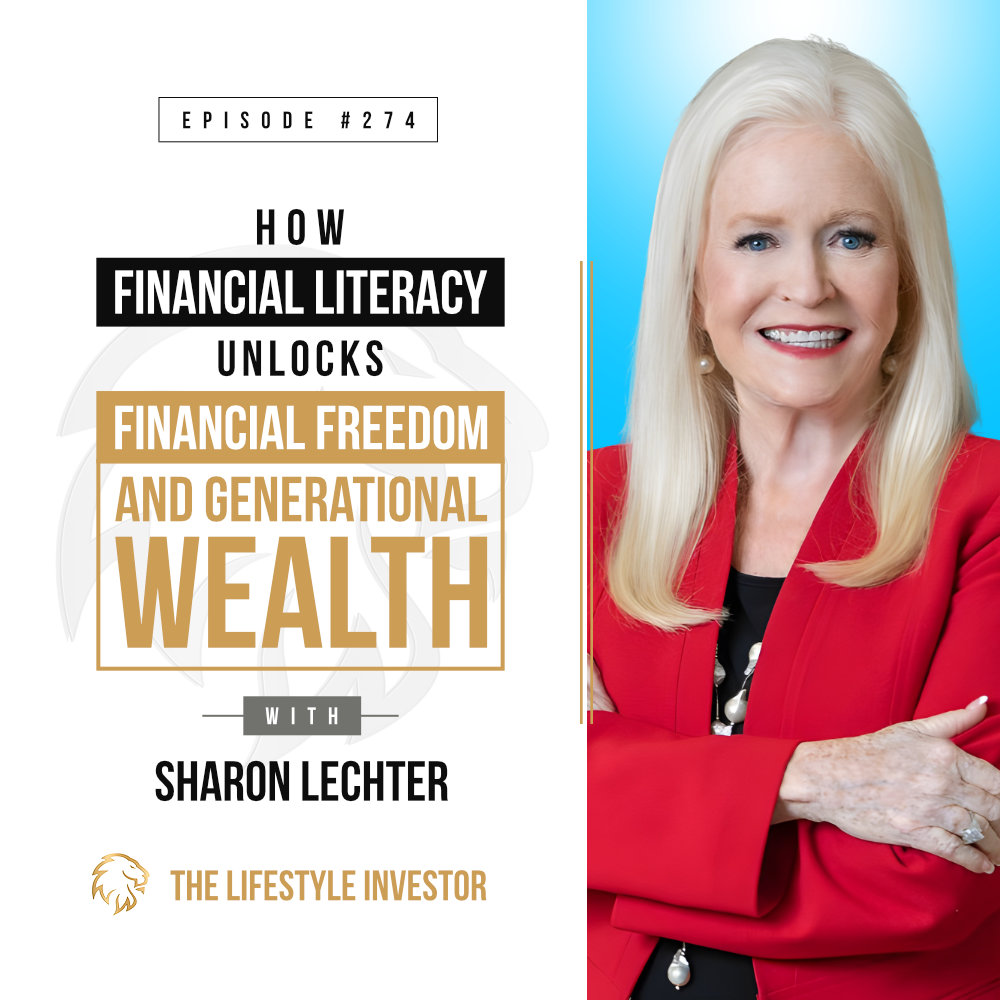
How Financial Literacy Unlocks Financial Freedom and Generational Wealth with Sharon Lechter – EP 274