![[Justin Donald] - Optin Preview](https://lifestyleinvestor.com/wp-content/uploads/2020/12/Justin-Donald-Optin-Preview-e1607533704966.png "[Justin Donald] - Optin Preview")

![Logo 1 Gold horiz [Converted]](https://lifestyleinvestor.com/wp-content/uploads/2019/08/Logo-1-Gold-horiz-Converted.png "Logo 1 Gold horiz [Converted]")
Interview with Anne Beiler
The Recipe For Building Successful Franchises with Anne Beiler
Today, I’m excited to be talking with Anne Beiler. Anne is the Founder of Auntie Anne’s, the world’s largest hand-rolled soft pretzel franchise (which she sold in 2005).
During today’s conversation, Anne shares her personal story and opens up about the series of tragic life events that left her broken, traumatized, and in a deep depression. Leaning on faith and family, she channeled that devastating pain into a bigger purpose that led to the birth of Auntie Anne’s, which she grew from a single stand into a beloved international franchise with 900+ locations.
You’ll also hear how Anne dealt with identity-crisis after selling Auntie Anne’s in 2005. A testament to her creativity and resilience, she shifted her focus to inspiring others. She now helps people face their demons and become a force for good in their businesses and communities through her speaking, books, and personal development courses.
In this episode, you’ll learn:
✅ Anne’s journey of growing Auntie Anne’s from a single soft-pretzel market stand into an international franchise with stores in all 50 US states.
✅ The mindset that helped Anne to overcome devastating pain and trauma, and turn them into foundations for honesty, love, kindness, and a life of service.
✅ Auntie Anne’s formula of three P’s (Purpose, Product, People) for success that any brand or franchise can use to grow their business.
Featured on This Episode: Anne Beiler
✅ What she does: Auntie Anne Beiler is best known as the founder of Auntie Anne’s, the world’s largest pretzel franchise. Today, she is a speaker, author and leader. Her entrepreneurial insights and personal story have been featured on many television shows including Secret Millionaire, The Oprah Winfrey Show and Good Morning America, and highlighted in numerous publications such as Fortune, Inc., Guidepost and Entrepreneur Magazines. Beiler is the author of The Secret Lies Within, Overcome and Lead and Come to the Table cookbook and regularly speaks at conferences around the U.S. For more information visit auntieannebeiler.com.
💬 Words of wisdom: “To become a good leader, I believe that one of the most important things is to be real, open, honest, and transparent in every way as you lead your company.” – Anne Beiler
🔎 Where to find Anne Beiler: Facebook | Instagram
Key Takeaways with Anne Beiler
- The unbeatable strength of family support
- Openness, honesty, love – that gets us through the darkest of times
- Strong purpose and great product = unbeatable brand
- Always something to give, no matter how little
- Auntie Anne’s unexpected franchise journey
- Why Anne always chose sampling over advertising
- Restoring your identity post-exit
- The importance of treating people well
The Tough Decision to Sell Auntie Anne’s Pretzels
Inspiring Quotes
“I think that we need to remember it really is more fun to give than it is to get. I mean, it’s more blessed to give than is to receive. It’s really a great model to live by. Even when you think you don’t have very much, you always have something to give.” – Anne Beiler
Resources
- AuntieAnneBeiler.com
- Anne Beiler on Facebook | Instagram
- Come to the Table by Anne Beiler
- Overcome and Lead by Anne Beiler and Emily Sutherland
- Olivet Nazarene
- Createur Conference
- Emerge Counseling Ministries
- Hobby Lobby
- The Purpose Driven Life by Rick Warren
Tax Strategy Masterclass
If you’re interested in learning more about Tax Strategy and how YOU can apply 28 of the best, most effective strategies right away, check out our BRAND NEW Tax Strategy Masterclass: www.lifestyleinvestor.com/tax
Strategy Session
The Lifestyle Investor Insider
Rate & Review The Lifestyle Investor Podcast
If you enjoyed today’s episode of The Lifestyle Investor, hit the subscribe button on Apple Podcasts, Spotify, Stitcher, Castbox, Google Podcasts, iHeart Radio, or wherever you listen, so future episodes are automatically downloaded directly to your device.
You can also help by providing an honest rating & review over on Apple Podcasts. Reviews go a long way in helping us build awareness so that we can impact even more people. THANK YOU!
Connect with Justin Donald
Get the Lifestyle Investor Book!
To get access to The Lifestyle Investor: The 10 Commandments of Cashflow Investing for Passive Income and Financial Freedom visit JustinDonald.com/book
Read the Full Transcript with Anne Beiler
Justin Donald: Well, hey, Anne. It's so good to have you on the show. I'm glad that this worked out and we got a chance to connect.
Anne Beiler: Yeah, I love it, too. And then thank you for the invite and I'm looking forward to talking to your folks on your podcast. And I appreciate the opportunity.
Justin Donald: Well, this is going to be fun. I posted a picture on social media of the two of us. We got a chance to meet at Olivet Nazarene. They had their Createur Conference.
Anne Beiler: Yes.
Justin Donald: You and I were invited in as a couple of the key speakers. And I heard your story and just fell in love with you, the way that you show up, the way that you have handled adversity. And I'm like, "We have to get you on this show. People need to hear your story.” And just the tremendous success that you've had but the humility that really allowed it to be the story that it is.
Anne Beiler: Well, I feel like when life gets hard and you get back up again a number of times, and you remember where you come from, mostly it's really not about me. And then when I say that, I really believe that it's really all about the wonderful people that came around me and my husband and the people that knew a whole lot more than what we did about business. And as I tell you my story, your audience will understand what I mean by that. So, I've been thrown off the wagon a few times by bad choices, by things that I did wrong, but I always got back up again. But I can tell you right now, I remember where I came from, as a little Amish girl on a farm in Lancaster County, who's experienced a lot of life. And my focus stays on who God is and who I am and that keeps me grounded.
Justin Donald: That's incredible. Well, we got such a great response from people when I posted that, and it was funny because I was limping around in my big old boot. I just torn three ligaments in my ankle.
Anne Beiler: That’s right.
Justin Donald: I had my scooter because it had just happened days before, and I was like, "Oh, I can't cancel on these guys.” So, my doctor is like, "You should not be traveling.” But I'm like, “I'm not going to last-minute cancel on these guys.” So, I showed up with a little scooter, a boot. It was a challenging speech to give and it worked out great. But one of the highlights was just seeing the impact that many of us were able to have that day and getting a chance to meet you and just learn more about you. So, I'm excited to dig in.
And it's interesting because you, I don't think, ever really thought of yourself as an entrepreneur that you are going to start a business, right? Like, that was kind of something that just happened? Maybe it wasn't your idea originally.
Anne Beiler: That's correct. I mean, that's a little bit like me thinking about going to the moon one day. I can't even imagine that. And so, being an entrepreneur, that may sound a bit extreme, but I grew up in an Amish farm and there were eight of us kids and mom and dad, ten of us around the table. And we met every single day without fail for I got married when I was 19, but from the time I was a little girl, so I was 19, we met around the table three times a day. And the word ‘entrepreneur’ or even one day having a career, that was never a part of our upbringing. It’s not what we talked about around the table.
But really, Justin, what I found out around, what I discovered, what I learned, and what formed and shaped me around the table was parents that cared for me, that worked really hard to provide for us siblings that we became a team, and we didn't understand teamwork. I mean, we just do, you go out to the field, and you gather a bunch of tomatoes and you make it fun, and you play games while you're out there working. It sounds maybe strange for people to hear that but I feel like in those moments, as I look back, it's where I learned how to become a businesswoman, even though that was never on my mind. But hindsight is 20/20, and I feel like it gave me a great foundation and then later, going to a business that I knew nothing about the franchise model.
So, it's amazing. And here I am today talking to you, Justin. And you're a great example. When I saw you riding around on your little scooter with your broken ankle, foot, whatever it was, yeah, that's a great example. That's a tough man. That means he’s going to plow through whatever comes his way. And that's really the attitude that we have to have as businesspeople.
Justin Donald: 100%. And one of the things that you had said here that I just feel like I've got to share is I had read a study and this is pretty recently that basically was tracking what are the most important things that a family can do to build depth and cohesiveness and just loving connection where there is a relationship so many years down the road. And the top thing on that list was regular meals together, specifically dinner around the dinner table, the majority, if not all nights of the week.
Anne Beiler: Justin, as you're saying that, I get goosebumps because what you spoke there is absolute truth and is what we have lost in our culture. And that's why I did a cookbook a few, don't know, within the last year. It’s called Come to the Table. And it's the thought behind it is I have all these years that I look back and I'm like, "Wow, coming around the table with our family just built character.” It just built strength within all of us. And to where today, all eight of us kids, we're still all living, we're still in good health, and we get around. And we still if one of us is invited to the home, we sit around the table, we turn the TV off. We just sit around the table and laugh like a bunch of kids. I don't know, it's just powerful.
And I would like to encourage the audience, you know? I know we're busy. You know, teenagers they pop up, like suddenly, they have jobs, they have sports. And it's really hard in our culture to bring the family together around the table without any distractions. But I just like to encourage that. Just say, "Hey, just try it one night a week for starters.” It would be awkward for a lot of people, like, actually sit around the table. I think it could be awkward but I think it's still something that we can strive to get back to.
Justin Donald: Yeah, I think that's wonderful. And I think I'm thankful for my upbringing. My parents were really disciplined about that. Outside of sports, I mean, we were always having family meals. And so, yeah, I look back at that as just being a very defining quality or attribute of the Donald family. So, I love that.
Anne Beiler: Yes. And can you imagine what your life would be like without that model and example? Yeah.
Justin Donald: That's right. Because of that, that's what we do with our daughter. I mean, that's normal, right, because that's what we grew up with.
Anne Beiler: That's right.
Justin Donald: So, tell me, how did you take the leap? How did this happen? You're supposed to be a farmer. It looks like you gathered some skills around the farm. You, I would imagine figured out ways to have unique relationships with each of your siblings and with your parents, but at some point, there's a transition. And where on earth did the idea for Auntie Anne’s even come from making pretzels?
Anne Beiler: Well, it really wasn't my idea but there is a little story behind it. I think, for starters, I always like to say that our pain propelled us into our purpose. And then you might say, "Well, what's that got to do with Auntie Anne’s?” Well, it has everything to do with Auntie Anne’s because, as a young couple, Jonas and I, we had two daughters, and life was good. And we really felt like we were on our way to living the American dream, which was just simply to have a family, make enough money to pay the bills, maybe own our own home one day and serve people and go to church. I don't know. That was just really kind of the only thing that we had as a goal and as a dream.
We were living that dream very early on in our life because we were 19 and 21 when we got married, and within a couple of years, we had our first daughter and then our second daughter, and very active in our community and in our church. And we could never have dreamed or even known how to think about tragedy and trauma. That was so not a part of our life. But one particular morning, we had our youngest daughter, who was 19 months old. Her name is Angela Joy. And she was walking to my mother's house, which was right next door to our house. But between our homes, we lived in the country, between our homes, my dad, he was making stone siding.
And so, my sister would load and unload sand with a bobcat or a farm tractor of some sort. And at that particular morning, she would always look to see where the girls were and be careful. And every now and again she'd swoop up Angie and put her up on the bobcat with her and they ride together for a while. So, we were all very close-knit, but that morning, as my sister looked around and see if any of the girls were there, she didn't see anybody, so she backed up. And when she went to move the bobcat forward, Angela, she saw that she had accidentally run over Angela, and Angie was killed instantly that morning.
So, when I talk about trauma and tragedy, I know now, at the moment, I didn't like know. I didn't understand how that would change me from the inside out. And trauma does change us. In the moment, you're traumatized and in shock but as time went on, I realized my sister was an accident. And we never blamed her because, I mean, why would we? Accidents happen. And so, I really never had any problem with the accident itself or what happened, what she did. But as time went on, I didn't understand why. Because I believed that if I was a good girl and I followed God, and I did all of the right things that He would be pleased and He would bless our lives.
I didn't understand then that life is hard and God is good. I thought that life is good and God is harsh, which means I just felt like if I do all right, God would bless me, he would be pleased, and we just live happily ever after. So, again, theologically, we were not prepared for any kind of tragedy or trauma. And so, that was the beginning of my sorrow. And I knew that as Angie made her ascend into heaven that day, I began my slow and gradual descent into a world of emotional pain and spiritual confusion. And I don't want to go into all of that. I just wanted to share a minute with your audience what I mean by the pain that propelled us into our purpose.
And soon after, a few months after that, I went to my pastor for help. And it's in that setting that he took advantage of me physically, which then took me into a much deeper, darker world. Angela's death, there was a lot of pain, a lot of sadness, a lot of grieving. But then the abuse was more I found myself in the dark world, and it was a world that I knew nothing about. I didn't know anything about abuse of spiritual power. But I made a choice. It was not my fault that I was abused that day but I made a choice as I left his office that I would never tell. And so, keeping a secret is something that I learned during those, that one secret kept me in the dark world for nearly seven years, never telling anyone.
So, at the end of those seven years, I was a shell of a woman. I had nothing to say, nothing to live for. I knew that life was over for me. And so, one day, I made my very hard, very difficult confession to my husband because the Holy Spirit compelled me, “Just go tell,” because I was dying. Literally, I was dying. And so, I did that. So, I want to just quickly say about that. The power of being transparent and the beauty of being open, honest, and transparent, authentic is something that the business world really needs. We need that in our personal lives, in our family lives, in the business world.
And so, that then was the beginning. My husband responded to me with nothing but love and compassion. And that then just was I felt my husband's love and that gave me, then over time, it gave me the ability then to love me as God loves me. And I was able to forgive and move on with my life. Not fast. It was a very long journey, a lot of hard work. But out of our pain, there was so many things that I learned during that time. And my compassion, because of that, I really just developed a heart of compassion for anyone. So, I carried all of that into the workplace. And because of what happened to us, then my husband decided to go for, he kept saying, “How could this happen? Why did this happen?”
And he began to be interested in psychology and went to Emerge Ministries in Akron, Ohio, and did a correspondence course back in the day and studied psychology and ended up being a layman's counselor for many years. But always he did it as a free service out of our home and then also out of the church basement. And that's what propelled me into our business because he was making no money. And that's the reason. That's a very long answer. But that's the reason Auntie Anne’s was started because I needed to make work. I became the breadwinner and I needed to go to work to make the dough, you know what I'm saying? And the dough ended up being Auntie Anne’s Hand-Rolled Soft Pretzels.
Justin Donald: Wow. I mean, I can't even put into words just the emotions I felt as you spoke and even try and conceptualize what you must have felt like and what you must have gone through in such a dark season. But you're an incredible role model for so many in the way that you handled that, in the way that you showed up transparently, in the way that you faced your fear and you were able to speak about it. And even the way that you didn't cast blame because I think in tragedy, the first thing that most people want to do is point a finger and they are a victim because the way to protect yourself is that it's someone else's fault. It's not your fault.
And it's not even that it's random chance but the blame needs to go somewhere. So, that's incredible that you were able to do that. And it's also incredible the gift that you allowed that tumultuous experience and season to provide for you is just beyond words.
Anne Beiler: Yeah. When we started the company, I wanted to honor my husband and what we had when we started the company was a purpose and that was to provide help. And eventually, we realized that Auntie Anne’s was created to give. So, the three things that we had was a purpose bigger than ourselves. And then the second thing was a product that was better than the best. And if you're an entrepreneur, you got to have a product that it may not be better than what's out there, but it has to be something that you believe in, that you believe is better than the best, that you know is the best in your heart. So, a great purpose and a great product, and then all the great people that came our way.
So, the three Ps that we began to focus on equals profit, the capital P, and that's what we all need to do as entrepreneurs. We really do need to be profitable. And so, our purpose then became twofold. Number one was to be light in the world of business. And number two was to be profitable so that we could be charitable because we realized the first year we built two stores and we bought a store. We had no money. The three things we did not have was we had no formal education. Jonas and I both grew up in the Amish culture, and we went through the eighth grade. I didn't feel like that was a hardship or it didn't matter to me. It's just the way that culturally is what it was.
And number two, we had no money. When I say no money, that's not a stretch by any of the imagination. We didn't have a checking account. We just live on about $150 a week and that was enough to pay for groceries or whatever, lived in a little trailer rent-free by my brother. And so, we had no formal education. We had no capital, and we had no business plan. So, I want your audience to know that it doesn't matter what we feel like, we have to blame it on why we cannot be successful or why we can't do what we wish we can do. As long as we blame, there is really no benefit. That doesn't benefit us in any way.
And I think, though, when I realize that what we had, the three things that we had, a great purpose, a great product, and great people when I began to focus on that, it means then for me, it meant I began to take responsibility for what God gave us and forget about or maybe I shouldn’t have said ‘forget about’ but developed the areas in my life that I needed to develop. And I think that blaming and it's always somebody else's fault, it puts you in a place of there's no activity there. You cannot move forward.
But when you focus on what you have and do everything you can to use the gifts and the talents that God has given you, whether it's a product or whatever it might be, when you focus on what you have and you decided you're going to develop yourself to match the gifts that God's given you, that to me, was when the opportunities became endless for us because I was driven by what God had given to me. And that meant then that I had to develop from this little Amish girl that knew nothing about business. I was married and had two daughters. Again, we had a third child in and so I was a mother and I was a wife, and I was active in the church, but I had no business skills.
But when I began to see what God gave us, that became… Being an owner, an entrepreneur is not all about, “Hey, look at me. Look what I got. Look what I'm doing.” It's really all about responsibility. And I began to feel responsible for the gift for the product and for the purpose that he put squarely in front of us. And we walked into that. And I believe that God gave me a pretzel first and then a platform to share our story for God's glory around the world.
Justin Donald: I love it.
Anne Beiler: So, developing me and developing you is really important as we find ourselves in a business that we may not know very much about, but we can always learn and we can become more. And even at this age, Justin, I'm still becoming more. You never arrive. We never arrive.
Justin Donald: Well, you can see that you just carry so much joy and enthusiasm. I mean, you just light up. I can see why you naturally were able to attract people and create a great culture in your organization because you still do it now, right? It's really neat. And one of the things that really spoke to me is that you wanted to be profitable so that you could be generous and charitable and philanthropic. And I love that. And I had David Green, founder of Hobby Lobby, on the show probably six months ago, seven months ago.
Anne Beiler: Great example.
Justin Donald: Right? He's just all about profitability for the generosity that can be. And he is a guy that gave away and still to this day, gives away half of the profits of the company of Hobby Lobby every single year. And it's so neat to see that from a textbook standpoint, that shouldn't work. That model of giving away 50% of your profits, it doesn't work. But in this instance, it really does. And I do think God has blessed his business, your business, and many others. You know, and it's not just that, "If I do this, I'll be blessed.” I think the motive really matters. It's a heart posture that really matters, that you actually desire to do that and have impact in the world and make the world a better place, do things that help people less fortunate than you. So, I like that you model that.
Anne Beiler: Absolutely. And we knew early on that, oh, actually the very first day at our little farmers market on here, yeah, we made $827 cash because it was selling pretzels. It was a retail store. So, I counted all my money, and I couldn't wait until the next morning to take 10% of that, which is not very much, to church that following morning. And I don't know, from day one, I got this giddy feeling about how much can we give and how much more can we give? And within just a very short time, we were very, very profitable. And we were able to get much larger amounts of money throughout the years as we owned the company.
And I can tell you, the giver never remembers what you gave. You really don't. But the receiver of the gift always remembers. And so, I think that we need to remember it really is more fun to give than it is to get. I mean, it's more blessed to give than is to receive. It's really a great model to live by. Even when you think you don't have very much, you always have something to give.
Justin Donald: That's right. And it's interesting because if you pay attention to the studies, and by the way, this shouldn't be the reason that you give, but you will actually find that all kinds of studies show that the people that are the happiest are the ones that give the most consistently and the ones that give most sacrificially. So, it's fascinating. Now, I've got an honest confession to make. In my younger years, I was not very good at this. My heart was hard. I did not want to give. It's like, “I worked for this. Why would I give this away?” I remember my parents trying to teach me this lesson, and I just would not have it. I fought really hard.
And what's neat is, today, I live in this different place where I relinquish this desire or this recognition that it's mine. I actually don't feel like it's mine. I feel like I've been blessed with it, but it's not mine. And that, I think, has given me the space and the freedom to actually give generously, to give with a heart that is full of joy for that action. But it took some time, and I think I got off to a really bad start. And unfortunately, it took me a few years to figure this out. I'm just thankful that I finally did because the longer I waited and the more money I made, the harder it was to give.
Anne Beiler: Absolutely. You know, I think that discovering that principle of giving with joy, do it with joy, well, I mean, I have to tell you, at the beginning, I couldn't wait to give that cash from our market, and I did that. I called it the three-stack system because I knew, because it was a cash business. We wanted to give 10%. And then so at the end of each weekend, I would count the money and I would actually do three stacks, 10% off at the top and put that in an envelope to take to church, 30% for taxes, I opened the savings account to put my tax money into there, and then the rest of it just for living expenses and operating expenses.
But I have to tell you, the more we made, the more I realize we need to give more than 10%. And I'm still getting used to this giving. And an honest confession like you just made, because there were times I would actually, particularly, if I knew there was like a missionary mission Sunday or like they're raising funds for, I don't know, whatever it might have been at church. And there were times I actually left the checkbook at home, so it cleared my throat, like, I don't know. I don't know what, but once you understand the blessing and the joy that you get from giving, and particularly the sacrificial giving, the 10% is kind of, I mean, yeah, that's hard. I mean, it can be if you're not used to it.
But as time has gone on, that has become the greatest joy for us, right? But then to give sacrificially beyond that was a whole other lesson that we had to learn. But you know what, God has blessed us. And I'm not about a prosperity gospel, please. That is not where I'm coming from at all. I just know that the principles of God work in our lives, and there's always times that we are tested, I believe, in that regard as well. And so, there have been times of testing for us in that area of our lives. But you continue to push through that, you continue to give. And as we look back, we're like, "Oh my gosh, how did that work? You know, we gave anyway. How did that work?” It doesn't equate.
Justin Donald: I remember, when Rick Warren's book, A Purpose Driven Life, came out and I read it, and I was like, "This is incredible.” And then I found out later that he reverse-tithed. So, he kept 10% and then gave 90% and my mind was just totally blown. And I was like, "Okay. If this guy can give 90%, how can I not give 10%, at least?” And then I do think that the more that you strengthen that giving, the easier it is to be a radical giver. Not that it's easy, but that's where that strength can come from.
Anne Beiler: That's right. You do become radical. That's right. That's right. And it's kind of fun.
Justin Donald: Yeah. No kidding. I love learning your story and kind of these stops along the way. I love that you are very generous in your giving at an early age, which is probably something that was instilled by your parents and through the church, but I know that it's not easy when the business is new, when it's on life support. I mean, you're going from a farmers market stand to like buying an actual business to then buying another location or starting another location. So, what was that growth like as you did kind of start things out? Like, what was the cost? You had very little money. Like, what was the cost to open this first new location that was a real store?
Anne Beiler: Right. So, it was at a farmer's market and I grew up in Lancaster County, Pennsylvania, where there are lots of that. That's kind of a, I mean, many people make their living at a two days a week farmer's market and do very well with that. And during that time, Jonas and I, again, we really had no money and we got a call from somebody that said to us, "There's a market store for sale.” It was 20 minutes from our house, and I was working at that time, I was a manager for a few months at another farmer's market, a job that I found again to support Jonas. That was the very beginning, my going into the market world. And so, somebody called me and said, "There's a market for sale 20 minutes from your house.” I’m like, "20 minutes from our house?”
So, we have no money to buy a market stand. And back in the day, a market stand can actually be a pretty huge investment. It can be anywhere from $10,000, $20,000 to $150,000 you buy a market stand. You don't pay rent but you buy the stand. Anyway, so I just right away I said, "Well, I mean, we have no money.” And this was a friend of mine, and she said, "Yeah, but just, I mean, call the people maybe.” So, even that, Justin, it wasn't part of my plan, you know? Okay. So, I told my husband about that and he said, "Well, let's call them and find out.” So, over the phone, they told us they want $6,000 for this store and we're like, "Wow, $6,000?” And I was like blown away.
I'm like, "Okay, we had no money,” but Jonas, his father was a very wealthy Amish man. And he had told us a few months before that, "Hey, if you ever want to buy a house or a business or something, just let me know,” and he said, “I'll help you out.” So, we had that in the back of our mind. And so, over the phone, I told these people, "Yes, we're going to buy the store. We're going to go get our money from my father-in-law. We're going to go see if we can get the money from him, and then we'll call you back and let you know.” So, we went over to my father the next day, father-in-law, and he gave us the $6,000 check. And we then took the check to the home with the people that we bought the store from.
And then we went to look see what we bought. So, that will tell you my business savvy and what I knew about business, and that's why I say everything about Auntie Anne’s is a miracle. It should never have happened. The three things we didn't have could have kept us from doing this. A call from a friend encouraged us. And so, we bought the store site unseen. Yeah. And so, we went to and we realized, "Wow, this was a pretty nice store,” but we knew we had to remodel and clean it up. It was in kind of bad shape. And so, we did that, spent a little bit more money. But my family, there are eight of us kids, and there's three of my brother's kids, oh, they're excited. So, they helped us remodel and we painted and cleaned.
And within the following week, I was at that store owning that store and selling soft pretzels. So, within six months, we did another store, which was about one hour from our house. So, we did two stores the first year and 12 stores the following year. And then in 1990, we did about 35 or 40 stores. And so, it was during that year, 1990, that we realized I was calling it a licensing agreement. So, I knew nothing about franchising. Zero. All I knew was that McDonald's. I kind of knew they were something like that, a chain or a franchise. I don't know what it was, but.
And so, we were licensing. Anyway, somebody revealed to us that we're not licensing. we're franchising. And I actually argued with them. I said, "No, no, we're licensing.” He said, "Well, your model is franchising.” I'm like, "Wow.” Anyway, so there were so many obstacles along the way, Justin, that almost stopped me dead in my tracks. And that was one of them. And my husband and I, we began to read up on what does it mean to franchise.
Justin Donald: Yeah, a lot of red tape around franchising. I mean, it is not easy. Tons of red tape from a legal standpoint.
Anne Beiler: Absolutely. Oh, the legalities in a franchise company are like over the top. And when we realized that, so we went to our little town in Lancaster, Pennsylvania. We talked to an attorney who was not a franchise attorney, but we drew something up that was a little more stable than what we had. Anyway, but in 1990, we realized that we were franchising and we went to a company in Chicago, Illinois, early 1991 to what’s called Friend Corp. And that's where we came away with a few weeks later with a 250-page document called the UFOC and I never read it through. My brother, who came in just at the right time, he read every line, every jot and tittle. He didn't miss a thing. He was like, “Holy cow, this is what we're doing.”
So, when you find yourself in a company and there are things you don't know, it's okay to say, "Oh, gosh, I don't know,” instead of pretending like I don't know. It was so hard and, again, with my background and not having a formal education, knowing nothing about business but what, again, Justin, have to go back to what I learned on the farm, hard work, perseverance, love people, giving. And I think that all three of the things that I focused on was having a great product, great purpose, and great people. Honestly, everything else, the things you don't have, if you have a solid foundation with those three things, honestly, you could do more than what you ever imagined. And that's what we did. It's unbelievable. Even as I tell the story, Justin, I'm like, what? But it's all true.
Justin Donald: I love it. Well, I'm an atypical customer because I don't love pretzels. Most people love pretzels. For whatever reason, I don't. And so, I would see these lines at these Auntie Anne’s and I'm like, "What is the big deal?” And by the way, still today I go to malls and there are always lines. Airports, there are always lines. But what I ended up doing one time, this is later on in the business, you guys came out with your pretzel dogs, and I grew up loving hot dogs, so I was like, "Pretzel dog? I should try this.” And so, one day, I waited in line. It was a long line. I'm like, “I got to see what this is all about.”
And I got a pretzel dog and I was like, "This is the most delicious thing I have ever had. This is way better than a hot dog.” And I was hooked. I was sold from there on out. And so, yeah, my story is kind of funny because you wouldn't have had me at just a pretzel but the pretzel dog got me.
Anne Beiler: And we had so many people that said, “I don't like pretzels,” but I was, I mean, honestly, anal is the best word for me. Like, I was a wild, crazy woman. That's another description. If you were walking by my store when I first started like I would not let you walk by. I would either give you a whole pretzel if you looked at me and said, "Nah,” “No, just take this.” Or we did sampling and that really became that's the way people did. I want to sample so people would buy a product. I don't know. I mean, I guess, but at the end of the day that worked for us. But for me, it was like, "You just got to try this amazing product.” And so, that really got people hooked.
We built our whole company on sampling, and that became a part of our franchise agreement. If you came in and you wanted to do an Auntie Anne’s store, it's mandatory that you sample. And I cannot tell you how often we had to fight. I wouldn’t say fight. That's not a good word, but we had to try to convince people the importance of building your sales on just samples. They would want us to market on TV, on radio, the normal ways that you would market. And I would just say, "No, no, if you will sample, it will increase your sales.” And I would actually go myself. A store may have been failing and I would go myself to the store. I would sample for the day and every single time, their sales were a few hundred dollars or more just because we would go sample.
So, we built our company on sampling. And by the time when I sold the company, we owned the company about 20 years. Up to that point, we'd never done any TV ads. It was all about sampling the product. And they still do sample their product. They got a whole lot more sophisticated with their marketing and all that stuff but for the almost 20 years I was there, we never did that.
Justin Donald: Wow. Well, I got to tell you that sampling works. And, also, still to this day, your pretzel is the only pretzel that I actually like.
Anne Beiler: Thank you, Justin.
Justin Donald: Yeah. So, it's a huge compliment coming from a guy that literally never gets pretzels anywhere else.
Anne Beiler: Makes my heart happy.
Justin Donald: Yeah. So, tell me this. So, you scaled it to a thousand stores I think at some point. I think it's a brand with over 2,000 stores now internationally. Right?
Anne Beiler: I believe the number is right around that number. I believe that we're in all of 50 states. And when you sell a company, you no longer, I'm not part of it. I sold it outright but with the name above all the stores, it's my name. And sometimes I’m like, I don't know, I can't help, but it's still the baby that I birth, I guess. Sounds silly. But to scale in that way was because we brought experts in the field and from outside, brought them into. We had employees from all over the country that came. They came to help us and the experts just really helped us build. I had one brother, a couple of brothers that helped us, but one brother that had a business degree.
And so, he really helped me. He was the head of the company, and I was the heart for sure. You cannot be all heart. You got to have someone that's got the brains, the head and is able to cast a vision and really department. I mean, he came in and did all of the structure for the company. But I was just the heart and I love the people. And so, to scale from one store to about 900 in about 15, about 20 years, was a big for us. And I guess during those years, Justin, I had stretched myself and I'd taken myself to the limit so many times, and then I'd stretch again and take myself to another level or limit.
And I guess by the time we had about 900 stores, we began to realize that we do have an option. And we’ve done very well. There's no reason for us to sell the company. We were doing very well. And we brought some advisors in and we talked about it and just felt like it was a good time. And we did, and it was one of the hardest things I've ever done in my life. It was hard to start the company but it’s much harder to sell it.
Justin Donald: Yeah. So, I'm curious because I work with a lot of people. A lot of entrepreneurs in our community have had an exit. And so, I'm curious what that was like. I'm sure there was a moment of celebration, but I think there's also a moment where you kind of lose kind of who you are, some of the ego or your self-concept is damaged or shaken a bit. Right?
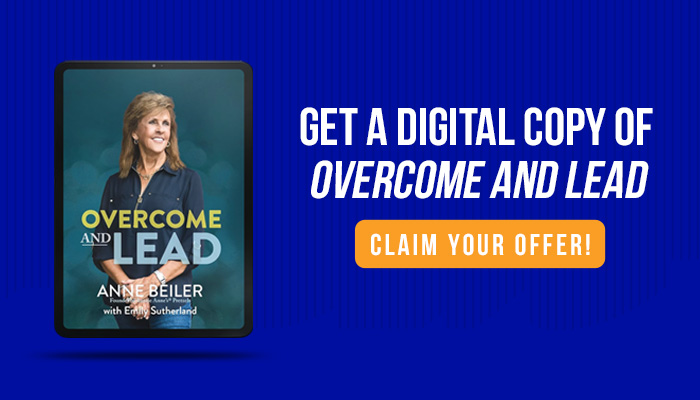
Anne Beiler: Or you lose your identity. If your identity is in the product and in the company, you actually lose your identity. And, yeah, that's a whole story. In my book, Overcome and Lead, which I don't know if you're going to put that on you, but I'm just holding...
Justin Donald: You bet we are. This is your newest book, right?
Anne Beiler: Yeah. Correct.
Justin Donald: Yeah, the one that just came out.
Anne Beiler: Yeah. So, overcoming all of those hurdles and obstacles as I was growing the company and one day selling it and the next day, sitting on my chair in my house. Wow. It was a moment, let me tell you. I bawled like a baby. And in the midst of that, I almost felt something deep within me said, "My company was about two minutes from our house by driving about two miles from where we lived.” And I just kind of thought that when I sold the company I'm Auntie Anne, my identity is entrenched in the company. And I know most people love me. Not everybody, but most people. I love everybody, but I don't know about everybody loving me.
But I just, I mean, I just felt like I didn't see it as a divorce. I just saw it as somebody else who's running it. But I can go back there and say hello to people. And you know what? I'm sitting there and in the midst of my, like, "What did we just do? What am I going to do today?” I just heard this very strong thought came, interrupted my thoughts and said, "You can't ever go back there.” And I'm like, I mean, it was so abrupt that I just stopped in that moment. I'm like, “I can't go back there.” And then I realized, Justin, that's right. I can't go back there.
I just told myself, if I want the new owner to really do well, I cannot interrupt that. And so, I called him and I said, “I just had a revelation, and I just want you to know, I'm not going to come back to Auntie Anne’s unless I call you first or unless I'm invited.” And he said, "Thank you for that. I really appreciate that.” Anyway, so there are just so many things along the way that I learned. But the identity that we put into our business is almost a false. You know, because we live in a culture of what do you do? You know, I introduce myself or you introduce yourself, “What do you do?” So, our identity is really in what we do pretty much. And that began another journey and my spiritual journey it started that day, and I'm still working on that.
Justin Donald: Yeah. That's great. Well, we all have things that we need to work on. I love that you are working on high quality, we can call it a problem. We can call it kind of like the next chapter, the newest form of education. But I love that you're still a student and that you're transparent about where you're at and how you feel and what the transition is like. I know that this transition is a tough one for most, if not all, entrepreneurs. And by the way, it's funny because many of them would say because in this instance, I have to assume this was life-changing money. And for a lot of the people I work with, that's the case. And so, on paper, it looks like, yeah, you just won the lottery.
Anne Beiler: Why not? Right, exactly.
Justin Donald: But emotionally, it's a different tale.
Anne Beiler: There's so much to learn about business and so much to learn about just as an entrepreneur, so many people want to own their own companies. And I love that part. You know what I mean? What I also know, Justin, and you know as well, it's a very difficult journey. It can be very challenging. And I think that if we take the calling to become a businessperson, an entrepreneur, leader, whatever that may be, it is truly a responsibility that we carry for our world. You know, no matter how big your world is, maybe it's your county, maybe it's your town, maybe it's your state. I don't know, maybe it's around the world that Auntie Anne’s went.
But whatever level that you're in right now, I just pray that God calls us as leaders to make a difference. And when I understood, “This is a great concept and Auntie Anne’s pretzels are really great.” But when I began to realize that God called us into the business world to be light and to be profitable, and that I'm a leader, not a manager, I was both for some time which we need to be. But I began to understand that my gifting was a leader. Well, I mean, the responsibility of that was so heavy on me that there was a period of time during that time that I just like, "Wow.” It almost sapped the joy because of the responsibility,
I had to grow. I couldn't stay who I was. I had to grow to become, to fit the task what God had called me to. I had to grow into that calling. Now, the world knew I wasn't qualified. You know, I knew I wasn’t qualified, but God called me. He saw me and he called me. And he knew that He would qualify me. He would teach me. And there's a verse in the Bible that he gave to me, Psalm 32:8, “I'll teach you in the way that you should go. I'll instruct and I'll teach you, and I'll lead you. I will counsel you with my eye.” So, I think that for me, just a spiritual aspect of where I came from, knowing God and trusting Him, doing it, “All right. No. Well, no,”
I lived a part of a life trauma and tragedy that took me into a crazy, crazy world. But even in that, I learned to come out of that and to grow from that and to take from my trauma and tragedy and carry that with me and develop who I was. Even there, I began to develop a better person after I came out of the dark world. So, we're constantly growing. But as a leader, it's really important that we understand it's a responsibility how we treat our people. The biblical truth about that is pretty strong. How we treat our employees and our people is very, very important. And so, to become a good leader, I believe that one of the most important things is to be real, open, honest, and transparent in every way as you lead your company.
Justin Donald: Anne, that was beautifully said. I have loved our time together. And your faith is inspiring. Your leadership is profound. So, thank you. Where can our audience learn more about you and all the books? I think you have four books. All the books that you've written, we'd love to be able to learn and support you.
Anne Beiler: Yes, absolutely. Just go to my website, Auntie Anne Beiler, and you'll find where I'm speaking and the books. We also have some online courses but it's all in our website. So, if you go there, you'll find it.
Justin Donald: I love it. Well, Anne, I love ending every podcast episode with a question to our audience. So, to those of you tuning in, listening, watching, whatever you're doing, my question for you is this: What is one step you can take today to move towards financial freedom and really living a life that you truly desire, one that's on your terms so unlike most people, not a life by default, but rather a life by design? And pick one thing that you learned from Anne today to move in that direction. Thanks so much and we'll catch you all next week.
Sign up to receive email updates
Enter your name and email address below and I'll send you periodic updates about the podcast.
Keep Learning
From a 9-Figure Exit to Inspiring the Next Generation of Entrepreneurs with Scott Lingle – EP 282
How to Avoid Leaving Millions on the Table When Selling Your Business with Stephen Scoggins – EP 281