![[Justin Donald] - Optin Preview](https://lifestyleinvestor.com/wp-content/uploads/2020/12/Justin-Donald-Optin-Preview-e1607533704966.png "[Justin Donald] - Optin Preview")

![Logo 1 Gold horiz [Converted]](https://lifestyleinvestor.com/wp-content/uploads/2019/08/Logo-1-Gold-horiz-Converted.png "Logo 1 Gold horiz [Converted]")
Interview with Andrew Lassise
How Niching Down Led to a 10x EBITDA Exit with Andrew Lassise
One of the biggest reasons many entrepreneurs struggle to scale their businesses is that they focus on attracting more clients by casting a wide net and pouring money into marketing that doesn’t generate and convert enough leads.
But everything changed when today’s guest did the opposite by narrowing his focus, niching down, which ultimately skyrocketed business growth and positioned his company for a huge exit.
Andrew Lassise is the founder of Tech for Accountants, a cybersecurity and IT company built exclusively for accounting firms. After initially struggling to sell his company, Andrew rebuilt it with tighter systems, sharper positioning, and a deliberate niche strategy. The result? A sale at a 10x multiple of projected EBITDA, more than double the industry norm.
In this conversation, Andrew shares how sobriety became a competitive advantage and why systematizing your business is the key to turning it into a sellable asset. We also discussed how to leverage AI and automation to scale your business without burning out.
In this episode, you’ll learn:
✅ How niching down skyrockets Andrew’s business growth and created market dominance in a crowded industry.
✅ Why AI isn’t a silver bullet and how to use it to create real leverage and buy your time back.
✅ The mindset shifts from being the operator to building a business that scales sustainably towards a successful exit.
Featured on This Episode: Andrew Lassise
✅ What he does: Andrew Lassise is the founder of Tech for Accountants, a cybersecurity and IT firm specializing exclusively in accounting firms. After rebuilding his company around systems, niche dominance, and scalable lead generation, he sold it at a 10x EBITDA multiple. He is also the founder of Sober Founders, a nonprofit community supporting entrepreneurs in recovery.
💬 Words of wisdom: “Everybody wants a silver bullet and all of the AI companies are promising silver bullets. But I haven’t found a tool that completely replaces the human element of sales.” – Andrew Lassise
🔎 Where to find Andew Lassise: Website | LinkedIn
Key Takeaways with Andrew Lassise
- Andrew’s All Or Nothing Mindset
- From 0 to 100: Addiction to a DUI Rock Bottom
- Using Sobriety as a Strategic Advantage
- Protecting Your Mental Health as a Founder
- Niching Down Unlocks Exponential Growth
- Turning Compliance Into 1,100 Leads
- Why AI Is Not a Silver Bullet
- he Key to Buying Your Time Back
- How Andrew Negotiated a 10x EBITDA Exit
- Where You Can Learn More from Sober Founders
Leveraging AI to Buy Back Your Time
Inspiring Quotes
- “I got good at marketing because I realized that it doesn’t matter how good your music is, it’s just how well you can market it.” – Andrew Lassise
- “You have to be intentional about setting aside time to do the things that you know you need to do.” – Andrew Lassise
- “The world idolizes the hustle and grind. Looking back on it, just systematize and be intentional with your business. I still had managed to be pretty successful despite myself for a good amount of time, but we catapulted and did way better once we started systematizing.” – Andrew Lassise
Resources
- Sober Founders
- Sober Founders on LinkedIn | Facebook | Instagram | X/Twitter
- Andrew Lassise on LinkedIn | Facebook
- Tiger 21
- eBay
- Yuengling
- Alcoholics Anonymous
- Narcotics Anonymous
- Gamblers Anonymous
- Entrepreneurs’ Organization
Want My Team’s Help?
- Tax Strategy Masterclass
Learn the 28 most effective tax strategies the wealthy use to save thousands.
lifestyleinvestor.com/tax
- Free Strategy Session
Get a personalized roadmap to financial freedom.
lifestyleinvestor.com/consultation
- Lifestyle Investor Newsletter
Join The Lifestyle Investor Insider for curated investing insights.
lifestyleinvestor.com/insider
Rate & Review The Lifestyle Investor Podcast
If you enjoyed today’s episode of The Lifestyle Investor, hit the subscribe button on Apple Podcasts, Spotify, Stitcher, Castbox, Google Podcasts, iHeart Radio, or wherever you listen, so future episodes are automatically downloaded directly to your device.
You can also help by providing an honest rating & review over on Apple Podcasts. Reviews go a long way in helping us build awareness so that we can impact even more people. THANK YOU!
Connect with Justin Donald
Get the Lifestyle Investor Book!
To get access to The Lifestyle Investor: The 10 Commandments of Cashflow Investing for Passive Income and Financial Freedom visit JustinDonald.com/book
Read the Full Transcript with Andrew Lassise
Justin Donald: What’s up, Andrew? Good to have you on the show.
Andrew Lassise: Hey, after we were just talking in the beginning, I was like, hey Don, how’s it going?
Justin Donald: That’s right. We were joking off air. We were talking about last names. And Andrew is joking. Yeah, probably no one messes up Donald. That’s so easy. And I was telling him, actually it gets messed up all the time. People think my first name is Donald and they shorten it to Don and you would be shocked at how often that happens. Yeah, it’s really, really funny.
Andrew Lassise: Again, with Lassise, I’ve heard all the different variations and people trying to make it fancy, and then not fancy and butchering. But thank you so much for having me, Justin. It’s great to be here.
Justin Donald: Oh gosh. Well, I can’t wait. You and I are in a bunch of groups together, so we’re in Tiger 21, we’re in Post Exit Founders. We’ve got a lot of overlap of friends. It was funny when you were checking out, people I had on the podcast, you’re like, “Oh, I know a ton of these people.” And so, yeah, I love featuring people from Tiger 21. I love featuring people from Post Exit Founders. I love featuring people from Lifestyle Investor. I mean, any place that there are people with a cool story to tell that have done incredible things, whether it be lifestyle, business, investing, I just love to feature them, and your story is quite incredible and I can’t wait to get into it.
Andrew Lassise: Yeah, I mean, if we’ll start kind of in the beginning, growing up, just sort of a middle class, Maryland. My dad was a stockbroker. My mom was a banker, so I kind of understood finance. I didn’t know that credit cards, I thought credit card and debit card meant the same thing, that you can’t buy things that you can’t afford. Like, I didn’t discover that until college that you’re capable of just buying things when you don’t have enough money for it. It blew my mind. So, I’ve just been frugal, just financially, and I guess smart about it, kind of my whole life.
But I’ve discovered in reflection over the past, we’ll call it 15 years or so, that everything in my life, I either do zero or a hundred. So, for instance, when my wife and I got pregnant with our first child in 2019, she was like, you’re fat. Let’s see if you can run a mile. And fast forward now, I’ve run six marathons. I’m going to be in the Tokyo Marathon in March ‘26. So, I don’t really have throttles.
Justin Donald: That’s awesome.
Andrew Lassise: Yeah. And so, that…
Justin Donald: All or nothing. By the way, we did a Lifestyle Investor event in Tokyo, so we just got back from Tokyo.
Andrew Lassise: How great is that?
Justin Donald: In Kyoto, and it was epic. So, you’re going to love it. How cool is it that you get a chance to run a marathon out there?
Andrew Lassise: Yeah. We were there in maybe, April or May, something like that. And the way the marathon world works is to get into major marathons, which Tokyo is one of them. You either have to be an elite athlete and I’m just never going to be, I don’t think I will ever be there, right? Then they also have lottery systems. And you may get in, you may not. But then they also have the charity bib and they do a silent auction basically. And they’re like, hey, how much would you care to donate to see if you could get in?
Justin Donald: Oh, nice. That’s a nice little hack, right?
Andrew Lassise: Yeah. Well, and if you have someone on the inside too, they’re like, okay, we have 10 bibs. Like, here’s who the highest one is and here’s who the middle one is. You can make some assumptions based on that. But when we were in Tokyo, I reached out to my friend, I know her organization was doing it, and I was like, whatever it is, I need any excuse to get back here. The food was incredible. The people were incredible, just…
Justin Donald: Totally.
Andrew Lassise: And I think that’s everyone’s experience the first time when they go to Japan. So, zero to a hundred and so, this materialized everything in my life. Even as a kid, when we got Nintendo, I was just glued to it 24/7, and that materialized into a just very, very addictive behavior. So, it’s probably not a huge shock that when I discovered alcohol at 16, that I got blackout drunk the first time that I ever drank, and most times thereafter. I just was a blackout drinker. That was just my truth. Like, I don’t understand people that can drink one beer or like a glass of wine or two even. That just wasn’t really in my vocabulary. I’m just at zero to a hundred. So, it’s like, hey, I did one shot. That felt neat. Let’s try 13. Okay, I’m going to do this all the time, and…
Justin Donald: Yeah, that’s intense.
Andrew Lassise: Yeah, yeah. Well, that was just the first one.
Justin Donald: Well, you’re all or nothing type of personality. I think that actually lends really well to entrepreneurship. I know you’re a lifelong entrepreneur. So, I would imagine that has really had its benefits there, but I can see the drawback on other elements that one could be addicted to, right?
Andrew Lassise: Yeah. The entrepreneurship, it started when I was 16. If you remember those Nokia, I think it was Nokia 3310, just kind of like the brick phones. And so, I was buying lots of phone cases, different designs. You remember, we’d have like an American flag skin and things like that. So, I would buy bulk packages of them on eBay and then sell them individually and started understanding a little bit how business worked.
I was in a band. And like another example of zero to a hundred, it was like, hey, I enjoy playing guitar. And then it was like, what can we do to play gigantic shows? And I got good at marketing because I realized that it doesn’t matter how good your music is, it’s just how well you can market it. And we actually came second place.
Justin Donald: Get known. How do you get known? That’s right.
Andrew Lassise: Yeah, we got second place in a battle of the bands and the first place winner, they got to open for this girl. She was like an up-and-coming country singer. The show was $10. So, we lost to opening for Taylor Swift.
Justin Donald: I was going to guess Taylor Swift. Oh, my goodness. Holy cow.
Andrew Lassise: 2007. $10 show. I found the banner, like dug away in the garage.
Justin Donald: Now, did that band ever end up doing anything? Did they ever materialize or not?
Andrew Lassise: No. It could have, and…
Justin Donald: Absolutely that it wouldn’t, but…
Andrew Lassise: Yeah, there were opportunities and record things, but I was very much told, go to school, get good grades, and you’ll have a good job. So, with that mentality, when I graduated in 2009 with a financial planning degree during the recession, and then discovered that nobody wanted to hire a recent college grad from a no name school that has zero experience, and I was like, wait a second. I spent my whole life doing this thing that you all said would materialize. And it didn’t.
And so, that really led me down a pretty dark path. Before that, I was still drinking way, way, way too much, but it was college so I could at least point to, come on, it’s college. But then my friends started getting real jobs, and people that graduated with me, also with financial planning degrees, were starting to work in finance, and I was just resentful at them. I had better grades. I should be getting that job, blah, blah, blah, blah, blah. And so, it eventually turned into, I was daily blackout drinker, 18 bottles of Yuengling a night by myself, playing Xbox. It wasn’t fun partying or anything. It was just a deep depression.
And then it was January 25th of 2013. So, at this point, I’m almost 26 years old, late 25. And I was living a little north of DC and we were at a Capitals hockey game. And I remember we were at the game and then the next thing I know, I sort of time warped out of a blackout and realized that I’m driving and being pulled over. And I look in my passenger seat. I see that there’s half a bottle of Fireball whiskey in it. And so, what I should have done was just…
Justin Donald: Hide the bottle.
Andrew Lassise: Hide the bottle. I knew I would get…
Justin Donald: Didn’t you?
Andrew Lassise: I chugged it because I thought an empty bottle would look better than a half empty bottle.
Justin Donald: Oh, my goodness.
Andrew Lassise: So, I got six charges, DUI per se, DUI and then like super DUI for 0.15 and up. I’d blown a 0.24. I got drinking while driving because you can’t do that. I got open container.
Justin Donald: Oh, man.
Andrew Lassise: Yeah. And reckless endangerment. And everything just sort of came crashing down. And that wasn’t even the worst part of it too, because then I get a lawyer and he says, the way we will beat this is by showing that this was a one-off accident. We’re going to put a breathalyzer in your car before you go to court. You’ll have months of clean blows. You have to upload your results to the state. So, don’t do anything stupid like give yourself DUIs. That would be a very bad idea. So, I go to court and I have my police DUI, as well as three more failed blows on the breathalyzer that I put in my car to show that I wasn’t frequently drinking and driving.
And just to be clear, it wasn’t, I would go to the bar, get drunk, and drive home, and forgot that I had the breathalyzer. It was drinking too much the night before. And you learn a lot about alcohol metabolism when you have a breathalyzer in your car and you’re still a raging alcoholic, but basically, your body can metabolize one beer an hour. So, if you get home at 10 PM and you have to drive to work at 6 AM, you have an eight-hour window. So, if you drink anything more than eight from that very moment, then it’s going to show up. And so, if my average was 18 a night, it did a number on me.
So, the judge essentially gave me an ultimatum of jail or rehab. I chose the latter. I didn’t want to get sober. I didn’t really think that I had a problem. I mean, the writing was on the wall when you take those tests and it’s like, have you ever blacked out when you drink? And I’m like, I need more detail than that and I black out every single night. So, have I ever blacked out? Finish your question. It’s like, no, just you shouldn’t do that. Period.
But rehab, what it did was it introduced me into 12-step recovery. And for people that don’t know what that is, you could think of things like AA, NA, GA, any of the anonymous programs. That’s what it had introduced me to and it forced me to do that for a month and kept me clean. And from there, I started practicing that, and what my lawyer had said, he had something 40 years sober, something like that. And he was like, getting sober, it’s not the stopping of drinking. It’s the starting of living. And I was like, that’s so dumb. But now, we’re…
Justin Donald: You see it.
Andrew Lassise: We’re almost 13 years past that night and it’s absolutely true. And that was the start. So, I had to move to Florida for that to happen, and then my life just catapulted in such a better direction where I’m a pretty analytical person. And it was just like Andrew trying his best while drinking was doing so bad compared to Andrew who doesn’t really want to get sober. But if we just look at these results, I’ll just keep doing this until it stops working. And 13 years later, it still works.
Justin Donald: Well, it’s got to be night and day to show up and run your business sober versus drunk. And you started an IT company, which you’ve since had an exit from. But let’s talk about it as you’re still in it, being a sober business leader. And my question here is, what are the most significant challenges that you faced staying sober while building a fast growing, fast-paced company? And at the same time, how did you create systems that supported both that business growth and your recovery?
Andrew Lassise: It’s a really tough thing to balance because I mean, when you’re in it as the entrepreneur and I had done stints of entrepreneurship, but it wasn’t in a W-2. I have people on payroll and things like that. This was my tech company, I started in 2014, so I was one year sober when I started it officially. And sort of the world idolizes the hustle/grind. I wake up and hustle/grind and really, now, I mean, looking back on it, I’ve tried the not hustle and grind, but systematize and be intentional with your business. And I mean, I still had managed to be pretty successful despite myself for a good amount of time. We catapulted and did way better once we started systematizing, but it’s difficult to.
So, having one year sober and kind of like the philosophy in 12-step recovery is, it’s not that you’re ever cured, it’s just something that you continue to do and it continues to work. So, you could think of it like going to the gym. Just because you go to the gym every day for a year doesn’t mean you never need to go to the gym again. It just means at this point you’re pretty healthy. If you missed a day, okay, it probably wouldn’t have a big effect, but you don’t want to go down that road. So, a year into it.
But most people that aren’t in that world, it makes a lot of sense. You’ve done this for a year, like you’re cured. Don’t do that anymore because with most medicines, you don’t keep taking it after the symptoms are gone, right? So, I’m in this hustle/grind mentality. It’s the only form of income that I have. I had been investing just the one class I took in college. It was Finance 104. It was just supposed to be an easy A, and he explained compound interests and Roth IRAs and my mind just exploded. My parents had been calling me about it, but it’s like, ah, you’re my parents. You’re annoying, but then the…
Justin Donald: Harder to learn from your parents. You can learn the same exact thing from someone else and you’re like, ah, what a great idea. It’s like the first time I’ve ever heard it and your parents are like, I’ve been telling you this for a decade, two decades.
Andrew Lassise: Yeah, my wife has started to get into entrepreneurship herself, and now, she’s starting to see all of the stressors that I’ve had in the past with sales and marketing and performance on campaigns and stuff, and she’s like, oh, is this what you’ve been complaining about for the last decade? It’s like, yeah, it’s fairly stressful, right? She’s like, I thought you were just kind of being like over at the top.
Justin Donald: Well, this might be an interesting question. For founders that feel overwhelmed or isolated, which by the way is most founders at some point in time, what practical steps can they take to protect their mental health without sacrificing business performance?
Andrew Lassise: I think you have to be intentional about setting aside time to do the things that you know you need to do. And any method works for, I could say, well, you should do time blocking, you should do pomodoro, you should do meditation. I mean, everybody’s got their own system of what works for them. So, I’ll just share what works for me is I have a daily routine that I don’t stray from. I’ve found what works for me, and in pieces that I notice that I fall off track on, I will pay other people to hold me accountable.
So, my running coach, like I had said, I’d run six marathons. It’s not because I’m adamant about being in shape or anything like that. Part of it is the addictive personality. But the other piece is I have accountability. I pay him to come to my house and when he’s at my house, I will not stay in bed. So, I will go and do the thing that I have paid him to make me do. He doesn’t teach me any new strategies. We mix up the runs every now and then, but it’s nothing that a $5 app couldn’t replace as far as tactics or a blog post, right? But…
Justin Donald: But you need that real accountability showing up, like, let’s go.
Andrew Lassise: Right. So, if you’re feeling that overwhelm, everyone knows something that they do that takes them out of themselves. Historically, for me, it was alcohol and I don’t think that that is a good solution. Different strokes for different folks. There’s a lot of evidence in science that suggests you shouldn’t do that regardless. I am obviously very biased on that subject, but if it’s meditation or breath work or just taking a five-minute break, whatever it is, having that either built into the day or having that be your knee-jerk reaction of I’m feeling overwhelmed. I know that when I feel overwhelmed, the next thing that I need to do regardless of how I feel is this.
But if you start off your day with a routine that gets you grounded and you’ve set aside specific time for that and accountability to make sure you do the things because it’s not about the knowledge, right? If it was all about knowledge, everyone would be billionaires with six packs. Now, it’s not the lack of knowledge, especially this day and age. Super, super now with AI, but I’ve been saying, especially this day and age for the last 20 years, but now, especially since like 22.
Justin Donald: That’s right. Well, in fact, let’s actually talk about AI for a second because this is something you’ve got some chops in. So, I’d love to talk about scaling lead generation in your sleep. This is something that you know a lot about. So, can you walk us through how founders can build an AI-driven lead gen engine that produces results with minimal ongoing involvement?
Andrew Lassise: So, the AI piece is sort of like the flashy, the sizzle, but really, what it all comes down to and what I have found has worked for myself in my own company from helping out other friends and working it in my non-profit Sober Founders. We, essentially, it’s a group of sober entrepreneurs and people will come to the group. It’s hour-long Zoom meetings, twice a week, different version, whatever. Just for an hour, someone will come and say, I am struggling with lead generation. We’ll use that as an example, right? I’m struggling with lead generation.
And the experience that I share was that I have found niching to be extremely, extremely valuable. And what’s funny now that I think about it and saying it out loud, that 0 to 100 in my life, it’s like niching. Huh? We’re cybersecurity for accountants. How do we become the best cybersecurity for accounting firm? Period. And I mean, we did, which was crazy. But so, the lead gen in your sleep, what I discovered was I had hired a ton of marketers. The math came out to around, I wasted about $500,000 on expert marketer. I got the cheap guy from Nigeria. I got the super expensive guy who gets flown out to conferences to work for me full time. Turns around, tries to sue me after he gets 30 leads in nine months and six fig. You know, it didn’t work, right?
But I could never get marketing in lead gen to actually work. I mean, it was that we would get lists and we’d call people on the list and it would work, and we just kept doing that. But it wasn’t glamorous or anything. It was just, if you smile and dial, we will get sales. And if you have thick skin, you’ll make a lot of money. But what I discovered, because I had tried to put out, oh, well, we’ll make seven tips to hiring an IT company. And the problem is no one wants to read that. So, it wasn’t about what…
Justin Donald: Yeah. Give me something actionable, right? That’s what they want.
Andrew Lassise: Yeah. It wasn’t…
Justin Donald: So, give me an end result, give me a story. Tell me, yeah, how can I benefit?
Andrew Lassise: Right. So, what I had always been looking at is, I want you to want this, so get it. But really, when I turned it around to what do they want and then produce something that they wanted and what ended up happening was the IRS made a requirement for accounting firms that they have to have this thing called a data security plan. And I had made one as a favor to my own accountant and it was so much work and I was like, and this is legally required of all of you. He’s like, yeah.
Justin Donald: Sounds like a great business.
Andrew Lassise: Yeah. Well, then I go into the IT forums and I’m like, who can help me with this? This is a lot of work. And there’s no templates, there’s no anything. And then it was like, there’s no templates. Everyone has to do this. So, I made the first WISP template two years before the IRS did. Theirs looked eerily similar to mine, but we’ll– yeah, for another day. But when we made that, and you can use this to help you get compliant and keep your license, when we made that and then we started working with partners that shared with their audience, that material that their audience wanted, we went from zero to two leads per week to, I recall, it was on my wife’s birthday and we’re away at, she always gets these crazy Airbnbs, so we were in like a random tree house and my phone, the push notifications don’t stop. It seems like my phone is broken because it doesn’t stop ringing. And so, from zero to two per week, we got, I believe it was 1,100 leads in one day.
Justin Donald: Oh, my goodness.
Andrew Lassise: And that was the moment where I was still in shock of it and it was like, maybe this is a one and done. And we were fortunate that the partner we worked with, we were like, wow, that was great. We got 1,100 leads. What do we do next? And he says, nope, we just keep doing this until it stops working. And six years later, it’s…
Justin Donald: And did it keep pumping out like that on a daily basis? Oh, my goodness.
Andrew Lassise: Not 1,100. It did eventually get diminishing returns, but it went very well for years.
Justin Donald: Oh, that’s incredible. And obviously, so moral of the story here adds a major value as an industry leader in a category that maybe doesn’t have anything yet. And there are tons of these coming out that AI can totally help solve or just your own ingenuity or using AI define these markets, but wow, I mean, totally incredible. And you having done so much with AI and creating all these leads, I’m curious what you see as the common mistakes that entrepreneurs make when trying to adopt AI into their sales or marketing workflows or into lead gen or whatever it is.
Andrew Lassise: So, I think right now, everybody really wants a silver bullet and all of the AI companies are promising silver bullets. Get this app, and we will get you a million sales and generate billions of leads, and for $10 a month, you have this competitive advantage and there’s merit to any of them. I haven’t found a tool that completely replaces the human element of sales, and I mean, we were growing at scale, so it wasn’t just people knowing who I was. I took the role as thought leader and speaking on stage and things like that and podcasts and things.
But the big– the people know, like, and trust the brand at least, and the brand could scale and that doesn’t happen overnight. And I’m not sure if a super well-crafted AI will super change. I believe that it will increase percentages, but I don’t think it’ll multiply things crazy exponentially. I could be super wrong, but in my experience so far, because I’ve tried a million of them, I want them to do it all for me, right. Or it’s like, download this app and your community will have 10 billion people inside of it and everyone comes every single week and you don’t have to do anything. And when I built my company…
Justin Donald: Yeah, run from that, right? That stuff doesn’t. I mean, you’re too good to be true. It screams too good to be true.
Andrew Lassise: Right. And I mean, I have been very amazed by some AI apps, but more on like the executive assistant side of things where it’s like, hey, you have an interview coming up with Justin. Here is some background on him and here are some talking points because we have mined all of your data and we know everything about you too, Andrew. So, you don’t mention that you have a daughter. Ah.
Justin Donald: That’s awesome, right? It’s incredible, like the benefits that exist if you just know how to use it. In fact, let’s talk about a fun example of making your first million dollars with automation. What areas of business are most ripe for automation disruption? Like, how can founders quantify the actual financial impact, such as paving the way to making a million dollars through AI automation?
Andrew Lassise: So, a lot of it, I think, stems to knowing where your strong suits are, doubling down on them. And here is a good way you can be utilizing the AI. Again, in the administrative position, most people in my experience were bootstrapped in my living room, and then at our peak, we had six offices and 50 employees. And then I burned that to the ground, rebuilt ashes. We acquired 12 people remote work from home. And happy ending, at least for now, anyway.
Justin Donald: And I do want to get into the specifics of the exit, whatever you want to discuss here momentarily, but let’s continue on with this thought.
Andrew Lassise: So, most people, their first hire– mine wasn’t this, it should have been this, but most people’s first hire is someone that’s doing the administrative tasks, so managing the appointments, CRMs, the booking, the books, the backend stuff. And the owner goes out and is still selling, doing these mundane tasks, but kind of the problem going from zero employees to one employee, say you’re making $100,000 and you’re starting to get overwhelmed, okay, I need an assistant. Well, that’s $60,000. And it’s like, well, now I only make $40,000.
And if you haven’t lived through the, well, you have now bought back your time and you can leverage that. And most people, or at least in my experience at that time, $60,000 is 60% of what I take home. I’d rather keep that 60% and keep doing all the work and burn out, not realizing that I…
Justin Donald: You’re solving a linear equation, right? And really, it’s a complex equation, but most people are literally just looking at it from the standpoint, the lens of money, that’s it, right? And if you really unpack it, by the way, I’m guilty of this early in my career too, but when you really unpack it, there’s exponential returns in that, that most people fail to just materialize or fail to even like research on the power of buying that time back and what can you do, and Pareto’s principle, focusing more on the 20% activities that create 80% of the results.
Andrew Lassise: Yeah, but if you haven’t lived that, and it’s funny because it’s a topic that comes up a lot in our masterminds for the people that are newer in the entrepreneurship journey, that going from zero to one, and for those that are struggling with this, it’s a very easy solution. Well, now, the easy solution is there’s AI tools that will do it for you, and it’s crazy. But even before that, you could get someone just part-time. And it doesn’t have to be a full-time salary and all.
Justin Donald: That’s right. Fractional for every role virtually.
Andrew Lassise: Yeah. I mean that’s something you can just kind of pawn off for like 10, 20 bucks an hour. Someone in the Philippines will do a perfectly mediocre enough job to get the ball rolling. So, when you find though, here is what worked, is it repeatable? And what I had discovered with– so, again, we’ll take my first clients in my IT company. What worked was I was at a startup before that they went out of business. I made an agreement with the owner that I would run it for him. He didn’t have to pay me, and after two months, anytime the phone rings, I will turn their billing onto me and he turns it off. So, he keeps all the MRR I work for free, and then just whoever picks up the phone and actually uses the service, I will get paid by them. And everyone that doesn’t use it, but still pays the subscription goes to him. That was our arrangement, which is pretty, pretty good for both of us.
So, the initial clients, how am I acquiring them? Well, I just sit back and wait for the phone to ring. And it does, and okay, but it’s not really a repeatable strategy. And frankly, the only clients you get are pretty much the worst clients because they’re the ones that are picking up and calling all the time. So, it’s not really scalable, but it started in the right direction. So, I looked at, okay, this is something that’s working, but is this scalable? Not to a huge extent. They had 500 customers, so there was only 500 people, period, that we could have even sold, and maybe like 20, 50 of them were actually calling. So, then we get to, okay, that well has kind of dried up. It doesn’t check the box of is this an infinitely scalable up to the total addressable market, but we’re talking conceptually here. Is this something we could really, really scale? And the answer was no.
And then I met a guy who was like, so wait, they had 500 and you only have 50. What are you doing with the other 450? And I was like, well, they haven’t called. He’s like, have you called them? I was like, no, I haven’t, but I’m a tech guy. I don’t like sales. He’s like, I’ll do it for you. And he was working at another company, literally doing that. And so, then we got…
Justin Donald: That’s perfect. Got your sales outreach. This is awesome.
Andrew Lassise: Yeah, so that was my first hire was a salesman who was a better salesman than I was.
Justin Donald: Well, and it’s great because you’re actually hiring the way I love teaching people. And what I’ve done in my career is you hire for the skillset that you don’t have, that you need, that’s going to help you grow the fastest next.
Andrew Lassise: Yeah. It’s usually not the salesman piece of it, though. I was just the worker tech guy, eventually learned I needed to switch hats and that my tech company had very little to do with tech. We could have swapped it out for a lot of different things and the systems still would work, but eventually, that 500 list became exhausted. And then we’re trying other things, and this is where sort of 12-step principles and entrepreneurship were in a big conflict. And when I created Sober Founders, really, what the thing that I was trying to solve for was sometimes there’s business strategies that are very aggressive. Not exactly something someone would call spiritual, but it’s like, well, it’s perfectly legal. Like, why wouldn’t you do it? You’ll make more money, and this is capitalism and you have bills to pay, and it’s not their fault that you’re in this position. So, they chose to work here. It’s an at-will state. You can point to a bunch of legalities.
But then on the flip side, then there’s recovery side of things where it’s like, always put others before you and it’s like, well, but I mean, if I have a family, I’m putting my family before myself, but also myself and a lot of it is sort of you let the results go as they will and not focus on how am I going to manipulate the situation to get the result that I think that I want. So, it’s like, but if I’m running a company, I have things that I have to get done. This isn’t just a sit back, it’s not that field of dreams, build it and they will come. I built it, they’re not coming. So, we’ve got some problems to solve because payroll hits every other week regardless of how we’re doing.
So, the struggle that I had was, hey, here’s some opportunities that it’s not the most wholesome route of things to go, but it would work. And if you think about it, we could justify it this way and that way. And so, I’d be in 12-step rooms and sharing some of the entrepreneurial struggles that I’m going through. And there weren’t a lot in each room. There were plenty of us that Sober Entrepreneurs, but there weren’t a lot in, you go to any room and maybe there is one other person that would understand what you’re saying.
So, I had made the mistake one time of, when our company was starting to crash and burn, where it said two years ago, we were doing $4 million, and this year, we’re only doing $1 million. And everyone was just like, oh, poor you, a million dollars. And it’s like, that’s gross. I mean, I’m negative 10,000. And it was like, I’m speaking to people that are used to getting paychecks. They hear $1 million. They don’t understand gross versus net. And it’s like, okay, now I have to explain why my problem is a problem. And so…
Justin Donald: Because I don’t make any money, because I’m making negative money right now. Yeah.
Andrew Lassise: Right. Well, and then, there’s people that have way worse problems too, right? I just lost my job and I’m going to kill myself, and my family’s left me, and I have nothing left. I have no reason to be on Earth. And then I’m like, revenue’s down and I’m really having trouble scaling. Like, it’s not the place for it. And I wasn’t aware of peer groups like EO and things like that. I didn’t know that that world even existed until after my exit. So, thanks to things like Post Exit Founders. It was like, oh, this is where people exist that deal with these similar problems.
Justin Donald: Yeah. Talking about your exit, let’s get into that. Let’s talk about whatever you’re willing to talk about. When did it happen? What are the terms or high-level details you’re able to share?
Andrew Lassise: Yeah. It was about as good as it could get. Everyone could have, would have, should have here and there. So, we’ll back up to 2019, I tried to sell my company and it went horrible. Everyone was like, you don’t have systems in place. This isn’t repeatable. You don’t have contracts. They basically gave me a laundry list of why I suck. Then the IRS ruling came out. We decided to just work only with accounting firms. The company was literally called Tech 4 Accountants. So, like very, very big line in the sand, and so…
Justin Donald: You niched down.
Andrew Lassise: Yeah. So, once we niched down, there were really only five players in the IT for accountants’ world. I mean, everyone’s got a guy and, oh, well, you know, he’s the best. And then I’m like, well, he doesn’t know about a WISP, and you would lose your license if you didn’t. So, I mean, we got very good at what we did. And so, as I’d said, we went from 50 people down to, we bottomed out at COVID. We had 10 full-time people working remote and we wanted to be remote. And then COVID gave us permission to go remote. We didn’t have the audacity that you did to have a team remote before it was regular. So, we pivot in 2019 and really make the clean break at 2020, maybe ‘21, and market share wise for the security plan, we were by far number one. I don’t know who number two could have been, but…
Justin Donald: You were that far ahead. You were just lapping number two several times over.
Andrew Lassise: I have no idea who would’ve been number two. Who acquired us definitely was not number two. I know that much for sure. So, I tried to sell the company. Didn’t work. And then when we rebranded into everything for accounting firms, I was like, I’m going to do everything that those people said that made me a bad company. And I’m just going to do…
Justin Donald: They basically gave you their wishlist. Here’s what we want. You don’t do these things, AKA, this is what I want. This is what it would take for me to buy you and you listened.
Andrew Lassise: Exactly. So, I took all that, and then what happened was my company ran itself, grew by itself. I had great team, great systems in place. So, my company, it ran itself and I was printing money, so it was like, oh, this is why they wanted to buy that. Yeah, I would love to buy it.
Justin Donald: That’s right.
Andrew Lassise: So, our biggest competitor came to us and they’re like, hey, I don’t know if you know who we are. And it was like, yeah, we definitely know who you are. Like we have SOPs for when we take your clients because they come to us a lot. So, he was like, yeah, you know, we’re interested in working together in an acquisition. And I was like, the only way I’m going to even consider this, and so, EBITDA on our– actually, we’ll tone it back. We’ll just say, I said to them, you’re never going to buy me unless you pay way more than it is actually worth. That’s the only way I’ll do it. And set a number. And then he said, how about we won up that number? We’ll do it off projected EBITDA. This is in May when we’re having this conversation. He says, we’ll do it off projected EBITDA, what you think you will land at seven months from now.
Justin Donald: Whoa.
Andrew Lassise: Let’s do the multiple on that because we were growing a ton. And so, okay, sure.
Justin Donald: What was the multiple on EBITDA?
Andrew Lassise: So, our industry for where my company was at was 4 to 6. And I flexed, saying 10, and then he said, how about 10 off of what we think it will be.
Justin Donald: Seven months out, yeah. Geez, that’s incredible.
Andrew Lassise: And they never– through the whole process, everybody’s telling me, don’t fall in love with that number. They’re going to…
Justin Donald: They’re going to retrade.
Andrew Lassise: Oh, well, we didn’t know this and that. And they’re like, don’t hold it against them. It’s just how the deal goes. It’s your first time being down this road that they’re backed by P/E. Their whole goal is to pay as little as possible. And to their credit, they never retracted. They didn’t change.
Justin Donald: Good for them. Well, they knew you were the one. They knew you were the Goliath in the space. They knew they wanted you and they were happy to pay a premium because they saw their ability to cross sell and expand and cut costs and the whole nine yards. I mean, it’s brilliant on both sides.
Andrew Lassise: Yeah. Well, also, they’re a platform company, so they trade at 15x. So, day one, when the deal closed, they earned an extra 50% on top of the purchase, anyway. So, I learned later that’s how that world works because I was like, why would you ever pay more than it’s worth? And it’s like, it’s worth more to them than it is to me and…
Justin Donald: Yeah, they had to give you a good enough number also that, if any other competition came into the fold, you were not interested, right? Like, they were your bride and you were going to close that deal, or they were going to close that deal with you.
Andrew Lassise: Well, and I also learned later on since, like I said, there were only five players in the space and these guys were giant. And then the other four of us were doing about the same numbers. So, part of their strategy was actually, we are going to acquire Andrew, and Andrew is going to tell the others that we treated him so well. So, I can be their introduction and the day that they announced our acquisition, number three in the space called me. He was like, hey, I heard at the conference that they acquired you. Like they came to me. I told them to kick rocks. Like, what was it like? And I was like, I’ve only been here a day. All I can tell you is what I just shared with you, that they never retracted their price.
And then I had the typical, I had worked there for a year, didn’t work well in corporate, everyone. Doesn’t see things the way that I see it. And so, my earnout was just one year. It was all cash. And so, I quit at one year and three hours.
Justin Donald: All right. Yeah, you knew that was coming. You knew that was coming way early.
Andrew Lassise: Yeah. When I told my boss, he said, I can’t say I’m surprised. I was expecting this to happen today.
Justin Donald: Yeah. Well, I think it’s an incredible story. Congratulations on the success that you’ve had. Where can our audience learn more about you and more about Sober Founders?
Andrew Lassise: SoberFounders.org. It’s a free membership, just if you’re a sober entrepreneur. I call it, if EO and AA had a baby, that’s sort of what the group is, and there’s an active WhatsApp community and it was cool. It was just, I sent out a group text to some people saying, hey, we should do this. And then some strangers showed up also. And the strangers were like, this was awesome. When’s the next one? And this was two weeks before my earnout and I was like, okay, I’ll just do this. I’ll just quit. I’ll quit when I get my wire and then I’ll just do this. And then people in my Tiger group were like, you’re playing too small. Make it a real 501(c)(3). You’re playing too small and just kept pushing. So, it’s grown.
Justin Donald: That’s incredible. Well, I love the success that you’ve had and it’s so cool to see. Congratulations on the creativeness and the ingenuity, your ability and willingness to pivot to create the wishlist that the company actually wanted and to basically scale all the way down to scale up with the right teams, outsource the way that you wanted. Super cool. Yeah.
Thank you for joining us. Thanks for sharing, your insights. And I like to end every episode by asking our audience a simple question. What is one step that you can take today to move towards financial freedom and move towards living life that you truly desire on your terms? So not by default, but by design. What’s something from Andrew today that you can take to implement into your business, to implement into your life, or to just take a step forward on the path that you want to be on? Thanks so much for tuning in, and we’ll catch you next week.
Sign up to receive email updates
Enter your name and email address below and I'll send you periodic updates about the podcast.
Keep Learning
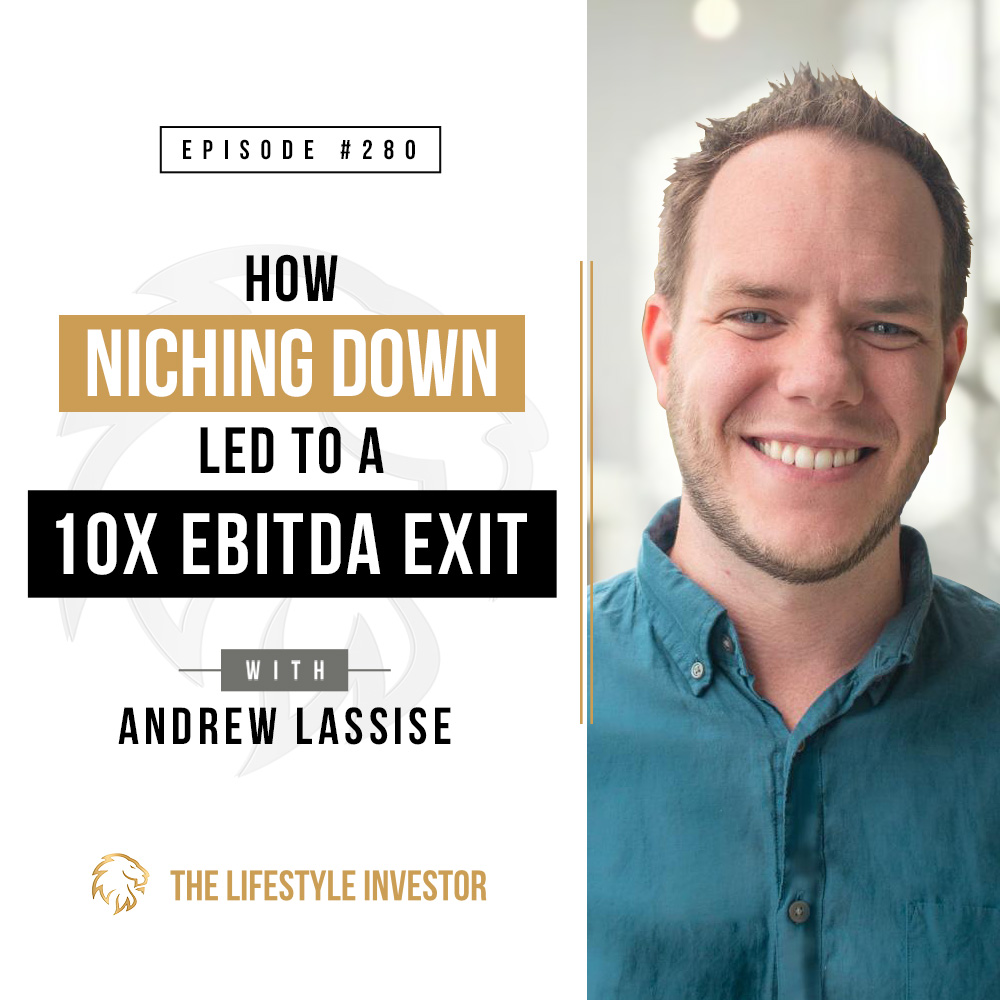
How Niching Down Led to a 10x EBITDA Exit with Andrew Lassise – EP 280
Giftology: Prioritizing Relationships and Building a Business That Outlives You with Rod Neuenschwander – EP 279