Interview with Brock Fortner

TLI Spotlight: Generational Wealth Through Whole Life Insurance with Brock Fortner
Today’s guest, Brock Fortner, is an investor, cash-flow specialist, and the founder of StoneCentury Financial who’s carved a niche for himself by specializing in wealth protection and helping clients understand how they can achieve their financial ambitions.
What’s incredible about Brock is that he’s the youngest-ever member of The Lifestyle Investor Mastermind. In our conversation, I wanted him to share the drive and motivation that propelled him into financial prominence at such a young age, alongside the invaluable insights he picked up by rubbing shoulders with some of the best financial minds in the game.
Brock also takes us through his top investing strategies, shedding light on how he maximizes the potential of whole life insurance for accumulating wealth, offering liquidity and flexibility in tax-free investment choices, all the while securing a financial foundation that strengthens over time.
In this episode, you’ll learn:
✅ The benefits of choosing whole life insurance over term insurance.
✅ How to leverage whole life insurance as collateral for investment or property acquisition.
✅ The potential of whole life insurance to generate substantial wealth under any market condition, with the added benefit of tax-free growth.
Featured on This Episode: Brock Fortner
✅ What he does: Brock Fortner is the founder of StoneCentury Financial. He specializes in working with individuals and families who need wealth protection. His clients are entrepreneurs, real estate investors, professional athletes, and entertainers. Brock encourages and fosters an educational environment for his clients to better understand how they can fulfill their financial goals. He received his Master of Science in Finance from Vanderbilt University’s Owen Graduate School of Management.
💬 Words of wisdom: “Freedom without safeguards is only temporary.” – Brock Fortner
🔎 Where to find Brock Fortner: LinkedIn
Work with Brock Fortner
Want to see if you’re a good fit to work with Brock and his team at StoneCentury Financial? CLICK HERE to find out!
Key Takeaways with Brock Fortner
- Learning by shadowing the experts
- Freedom without boundaries may end up a prison
- How jumping on every investing bandwagon can backfire
- You’re your number one asset
- How competition pushes us to up our game
- Sharing your knowledge and giving back
- Diving into the TLI Mastermind experience
- The benefits of whole life insurance
- Whole life vs. term insurance: What’s better?
Are You Gambling or Investing | Brock Fortner
Brock Fortner Quotes
“I’m putting money back into myself because I know that I am my number one asset and my business is my number one investment. And by doing that, my value will increase, which will also increase my income and the ability to do the things that I want to do in life.” – Brock Fortner
Resources
- StoneCentury Financial
- Brock Fortner on LinkedIn
- Chris Board
- Garrett Gunderson
- Michael G. Isom
- Thomas Edison
- Thomas Jefferson
- Michael Hyatt
- Vanderbilt University
- Michael Jordan
- Tom Brady
- Brandon Marshall
- Tony Robbins
- Ryan Thacker
- TLI 164: Tax-Free Wealth Accumulation with Ryan Thacker
- What Would the Rockefellers Do?: How the Wealthy Get and Stay That Way … And How You Can Too by Garrett B. Gunderson, Michael G. Isom
- Scott Ford
- The Way2Wealth
- Michael Lewis
- Flash Boys: A Wall Street Revolt by Michael Lewis
Tax Strategy Masterclass
If you’re interested in learning more about Tax Strategy and how YOU can apply 28 of the best, most effective strategies right away, check out our BRAND NEW Tax Strategy Masterclass: www.lifestyleinvestor.com/tax
Strategy Session
The Lifestyle Investor Insider
Rate & Review The Lifestyle Investor Podcast
If you enjoyed today’s episode of The Lifestyle Investor, hit the subscribe button on Apple Podcasts, Spotify, Stitcher, Castbox, Google Podcasts, iHeart Radio, or wherever you listen, so future episodes are automatically downloaded directly to your device.
You can also help by providing an honest rating & review over on Apple Podcasts. Reviews go a long way in helping us build awareness so that we can impact even more people. THANK YOU!
Connect with Justin Donald
Get the Lifestyle Investor Book!
To get access to The Lifestyle Investor: The 10 Commandments of Cashflow Investing for Passive Income and Financial Freedom visit JustinDonald.com/book
Read the Full Transcript with Brock Fortner
Justin Donald: What’s up, Brock? Good to have you on the show.
Brock Fortner: Thanks for having me, Justin. I’m excited to be here.
Justin Donald: Well, it’s always fun for me when we get to take our Lifestyle Investor Mastermind members and highlight and feature them. And what’s fun for me is even if we didn’t have the mastermind, every one of the people in our community, I would easily highlight and spotlight because they’re world beaters in their own right. And I love everyone’s story. I love the expertise that people show up with. Your story is fascinating, and one of the cool stats about you is, it was funny, I feel bad for Chris Board who is an NFL player and go check his podcast episode out. He got started in real estate super early.
But he got to, say, he was the youngest person in the mastermind, but only for two weeks because then you joined and you’re still officially the youngest person in the Lifestyle Investor Mastermind. So, congratulations to you. And I know people are going to be interested to know how you did it at such a young age. But we definitely got to dive into your story and all the cool stuff you’re up to.
Brock Fortner: Yeah, absolutely. I’m excited for it. And I’m glad I get to continue to hold that title.
Justin Donald: That’s wonderful. Well, when I think about you, I think about someone that is young, hungry, eager, takes full advantage of opportunities in front of him. And at this last year’s Lifestyle Investor Mastermind retreat, you brought your father, who I’m really impressed with, who is just one of the most humble, kind, intelligent people out there. And many would consider him, like an OG, one of the wisest people in the financial space, right? You would never know it from meeting him, but he’s been a huge mentor to you. He was a huge mentor to Garrett Gunderson, who’s a good friend of both of ours. We feature Garrett at a ton of our events, and he’s been on the podcast. But your dad is really kind of highly sought after in the financial space. And I’d love to kind of hear your thoughts, like growing up with such a stud in your industry.
Brock Fortner: Yeah. Growing up was kind of interesting because I didn’t actually know what he did until I got done, I got to school. I was going for accounting because that’s what he did, that’s what my grandfather did. And I was like, “Oh, well, I just do accounting.” And then I started doing my accounting homework, and I’m like, “Man, if I miss in the beginning of this homework, everything else is just screwed up.” And I went home, I’m like, “Dad, I can’t do this accounting stuff. I can’t sit behind a desk.” And he was like, “Well, how about you come to one of my workshops?” And that point on, I think I was 17 at the time and I went to that workshop, lasted in two days. And I was like, “All right, I know exactly what I’m doing with the rest of my life. This is it. I’m energized. I love this.”
Justin Donald: Well, we’ll have to dissect what that is a little more. But I’ve got to tell you we share something in common because I was originally an accounting major. And for anyone that knows me and knows my personality and knows what I love and what I don’t love, I don’t have any idea how I ended up there. I think someone told me they thought I would be good at it, and man, was I (a) just so profoundly bored and unmotivated and uninspired, but (b) was so bad at it.
And so, it’s funny, you and I share this theme of, like, hey, I thought I was going to be an accountant. I started taking accounting classes, I dreaded accounting. Now, I’m glad that I have a foundation of it. I’m glad that I understand. There are some foundational concepts that I think are really important that everyone should know, and I’m really glad that I understand at least that. But I’m also so thankful that I can outsource this to a professional who’s really good at it. I can pay a best-in-class provider to be my eyes and ears in the world of accounting.
Brock Fortner: Yes, I hope I never ever, ever, ever, ever have to do a tax return.
Justin Donald: Yeah. No doubt. It’s interesting. By the way, even my friends that are in this space are saying, “This is a dying industry.” It’s harder to hire people. It’s an industry that there’s just, if people are not lining up for the compensation is not adequate. We’re having a lot of AI and software kind of stepping in. And it’s fascinating what’s happening here and what will continue to happen.
Now, if you’re best in class, if you’re elite, there’s always going to be a spot for you and you can always charge a high ticket. And there are a lot of those out there. The CPA firm that I use is just wonderful and incredible. And I’m so happy to pay them. I pay a lot, but it’s not about how much you pay. It’s how much are they saving you for what you pay, right? And so, I’m thankful to have a top tier, world-class firm. But what did you end up doing? So, instead of accounting, what did you realize that day at that workshop with your dad?
Brock Fortner: Well, one, I wanted to get in the financial industry along the lines of financial strategy. Now, I will say, though I may not fully subscribe to the whole college and go get your degree, everything I do have, a risk management insurance degree, an accounting degree, and then a masters of finance. And what I did with those was not much, even though that they are in my world. So, now, I’m typically working with younger, higher performing W-2 earners and entrepreneurs on building these financial strategies for their lives.
Justin Donald: So, I love that. I love the competencies that you have, the expertise that you have. And we, by the way, agree on yet another thing. This is so fun. And it’s great because you and I have known each other for a while. You’ve renewed as a second-year member in the Lifestyle Investor Mastermind. And it’s funny, hearing some of our views and thoughts around education, we’re so aligned. I think outside of a few technical specialties. Certain specializations are going to need some sort of degree, but most things can be learned on the job or through apprenticeships. And so, outside of a very small niche of industries, like attorneys are going to need more specific program school or doctors and people in the medical profession, I mean, there’s a handful of them, right?
But outside of that, I do think that the university, the college program, it’s losing its luster. It’s costing more than the benefit that you get. There’s a lot of jobs that you can get paid really well and you don’t need a degree for, if you want to become a coder, if you want to become experienced and knowledgeable in AI, artificial intelligence, in robotics. There’s so many different niches in blockchain. I mean, there’s so many niches where you don’t need any formal education.
And even in trades, you can learn that through apprenticeship. You don’t have to go to a technical college to learn these things. You can do it through on-the-job training. And so, we’re very much in agreement. I mean, my wife and I talk about this all the time that each of us went to college. We feel like there’s probably more negative influences than positive influences that we learned. There are things that I’m appreciative that I have in terms of my background, my education, as I’m sure you are the same. But those could have been gained in a faster fashion, a cheaper fashion, a more specialized fashion. And so, we even say for our daughter, we’re going to support the route that she wants, but we really hope that she actually doesn’t choose college.
Brock Fortner: Yeah, absolutely. I am 100% on board with you. And as I looked at my own college career, I started working when I was 18. So, I just started my freshman year of college. Over my sophomore year and on, I was making more money and making more decisions than almost all of my professors that I was learning under, and even was asked to speak at a few of my, not only classes, but also events of the school. And so, when I look at that, the profession that I chose, I chose also to be apprenticed and learn and get mentored within that space while I was at school. And so, Monday, Wednesdays, Fridays, I’d be working. Tuesdays and Thursdays, I’d be going to class. But my learning was massively expedited because I was in it and I was learning from the people that have been doing it for the longest time in the real world.
Justin Donald: Yeah, and there’s a big difference between theory and actual, between the real application. I just remember all these classes, it’s like the three keys to marketing and the five keys to accounting, and it’s like, this is so outdated, unapplicable, just so far off from what is really happening. Like, you hear these things, we’re both finance majors and we both have a few different specialties around that. And when I look at what I learned and what the textbook said versus what the reality is and what I do today and what I’ve done in investing, it is vastly different. And it’s quite comical. It’s not even like it’s a little different. It’s like, here’s the five keys that were supposed to be applicable, and then here’s the real-life application that doesn’t even use any of the five keys.
Brock Fortner: Yeah, 100%. I’d be asked in class all the time, “Brock, what? Are you seeing this in the real world?” And I would sometimes politely say, “Hey, sure. We see it every now and then.” Other times, I’d be like, “No, this does not happen in the real world.”
Justin Donald: Well, I love what you’re about. I love what you’ve built your business around. And so, this whole idea, so number one, you started working at a young age, you really blossomed and kind of took off on a rocket ship and probably were an outlier and outperformed many of your peers, many of which being older than you, not just from a results and performance standpoint, but also from an income standpoint. And so, I love that your niche in business is working with other young high performing entrepreneurs and those in the W-2 world.
But you focus on helping them build their financial life with both freedom and safety, right? And I think that that’s important that they can coexist. And what you say is that freedom without safeguards is only temporary, and I couldn’t agree more with that. But I’d love for you to expand a little bit on it and even enlighten us as to kind of what you’re teaching these business professionals, these entrepreneurs.
Brock Fortner: Yeah, absolutely. Well, first, it does come down to that core aspect of freedom without safeguards is only temporary. And you can see that in any area of our life. Like the biggest form would be, you win the lottery. Well, if you don’t have safeguards in place, if you don’t know how to handle that money, it’s gone. The same could be said about…
Justin Donald: By the way, most lottery winners go bankrupt.
Brock Fortner: Exactly.
Justin Donald: So, this is not like, we’re coming up with this. Like, factually, most people win the lottery, literally spend all the money and are not only back to zero, they’re worse than zero because they have this underlying debt.
Brock Fortner: Yeah, absolutely. The same could be true in tons of different areas. If we look at medicine, if we don’t have safeguards around how we use medicine, like maybe it’s a painkiller after surgery, if we don’t have those safeguards, well, then that freedom will be taken away very quickly, right? And the same would be true within our own financial life. If we don’t have redundancies, if we don’t have safeguards in place to help us with how we’re building our financial life, if we get to where we think we want to go, it might not last forever or as long as we want it to because of the fact that we didn’t put those things in place.
We talked a lot about in the Lifestyle Investor group about our investment criteria, our due diligence, how we go along these processes. Well, a lot of times, most people aren’t even investing. They’re just speculating and gambling, putting money in places that somebody else told them to put the money. But when you actually sit down and say, “Okay, well, why did you do this? What do you like about it? What do you not like about it?” Nobody really is able to answer you on why they did it. And majority of the time is the underlying aspect is they had some FOMO and they had this fear of missing out.
And you talked about it on your call with Scott the other day about you could be doing great, have all this money, maybe you even just exited the company, and your thought process is, man, I got to allocate this money. I got to hurry up. But we need to slow down. We got to figure out why we are building things the way that we are, how we want to build them, what do we want our life to look like, and when we can figure it out, as our friend Garrett says, how we can win and then play, well, then everything else becomes so much easier in life, and we get a lot more fulfillment in the things that we’re doing rather than just throwing our money at everything that comes our way.
Justin Donald: Yeah, there’s no doubt. And as you solve for the financial portion of the equation, it opens up the playbook. Life just takes this really fun transition because it’s not about how much money can you make. It’s not about paying the bills. It’s about what can I do that offers the most value? What can I do that inspires me? What can I do that brings out the pure joy and passion in me? Who can I spend time with that really lights me up energetically or intellectually? And I just think it creates a lot more options. And we get to make a decision that doesn’t come from the framework of can I afford it or not, which is not always the most quality question to be asking when making decisions, both professionally and personally.
Brock Fortner: Right.
Justin Donald: So, how old are you?
Brock Fortner: I will be 26 in 25 days.
Justin Donald: I love it. So, you join the Lifestyle Investor when you were either 25 or 24. I think, was it 24?
Brock Fortner: 24.
Justin Donald: So, 24 years old, youngest guy to ever join the Lifestyle Investor, which is really fantastic. But at that age, and by the way, you’ve done well financially. So, I don’t know that it’s necessarily a stretch from the financial standpoint. Maybe it was. But you’re really early on. I feel like a lot of people your age have not figured out the importance of peer group and the importance of really committing to educating yourself in different areas, especially areas that you may not know a lot about or that are just so important. But why did you join the Lifestyle Investor community? Why at such a young age, was this a priority to you?
Brock Fortner: Yeah. So, great question. So, it comes from two guys in my life that are on what I call my Board of Titans, which is Garrett Gunderson and Mike Isom. So, I know from Garrett and what he has meant to me on was that it doesn’t take money to make money. It takes value creation to make money. And your income is just a byproduct of the value that you create. That was from Garrett. And then Garrett’s old partner and one of my mentors, and he worked with Garrett and my dad a long time ago, what he says often and talks to me about is your human life value is the source and creator of your property value. And when I took that to heart, what I noticed was if I invest in myself, if I develop my human life value at such a young age, I mean, there’s really nothing that would stop me into the future.
And I think it’s Thomas Edison or Thomas Jefferson, one of those guys that talks about, nobody can ever take away your education. They can’t take away what you’ve learned. And I know that, sure, I might not be putting money in the stock market. Sure, I might not be buying as many real estate properties as I want or maxing out my retirement plans. But what I am doing is putting money back into myself because I know that I am my number one asset and my business is my number one investment. And by doing that, my value will increase, which will also increase my income and the ability to do the things that I want to do with in life.
Justin Donald: That is powerful. And I’m curious. I’ve got to imagine your dad also being one of your mentors, advisors. I’m not sure if he’s on your Board of Titans. But what are some lessons that you’ve picked up from him? Because you seem to have done a great job with mentorship, finding wise people, and you’ve done a great job with peer group. And those are two of the biggest things that I talk about.
Brock Fortner: Yeah, absolutely. So, couple of things that I have been fortunate to learn from my dad. One, I will say that I also talk a lot to the high performing guys that I work with, is being a high performer myself and having a lot of success at a young age. He always talked to me about the fact that you don’t accept the pedestal and don’t accept flattery because that’s what most people will help you with when they see that you’re young and successful. The other things that I also learned from him were things like, hey, you need to be in peer groups. You need to be around people in your life that are going to push you further.
Even when I was younger and this was completely out of finance and work, he was always trying to put me in a higher age group of playing baseball or working out or doing anything that was competitive. He would always just place me, say, “No, you need to go a little bit older.” Because he knew that when you throw yourself into a position with higher performers, typically, you perform at that level. Those were some massive lessons that I got from him, just on the mental side of things and why it’s so important to develop who you are and put yourself in a position to be in rooms with people that you not only want to surround yourself with, but people you want to be like.
Justin Donald: That is absolutely well said. And for years, I have talked about the most important thing that you invest in is yourself. And if you really boil it down, like, I mean, it’s so interesting. Back when I was learning, there was no such thing as a podcast. You had to go to the library to check out a book, and I did that. I did a lot of that. I did a lot of reading. And for me, it was a lot of self-study. I had curiosity, I wanted to learn things, I wanted to figure stuff out. And so, I became a student of whatever it was that was intriguing to me. For me, as life went on, money was just fascinating. And wealth creation and cash flow and de-risking and insurance of all types, like all these things, real estate, I just became so fascinated. I just read books and books and books.
And now, we have the luxury of having podcasts where we can get even more specialized sometimes and hear right from the mouth or the voice of a person that has done it at a high level. And we got to be careful because there are a lot of people out there that are influencers that are teaching something that they actually haven’t done. They make money, they make a lot of money. They make their living based on what they’re teaching, not on what they’ve actually done. So, I think it’s important that we really critique hard who it is we’re learning from. And are they actually world class at the thing that they’re teaching? Because there are a lot of charlatans out there, there’s a lot of people that make money on a platform, make money on education, but not on what they’re educating on, right? So, just want to say that first and foremost. But when I think about the best place to invest, for sure, for me, it was in my own self-study. So, that’s me being intentional with what I read, who I listen to, who I follow, who I learn from.
Number two, it’s always hiring a coach for whatever area of my life that I want to get better in. Right now, I have a fitness coach, I have a personal trainer that is literally world class at the things that he does. He’s fantastic. I have a pickleball coach because I want to get better at pickleball. And so, I’ve been playing a lot of pickleball, and I figured, why not hire? So, I got two different coaches. Actually, tomorrow, I’m playing for two hours with one of my coaches, just drilling for skill because I want to cut down the learning curve. But then I also have someone in a business area that I want to learn and grow in. And for anyone that’s listening at Michael Hyatt’s podcast, I hired him this past year. But I’ve had many coaches, and I always hire coaches. That’s totally shortcutting that learning curve, right?
And then, from there, it’s peer group. Who’s playing the game of life, the game of business, the game of exponential growth at a higher level? Who’s playing the game of wealth creation and investing at a higher level? Who’s playing the game of wealth creation, wealth protection at a higher level than I am? And how do I get into those circles? How do I get into that ecosystem?
And then, the other thing that I’ll say is, I think it’s really important that we mentor other people. So, as we gain expertise, we have mentees, we teach people the things that we’re doing. That to me is so important. And as an educator, as an instructor, as someone that really highly values empowering other people, I learn a lot in the process of teaching people. And so, I’d love to get some of your thoughts around that, too.
Brock Fortner: Absolutely. Even myself, I have spent, I shouldn’t even say the word spent, but invested. I have invested probably triple of what I spent on my college degree at Vanderbilt.
Justin Donald: And by the way, that’s a prestigious school. That’s an expensive school. That is a high price point for education going to Vanderbilt. Hard to get into also, but like high price point.
Brock Fortner: Yeah. So, in my own life, I just rehired my father as a coach for my business. Garrett is one of my coaches, both personally and mentally. I have a communications coach because I am very much an introvert and I have quite a problem with having conversations with people. And I wanted to get better at that. So, I hired what I call a communications coach, and he helps me with questioning and talking with other people. And I also have a trainer as well that helps me develop my physicality the way that I want to. And I mean, we are so in line with that thought process of you should always have coaches in your life in areas that you want to grow.
And then, as you do that, you also want to be in the peer groups with people that you like and aspire to be. But then also, you need to be able to coach and mentor people around you as well. That is one of my favorite things to do. Weekly, I meet with different advisors in the financial world that are older than me or could be younger than me. But they want to know what I know. I’ve spent hundreds of thousands of dollars on the things that I know, and I’ve had some pretty good success. So, they’re coming to me. Well, what I end up finding out is sometimes in our sessions, I actually end up learning more than they do because I’m finally giving it to somebody else and I’m teaching what I think that I know.
Justin Donald: Yeah. It’s powerful what comes out. I record everything, every teaching session that I do, every coaching session I do, every instructional thing or keynote. Whatever I do, I record it because often, there’s this compounding effect with being in different groups or having people ask different questions than what you’re used to asking where you can kind of take your methodologies and you’re like, oh, wow, I didn’t even see this. But actually, this translates this way, and I actually need to look at it through this view. I have these takeaways, these aha moments all the time, which is really fun.
And I got to tell you, I’m impressed and jealous that you got started at such a young age, hiring coaches, getting into masterminds, getting into high-level peer groups. I’m thankful that I have. And I just didn’t see it, I didn’t know about it, I didn’t think about it earlier in life. I mean, today, it’s a lot more common to have masterminds than it was back in the day. I mean, the original junta group is kind of where the mastermind came from. And it’s some of the biggest thought leaders out there, some of the most successful entrepreneurs out there, go back and do some research and see some of the founding fathers and some of the big names and the people who were part of that group.
But I tell people all the time, I’m part of right now, I think I’m in nine different masterminds, which sounds crazy. I don’t attend everything. I can’t attend everything. But for me, I just find a way to get the value out of the things that I do. And for me, I can get value. The tuition might be a certain price. Let’s call it X. Maybe it’s 5,000, 10,000, 20,000, 50,000, 100,000, whatever the number is. All I have to have is one deal, one conversation, one mindset shift, one epiphany, just one thing that can shift my perspective and create a tangible result that is going to forever pay for that investment.
And so, you got started so much younger than I did. I don’t know where I would be had I not invested in myself in this way. I mean, to give you perspective on the last two coaches that I’ve hired, each of them were well into the six figures per year and each of them with one idea more than covered their costs. It didn’t happen in the first session for anyone, but I was intentionally trying to go after it. And it’s really amazing what happens when your mindset is, okay, I don’t have to have this scarcity mindset that because I spend this money, I have to go to every event and every function. And you don’t want to be a maximizer. You just want to be an optimizer, right? We don’t have to get the most out of something. It doesn’t have to be the biggest. We want it to be the most optimal. We want to get the greatest return or the most value.
And so, I see this, in my personal life and then in my professional life, personally, it’s a fascinating thing. I remember watching people talk on this and reading articles. I read this one article, and one of them was on Michael Jordan, one of them was on Tom Brady, and one of them was on Brandon Marshall. And each of those individuals talked about how they spent, in most cases, over $1 million, but hundreds of thousands of dollars to a million-plus dollars on their body a year. And of course, they’re athletes. This is what provides them the income.
But at the same time, why am I not thinking about that on a smaller scale, right? And so, that gave me the permission instead of being like thrifty with my dollars to say, actually, I have a goal, I want to spend this much money, these hundreds of thousands on my personal health. That means hiring a trainer, that means nutrition, that means physical therapy for injuries and making sure that I’m really working through them. That means the highest quality care of chiropractic. That means blood work. That means just really trying to do all the things. And so, that’s on that personal health side. But I think it’s just, and by the way, that’s so important because that’s the foundation to it all, right? That’s what gives the energy, the longevity.
But you look at it on the business side, and that’s what I’m doing with the masterminds, that’s what I’m doing with the coaches, that’s what I’m doing with my self-study. I try to read about an hour a day every day and a lot of times, I’ll knock it out doing two things. So, I want to get 10,000 steps a day. And so, I’ll listen to audiobooks for those 10,000 steps, right? And so, I’ll read in addition to my one hour first thing when I get up. But I just thought I would share that framework as you kind of inspired that through our conversation because that’s been a game changer for me.
Brock Fortner: Absolutely. I think there’s some mindsets that you have to have going into those things. One, you need to have your self-study. You’ve talked about it. My mornings from 5:00 to 8:30 is all self-study reading and doing the things that I want to learn. But also, I’ve become known in the industry as the guy who just shows up at the learning things. So, I go to one to two learning events every single month. But you need to, I think Tony Robbins says it the best is the quality of your life is dependent on the quality of questions you ask, and when you can show up with genuine curiosity, that means showing up not in the mindset of this isn’t going to work and I’m going to prove to you why, but hey, you have a different mindset than me. Let me see if it will work and why it might work for me. I think having those mindsets is super important going into those events.
Justin Donald: Yeah, that’s so good. And by the way, what a great addition to what I was saying because another way to self-study is exactly that. For me, I know that I learn best through immersion. So, I like going to conferences. I like going to seminars, I like going to events, where I can learn. And I think that I learn best when I can just compound the time in an arena of experts where I’m meeting people in the halls before and after sessions, and I’m in learning from experts who are speaking on whatever the topic is. So, I think you hit the nail on the head. I’m curious, Brock, what are some of the big takeaways that you’ve had with the Lifestyle Investor Mastermind? Why did you renew?
Brock Fortner: One of the reasons I renewed was because of the people. I mean, our community is massively valuable. One of the things I joke about a lot of times is like, we actually save somebody’s life in that group. And that should just show the value of the group there. But being able to show up on the first night, and I knew more speakers than I actually knew members in the group. But when I showed up, what I found was I was in a room of people that were like-minded of me. I got to have conversations about golf, about baseball, about just wealth building in general. And that not only helped me grow in my relationships with other people, but then I got to be around some of the highest performers in these different industries and how they invest and why they invest.
And since then, I’ve had incredible conversations with guys in our group, girls in our group of, hey, how do you think about this? How do you do due diligence? What is your investment criteria? And how did you come up with that? How do you build your life? And I remember, I got off the elevator one time, and Ryan Thacker and I, we were on the same floor. I mean, the guy’s way older than me, way wealthier than me. You’d think in today’s world of social media, like, oh, he doesn’t have time for me. Go away. No, I think we sat in the hallway for 45 minutes to an hour of him just pouring into me, talking about the lessons he’s learned, what he’s done, how he grows. And that right there is simply one of the greatest factors of why I renewed.
Justin Donald: Oh, it’s amazing. And it is about the people. I mean, they’re just genuine, they’re humble, they’re hungry to learn, they’re eager to share their gifts. And for those of you guys that haven’t checked out the episode with Ryan Thacker, go check it out. That guy is a wealth of knowledge. He’s incredibly successful. It’s funny because we actually shared in that episode, he shared some things that we had to edit out because they– and by the way, we virtually never edit anything. It’s all just raw and unfiltered and free flow. I don’t know if it was intentional or unintentional, but he definitely shared a few things about net worth and cash flow and just a number of things. He’s like, “Oh, that probably shouldn’t be out in the world. I don’t want to be this huge of a target.” But his numbers would make your head spin. So, check out that episode.
And what a resource to have that type of conversation. And probably even more important, that conversation, I know you can follow up with him at any time. And by the way, for anyone like that’s the value is having these people ahead of you in life further along in certain areas that you can reach out to. And this is in any group. So, this is not just for Lifestyle Investor Mastermind. This is, I think, everyone should have a group of peers, a group of people that play the game of business and life at a higher level that you can reach out to, you can pour into, they can pour into you, you can learn from, right?
Brock Fortner: Yeah, absolutely. And I would say another thing since you were talking, at our annual retreat last year, you had a panel of our lifestyle investors up there. Well, as I consult on other people’s finances, I have a lot of these younger guys come in and they’re like, “Oh, I want to be financially free by 50, 40 years old.” And then I have to ask the question, “Okay, well, what’s next?” And they’re like, “I don’t know.” I said, “Well, have you ever actually met somebody who’s financially free who is living the lifestyle that you want?” And majority of the time it’s “No, actually, I haven’t.” And when I can get a sense into that world and seeing them, that goes so further for not only me, but then the people that I get to pour onto as well.
Justin Donald: Love it. And by the way, that was one of the highest rated sessions that we have ever done is featuring, I think it was four different lifestyle investors that are all members that just live an incredible life. They are very thoughtful. They’re very successful, but they’re very intentional about the life that they live, what they spend their time doing, spending it with their family, spending it on experiences, and really just not being a slave to money.
Brock Fortner: Yeah, absolutely.
Justin Donald: Yeah. It’s powerful. Well, I feel like we would not have a full download of your expertise and your knowledge if we didn’t dive into the realm of whole life insurance and the positive attributes there, the value to doing it. As many people know, I’ve talked about this many times on the podcast. And for anyone in the mastermind, I’ve shared this, but I have been a whole life owner since, I believe it was 2005. I would have to check my original date in my policies. Either 2005 or 2006. I think it was 2005.
So, we’re going on for me, close to 20 years, and I think it’s hard at the beginning to wrap your mind around the power of what whole life can do, the power of building your own bank and creating a framework for which you can do all of your investments. You can buy real estate from borrowing against those funds for the down payment. You can invest in investments as an LP, for example, with a sponsor by taking a loan against those dollars and paying it back with the distributions that come. You can use it as collateral for getting lending from a bank or from a specialty lending company. And it’s just, and by the way, some of these specialty lending companies, you can actually use it as collateral and you can get a line of credit that you just do interest only loans with, which is powerful because it becomes that much easier to get a return on those dollars, especially in low interest rate environments.
Now, it’s a little different and it’s a little trickier. And we’ve got to be a little bit more conscientious of how we use those vehicles. But I’d love to get your thoughts because you not only have been in this space basically your entire adult life, but even your younger years, your more formidable years. And your dad is also an expert in this space.
Brock Fortner: Yes, correct. So, some realities that I had to come to terms with, one, I want to live a long life. So, everything that I do needs to have a long-term viewpoint. And the second is, there is no investment that I can put money into other than a 401(k) if you got dragged into that, that you cannot put money into it without going to a bank account first, right? All my first has to go to a bank account. Well, if I know, especially as a younger person, that no matter how believable it is, I’m at my lowest economic point in my life, which means my income is only going to grow from here on out. And I’m going to be saving money from here on out.
Well, then that should mean that I should go put money in a place that is not only efficient today, but is also going to be efficient in the long term. And by doing this, by saving my money within the whole life contract, I’m putting myself in a position where I am building a bucket of money that is completely uncorrelated with the market, which we might talk about a little bit later. But I can access that money by borrowing against it without interrupting the growth of the money. And when we break this down, I might break it down into real estate later, but you are going to invest either from a savings account or from a whole life insurance policy.
Well, whichever one that you invest from, you’re going to be paying that account back, right? It’s not like we liquidate our savings account to go buy a real estate property, and then all of our free cash flow just goes right back into the real estate property. No, it just goes into another bank account. It might not have the same bank account numbers, but the money is still being repaid to a bank account. Well, if we know that, and that’s the logic of it, well, then we should be taking that cash flow and saving it in a position that’s going to grow tax free, tax deferred. You can make sure it grows tax free. You can access it tax free. In most states, it’s creditor protected. And you have all these other economic benefits that just make the rest of your financial world so much better.
Justin Donald: Yeah, tax-free growth, tax-free death benefit, tax-free distribution, creditor protected. And even in the states where it’s not, there are vehicles you can use where you can make it creditor protected, right? So, yeah, I mean, just at face value, there’s tons of perks and tons of advantages, but I think it might be fun to kind of dissect it even a little bit more. I think sometimes, it gets a bad rap from people that don’t understand it, that don’t know it, or put it in the same bucket as term insurance. You look at term insurance and the stat right now is that really about 95% or 96% of the time, term insurance policies don’t pay, right? They don’t pay out. They lapse or they go full cycle.
Whereas whole life is different. It is not a term. It’s permanent. You can use it for the rest of your life whenever something does happen to you. And it’s only a matter of time until something does. Your heirs can benefit from it. But I like that these can be structured in a way that you can benefit from it while you’re alive, and then your future generations can benefit from it later on. And Garrett does a good job in his book, What Would the Rockefellers Do?, which later was rebranded to What Would Billionaires Do? since the Rockefellers don’t like anyone else using their name except them.
But I mean, this is kind of the foundation that they had for their family bank, a family that has been able to pass wealth down through generations for a long time, but it’s because they have a system, they have a protocol. And everyone in the family kind of bought into that program of everyone has life insurance, everyone borrows against it for education, for starting businesses, for homes, whatever it is, but then they paid it back. Everyone knew you had to pay it back. And that just continued to grow over the years. And so, I think it’d be fun to kind of dissect. You first started talking about something that’s uncorrelated. And for most of these life insurance companies, it’s a heavy bond portfolio, which is actually really good right now. We’re getting good returns, higher dividends than we’ve seen in a long time. And secondly, you said that you kind of wanted to get into the real estate play of it. So, let’s dive in some more.
Brock Fortner: Yeah. So, I’m going to start very, very top, and then we’re just going to keep getting deeper and deeper. Now, the first thing I’m going to say because you brought up the fact that these companies are investing in bonds. You and I know, Justin, they don’t buy the same bonds that we buy.
Justin Donald: That’s right.
Brock Fortner: There’s a difference between retail investors and these institutional investors, right?
Justin Donald: That’s right.
Brock Fortner: And having the strength of them and these mutual insurance companies is way better way to purchase bonds than it is you just coughing up money and trying to buy it in your stock portfolio.
Justin Donald: That’s right. Think about it. You as a retail investor and you’re looking to do an investment, whatever the investment might be, versus you coming in with a group of people versus you coming in with a pension versus you coming in with a capital that is the size of some of the largest companies balance sheets, right?
Brock Fortner: Yeah, absolutely. So, very top level, okay? Most of the time, most people would say, “Okay, well, I can just buy term and invest the difference rather than buying whole life.” So, if we were to look at the world of buy term and invest the difference from a very high level, what you’re saying is I’m going to buy term insurance and invest what I’m not putting in term insurance into the market. Well, the reality is, when you do that and you get to retirement, you cancel your life insurance, which means your assets that you built over all this time, not have to be your lifetime income, not just for you, but also your spouse if you have one, and then your life insurance because you canceled yours. So, you self-insured, which is really just having insurance.
So, studies have shown that the safe withdrawal rate to make sure that you have enough money left over is about 2.7%. So, taxable. Think about how many millions of dollars you need to produce the income that you want during retirement. Whereas if you showed up at the day of retirement and you knew that your death was a win scenario because my dad likes to say, everybody lives until they don’t, which is pretty obvious, but apparently, we don’t understand this. Whole life is a when product so that we can win is the reality that if we can show up at the day of retirement with the same amount of death benefit to the same amount of assets, that means we have a much greater distribution rate, but also much greater distribution options in retirement. So, that would be the first like super, super high level, why you would want whole life in your portfolio.
The second is, okay, well, let’s talk about, how does whole life insurance work. Okay? And I’m going to preface here and say, I am specifically not talking about indexed universal life, variable universal life, any type of universal life. When I am saving money, I want to put it in a place that has no risk of loss. It’s guaranteed to be there. I can access it and it’s likely. Okay? With those vehicles, sometimes that’s not an ability that they can provide. So, I’m only talking about whole life.
Well, if we compared it to real estate, in real estate, we go buy a property as a mortgage payment. As we pay that mortgage payment, it builds equity in that property. And then that property also has a market value. Well, we know that equity cannot go above the market value. The equity, we can borrow it, we can use it, we can do whatever we want with it. Whole life insurance is the exact same. We pay a premium. As we pay the premium, it builds equity in the policy, also known as cash back. Well, that policy has a death benefit. And we know that cash value can never go above the death benefit. We can borrow it, we can use it, and we can do with it whatever we want.
The difference is, and I think you should have both, but the difference is when we look at real estate is, it does fluctuate with the market. If we’re looking at single-family homes, it fluctuates with the market. Credit checks, we got to jump through some hoops to get the money. I hope it never happens again. But they could call the loans back, right? Whereas with the life insurance policies, I mean, the only qualification is that you make sure that you sign your policy loan document and you send a voided check, and then they send it to you within three to five business days, seven days, maybe if it’s an end of the year and it’s super busy, right? But it does not fluctuate. It goes up and it’s guaranteed to go up over time even if you don’t get any dividends.
Justin Donald: Yeah. And the interesting thing is you actually don’t have to pay your loans back. I mean, it performs better if you do, but you’re borrowing from your own dollars. So, if you don’t pay it back and at the end of the story, whenever you pass away, that death benefit just reduces out the cost of the loans that you hadn’t repaid. And that’s it. Now, if you want to optimize, then you’d certainly want to pay those back. But I’ve used my whole life policy as the down payment for virtually every piece of real estate we have ever bought. And then I would pay it back so that it builds up, and then I can borrow again, and I pay it back so it builds up. And I have used it for many of the other investments I’ve done. So, buying businesses, whether buying them outright, buying a minority piece, buying a majority piece, they’ve been very handy for that. I’ve used them for LP investments. So, I’ve used it across the board for so many things.
And what I also love about, I mean, the list goes on and on, on the things that I like and ways that I’ve used it. But when I think about the versatility of it, when I think about it from the standpoint of like, this is– consider it like a fixed income product, like, when you look at your asset allocation, you look at the way that the wealthiest people in the world allocate their wealth, what percentage to what? How much is real estate? How much is public equity? How much is private equity? How much is private credit? How much is fixed income? And so, there’s a group that we’d share with the Lifestyle Investor, Scott Ford Way2Wealth. I did a podcast a while back with Scott. But their methodology around Way2Wealth is just incredible. And they actually like half of your net worth being in fixed income, aka being in life insurance or life insurance products, right?
Brock Fortner: Absolutely, yeah. It’s important because you want that uncorrelated asset that you’re building this war chest, you’re building this capital fund, this opportunity fund to get into these other assets without having to liquidate something else or because what they want to talk about a lot of times is, oh, well, we need to make sure our asset allocation is still balanced. We had a 60/40, but now it’s 70/30. So, we got to sell some of our stocks to get back to our bonds. Well. I don’t know if you know this, but you’re going to cause a taxable event when you sell some of your stocks to buy some more bonds. What if your bond portfolio was within the whole life contract, not having to completely always balance it within this portfolio that your money manager has tried to get you to have this whole time?
Justin Donald: Yeah, I love that. I also think it’s important that we’re not trying to maximize the return in our portfolio on all the dollars. Most people make their wealth via concentration, but the wealthiest people maintain and grow their wealth via diversification. And what that means is that you’ve got different buckets or different allocations that you are targeting a different return to. You don’t want to make 15% on all your money. You have a bucket that you want to make 15% on. You can have a bucket that you want to make closer to 20% on. And maybe even on the high-risk stuff, that’s generally a very small allocation, usually about 1%, sometimes less. Sometimes, it’s not even there on early-stage seed round, like super high risk.
But every wealthy person that I know has money sitting in cash, cash equivalent, and fixed income. And that provides liquidity, it provides cash flow, it provides the opportunity to outperform in certain markets when the other part of the portfolio isn’t performing. And I think that’s really important to recognize. I’ve talked a lot about markets and whether they’re efficient or inefficient. And when you look at the stock markets, the most efficient thing in the world, it’s really hard to beat the algorithms that are out there, to beat the quants. It’s not even the quants you have to beat anymore. It’s the algorithms. It’s the AI that they have created that you have to be able to beat and on a short-term basis, on a day trading basis, there’s just no chance. If you read Michael Lewis’ book, Flash Boys, you will learn that you just don’t stand a chance.
And I mean, for the long haul, you certainly can grow your wealth and if you invest, especially in index funds, that’s your lowest cost way of doing it and getting the diversification in the long run, really playing that out. And if you to borrow against it to buy assets with the opposite, what most people do, they sell stock to rebalance and there’s a taxable event. Well, if you have dollars in there and it’s a smaller allocation and it grows over time, you can borrow against it to them by other assets.
And so, when I think about just this part of the portfolio and the way these dollars are being used, I just think we all want to recognize that certain dollars are for certain activities. So, if you’re over here being really efficient, it’s hard to make money. I like being on the other side, really inefficient, much easier to make money, you get much more outsized returns because that inefficiency creates opportunity. And so, that to me, what I have found is that it lands more on the alternative investment side, where you’re seeing real estate and private equity and private credit. And really, some of this is also concentration, right? So, what’s the most institutionally owned? What’s the most concentrated?
So, if you look at the stock market, you’ve got so much institutional money there, you’ve got so many big players. There’s definitely a lot of institutional money in real estate, but there’s less concentration and less consolidation in certain asset classes. And so, like mobile home parks are one of the least consolidated asset classes out there, so there’s outsized returns. Multifamily is probably one of the most consolidated asset classes in real estate, and so, it’s harder to get a good return, but you still can because it’s still more inefficient than the stock market.
Brock Fortner: Yeah, absolutely. I’m 100% on board with you. And I think when you can position yourself to take advantage of these opportunities and you have the approach of the guy with the longest time horizon always wins, over the long term, you will win because you’re able to take advantage of these.
Justin Donald: Yeah, 100%. Brock, this has been so much fun. You are so wise for your age. I’m so impressed with what you’ve been able to accomplish, your mindset, the way you look at the world, the way you look at growth, the way you look at your network and your peer group and coaching. And it’s just a whole life, all these things that you’re doing, you’re having major impact on the world. You’re influencing and helping serve a really important group of young entrepreneurs out there. So, I want to thank you for making the time to be here, but I also want to make sure our audience knows where they can reach you and find out more about you and what you’re doing and for anyone that would be a good fit for your services that they can contact you.
Brock Fortner: Yeah. So, I think one of the best ways would be LinkedIn. I do a lot on LinkedIn. I think you can just find me at Brock Fortner. And then, since this was more of a financial discussion, email me at my financial email, so my team can receive it. But that would be, I think it’s brock@stonecenturyfinancial.com. And if you just shoot me a message, I will either see it unless my team catches it before me, but I’ll be sure to be able to talk to anybody about the growth that they’re seeking.
Justin Donald: I love it. Well, I appreciate your time. I hope people take advantage of this opportunity to reach out to you, to get to know you, to learn from you. And I hope that you find some right fit, clients and business partners and entrepreneurs that you can create, the one plus one equals three type of scenario. And I love wrapping up every episode that we do with a question for our audience. So, if you’re watching this, if you’re listening to this, my question for you, it’s the same every week. What is one step you can take today to move towards financial freedom, to move towards a life that you truly desire? So, it’s on your terms. It’s not a life by default, but a life by design. And I challenge you to go after it, to take one nugget, one thing that you learned from Brock today and move and pivot towards that life that is on your terms. Thanks. And we’ll catch you next week.
Sign up to receive email updates
Enter your name and email address below and I'll send you periodic updates about the podcast.
Keep Learning

Why Asking for Help Is a Superpower for Success with Nathan Thomas – EP 307
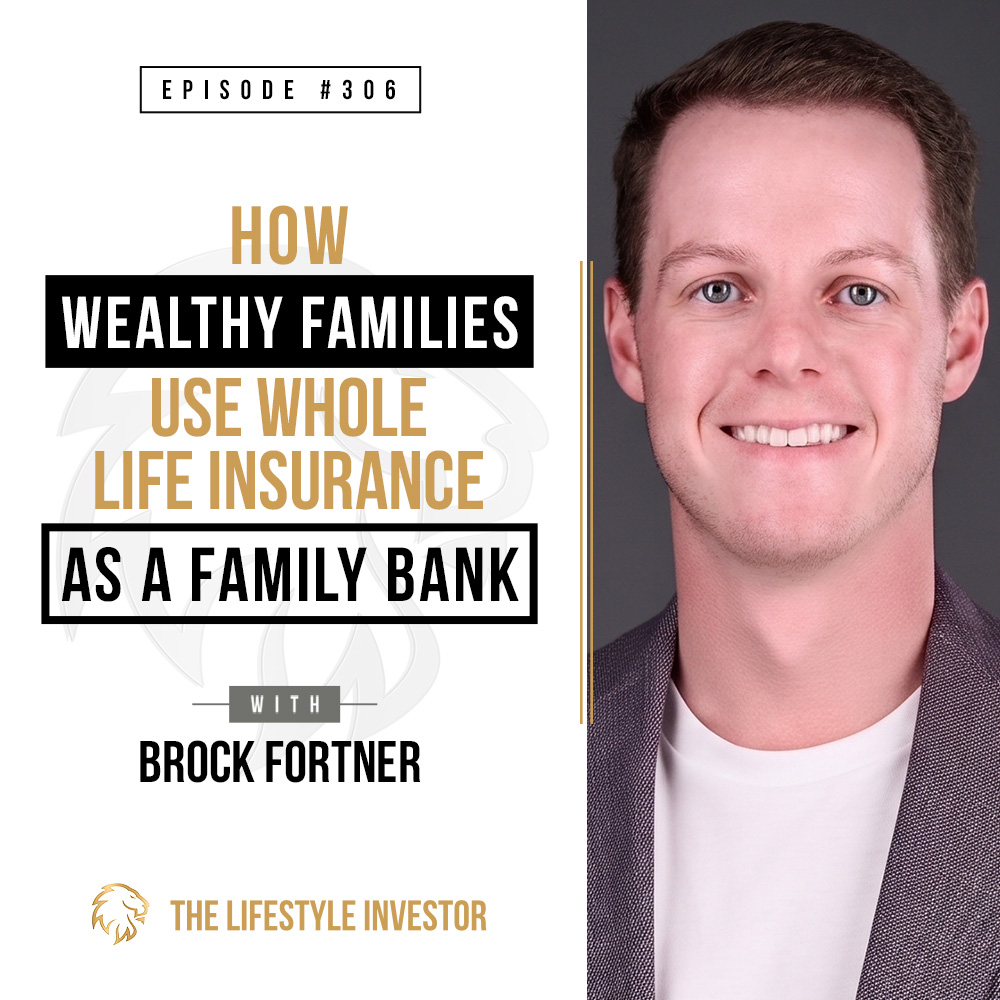
How Wealthy Families Use Whole Life Insurance as a Family Bank with Brock Fortner – EP 306